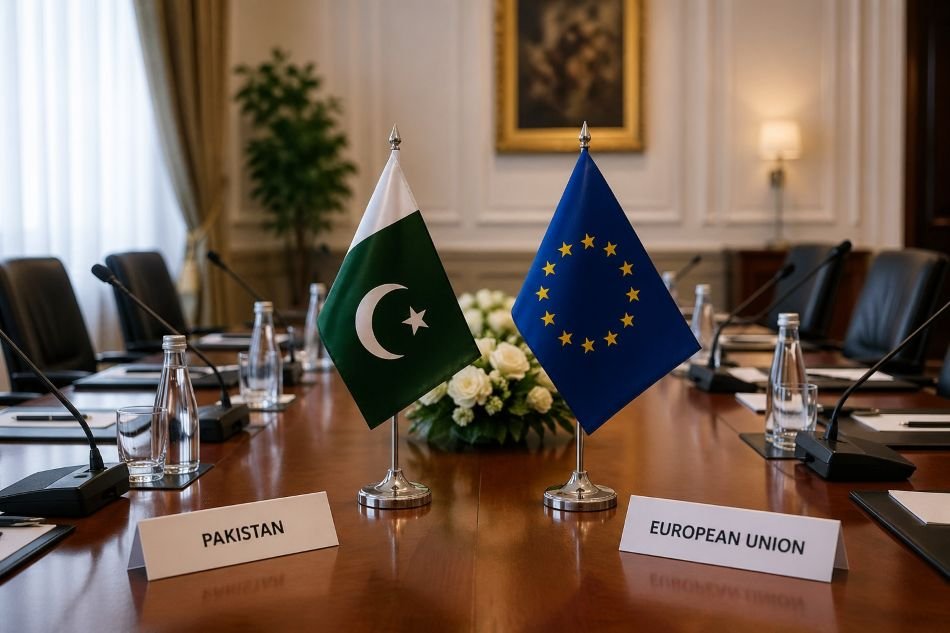

Pakistan is approaching the EU-Pakistan Business Forum at a moment of economic constraint rather than confidence. With external buffers under pressure and export growth losing momentum, Islamabad is not simply hosting a forum-it is testing whether one of its most important economic relationships can be recalibrated before existing advantages begin to erode.
This comes alongside a broader diplomatic push. Pakistan’s recent efforts to position itself as a regional facilitator, including engagement around the Iran crisis, indicate an attempt to reassert global relevance. That visibility is not incidental. It underscores a calculated effort to convert diplomatic engagement into economic opportunity, using international access to attract investment, rebuild confidence and support economic recovery.

The European Union remains Pakistan’s largest export destination and second-largest trading partner after China, with total trade reaching $12.1 billion in 2024 and accounting for approximately 13.6% of Pakistan’s overall trade. It is also Pakistan’s most significant export destination, absorbing nearly 27.6% of the country’s exports, while imports from the EU remain comparatively limited at $3.2 billion, making it the sixth-largest import source. Yet this relationship, while stable, has remained heavily tilted toward trade rather than investment. The question now is whether Europe can move beyond market access and play a more structural role in Pakistan’s economic recovery.
From Trade Dependence to Investment Partnership
For over a decade, Pakistan’s engagement with Europe has been anchored in the Generalised Scheme of Preferences Plus (GSP+), which has allowed tariff-free access to a majority of EU tariff lines and helped drive export growth, particularly in textiles. But this model has clear limits. Trade alone has not delivered the scale of industrial transformation or capital inflows needed to stabilize the broader economy.
The upcoming forum reflects an attempt to correct that imbalance. The launch of the EU–Pakistan Business Network during the EU-Pakistan Business Forum on 28–29 April 2026 in Islamabad, bringing together European firms already operating in the country, signals a move toward sustained, institutional engagement that extends beyond networking into policy dialogue and advocacy for a more predictable investment climate. The objective is no longer just to sell more into Europe, but to bring European capital, technology and production into Pakistan itself.
Alignment with the EU’s Global Gateway initiative adds weight to this shift, positioning Europe as a long-term investment partner rather than merely a trading bloc. With financing tools such as the European Fund for Sustainable Development Plus and support from the European Investment Bank, the EU is expanding its role in infrastructure, energy and industrial development.
For Pakistan, this opens a pathway into sectors such as renewable energy, digital services and value-added manufacturing. Priority areas identified for collaboration include agribusiness, fintech, green logistics, renewable energy, textiles and responsible mining sectors that reflect both domestic needs and opportunities for integration into European-led supply chains.
But access to capital is only one side of the equation. The more difficult question is whether Pakistan can create the conditions required to absorb it.
A Forum Designed for Outcomes
Unlike earlier engagements, the EU-Pakistan Business Forum is being structured as a working platform rather than a ceremonial event. It is expected to function as one of the most significant economic engagement platforms of the year, bringing together policymakers, investors and industry leaders in a structured business-to-business and business-to-government format. With hundreds of meetings planned and direct interaction with financial institutions, the emphasis is on deal-making rather than declarations.
European officials have been clear about the purpose. The forum is meant to reduce the perception gap that continues to define Pakistan in many boardrooms. For many investors, the country is still viewed through the lens of risk-policy reversals, regulatory inconsistency and governance concerns-rather than opportunity.
Direct engagement may help shift that perception. But it will not, on its own, resolve it.
GSP+, Governance and Investor Confidence
The underlying trade relationship remains conditional. Pakistan’s access to the EU market under GSP+ is tied to compliance with international commitments on human rights, labour standards, environmental protection and governance. Pakistan has ratified the required conventions and enacted reforms-but compliance remains under continuous review.
The risk is not theoretical. If preferential access weakens before new investment flows materialize, Pakistan could find itself exposed on both fronts-losing market share while failing to attract replacement capital. For an export base still heavily reliant on Europe, particularly in textiles, that would carry immediate economic consequences.
European investors are not only assessing sectoral opportunities; they are evaluating the broader policy environment. Issues such as contract enforcement, tax stability, foreign exchange access and regulatory transparency remain central to investment decisions. Incentives alone are rarely decisive. Consistency is.
At the same time, Pakistan continues to emphasize its constitutional protections, legislative reforms and institutional mechanisms in response to governance concerns, arguing that compliance and oversight frameworks are in place and evolving. In investment terms, however, perception tends to matter as much as formal alignment.
Macroeconomic Signals, but Questions Remain
Recent developments suggest some stabilization. Pakistan’s return to international capital markets through a Eurobond issuance, after a four-year absence, was met with strong investor interest. Officials have presented this as evidence of improving fundamentals and renewed confidence.
There is some merit to that claim. But markets respond to trajectories, not moments. The durability of investor confidence will depend on whether reforms are sustained, not announced.
The government’s emphasis on a diversified capital markets strategy reflects an understanding of this challenge. What remains uncertain is the pace and consistency of implementation.
Rising Competition, Narrowing Space
Pakistan is also operating in a more competitive environment. India’s expanding economic engagement with the European Union, including ongoing efforts toward deeper trade integration, is raising the competitive bar for Pakistan in European markets. A more competitive Indian presence could further constrain the space available to Pakistani exports, particularly if preferential access comes under pressure.
In this context, maintaining existing advantages becomes as critical as securing new ones.
From Engagement to Execution
The launch of the EU-Pakistan Business Network is intended to ensure that engagement does not end with the forum. By institutionalizing dialogue between businesses and policymakers, it offers a mechanism to address regulatory challenges and sustain investor interest over time.
The framework also creates entry points for Pakistani SMEs seeking access to EU markets, certifications and partnerships, supported by financing structures involving the European Investment Bank and EFSD+ instruments. This is where the practical impact of the forum will ultimately be measured.
Pakistan has hosted many high-level forums that generated momentum but failed to deliver follow-through. The difference this time will lie not in participation, but in execution.
Conditional Opportunity, not a Guarantee
Can Europe anchor Pakistan’s economic recovery? The answer is conditional.
Europe offers capital, technology, market access and a structured investment framework. But anchoring a recovery requires more than external support. It depends on domestic policy coherence, regulatory consistency and the ability to sustain reform beyond short-term stabilization.
Pakistan’s economic position leaves little margin for delay. External financing needs remain significant, export growth uneven and alternative sources of capital limited. Preserving GSP+ access while attracting new investment is not a sequential task-it must happen in parallel.
Ultimately, the forum will not be judged by participation or announcements, but by whether Pakistan can convert access into credibility, and credibility into capital.
Image Credit: Generated with ChatGPT (OpenAI)
Saima Afzal is a researcher specializing in South Asian security, counterterrorism, and broader geopolitical dynamics across the Middle East, Afghanistan, and the Indo-Pacific. Her work examines strategic affairs and evolving patterns of regional conflict. She is currently a PhD candidate at Justus Liebig University, Germany.

