
[ad_1]
China was observing the war in the Middle East from a distance, benefiting from the US entanglement and diversion of its military assets away from the Indo-Pacific theatre but following the Trump administration’s imposition of blockade of the Strait of Hormuz, China began to be concerned that a US-led blockade could sever its vital supply lines and send shockwaves through its economy. Hence, Beijing called on all parties to honour the ceasefire, return to dialogue, and take concrete steps to de-escalate regional tensions so that normal transit through the strait can be restored without delay. While the US, until the second term of the Trump administration, identified and focused on China being the peer competitor and a primary threat, the focus has significantly shifted to the Middle East to detriment of the US interest in the Indo-Pacific region during this administration.

The administration has not only soured the American ties to allies, President Donald Trump also broke with the conventional approach to containing adversaries by demonstrating inclinations towards directly engaging and conducting personal diplomacy with the Chinese counterpart Xi Jinping and Russian counterpart Vladimir Putin in a bid to secure American objectives. The US slapped tariffs on allies and adversaries alike. Against China, it not only reversed its tariff policy under pressure, it also hoped to clinch a mega deal by meeting with Xi. However, the meeting is yet to take place. Meanwhile, the US got enmeshed in the Middle East war where it demonstrated its intelligence, missile and naval capabilities but at a significant cost. Together with Israel, the US put in place a formidable air defence capabilities to intercept the Iranian drones and missiles. Very few of Iran’s drones and missiles could penetrate the shield provided by the US. On the other hand, these powers went on a rampage to degrade Iran’s nuclear and military capabilities.
Long-term Benefits of China’s Non-Reactive strategic Posturing
China’s relatively non-reactive strategic posturing and sporadic reports of covert assistance to Iran have enabled it to observe the unfolding of military tactics by the US from a distance. Despite the military superiority of the duo- the US and Israel, China learnt how Iran could still prevail in the war and a few of the swarm of drones released by it could still reach their destinations and harmed US military bases and the Gulf’s energy infrastructure.
China, being on the sidelines in the evolving war in the Middle East, learned the key gaps in the US military strategy much of which will likely play out in the Indo-Pacific should any military clash occur between the two. The US relied on expensive military systems including aircraft carriers, long-range missiles and bombers, whereas Iran carried on a cheap warfare primarily driven by drones and short-range missiles. The war not only depleted the US arm inventories, it also forced Washington to relocate the military assets, diverting the resources away from the Indo-Pacific theatre. Key takeaways for China would be to circumvent the decapitation strategies adopted by the US in this war and adapt to mass production of arms, since high quantities of cheaply produced arms can still overwhelm the quality aspects of the war. China has learnt that to deter the US in the Indo-Pacific, it does not need to make any extraordinary military preparations. The US is causing its own decline through self-inflicted damage. This has become an irreversible trend as the Trump administration’s second term advances. The European countries and the Gulf states can hardly rely on the American security commitments as the dynamics of the war suggest.
On the other side, China’s relatively non-reactive strategic posturing is poised to make it a reliable partner for the countries seeking to diversify their economies away from the US. While the war has caused a decline in investment in the joint ventures that the US and Gulf countries were making in the sectors of Advanced Technologies and Artificial Intelligence which need continuous advancements, China’s insulation from the conflagrations of the Middle East has helped it make irreversible progress in this area.
Apart from this, the war in the Middle East has underlined the significance of renewable energy resources with the blockades imposed on the Strait of Hormuz by Iran and subsequently by the US, impeding the transportation of oil and natural gas to the world market. China has a deep storage capacity of these natural resources for domestic consumption for at least 6 months. It will certainly become more concerning if the war drags on. Meanwhile, China is cementing its role as the central force in the clean energy era. Its control of the non-renewable supply chain runs deep, anchored in critical minerals and rare earths that power everything from transmission lines to solar panels, batteries, and modern grids. As global demand for copper, nickel, lithium, and graphite accelerates, China’s market dominance becomes harder to ignore.
The International Energy Agency (IEA) finds that China leads production in 19 of 20 critical minerals and commands 70% of global refining capacity. Its industrial scale is equally striking: 80% of solar manufacturing, a commanding share of the wind supply chain, 85% of battery production, and 95% of anode production, the core component that stores energy inside every battery. It is not only the prices of batteries, electric vehicles and solar panels that are climbing up due to the war benefiting China, many countries are likely to forge ties with China in the areas of investment, production, exploration and marketing of non- renewable resources.
The war in the Middle East has benefited China in multifaceted ways but the US control over the Strait of Hormuz through its own blockade apart from the Iranian one has deeply concerned it. Despite the constraints over free passage, Chinese commercial ships were receiving green signal from Iran to move on. As the US has imposed its own blockade, doubts erupted in Beijing whether its ships could sail through. In this light, China has called the US naval blockade of Iranian ports “irresponsible and dangerous”.
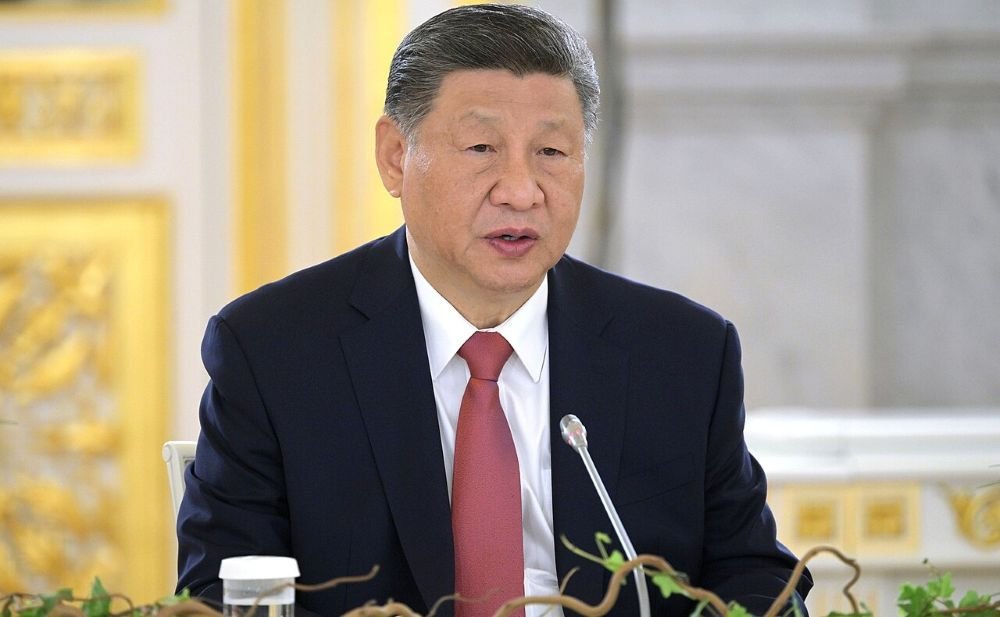
[Photo by Kremlin.ru, CC BY 4.0, via Wikimedia Commons]
Dr. Manoj Kumar Mishra is a Lecturer at the Department of Political Science, SVM Autonomous College, Odisha, India. The views and opinions expressed in this article are those of the author. The views and opinions expressed in this article are those of the author.
[ad_2]
Source link


.jpg)