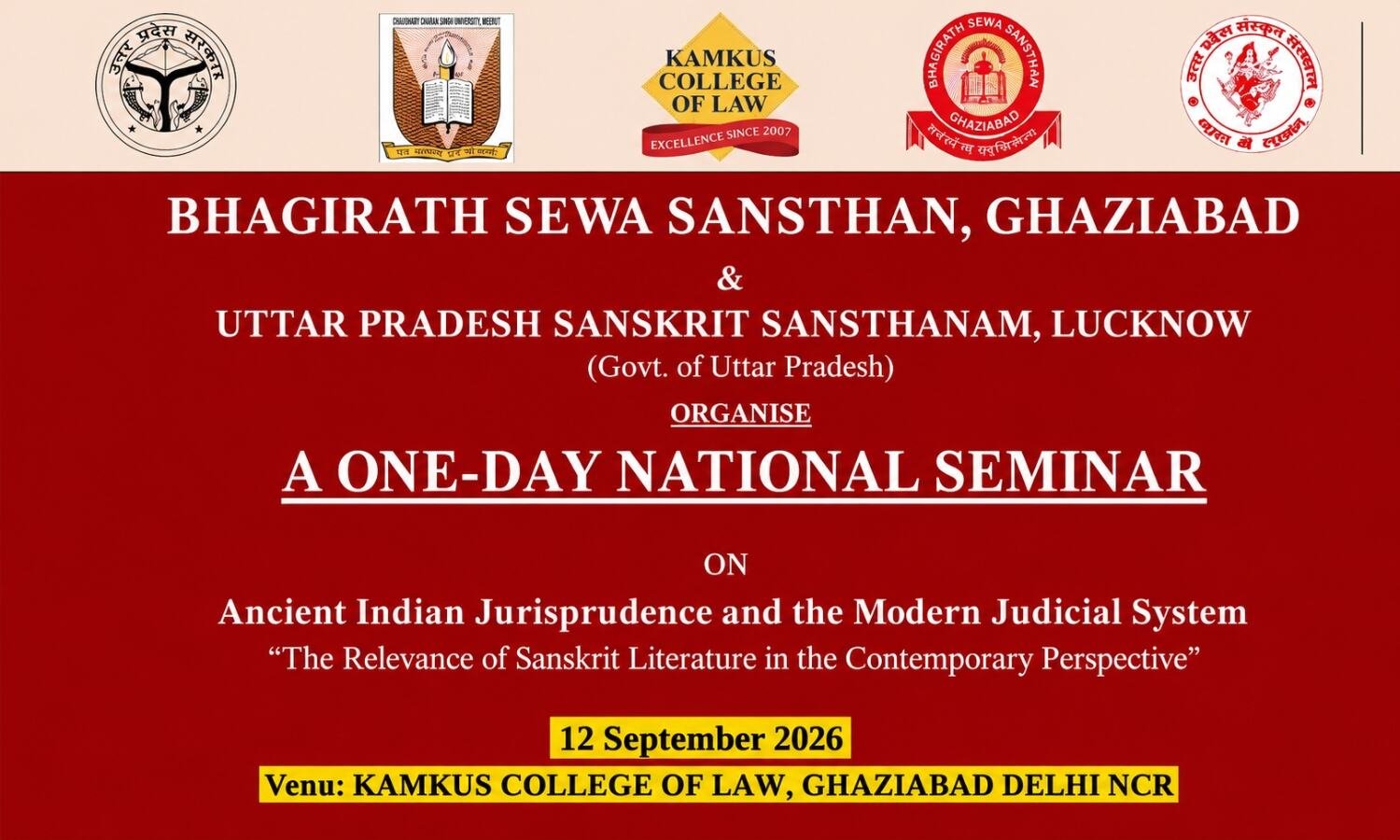

Kamkus College of Law is organising a One-Day National Seminar on “Ancient Indian Jurisprudence and the Modern Judicial System: The Relevance of Sanskrit Literature in the Contemporary Perspective” on September 12, 2026. Interested participants may submit their abstracts by August 20, 2026.
About Kamkus College of Law
Kamkus College of Law was established in 2007 with a vision to impart quality legal education. It is a premier educational institution managed by Bhagirath Sewa Sansthan, a society registered under the Societies Registration Act, 1860.

The institution is affiliated with Chaudhary Charan Singh University, Meerut. The courses offered by the institution are approved by the Bar Council of India.
About the National Seminar
Kamkus College of Law is organising a One-Day National Seminar on “Ancient Indian Jurisprudence and the Modern Judicial System: The Relevance of Sanskrit Literature in the Contemporary Perspective.”
The seminar aims to bring together legal scholars, practitioners, researchers, students and Sanskrit scholars to discuss and deliberate upon critical themes concerning ancient Indian jurisprudence, Sanskrit literature and the modern judicial system.
Theme of the Seminar
Ancient Indian Jurisprudence and the Modern Judicial System: The Relevance of Sanskrit Literature in the Contemporary Perspective
Sub-Themes
The sub-themes of the seminar include, but are not limited to, the following:
-
Rajdharma and Modern Administrative Law
Kautilya’s Arthashastra and the principles of good governance.
-
Ancient Methods of Dispute Resolution
The origin of arbitration, conciliation and the Panchayat system in Sanskrit texts.
-
Law of Contracts and Civil Law
References to debt, transfer of property and commercial rules in the ancient Yajnavalkya Smriti and Narada Smriti.
-
Environmental Protection and Law
Environmental justice in Vedic and Puranic Sanskrit literature and its relevance to contemporary laws.
-
Jurisprudence and Rules of Interpretation
The applicability of the Mimamsa rules of interpretation in interpreting modern laws.
Call for Papers
Original abstracts and research papers are invited from eligible participants on the primary theme and sub-themes of the national seminar.
Eligibility
The seminar is open to:
- Law students
- Academicians
- Judges
- Legal practitioners
- Sanskrit scholars
- Researchers
Eligible participants may attend the seminar and submit abstracts and full papers.
Submission Guidelines
- Abstract: 300–400 words
- Full Paper: 1,500–2,500 words
- Font: Times New Roman
- Font Size: 12
- Line Spacing: 1.5
- Citation Style: Bluebook, 20th Edition
- Co-authorship: Permitted for up to four authors
Important Dates
- Deadline for Abstract Submission: August 20, 2026
- Confirmation of Abstract Acceptance: August 25, 2026
- Deadline for Full Paper Submission: September 5, 2026
- Date of the Conference: September 12, 2026
Registration Fee
There is no registration fee for participating in the seminar.
Best Paper Award
The best paper will receive a publication opportunity and certificates.
Certificates
Physical certificates will be provided to all registered authors and attendees.
How to Register
Interested participants may register for the national seminar through the registration form provided below.
Registration Form: Click here to register
Brochure
Brochure Link: Click here to access the brochure
Contact Information
For queries concerning the seminar, participants may contact:
Email: [email protected]
Deepak Mishra [Convener]: +91-8595656658

