
[ad_1]
Written by Jagdish Reddy | Reviewed with NOAA, USDA & University Extension Resources | Updated May 2026

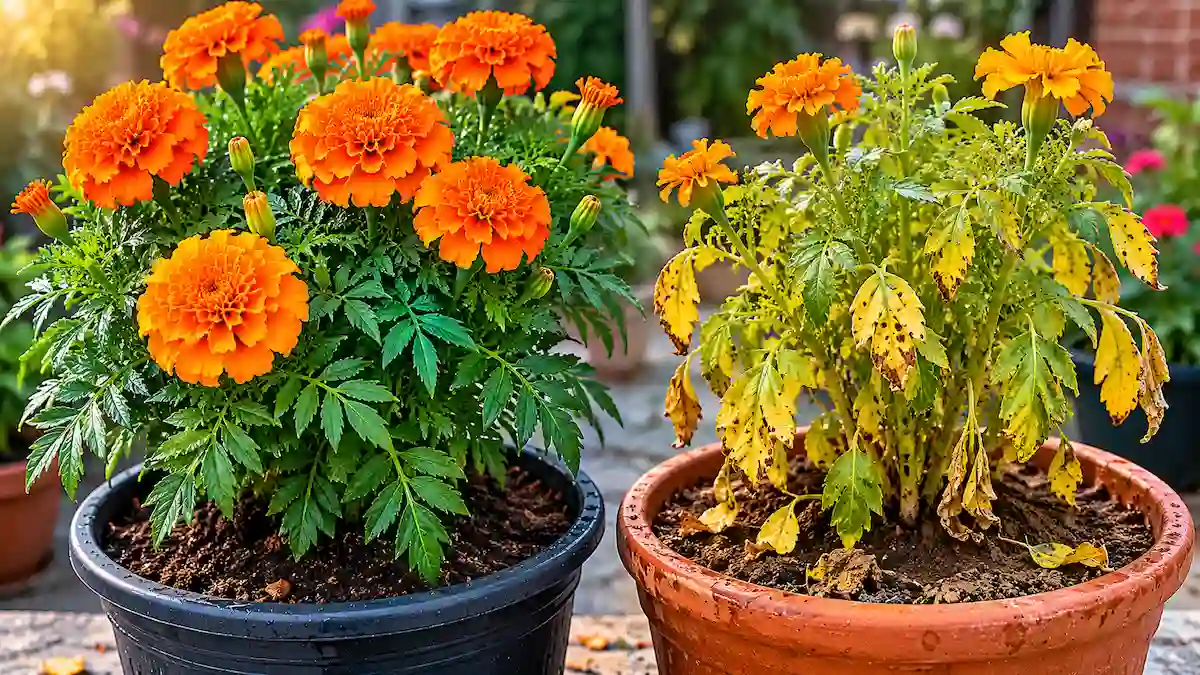
Yellow marigold leaves are almost always fixable, but only if you treat the right problem. Marigold leaves turning yellow from overwatering look almost identical to yellowing from a nitrogen gap or a spider mite infestation. Treat the wrong one and the plant gets worse. This guide covers all 15 causes with the visual clues that tell them apart, so you know exactly what you’re dealing with before you touch the plant.
Quick answer: The most common reasons marigold leaves turn yellow are overwatering, nitrogen or iron deficiency, spider mites, root rot, and insufficient sunlight. Check where on the plant the yellowing starts and whether it looks soft, stippled, or bleached. That pattern points directly to the cause.

What Healthy Marigold Foliage Should Look Like
Healthy marigold leaves are a deep, uniform green with a slightly pungent scent when brushed. They should feel firm, not limp or papery. The lower leaves on a mature plant may be slightly lighter in tone, but nothing close to yellow.
Any yellowing outside the very lowest one or two leaves on an established plant is worth investigating. The pattern tells you almost everything.
How to Diagnose Yellow Marigold Leaves in 60 Seconds
Before doing anything, look at three things: where the yellowing starts, what the soil feels like an inch below the surface, and what the undersides of the leaves look like. That alone narrows it to two or three possibilities in almost every case.
| What You See | Most Likely Cause | Recoverable? |
|---|---|---|
| Lower/older leaves, uniform pale yellow, wet soil | Overwatering or root rot | Yes, if caught early |
| Lower/older leaves yellow, dry soil, no recent feed | Nitrogen deficiency | Yes |
| Young top leaves yellow, veins stay green | Iron deficiency (chlorosis) | Yes |
| Yellow blotches between veins, older leaves | Magnesium deficiency | Yes |
| Tiny pale dots, fine webbing on leaf undersides | Spider mites | Yes |
| Sticky leaves, clusters on stems | Aphids or whiteflies | Yes |
| Brown spots with yellow halo | Fungal leaf spot (Alternaria) | Partially |
| Black spots with purple margins | Bacterial leaf spot | No, remove plant |
| Pale, white powder then yellowing | Powdery mildew | Yes, if mild |
| Stunted, bushy, deformed flowers | Aster yellows disease | No, remove plant |
| Yellow and crispy at tips, dry soil | Underwatering or heat scorch | Yes |
| Pale overall, fewer flowers, shade nearby | Insufficient sunlight | Yes |
| Yellowing right after repotting or transplanting | Transplant shock | Yes |
| Scorched patches, no pests, recent herbicide nearby | Herbicide drift or fertilizer burn | Partially |
| Only the bottom two or three leaves, plant otherwise fine | Natural aging | No action needed |
Why Marigold Leaves Turn Yellow: 15 Causes and Fixes
1. Overwatering
By far the most common cause, especially in pots and heavy clay soils. Waterlogged roots can’t absorb oxygen, so they begin to fail. Leaves yellow from the bottom up, feel soft, and the soil smells slightly musty. Fungus gnats hovering near the base are a reliable secondary clue.
Most beginners water on a calendar schedule rather than checking the soil first. That habit is where the trouble starts.
Fix: Stop watering. Let the top two inches of soil dry completely before the next session. For containers, unblock drainage holes and tilt the pot to drain any standing water. Going forward, check the soil with your finger before every watering rather than following a fixed schedule.
2. Root Rot
Root rot follows overwatering that goes uncorrected. The fungi Pythium and Phytophthora move in once soil stays waterlogged for too long. The plant wilts and yellows despite wet soil, which confuses most growers into watering more.

Pull the plant and check. Healthy roots are firm and white. Rotted roots are brown, black, and mushy.
Fix: If some healthy white roots remain, trim away all rotten ones, dust cut ends with cinnamon, and repot into fresh well-draining mix. Withhold water for four to five days. If roots are almost entirely gone, the plant will not recover.
3. Underwatering and Heat Stress
Underwatered marigolds go yellow differently from overwatered ones. Leaves look pale and eventually dry out at the tips and edges. The soil is powdery dry an inch down, and pots feel light when lifted.
In hot climates above 35°C (95°F), even well-watered marigolds in small pots can show heat stress yellowing mid-afternoon. This usually reverses overnight without intervention.
Easy Fix: Water deeply until it flows freely from drainage holes. Switch from shallow daily watering to thorough sessions two or three times a week. For container plants in summer heat, morning watering keeps soil cooler through the day.
Overwatering vs Underwatering: Quick Visual Comparison

| Sign | Overwatered | Underwatered |
|---|---|---|
| Leaf texture | Soft, limp, mushy | Dry, papery, crispy edges |
| Soil condition | Wet, compacted, smelly | Dry, pulls away from pot edges |
| Yellowing location | Lower leaves first | Spreads from tips inward |
| Root appearance | Brown, slimy | Dry, possibly shrunken |
| Associated pests | Fungus gnats | Spider mites (dry conditions) |
4. Nitrogen Deficiency
Nitrogen keeps leaves green. Without enough of it, the plant pulls nitrogen from its oldest tissue first, so lower leaves go uniformly pale yellow while newer growth at the top stays greener for longer.
Sandy soils lose nitrogen quickly through leaching. Container plants that haven’t been fed in two or more months show this pattern reliably.
Best Fix: Apply a balanced water-soluble fertilizer (10-10-10 NPK) or liquid nitrogen sources like compost tea or diluted fish emulsion. Feed lightly every four to six weeks through the growing season. See homemade fertilizer options for marigolds if you prefer organic inputs.
5. Iron Deficiency (Interveinal Chlorosis)
Young leaves at the top of the plant yellow between the veins while the veins stay green. That interveinal pattern on new growth only is the signature of iron chlorosis, not nitrogen deficiency, which hits older leaves first.

It’s almost never a lack of iron in the soil. Alkaline soil above pH 7.0 locks iron into a form roots can’t absorb. Excess phosphorus fertilizer can do the same thing.
Ideal Fix: Test soil pH. If it’s above 7.0, amend with elemental sulfur or acidic compost over time. For faster visible improvement, apply chelated iron as a foliar spray or soil drench at the labeled rate.
6. Magnesium Deficiency
Older leaves develop yellow blotches or patches between the veins while the veins themselves stay green. Unlike iron deficiency, this hits the lower, older leaves first, not the new growth at the top.
Common in sandy soils, containers watered frequently, or where potassium fertilizers have been over-applied (excess potassium blocks magnesium uptake).
How to Fix: Dissolve one tablespoon of Epsom salt (magnesium sulfate) in one liter of water. Apply as a soil drench or foliar spray every two weeks until colour improves. Don’t overdo it, too much magnesium interferes with calcium.
7. Fertilizer Burn or Salt Buildup
Too much fertilizer, or fertilizer applied to dry soil, scorches roots through salt toxicity. Leaves develop yellow then brown tips, often with a crispy margin. Unlike nutrient deficiency, this tends to appear suddenly after a feeding rather than gradually over weeks.
Salt buildup in containers is a slow version of the same problem. A white crust on the soil surface is a giveaway.
Fix Formula: Flush the pot thoroughly with plain water to leach out excess salts. Let it drain fully, then stop fertilizing for at least four weeks. Water before feeding, never apply fertilizer to dry roots.
8. Spider Mites
Spider mites leave a finely stippled, pale speckled look across the leaf surface. Turn the leaf over and look for fine silky webbing between the veins and along stems. Hot, dry conditions are their ideal environment, including heated indoor spaces and south-facing balconies.

To be sure: hold white paper under a leaf and tap it. Moving specks the size of a pepper grain mean spider mites are present.
Best Fix: Blast undersides with a hard jet of water for several consecutive days. Follow with weekly neem oil spray (2 ml neem oil, a few drops of liquid soap, 1 liter of water). Avoid broad-spectrum insecticides, they eliminate the predatory mites that keep spider mites in check.
9. Aphids and Whiteflies
Aphids cluster on stems and leaf undersides as tiny green, black, or yellow insects. Whiteflies scatter in a cloud when you brush the plant. Both drain sap, causing leaves to yellow and curl. Their sticky honeydew residue leads to sooty mold as a follow-on problem.
Fixing Solution: Insecticidal soap solution handles light infestations. Yellow sticky traps catch whiteflies early. For heavier colonies, neem oil applied in the evening (to avoid harming pollinators) works well. Check plants every few days; these pests move fast once established.
10. Powdery Mildew
White or grey powdery patches on leaves, followed by yellowing of the affected tissue. Powdery mildew is a warm-weather fungal disease that thrives not when it’s wet, but when humidity is high and air is still. Crowded plants in humid gardens are most vulnerable.

African marigolds (Tagetes erecta) are more susceptible than French varieties (Tagetes patula) in humid conditions.
Fix It: Improve spacing between plants to boost airflow. Spray with a baking soda solution (1 tbsp baking soda, 1 tsp horticultural oil in 1 liter of water) or a 10% milk and water mix. Sulfur-based fungicides work for persistent cases. Always water at soil level, never overhead.
11. Fungal Leaf Spot (Alternaria)
Dark brown or black spots with a visible yellow halo around each one. As spots multiply, the surrounding leaf tissue dies and falls out. Alternaria spreads fast when overhead watering or rain splashes spores from infected debris to healthy leaves.
Fix This Way: Remove and bin affected leaves immediately. Switch to base watering. Apply copper-based fungicide as a preventive before wet weather. Keep spacing at 20 to 30 cm (8 to 12 inches) between plants to reduce leaf-to-leaf contact.
12. Bacterial Leaf Spot
Caused by Pseudomonas syringae pv. tagetis, which only affects Tagetes species. Look for dark brown or black spots with distinctive purple margins, and yellowing tissue around them. There is no effective chemical treatment.
Fixing Method: Remove and bin infected plants. Do not compost. Avoid that planting spot for marigolds for at least two seasons. The pathogen spreads through water, so drip irrigation reduces future spread. Penn State Extension’s marigold disease management table covers identification and control for all major bacterial and fungal diseases.
13. Aster Yellows Disease
A phytoplasma disease spread by leafhoppers. Symptoms include yellowing and clearing of leaf veins, stunted bushy growth, and deformed or green-tinted flowers. New leaves come in undersized and abnormal. Once visible, the plant is already a disease reservoir for leafhoppers to spread to neighbours.
According to Iowa State University Extension, aster yellows infects hundreds of species including zinnia, carrot, and lettuce. Leafhopper control in mixed gardens is the key prevention strategy.
Fixing Ideas: No cure exists. Remove and bin affected plants immediately. Manage leafhoppers with fine insect mesh over vulnerable plants. Clear weeds like dandelion and plantain, which act as leafhopper host reservoirs nearby.
14. Cold Stress, Frost Damage, and Temperature Swings
Marigolds are warm-season annuals. Temperatures below 10°C (50°F) slow nutrient uptake and cause leaves to pale or develop yellow patches. A sudden overnight frost turns leaf edges translucent, then yellow, then brown within 24 hours.
Even without frost, moving a potted marigold from indoors to a cold outdoor spot, or a sudden temperature drop after a warm spell, causes temporary stress yellowing that resolves once conditions stabilise.
Fixing Procedure: Do not plant out until nighttime temperatures stay reliably above 10°C. Use frost cloth if a late cold snap is forecast. For container plants, bring indoors when temperatures drop sharply.
15. External Stress: Herbicide Drift, Root-Bound Pots, and Saucer Drainage
Herbicide drift causes rapid, irregular bleaching or pale discoloration across the foliage within one to three days of nearby spraying. The pattern is patchy with no visible pests or lesions. Rinse with clean water, remove the worst-affected growth, and mild exposure usually resolves within a week.
Root-bound containers produce slow, generalised chlorosis with no other obvious cause. A dense root mass circling the base of the pot blocks drainage and limits nutrient absorption. Repot into a size larger with fresh mix.
Saucers left full of standing water keep the drainage hole submerged, so roots stay wet regardless of how carefully you water. Empty saucers within 30 minutes of watering, every time.
Why Marigold Seedlings Turn Yellow
Pale or chlorotic seedlings follow a different diagnostic path than stressed established plants. The three main causes at the seedling stage are insufficient light, overwatered seed-starting mix, and damping-off fungus.

Seedlings started indoors on a windowsill without supplemental light go pale yellow-green within a week, stretching toward the light source. This is light starvation, not a nutrient problem.
Damping-off causes seedlings to yellow, collapse, and die at the base. It’s caused by overwatering in non-sterile seed-starting mix. There is no recovery once it takes hold. Start fresh with sterile mix and better drainage.
Seedlings yellowing after transplanting are almost always dealing with transplant shock. Water in well, provide two days of partial shade, and hold off on fertiliser for the first two weeks.
Why Potted Marigolds Turn Yellow Faster Than Garden Marigolds
Container marigolds are more prone to overwatering, nutrient depletion, and salt buildup than in-ground plants. The limited soil volume dries out faster and gets exhausted faster. They need feeding more often and checked for moisture more regularly.
Garden bed marigolds are more exposed to soil-borne pathogens, slugs, and fungal leaf spot from rain splash. Spacing is the main defence. 20 to 30 cm (8 to 12 inches) between plants allows enough airflow to keep foliage dry between rain events.
The best container mix for marigolds: two parts good quality potting compost, one part perlite or coarse grit, and a slow-release balanced fertiliser worked in at planting. This prevents most of the watering and nutrition issues that lead to yellowing.
How Soil pH, Climate, and Drainage Affect Marigold Leaf Yellowing
Marigolds grow best in slightly acidic to neutral soil, pH 6.0 to 7.0. Above pH 7.0, iron and manganese become chemically unavailable regardless of how much fertiliser you apply. Iron chlorosis in alkaline regions almost always traces back to pH rather than a lack of iron in the ground.
Regions with consistently alkaline soils include parts of the American Southwest, the Mediterranean basin, South Asia, Australia’s interior, the Middle East, and southern Africa. Growers in these areas should test soil pH before planting and amend annually.
Heavy clay soils hold excess moisture and raise root rot risk. Sandy soils drain fast but leach nitrogen quickly. Both benefit from adding organic compost at planting time.
Marigolds perform best between 15°C and 29°C (59°F to 84°F). Sustained temperatures above 35°C cause temporary chlorosis that corrects itself once heat breaks. Monsoon seasons in tropical and subtropical regions bring elevated fungal leaf spot and powdery mildew pressure due to high humidity combined with warm temperatures.
When Marigold Leaves Turn Yellow by Season
Spring: Transplant shock and cold-soil stress are the main culprits. Nutrient uptake is slow until soil warms above 15°C. Hold off on heavy feeding until plants are actively growing.
Summer: Heat stress and spider mites peak. Watering frequency needs to increase. Plants in full sun in small pots dry out faster than most growers expect.
Monsoon/rainy season: Fungal diseases dominate. Alternaria, powdery mildew, and bacterial leaf spot all spike with prolonged wet periods. Drainage and spacing become critical.
Autumn/Fall: Natural lower-leaf senescence increases as days shorten. Some yellowing at this stage is completely normal and shouldn’t be treated as a problem.
How to Prevent Marigold Leaves From Turning Yellow
Stressed or pale foliage on marigolds is rarely bad luck. Most problems trace back to the same handful of care habits.
- Check soil moisture with your finger before every watering, not by calendar.
- Water at the base, never overhead, to keep foliage dry.
- Space plants 20 to 30 cm apart for adequate airflow.
- Feed lightly every four to six weeks, and always water first before applying fertiliser.
- Test soil pH if you’re in an alkaline region. Correct before planting, not after chlorosis appears.
- Inspect leaf undersides weekly. Catching spider mites at five insects is far easier than managing a colony of thousands.
- Deadhead spent flowers regularly. It keeps the plant in active growth and makes early disease symptoms on stems much easier to spot.
If symptoms don’t match anything here, our plant problem finder covers a wider range of species and can help when the cause isn’t specific to marigolds.
Signs Your Marigold Cannot Be Saved
Three situations are not recoverable: advanced root rot with no healthy roots remaining, confirmed bacterial leaf spot, and aster yellows disease. In all three cases, keeping the plant does more harm than good.
Remove and bin infected plants. Do not compost them. Alternaria, Botrytis, and bacterial pathogens persist in compost heaps and can reinfect the garden the following season.
For the marigold farming guide covering planting spacing, soil prep, and variety selection that prevents most of these problems from the start, see our complete marigold cultivation guide.
What Gardeners Misdiagnose Most Often
The most common mistake is fertilizing a plant that’s actually overwatered. Yellowing makes you think it needs feeding. But if the roots are already oxygen-starved, adding fertilizer increases salt stress and accelerates the damage.
Most yellowing problems are misdiagnosed because several issues produce nearly identical discoloration at first glance. These are the mix-ups that happen most often.
Curling yellow leaves with no visible pests get treated as a disease when spider mites are the actual cause. The mites are too small to see without looking at the leaf underside in decent light. Most gardeners never check there until the infestation is already large.
| What Gardeners Think It Is | What It Usually Is | What Makes It Worse |
|---|---|---|
| Needs more water (yellow + limp) | Root rot from overwatering | Watering more |
| Needs fertilizer (yellow overall) | Overwatering blocking nutrient uptake | Applying fertilizer to wet soil |
| Iron deficiency (yellow patches) | Magnesium deficiency | Using chelated iron instead of Epsom salt |
| Disease (curling yellow leaves) | Spider mites | Spraying fungicide, which does nothing |
| Nutrient deficiency (pale seedlings) | Insufficient light indoors | Adding fertilizer to a light-starved plant |
| Normal aging (spreading yellow) | Nitrogen deficiency or overwatering | Ignoring it until it spreads upward |
Iron and magnesium deficiency are the two most commonly swapped. Both produce interveinal chlorosis, but iron deficiency hits young growth at the top; magnesium deficiency targets older foliage lower down. Treating the wrong one delays recovery by two to three weeks.
Diagnose Yellow Marigold Leaves Without Photos
Gardeners tend to focus on colour, but texture is usually the faster clue. Soft, limp foliage almost always points to excess moisture. Dry, crispy discoloration points to drought, heat, or fertilizer salts. Get that distinction right first and you eliminate half the possibilities before you do anything else.
- Soft and yellow, lower leaves: overwatering or root rot
- Crispy at tips and edges: underwatering, heat scorch, or fertilizer burn
- Yellow between green veins, young top leaves: iron deficiency or alkaline soil
- Yellow blotches between green veins, older lower leaves: magnesium deficiency
- Tiny pale dots, fine webbing underneath: spider mites
- Pale and curling, sticky residue on stems: aphids or whiteflies
- Brown spots ringed with pale halo: fungal leaf spot
- Pale growth tips after recent feeding: fertilizer burn or salt buildup
- Patchy bleaching, no pests, recent nearby spraying: herbicide drift
- Washed-out foliage, weak blooming, shade nearby: light deficiency
A plant that is wilting and pale despite wet soil is almost certainly root rot, not drought. That single observation rules out half the list immediately.
How Long Marigolds Take to Recover From Yellow Leaves
Already yellowed foliage will not recover its colour. Recovery means fresh healthy growth appearing at the centre and growing tips. Here is what to expect per cause once the right fix is in place.

| Cause | Recovery Time | First Sign of Recovery |
|---|---|---|
| Overwatering (mild) | 7 to 10 days | Firm new leaves at growing tips |
| Root rot (caught early) | 10 to 14 days after repotting | New root growth, then fresh leaves |
| Underwatering | 2 to 5 days | Leaves firm up before colour returns |
| Nitrogen deficiency | 2 to 3 weeks | New growth comes in greener |
| Iron deficiency | 2 to 4 weeks | Young leaves emerge with better colour |
| Spider mites | 1 to 2 weeks after control | No new stippling on fresh leaves |
| Transplant shock | 5 to 14 days | Drooping stops, new growth resumes |
| Heat stress | Overnight to 3 days | Leaves firm up when temperature drops |
| Fertilizer burn | 2 to 3 weeks after flushing | New growth without brown tips |
| Root rot (advanced) / aster yellows | No recovery | Remove plant |
If new growth is still coming in yellow three weeks after you addressed the cause, the diagnosis was wrong. Go back to the pattern table above and reconsider.
Frequently Asked Questions about Marigold Plant Yellow Leaves
Can yellow marigold leaves turn green again?
No. Once a leaf turns yellow, it will not recover its colour. Fix the underlying cause and watch for healthy green growth at the centre and tips. Remove yellow leaves once the problem is addressed.
Should I cut off yellow leaves from my marigold?
Yes. Yellow leaves won’t recover, and leaving them on creates damp conditions that invite fungal disease. Use clean scissors and wipe the blades with rubbing alcohol between plants if you suspect disease.
Why are only the bottom leaves on my marigold turning yellow?
If it’s just the lowest two or three leaves and everything above looks healthy, that is natural aging and needs no action. If yellowing is moving upward, check soil moisture first. Wet soil points to overwatering; dry soil with no recent feed points to nitrogen deficiency.
Why are my potted marigolds turning yellow?
Container marigolds yellow most often from overwatering, salt buildup from frequent feeding, or compacted roots in a pot that’s too small. Check drainage holes first. If the soil is consistently wet, that’s the problem. If there’s a white crust on the soil surface, flush with plain water and hold off feeding for a month.
Why are my marigold seedlings turning yellow indoors?
Insufficient light is the most common reason. Seedlings on a windowsill without supplemental lighting stretch and pale within days. Move them closer to a bright window or use a grow light for 14 to 16 hours daily. If the base of the stem is also collapsing, that is damping-off fungus caused by overwatered seed mix. Start fresh with sterile compost and ensure drainage.
Can too much rain cause marigold leaves to turn yellow?
Yes, indirectly. Heavy or prolonged rainfall saturates soil, producing the same oxygen-starved root conditions as overwatering. It also splashes fungal spores onto foliage, raising the risk of Alternaria leaf spot and powdery mildew. Improve drainage before rainy season and avoid dense planting that traps moisture between plants.
[ad_2]
Source link

