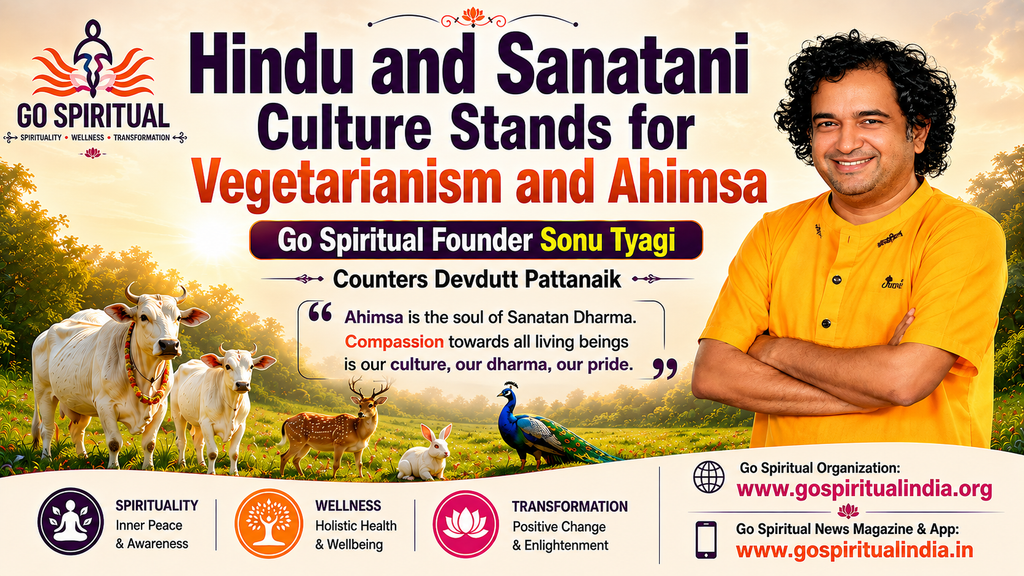

Go Spiritual says selective references to ancient meat-eating cannot define Sanatan Dharma, which has championed Ahimsa, Karuna, Sattvic living and compassion towards all living beings
Mumbai : Sonu Tyagi, Founder of Go Spiritual, has strongly countered recent arguments by mythologist and author Devdutt Pattanaik on vegetarianism, caste and references to meat-eating in ancient Hindu literature, asserting that Hindu and Sanatani culture has a profound and enduring tradition of vegetarianism, Ahimsa, compassion and reverence for all living beings.

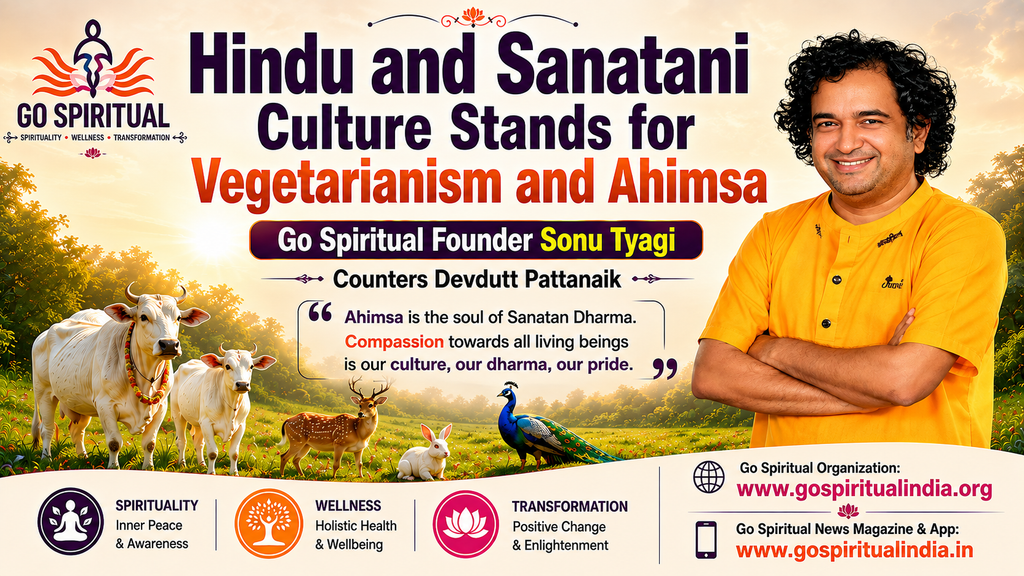
Tyagi’s response comes in the wake of Pattanaik’s recent commentary on vegetarianism and meat-eating, including arguments linking vegetarian identity with caste, purity and power, alongside references to animal sacrifice and meat consumption in Vedic and other ancient Sanskrit literature. Tyagi said that selective references from texts composed across different historical periods cannot be presented as the defining character of Sanatan Dharma while its vast spiritual traditions of Ahimsa, Daya, Karuna, Sattva and respect for life are pushed into the background.
“Sanatan Dharma must be understood through its highest spiritual ideals and not reduced to a catalogue of what someone may have eaten or sacrificed thousands of years ago. Its spiritual journey takes human consciousness towards compassion, self-restraint, purity and respect for life. For Go Spiritual, vegetarianism is a natural expression of that journey,” said Tyagi.
He strongly disagreed with attempts to interpret India’s vegetarian traditions predominantly through the prism of caste and political power. According to Tyagi, compassion cannot belong to any particular caste, class or political ideology. “An animal being taken for slaughter does not know whether the person protecting it is a Brahmin, Baniya, Dalit, tribal, Hindu, Jain, Buddhist or atheist. It knows fear, pain and the desire to remain alive. Turning vegetarianism into caste warfare distracts us from the fundamental ethical question: when human beings can nourish themselves without deliberately killing an animal, why should an animal have to die for our taste?”
Tyagi clarified that Go Spiritual does not argue that vegetarianism alone makes a person morally superior. A person’s character, he said, cannot be determined simply by what is on his or her plate. However, that does not make the ethical consequences of dietary choices irrelevant. “A vegetarian can be a bad human being and a non-vegetarian can possess many admirable qualities. But that does not change the reality of an animal losing its life for food. Vegetarianism should not be about declaring ourselves superior; it should be about trying to cause less suffering.”
Go Spiritual maintained that ancient Hindu literature represents an enormous and historically layered tradition encompassing different periods, rituals, philosophical schools and interpretations. References to animal sacrifice or meat consumption, Tyagi said, should neither be dishonestly erased nor selectively elevated into the eternal moral message of Hindu civilisation.
“Even if scholarship establishes that certain people consumed meat or particular ancient sacrifices involved animals, does that automatically make animal killing a spiritual ideal for a Hindu living today? History can tell us what human beings sometimes did. Dharma asks us what human beings ought to become,” Tyagi said.
He pointed out that Hindu literature itself contains powerful teachings supporting abstention from meat and compassion towards living creatures. Manusmriti 5.48 links obtaining meat with injury to living beings and consequently advocates abstention, while the following verse asks people to contemplate the origin of flesh and the bondage and killing of creatures. The Mahabharata’s Anushasana Parva contains an extensive discourse on abstention from meat, compassion towards creatures and the spiritual merit associated with avoiding flesh.
“If passages apparently referring to meat consumption are considered legitimate evidence of Hindu tradition, then passages explicitly advocating abstention and compassion must be given equal, if not greater, attention. Intellectual fairness demands that we acknowledge the complete spiritual conversation rather than selecting only those passages that support a predetermined conclusion,” Tyagi said.
Tyagi also highlighted the Bhagavad Gita’s emphasis on Sattvic food. Bhagavad Gita 17.8 describes foods associated with Sattva as those promoting life, purity, strength, health, happiness and satisfaction, while Bhagavad Gita 9.26 speaks of Lord Krishna accepting with devotion an offering of a leaf, flower, fruit or water. Tyagi said these teachings have helped inspire generations of vegetarian Hindu households, temples, saints, devotees and spiritual institutions.
“Look at the tradition of Prasad, the vegetarian practices of numerous Vaishnava traditions and the emphasis placed upon Sattvic food by generations of spiritual teachers. Vegetarian spirituality is not a modern political invention. It is a living and deeply rooted part of Hindu and Sanatani culture,” he said.

According to Tyagi, Ahimsa represents one of Indian civilisation’s most significant spiritual contributions because it expands the circle of compassion beyond human beings. Animals experience fear, pain and an instinctive desire for survival, he said, and spirituality should increase humanity’s sensitivity towards that suffering rather than provide intellectual arguments for ignoring it.
Addressing the frequently raised argument that plants are also living, Tyagi said the impossibility of eliminating every form of harm does not justify avoidable suffering. “Ahimsa in everyday life can also mean choosing the path of minimum harm. The fact that human existence cannot eliminate every form of injury cannot become an excuse to cause suffering that we have the reasonable ability to avoid.”
Tyagi said Hindu society should celebrate its compassionate spiritual heritage rather than allowing food to become another source of caste or political division. He also rejected sweeping attacks on Brahmins, Banias, Dalits, tribal communities or any other social group, saying no community has a monopoly over either compassion or cruelty.
“We do not need to erase history to defend Sanatan Dharma, but neither should selective readings of history be used to diminish its magnificent traditions of vegetarianism, Ahimsa and compassion. Go Spiritual proudly stands for a vegetarian and compassionate way of life. The higher message of Sanatan Dharma is Ahimsa, Karuna, Sattva and kindness towards every living being,” Tyagi said.
“If we have the choice to nourish ourselves without killing an innocent creature, let us choose compassion. An animal’s life is greater than a few moments of taste. For us, that is not merely vegetarianism; that is spirituality in action,” he concluded.

Go Spiritual, founded by Sonu Tyagi, is a spiritual and wellness organisation working in spirituality, spiritual awareness, philanthropy and social causes, mental health and wellness, Ayurveda and holistic living, spiritual tourism, media and events. The organisation advocates vegetarianism, animal kindness, conscious living and spirituality centred on humanity and compassion.
Sonu Tyagi is an award-winning writer, director and producer, and the Founder of Approach Entertainment Group and Go Spiritual, with more than two decades of experience in the media and entertainment industry. Under his leadership, Approach Entertainment works across Celebrity & Talent Management, Film Productions, Advertising & Corporate Film Productions, Film Marketing, Events and Entertainment Marketing; Approach Communications is an award-winning PR, Digital and Integrated Communications agency offering strategic communications services across diverse sectors; while Approach Bollywood operates as a Bollywood and Entertainment Newswire, News Portal and App, covering films, celebrities, television, OTT, music and the wider entertainment industry
For Media Information: 9820965004 / 9716962242
Go Spiritual | Organization: www.gospiritualindia.org | News Magazine & App: www.gospiritualindia.in www.sonutyagi.com
The post Hindu and Sanatani Culture Stands for Vegetarianism and Ahimsa: Go Spiritual Founder Sonu Tyagi Counters Devdutt Pattanaik first appeared on Go Spiritual News Magazine & App.
News, go spiritual, hindu, hindu non vegetarian, kindness for animals, non vegetarian, sanatani hindu, sonu tyagi, sonu tyagi approach entertainment, sonu tyagi go spiritual, spiritual, spiritual apps, spiritual hindu, spiritual india, spiritual journalists, spiritual journalists in india, spiritual journalists in mumbai, spiritual journalists in new delhi, spiritual media agencies in india, spiritual media companies, spiritual media tv, spiritual mind, spiritual newspapers, spiritual pr, spiritual pr agencies in india, spiritual pr agencies in mumbai, spiritual pr agency, spiritual tv, spiritual tv films productions, top spiritual pr agencies in mumbai, top spiritual pr agency, vegetarian Go Spiritual News Magazine & App

