
[ad_1]


By Dr JP Singh
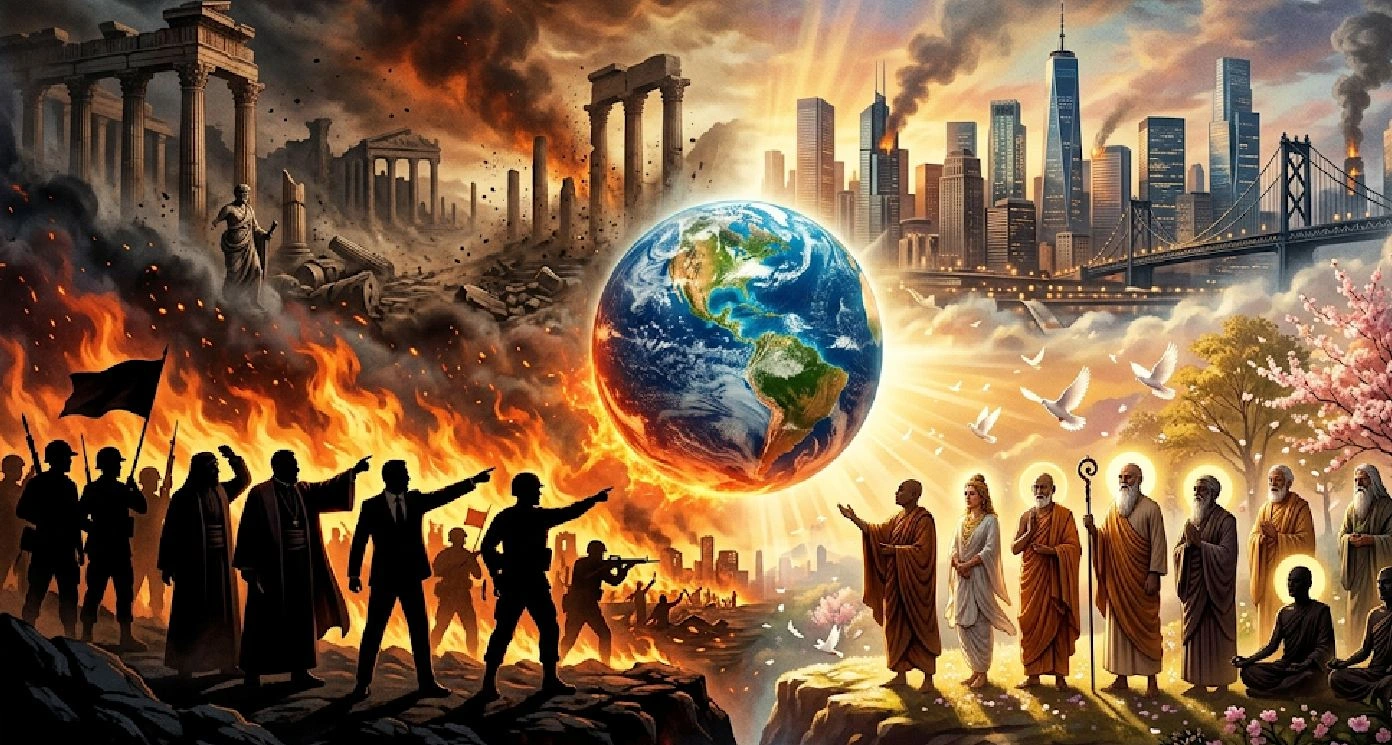
History does not merely record events; it reflects the inner condition of human consciousness. What unfolds in the world today is not simply geopolitics—it is the outward expression of deeper psychological and civilizational forces: fear, insecurity, ambition and the persistent longing for control.
At the heart of many global tensions lies a pattern as old as empire itself—the belief that security can be achieved through dominance. This idea has shaped expansionist visions across centuries and continents.
THE IDEA OF EXPANSION AS SECURITY
The concept sometimes described as “Greater Israel,” historically linked to thinkers such as Theodor Herzl and Ze’ev Jabotinsky, has evolved through different interpretations over time. In its more assertive readings, it envisions security through territorial depth and strategic control across regions, including the West Bank, Gaza and the Golan Heights.
Modern political figures such as Benjamin Netanyahu and Bezalel Smotrich represent strands of political thought where security concerns intersect with ideological conviction.
In such frameworks, expansion is often described not as conquest, but as preemption—the elimination of threats before they emerge. Yet, history reminds us that similar reasoning has surfaced before, often with tragic consequences.
ECHOES FROM EUROPE’S DARKEST CHAPTER
The 20th century saw a comparable doctrine under Adolf Hitler, whose vision of a Greater Germanic Reich rested on the concept of Lebensraum—the belief that national survival required territorial expansion.
This ideology ultimately contributed to the devastation of the World War II, a conflict that engulfed continents and reshaped the global order.
Even earlier, Napoleon Bonaparte pursued continental dominance, convinced that stability could be achieved through centralized control. Both visions, though different in character and context, eventually collapsed under the weight of overreach.
History’s verdict remains consistent: empires driven by fear and expansion tend to exhaust themselves.
THE PSYCHOLOGY OF POWER
Behind geopolitical doctrines lies a deeper human psychology—a triad that has often shaped the fate of nations:
- Fear clouds judgment like smoke.
- Rage blinds reason like a storm.
- Desire for power traps leaders and societies in a cycle of domination.
When states begin to see neighbours primarily as threats—or worse, as obstacles to be removed—they enter a dangerous psychological terrain. What begins as defensive strategy can slowly evolve into perpetual confrontation.
Importantly, this dynamic is not unique to any one nation or culture. It is a recurring pattern in human history.
THE AMERICAN CROSSROADS
The role of the United States remains pivotal in this evolving landscape. Historically guided by the Monroe Doctrine, the country once emphasized consolidating stability within its own hemisphere while avoiding prolonged involvement in distant conflicts.
During the 20th century, the United States played a crucial role in rebuilding global order after two world wars and
supporting institutions such as the United Nations—an attempt to anchor international relations in cooperation and sovereignty.
Today, however, global politics appears increasingly complex, particularly in West Asia, where alliances and rivalries intertwine. The challenge facing great powers is not participation in world affairs, but ensuring that engagement is guided by foresight rather than inherited fears.
History shows that even the strongest nations falter when reaction replaces long-term strategy.
LESSONS FROM CIVILIZATION: THE INDIAN INSIGHT
Civilizations have also offered alternative visions of power.
Thinkers and spiritual leaders such as Swami Vivekananda, Paramahansa Yogananda, Mahatma Gandhi and Sai Baba of Shirdi demonstrated influence without armies or territorial ambition.
Their message emphasized a different understanding of strength:
- Fearlessness dissolves conflict.
- Compassion outlasts conquest.
- Service transforms power into responsibility.
India’s civilizational resilience grew not from imperial expansion, but from a long tradition of coexistence—absorbing and harmonizing diverse cultures and beliefs.
Even the ancient emperor, Ashoka, after witnessing the devastation of war, turned towards governance rooted in peace and moral responsibility.
A MULTIPOLAR WORLD
The modern world is increasingly multipolar. Powers across Eurasia and beyond—including Russia, China and India—now shape a complex global balance.
In such a landscape, attempts to impose singular dominance risk repeating the mistakes that once led empires to decline. Geography itself often resists overreach—from the mountains of the Hindukush to the vast cultural landscapes of Eurasia.
These barriers are not only physical, but civilizational.
THE WAY FORWARD: FROM POWER TO PURPOSE
Humanity today stands at a threshold where the challenge is less territorial and more evolutionary.
The transformation required is profound:
• Fear → Understanding
• Rage → Restraint
• Dominance → Cooperation
Institutions such as the United Nations can be seen as the modern equivalent of a global samudra manthan—a churning born from conflict that produced the possibility of cooperation.
The goal is not the elimination of power, but its transformation:
- A world where strength protects rather than dominates.
- A world where nations compete not in conquest, but in compassion.
- A world where no individual sleeps hungry and no suffering goes unseen.
FINAL REFLECTION
Empires rise and fall—but consciousness endures.
If humanity continues to act from fear, history may repeat itself in increasingly destructive forms. Yet, if it chooses compassion, an entirely new chapter becomes possible.
As Mahatma Gandhi reminded the world, the doors of hell are closed not by force, but by fearlessness.
And as Sai Baba of Shirdi embodied, the greatest influence in human history has never been power—it has been love.
The choice before the world is therefore deeper than the choice between war and peace. It is a choice between consciousness and collapse.
The future will belong to whichever humanity chooses.
—The writer is a retired Associate Professor of History, Department of History, Delhi University
[ad_2]
Source link

