
[ad_1]


What is a pet in the eyes of the law—a possession to be returned, a disputed asset, or a living being capable of memory, attachment and fear? For decades, Indian law has largely answered this question with quiet indifference, placing animals within the rigid confines of property.
But a recent ruling by the Delhi High Court has unsettled that orthodoxy.
In Sunil Malhotra & Ors vs State, Justice Girish Kathpalia confronted what appeared to be a routine custody dispute—one that would ordinarily be resolved through the procedural mechanism of superdari, where property seized during an investigation is temporarily released to a claimant until the trial concludes.
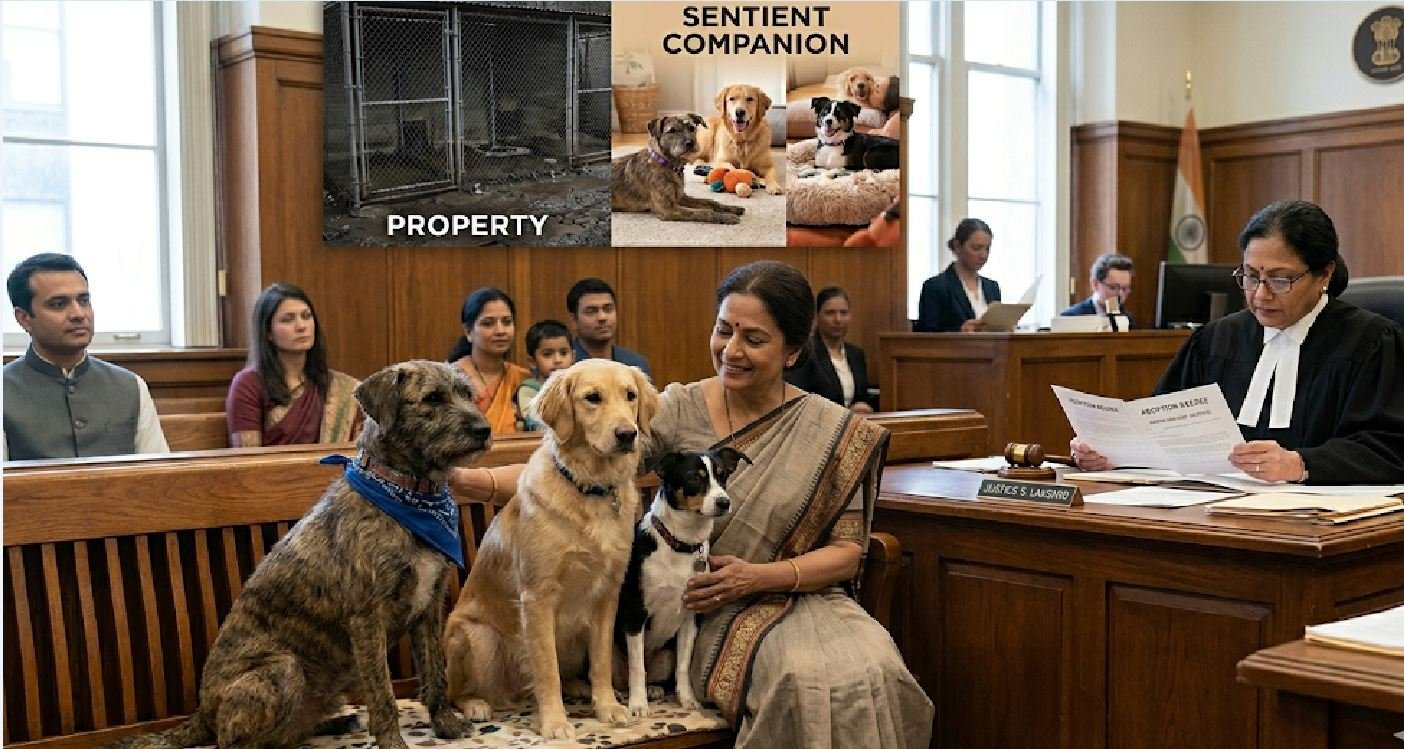
What lay before the Court, however, were not vehicles, documents or commodities. They were three rescued dogs—sentient beings who had already been uprooted once from conditions of alleged neglect and had since found care, stability and attachment in a new home. The Court’s conclusion marked a quiet-yet-profound shift: pets cannot be treated as property.
FROM SUPERDARI TO SENTIENCE
A trial court had earlier directed the release of the dogs on superdari to a man claiming to be their original owner, reportedly a breeder facing allegations of cruelty. The animals had been rescued during a police raid conducted with the assistance of an animal welfare organisation, after which they were rehabilitated and eventually placed with adoptive caregivers, including advocate Puja Anand, one of the petitioners who approached the High Court.
Ordinarily, superdari operates on a straightforward logic: custody follows prima facie ownership, subject to final adjudication. The doctrine was designed for objects—not lives.
Justice Kathpalia’s ruling disrupted this assumption. Setting aside the trial court’s order, the High Court emphasised that animal custody stands on a different footing from that of inanimate property. Removing the dogs from their adoptive home, the Court observed, would likely inflict “emotional trauma” on the animals.
This recognition was not merely rhetorical. It shifted the axis of adjudication from ownership to well-being, from entitlement to empathy.
THE EMOTIONAL TURN IN ANIMAL JURISPRUDENCE
Indian courts have previously acknowledged animal sentience. The Supreme Court has affirmed that animals are entitled to dignity and protection from cruelty. Yet, this judgment goes a step further. It recognises emotional bonds as legally relevant. “One cannot ignore the emotional bond that gets created between the person adopting the pet and the pet itself,” the Court noted.
The observation signals an important doctrinal evolution. It acknowledges that domesticated animals do not merely exist under human control; they live within relationships of familiarity, dependence and affection.
In doing so, the judgment opens the door to a more evolved legal framework—one that treats companion animals less as property and more as beings with relational identities.
FACTS THAT SHAPED THE COURT’S VIEW
The moral force of the ruling lies in the circumstances surrounding the rescue. The dogs were reportedly recovered from deeply unsatisfactory conditions. Accounts of the rescue described a dilapidated environment, with at least one animal suffering from illness at the time.
Following intervention by the police and an animal welfare NGO, the animals were rehabilitated and eventually adopted. Over time, they settled into their new home. Care was not merely provided—it was reciprocated. Bonds were formed.
It was this lived reality that the High Court chose to prioritise over abstract claims of ownership.
A PROGRESSIVE STEP—BUT WITH A PARADOX
Even as the judgment charts new territory, it carries an internal tension.
While directing that the dogs remain with their adoptive caregivers for now, the Court recorded an agreement between the parties: if the original owner is acquitted in the pending criminal case, the animals may be returned to him.
This introduces a fundamental question. If the emotional well-being of the animals is paramount today, can it become secondary tomorrow?
Emotional bonds do not operate on legal timelines; they deepen with time. A future transfer—after the animals have further settled into their adoptive environment—could inflict even greater trauma.
In that sense, the judgment both affirms and dilutes its central principle.
The Court also clarified that it was not adjudicating the allegations of cruelty, leaving that determination to the trial court. While procedurally sound, this separation raises concerns.
Custody decisions grounded in emotional well-being cannot be entirely divorced from the conditions from which the animals were rescued. If those conditions were indeed harmful, the possibility of returning the animals—even upon acquittal—requires deeper scrutiny.
REDEFINING THE LEGAL STATUS OF PETS
Despite these contradictions, the ruling’s broader significance is undeniable. It signals a shift in Indian law—from a welfare-centric approach focused primarily on preventing cruelty, towards a more expansive understanding of animal well-being that includes emotional and psychological dimensions.
The implications could be far-reaching:
Pet custody disputes may begin prioritising the “best interests” of the animal rather than strict ownership claims.
- The doctrine of superdari may need rethinking when applied to living beings.
- Legislative reform may eventually be required to recognise companion animals as sentient entities rather than movable property.
In essence, the judgment challenges the legal system to evolve—to align doctrine with lived reality.
The Delhi High Court’s ruling is both a milestone and a moment of hesitation. It boldly declares that pets are not property, yet stops short of fully severing the legal consequences of that declaration.
Perhaps that is inevitable. The law often moves incrementally, particularly when confronting deeply embedded classifications. But even incremental shifts matter.
By placing emotional well-being at the centre of its reasoning, the Court has expanded the moral vocabulary of Indian law. It has recognised that justice, when applied to living beings, cannot remain blind to their capacity to feel.
The question now is whether future courts will carry this reasoning forward—or retreat into the familiar comfort of property law.
For now, one thing is clear: the era of treating pets as mere objects has been meaningfully challenged.
—The writer is a New Delhi-based journalist, lawyer and trained mediator
[ad_2]
Source link

