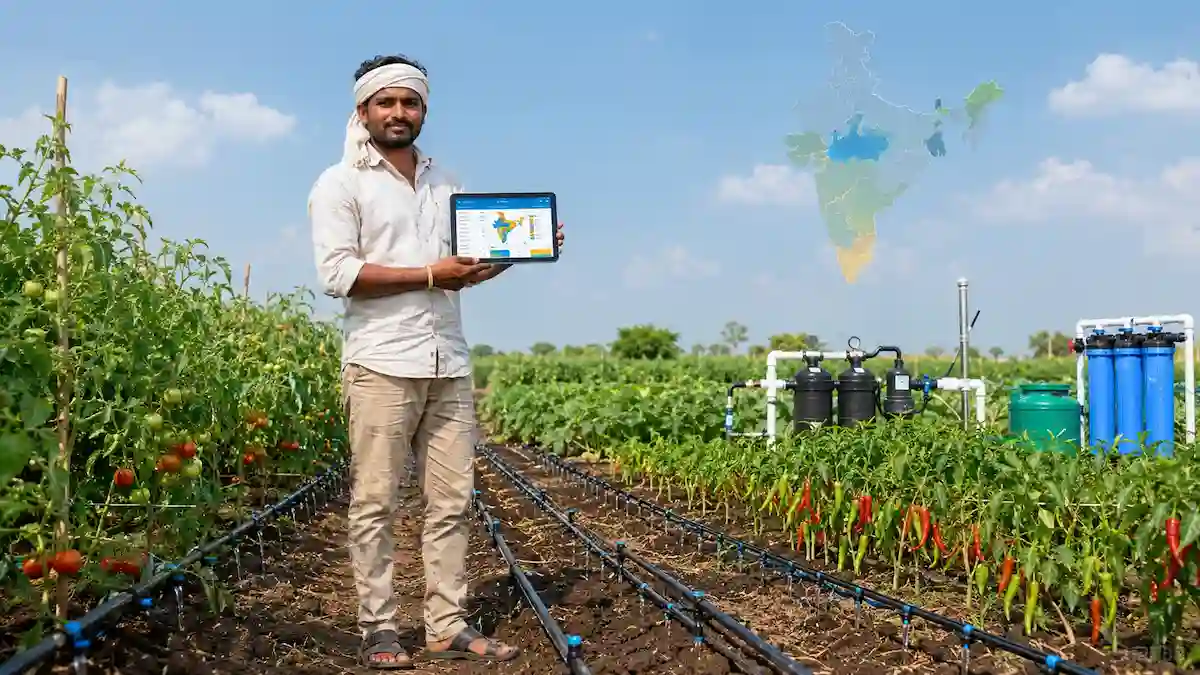

Diesel prices, electricity tariff hikes for agricultural pumps, and falling groundwater levels have pushed irrigation costs up in almost every farming belt over the last few years. Farmers who once flooded their fields without a second thought are now watching every rupee spent moving water from the source to the crop.
The drip irrigation subsidy under India’s PMKSY scheme covers a large part of that installation cost. The subsidy amount depends on your state, your farmer category, your social category, and the area you want to cover, so the drip irrigation subsidy calculator below gives you an exact figure rather than a rough state average. Think of it as a free PMKSY subsidy calculator built specifically for drip irrigation, not a generic government subsidy calculator.


This guide covers how the calculator works, state-wise subsidy percentage and cost norms, eligibility by farmer category, the document checklist, the DBT payment process, common rejection reasons, and what to do if your application gets stuck.
Drip irrigation subsidy is government financial assistance provided under PMKSY to reduce the installation cost of a drip irrigation system. The subsidy amount depends on the state, farmer category, approved project cost, and land area.
| Drip Irrigation Subsidy at a Glance | Details |
|---|---|
| Scheme | PMKSY, Per Drop More Crop (PDMC) component |
| Calculator | Free, instant, state-specific estimate |
| Subsidy | 47% to 65% of project cost, up to your state’s cap |
| Eligible farmers | Small, marginal, general, SC/ST, OBC, tenant, FPO |
| Apply | Online through the state portal, or offline at the department office |
Estimate your subsidy for installing a drip irrigation system under the Per Drop More Crop (PDMC) micro-irrigation scheme.
Scheme
Eligible Subsidy
Subsidy Percentage
Maximum Subsidy
Farmer Contribution
Central Govt. Share
State Govt. Share
Last Updated
Frequently Asked Questions
Per Drop More Crop (PDMC) is the central micro-irrigation scheme that funds drip and sprinkler irrigation systems to improve water-use efficiency.
The subsidy is calculated as a percentage of the standard per-acre installation cost notified by your state, multiplied by the area you enter, subject to a maximum cap.
The scheme itself is largely crop-neutral, but some states set higher priority or slightly different cost norms for horticulture and orchard crops.
Disclaimer: Figures shown are indicative estimates based on published scheme guidelines and may change without notice. Always verify current subsidy rates, caps, and eligibility with the concerned government department before making financial decisions.
What Is the Drip Irrigation Subsidy in India?
Drip irrigation subsidy is financial assistance from the central and state governments under PMKSY that covers a fixed percentage of a farmer’s drip irrigation installation cost. The subsidy percentage, cost norm, and maximum cap vary by state, farmer category, and approved project cost.
You pay an approved drip irrigation vendor for the full system, and a portion of that bill is reimbursed to your bank account after verification, or in some states adjusted directly against the vendor invoice, depending on the state’s disbursement process.
This is not a loan. There is no repayment and no interest. The only real cost to you is the farmer contribution share, plus any add-ons beyond the state’s standard cost norm, such as premium filtration or automation.
Why the Government Funds Drip Irrigation
Because drip irrigation saves water, governments spend less on expanding irrigation infrastructure. Funding drip systems for existing farmland is often cheaper than building new canals, check dams, or reservoirs to serve the same acreage under flood irrigation.
Groundwater tables are falling in most agricultural districts, and flood irrigation loses a large share of every litre pumped to evaporation and runoff. Drip systems apply water at the root zone, so the same borewell or canal supply stretches across more acres.
What You Get From Installing a Drip System
- Water savings: commonly 30 to 50 percent less water than flood irrigation for the same crop area
- Yield gains: steadier soil moisture reduces stress-related yield loss in fruit and vegetable crops
- Lower fertiliser loss: fertigation through the drip line places nutrients at the root, cutting runoff waste
- Lower electricity use: pumps run fewer hours since water is not spread over open channels
- Lower labour cost: no manual channel digging or flood supervision each cycle
How the Drip Irrigation Subsidy Calculator Works
The calculator above runs on four inputs and one formula. Here is what happens behind the result cards.

Inputs You Need to Enter
| Field | What It Means | Example |
|---|---|---|
| State | Sets your cost norm, subsidy rate, and cap | Maharashtra |
| Farmer Category | Small/marginal or general landholding | Small / Marginal |
| Social Category | General, OBC, or SC/ST | General |
| Crop | Vegetables, fruits/orchard, cotton, sugarcane, or other | Vegetables |
| Area (Acres) | Land you want under drip irrigation | 2.5 acres |
Your state selection matters more than any other field. Two farmers with identical landholding and crop, standing in different states, can see a subsidy gap of over 40,000 rupees on the same area.
The Subsidy Formula
- Step 1: Base project cost = Area (acres) x Standard cost per acre for your state
- Step 2: Raw subsidy = Base cost x Subsidy percentage for your category
- Step 3: Eligible subsidy = Raw subsidy, capped at your state’s maximum subsidy amount
- Step 4: Farmer contribution = Base cost minus eligible subsidy
- Step 5: Central and state share = Eligible subsidy split by your state’s funding ratio, commonly 60:40
Worked Example: Maharashtra, 2 Acres, Small Farmer
Maharashtra’s standard cost per acre is 51,165 rupees, with a 63 percent subsidy rate and a cap of 227,400 rupees.
| Item | Calculation | Amount (Rs.) |
|---|---|---|
| Base Cost | 2 acres x 51,165 | 1,02,330 |
| Eligible Subsidy | 1,02,330 x 63% | 64,468 |
| Farmer Contribution | 1,02,330 minus 64,468 | 37,862 |
| Central Share (60%) | 64,468 x 60% | 38,681 |
The remaining 40 percent, roughly 25,787 rupees, comes from the state government. Total assistance stays well under the cap here, so the farmer gets the full 63 percent.
Worked Example: What Happens When You Hit the Cap
Same state, but now 8 acres. Base cost jumps to 4,09,320 rupees, and 63 percent of that is 2,57,872 rupees.
That number crosses Maharashtra’s cap of 2,27,400 rupees, so the calculator stops there. Farmer contribution rises sharply to 1,81,920 rupees, since the subsidy no longer scales with area past the cap.
Beyond a certain acreage, adding more land under drip stops adding proportional subsidy. Use the calculator to estimate your subsidy before requesting a vendor quotation sized for your full holding.
Subsidy Per Hectare vs Per Acre
Most state notifications quote cost norms per hectare, but the calculator above works in acres since that is how most Indian farmers measure their land.
To convert, multiply your per-acre figures by 2.47 to get the per-hectare equivalent. In Maharashtra, the 51,165 rupee per-acre cost norm works out to roughly 1,26,378 rupees per hectare, before the subsidy percentage is applied.
PMKSY and the Per Drop More Crop Scheme
Pradhan Mantri Krishi Sinchayee Yojana was approved in 2015 with the goal of Har Khet Ko Pani, water for every field, and Per Drop More Crop, better yield per unit of water. Micro irrigation, meaning drip and sprinkler systems, is funded through the PDMC component of PMKSY, as confirmed on the official PMKSY micro irrigation portal.

Funding is shared between the central and state governments, commonly a 60:40 split in general states and a higher central share in hill and northeastern states. Your state’s Agriculture or Horticulture Department, sometimes referred to as the Department of Agriculture and Farmers Welfare, runs the actual application process even though part of the money originates centrally.
PMKSY also targets national goals beyond one farmer’s water bill: more area under micro irrigation nationwide, better water use efficiency in agriculture, and higher farmer income through improved yield per unit of water and fertiliser used.
PMKSY vs State-Specific Schemes
| Aspect | PMKSY (Central) | State Scheme (Top-Up) |
|---|---|---|
| Sets base rate | Yes, notifies broad cost norms | Adjusts final percentage and cap |
| Funds directly | 60% share in most states | 40% share, or more in some states |
| Application point | No separate central portal | State agriculture/horticulture portal |
A handful of states also run their own top-up schemes on top of the PMKSY base rate, usually for SC/ST farmers or for specific horticulture clusters. Check your state’s current circular before assuming the base PMKSY rate is your final number.
Separately, NABARD administers the Micro Irrigation Fund, a corpus states can borrow from at concessional interest to expand their own micro irrigation coverage faster than their annual budget alone would allow. This fund does not pay farmers directly, it backstops state governments so they can widen drip and sprinkler coverage without waiting for the next budget cycle.
Drip Irrigation Subsidy by Farmer Category
In most states, the notified subsidy percentage now applies as a single flat rate across small, marginal, and general farmers, rather than a tiered structure. What actually changes by category is processing priority and, in some states, a reserved share of the annual budget.
| Category | Subsidy Treatment | Practical Effect |
|---|---|---|
| Small / Marginal Farmer | Same state rate, priority processing | Faster verification in most districts |
| General Farmer | Same state rate | No processing priority |
| SC/ST Farmer | Same state rate, reserved budget share | Dedicated allocation reduces waitlist risk |
| Woman Farmer | Same state rate, some states add a top-up | Check your state circular for a women-specific incentive |
Because this varies by state and by year, always confirm your category’s current treatment with your district office rather than relying on a fixed national rule.
FPO and Group Application Eligibility
Farmer Producer Organisations, Self-Help Groups, and registered cooperatives can usually apply on behalf of member farmers, either as a bulk project covering multiple small holdings or as individual applications routed through the FPO for documentation support.
Group applications often move faster through verification, since one field visit can cover several adjoining plots at once. Talk to your FPO’s board or your Krishi Vigyan Kendra to check whether a group application is running in your area.
Tenant Farmer Eligibility by State
Tenant farmers and sharecroppers can generally apply if they hold a recognised lease agreement or a No Objection Certificate from the landowner, along with their own Aadhaar and bank documents. A handful of states still require the landowner to co-sign the application, so confirm the exact requirement at your district office before you start collecting paperwork.
Drip Irrigation Subsidy Eligibility: Who Can Apply?
- Any registered farmer with valid land ownership or recognised tenancy records
- Small and marginal farmers, who usually get priority processing rather than a higher percentage in states with a flat rate
- SC/ST and OBC farmers, who qualify under the same scheme, with some states reserving a fixed budget share for them
- The system must be installed by a company empanelled with your state’s micro irrigation authority
- A valid Aadhaar card and an active bank account linked for Direct Benefit Transfer
Aadhaar linkage matters because most states now disburse the subsidy only through Direct Benefit Transfer, straight into the applicant’s own account, not a joint or third-party account. A mismatch between your Aadhaar name and your bank account name is one of the more common, and easily avoidable, causes of payment delay.
Minimum and Maximum Area Eligible
Most states set a minimum area of around 0.1 to 0.5 acres, so the scheme stays workable for small plots. A maximum per farmer per year, often between 5 and 10 hectares, keeps the annual budget spread across more applicants.
There is usually no requirement to enrol your entire holding in one go. Farmers commonly apply for one field this year and another next season, once each round is verified and paid.
How the Subsidy Is Paid: DBT, Vendor Empanelment, and Inspection
Your subsidy payment depends on three steps: vendor empanelment, physical inspection, and Direct Benefit Transfer.
Vendor Empanelment
Only drip irrigation companies empanelled with your state’s micro irrigation authority can supply a subsidy-eligible system. Empanelled vendors are listed on the state portal, and their quotation format is pre-approved to match the state’s cost norm structure. A quotation from a non-empanelled company is one of the fastest ways to get an application rejected.
Physical Inspection
A field officer visits your plot to confirm the land, crop, and installed system match your application. Some states inspect before installation to approve the layout, others inspect after installation to confirm completed work, so ask your district office which sequence applies before you place an order.
Direct Benefit Transfer
Once inspection clears, the subsidy amount moves through Direct Benefit Transfer straight to your Aadhaar-linked bank account. A handful of states instead adjust the subsidy against the vendor’s invoice, so you pay only the farmer contribution share upfront. Check which model your state follows before you negotiate payment terms with your vendor.
Subsidy Release Timeline and How to Track Your Status
Approval typically takes 30 to 90 days, depending on how many applications your district is processing that quarter and how quickly your documents clear the first review.
Track your application through the same portal using your reference number. Most state portals show status stages such as submitted, under verification, inspection scheduled, approved, and payment released.
If there is no movement after 45 days, a written follow-up to the district agriculture officer, with your reference number attached, usually gets a faster response than a phone call alone.
Documents Required for Drip Irrigation Subsidy Application
| Document | Purpose |
|---|---|
| Aadhaar Card | Identity and DBT linkage |
| Land ownership or lease record | Confirms eligible land area |
| Bank passbook with IFSC | Subsidy disbursal account |
| Passport size photograph | Application form requirement |
| Quotation from empanelled vendor | Confirms project cost and system design |
Some states also ask for a soil or water test report, especially for larger orchard or sugarcane projects. A registered mobile number is required too, since most portals send the login OTP and later send verification appointment reminders by SMS.
How to Apply for Drip Irrigation Subsidy Online (Step-by-Step)
- Visit your state Agriculture or Horticulture Department portal, or the DBT Agriculture portal where applicable
- Register using your Aadhaar number and mobile number
- Select the micro irrigation or PDMC scheme and fill in land and crop details
- Upload the required documents in the specified format
- Get a quotation from a state-empanelled drip irrigation company and attach it
- Submit the application and note your reference number for tracking
- Wait for physical verification by the field officer before installation, in states that require pre-installation approval

Offline Application Through the Agriculture or Horticulture Department
Not every district has a smooth online portal experience. Visiting your local agriculture or horticulture office directly remains a valid, sometimes faster, route in many states.
Carry your documents in physical copies plus a photocopy set, ask for the micro irrigation or PDMC application form, and get a written acknowledgment with a reference number. This paper trail matters if your file needs to be tracked later.
Best Time to Apply for Drip Irrigation Subsidy
Timing your application matters as much as your paperwork, since most states run this scheme on an annual budget that does not roll over automatically.
- April to June: the strongest window, right after the new financial year’s budget opens and before demand picks up
- Before Kharif sowing: apply by May if you want the system installed ahead of the June-July sowing window
- Before Rabi sowing: apply by September if your crop cycle starts in October-November
- Avoid January to March: most state budgets are exhausted by this point, and new applications often roll into a waitlist for the next financial year
State Agriculture Department Portals
Readers searching for a specific state’s application page usually want the department name and portal, not just the subsidy rate. Portal URLs are occasionally restructured, so treat the list below as a starting point and confirm the live link through a quick search if it does not resolve.
| State | Department | Portal (verify before use) |
|---|---|---|
| Maharashtra | Dept. of Agriculture and Cooperation | krishi.maharashtra.gov.in |
| Telangana | Dept. of Agriculture and Cooperation | agri.telangana.gov.in |
| Andhra Pradesh | Dept. of Agriculture | agriculture.ap.gov.in |
| Karnataka | Dept. of Agriculture | raitamitra.karnataka.gov.in |
| Tamil Nadu | Dept. of Agriculture and Farmers Welfare | tnagrisnet.tn.gov.in |
| Gujarat | Dept. of Agriculture and Cooperation | agriculture.gujarat.gov.in |
| Rajasthan | Dept. of Agriculture and Cooperation | agriculture.rajasthan.gov.in |
| Madhya Pradesh | Dept. of Agriculture and Cooperation | agriculture.mp.gov.in |
If your state is not listed here, search “[your state] agriculture department PMKSY micro irrigation” to find the current portal, or start from the national PMKSY micro irrigation page, which links out to each state’s implementing department.
State-Wise Drip Irrigation Subsidy in India (Percentage, Cost Norm & Maximum Assistance)
Below is the current cost norm, subsidy percentage, and maximum assistance for major states. Figures are per acre and apply uniformly across farmer and social categories unless your state issues a specific top-up.
| State | Subsidy % | Cost/Acre (Rs.) | Max Subsidy (Rs.) |
|---|---|---|---|
| Odisha | 65% | 53,010 | 2,35,600 |
| Rajasthan | 64% | 52,560 | 2,33,600 |
| Madhya Pradesh | 64% | 52,290 | 2,32,400 |
| Maharashtra | 63% | 51,165 | 2,27,400 |
| Bihar | 63% | 51,570 | 2,29,200 |
| Tamil Nadu | 61% | 49,500 | 2,20,000 |
| Jharkhand | 60% | 49,455 | 2,19,800 |
| Gujarat | 57% | 46,665 | 2,07,400 |
| Karnataka | 57% | 46,800 | 2,08,000 |
| Telangana | 55% | 45,000 | 2,00,000 |
| Kerala | 55% | 45,090 | 2,00,400 |
| Chhattisgarh | 55% | 45,405 | 2,01,800 |
| Uttar Pradesh | 54% | 44,505 | 1,97,800 |
| Andhra Pradesh | 53% | 43,200 | 1,92,000 |
| Punjab | 53% | 43,155 | 1,91,800 |
| West Bengal | 51% | 41,805 | 1,85,800 |
| Haryana | 49% | 40,095 | 1,78,200 |
| Assam | 47% | 38,700 | 1,72,000 |

Odisha and Rajasthan currently offer the highest subsidy percentage, largely to push adoption in water-stressed and drought-prone belts. Assam sits at the lower end, reflecting its comparatively wetter agro-climate and lower reliance on micro irrigation so far.
Use the calculator above for your exact state, since it also applies your farmer and social category automatically. For a broader look at drip irrigation costs before subsidy, our drip irrigation cost per acre guide is a useful companion read.
Subsidy percentages and cost norms change as states issue new circulars. Treat the figures below as a current reference point, and confirm the latest notification with your district agriculture office before budgeting.
Maharashtra Drip Irrigation Subsidy
- Subsidy: 63% of project cost
- Cost norm: Rs. 51,165 per acre
- Maximum assistance: Rs. 2,27,400
- Department: Maharashtra Department of Agriculture and Cooperation
- Popular eligible crops: sugarcane, cotton, grapes, pomegranate, vegetables
Telangana Drip Irrigation Subsidy
- Subsidy: 55% of project cost
- Cost norm: Rs. 45,000 per acre
- Maximum assistance: Rs. 2,00,000
- Department: Telangana Department of Agriculture and Cooperation
- Popular eligible crops: cotton, chilli, turmeric, mango
Andhra Pradesh Drip Irrigation Subsidy
- Subsidy: 53% of project cost
- Cost norm: Rs. 43,200 per acre
- Maximum assistance: Rs. 1,92,000
- Department: Andhra Pradesh Department of Agriculture
- Popular eligible crops: mango, banana, chilli, groundnut
Karnataka Drip Irrigation Subsidy
- Subsidy: 57% of project cost
- Cost norm: Rs. 46,800 per acre
- Maximum assistance: Rs. 2,08,000
- Department: Karnataka Department of Agriculture
- Popular eligible crops: sugarcane, arecanut, vegetables, grapes
Tamil Nadu Drip Irrigation Subsidy
- Subsidy: 61% of project cost
- Cost norm: Rs. 49,500 per acre
- Maximum assistance: Rs. 2,20,000
- Department: Tamil Nadu Department of Agriculture and Farmers Welfare
- Popular eligible crops: sugarcane, banana, coconut, vegetables
Gujarat Drip Irrigation Subsidy
- Subsidy: 57% of project cost
- Cost norm: Rs. 46,665 per acre
- Maximum assistance: Rs. 2,07,400
- Department: Gujarat Department of Agriculture and Cooperation
- Popular eligible crops: cotton, groundnut, cumin, vegetables
Rajasthan Drip Irrigation Subsidy
- Subsidy: 64% of project cost
- Cost norm: Rs. 52,560 per acre
- Maximum assistance: Rs. 2,33,600
- Department: Rajasthan Department of Agriculture and Cooperation
- Popular eligible crops: cumin, citrus, vegetables, pomegranate
Madhya Pradesh Drip Irrigation Subsidy
- Subsidy: 64% of project cost
- Cost norm: Rs. 52,290 per acre
- Maximum assistance: Rs. 2,32,400
- Department: Madhya Pradesh Department of Agriculture and Cooperation
- Popular eligible crops: soybean, orange, vegetables, sugarcane
Punjab, Haryana, and Uttar Pradesh
These northern states show comparatively lower drip irrigation subsidy percentages, at 53, 49, and 54 percent respectively, since canal and tube well irrigation still dominates. Demand is rising among vegetable and horticulture growers looking to cut pumping costs.
Assam and the North Eastern States
Higher rainfall and smaller landholdings mean micro irrigation adoption has been slower here. Assam’s 47 percent rate is among the lowest nationally, though the central government funds a larger share of the subsidy in hill and northeastern states to encourage uptake.
Drip Irrigation Cost Before and After Subsidy, by Crop
Installation cost per acre shifts a little by crop, since spacing and dripper density change with plant type. Here is a rough picture using Maharashtra’s cost norm and 63 percent subsidy rate.
| Crop Type | Cost Before Subsidy | Cost After Subsidy |
|---|---|---|
| Vegetables (per acre) | Rs. 50,000 to 60,000 | Rs. 18,500 to 22,200 |
| Fruit Orchards (per acre) | Rs. 55,000 to 70,000 | Rs. 20,350 to 25,900 |
| Sugarcane (per acre) | Rs. 45,000 to 55,000 | Rs. 16,650 to 20,350 |
| Cotton (per acre) | Rs. 40,000 to 50,000 | Rs. 14,800 to 18,500 |

These are illustrative ranges. Your actual quotation depends on plot shape, distance to the water source, filtration needs, and vendor pricing, so confirm the exact figure with an empanelled installer before you finalise your budget.
Drip vs Sprinkler Irrigation Subsidy
| Factor | Drip Irrigation | Sprinkler Irrigation |
|---|---|---|
| Best suited for | Row crops, orchards, wide spacing | Close-spaced field crops, cereals |
| Subsidy scheme | PMKSY, PDMC component | PMKSY, PDMC component |
| Cost norm | Usually higher per acre | Usually lower per acre |
Both systems draw funding from the same PDMC component, but each has its own separate cost norm and cap. Check your state’s sprinkler-specific rate through sprinkler irrigation design and cost guide rather than assuming your drip figure carries over.
Crops Eligible for Drip Irrigation Subsidy
- Fruits and orchards: mango, banana, grapes, pomegranate, citrus, guava
- Vegetables: tomato, chilli, brinjal, okra, and most row crops
- Field crops: cotton, sugarcane, groundnut
- Spices and plantation crops: turmeric, coconut, arecanut
- Flowers: marigold, rose, and other commercial floriculture
Plantation crops like coconut and arecanut, along with medicinal and aromatic plants in a few states, are also covered under most state PDMC lists. If your crop is not shown in the calculator’s dropdown, select the closest match or Other, since the subsidy percentage itself does not usually change by crop within a state.
How Vendors Prepare Your Estimate
An empanelled vendor’s quotation is built around your plot’s layout, not just its total area. Expect line items for the main line, lateral pipe, emitters or drippers, control valves, a filtration unit sized to your water source, a pressure regulator, and a fertigation unit if you want in-line nutrient delivery.

Pump capacity and crop spacing both affect the final design. Wider crop spacing, such as in mango or pomegranate orchards, needs fewer emitters per acre than tightly spaced vegetable beds, which changes the per-acre cost even within the same state.
Hidden Costs Vendors Sometimes Leave Out
- Site levelling or minor grading before pipe-laying
- An additional filtration stage for borewell water with high silt or iron content
- Extra couplers and connectors for irregular plot shapes
- Annual Maintenance Contract charges after the free warranty period ends
Ask for an itemised quotation rather than a single lump sum, so you can compare what is and is not covered by the subsidy-eligible cost norm.
Maintenance, Warranty, and Filter Replacement
Most empanelled vendors offer a one to three year warranty on components, though this varies by company and state guideline. Filters need periodic cleaning or replacement, since clogged filters are the single most common cause of reduced water output over a season.
Budget for annual maintenance separately from the subsidy, since AMC and filter replacement costs are not covered under PDMC and fall entirely on the farmer after installation.
Common Reasons Your Drip Irrigation Subsidy Application Gets Rejected
- Mismatched land records: the name on the application does not match revenue records
- Unapproved vendor: quotation from a company not empanelled with the state
- Duplicate claims: applying under two schemes for the same plot in the same year
- Budget exhaustion: applying late in the financial year after the annual allocation runs out
- Ineligible land use change: claiming subsidy for land converted to non-agricultural use since the last revenue survey
- Missing physical verification: installing the system before the field officer’s visit, leaving no baseline to verify against

A rejected application is usually not final. Most states allow you to correct the flagged issue and resubmit within the same financial year, provided the budget window is still open.
Appeal Process After Rejection
If your application is rejected, request the rejection reason in writing from the district agriculture office. Most states allow a written appeal within 15 to 30 days, attached with the corrected document or clarification. Escalate to the Joint Director of Agriculture at the district level if the appeal sees no response within a reasonable window.
Troubleshooting Common Problems
| Problem | Likely Cause | What to Do |
|---|---|---|
| Portal not accepting login | Server load or expired session | Retry during off-peak hours, clear browser cache |
| Aadhaar mismatch error | Name or DOB differs from Aadhaar database | Update details via UIDAI before resubmitting |
| Bank account mismatch | Account name differs from Aadhaar name | Use a bank account matching your Aadhaar exactly |
| Verification delayed | High application volume in your block | Follow up in writing with your reference number |
Vendor delays are also common during peak sowing season, when empanelled companies are booked out for weeks. Confirm your vendor’s installation slot in writing before your verification window closes, so a scheduling gap on their end does not cost you your subsidy approval.
How to Increase Your Chances of Getting Drip Irrigation Subsidy Approved
- Apply early in the financial year: most state budgets exhaust well before March, so April to June applications clear faster
- Keep land records current: mutation entries and revenue records should match your Aadhaar name exactly
- Use only empanelled vendors: a quotation from a non-listed company is one of the fastest ways to get rejected
- Respond quickly to verification calls: field officers usually give a short window to schedule the site visit
None of these guarantee approval, since final sanction still depends on your state’s remaining annual allocation, but together they remove the delays that are within your control.
Frequently Asked Questions
What is the maximum drip irrigation subsidy available in India?
It depends on your state. Current caps range from around 1.72 lakh rupees in Assam to 2.35 lakh rupees in Odisha, based on each state’s notified per-acre cost norm and subsidy percentage.
How much subsidy is available per acre?
Subsidy per acre equals your state’s standard cost per acre multiplied by the subsidy percentage. In Maharashtra, for example, that works out to about 32,234 rupees per acre before the overall cap applies.
Can tenant farmers apply for drip irrigation subsidy?
Yes, in most states, provided you hold a valid lease agreement or a No Objection Certificate from the landowner along with your own identity and bank documents.
Is PMKSY available in every state?
Yes, PMKSY’s Per Drop More Crop component runs in every state and union territory, though the subsidy percentage, cost norm, and cap are set individually by each state government.
How long does subsidy approval take?
Approval generally takes 30 to 90 days from submission, depending on document completeness and the volume of applications your district is processing that quarter. Some states also require a pre-installation site verification, which can add a few weeks before you get clearance to start work.
If you want to check which other schemes your farmer category qualifies for, the Subsidy Eligibility Checker covers PMKSY alongside solar irrigation, livestock, and other central schemes. If you are also considering a groundwater source, the borewell subsidy calculator covers that companion scheme. Official cost norms and funding patterns are documented on the Department of Agriculture and Farmers Welfare website.
Which state gives the highest drip irrigation subsidy?
Odisha and Rajasthan currently notify the highest rates, at 65 and 64 percent of project cost respectively, though the actual rupee amount you receive still depends on your area and your state’s maximum cap.
Is GST included in the subsidy calculation?
Treatment varies by state. Some notify the cost norm inclusive of GST, others calculate the subsidy on the base cost and treat GST as part of the farmer’s contribution. Confirm this with your vendor’s quotation format before you sign.
Can I buy the drip irrigation system from any company?
No. The subsidy is only valid for systems supplied and installed by a vendor empanelled with your state’s micro irrigation authority. A quotation from a non-empanelled company will not be accepted for subsidy processing.
Can I apply for drip irrigation subsidy twice?
Yes, for different fields or in different years, as long as you stay within your state’s maximum area limit per farmer per year and each application is for a genuinely separate installation.
Is subsidy available for replacing an old drip system?
Most states fund new installations rather than straightforward replacement of an old system on the same area, though a few allow re-application after a minimum gap of several years. Check your state’s specific replacement policy before assuming you qualify.
Conclusion
Subsidy percentage, cost norm, and caps all shift by state, but the underlying formula stays the same everywhere: area multiplied by cost per acre, then a percentage applied, then capped at your state’s maximum.
PMKSY’s Per Drop More Crop component remains the backbone of this support across the country, and small and marginal farmers continue to get priority processing in most states even where the percentage itself is now flat across categories.
Use the drip irrigation subsidy calculator above to estimate your subsidy, farmer contribution, and expected government assistance before you approach any vendor. That single step saves most farmers from budgeting around the wrong number.
Disclaimer: Information on this site is for educational purposes only. Subsidy percentages, cost norms, eligibility, and application procedures may change. Always verify the latest guidelines with your State Department of Agriculture, Horticulture Department, or the official PMKSY portal before applying.

