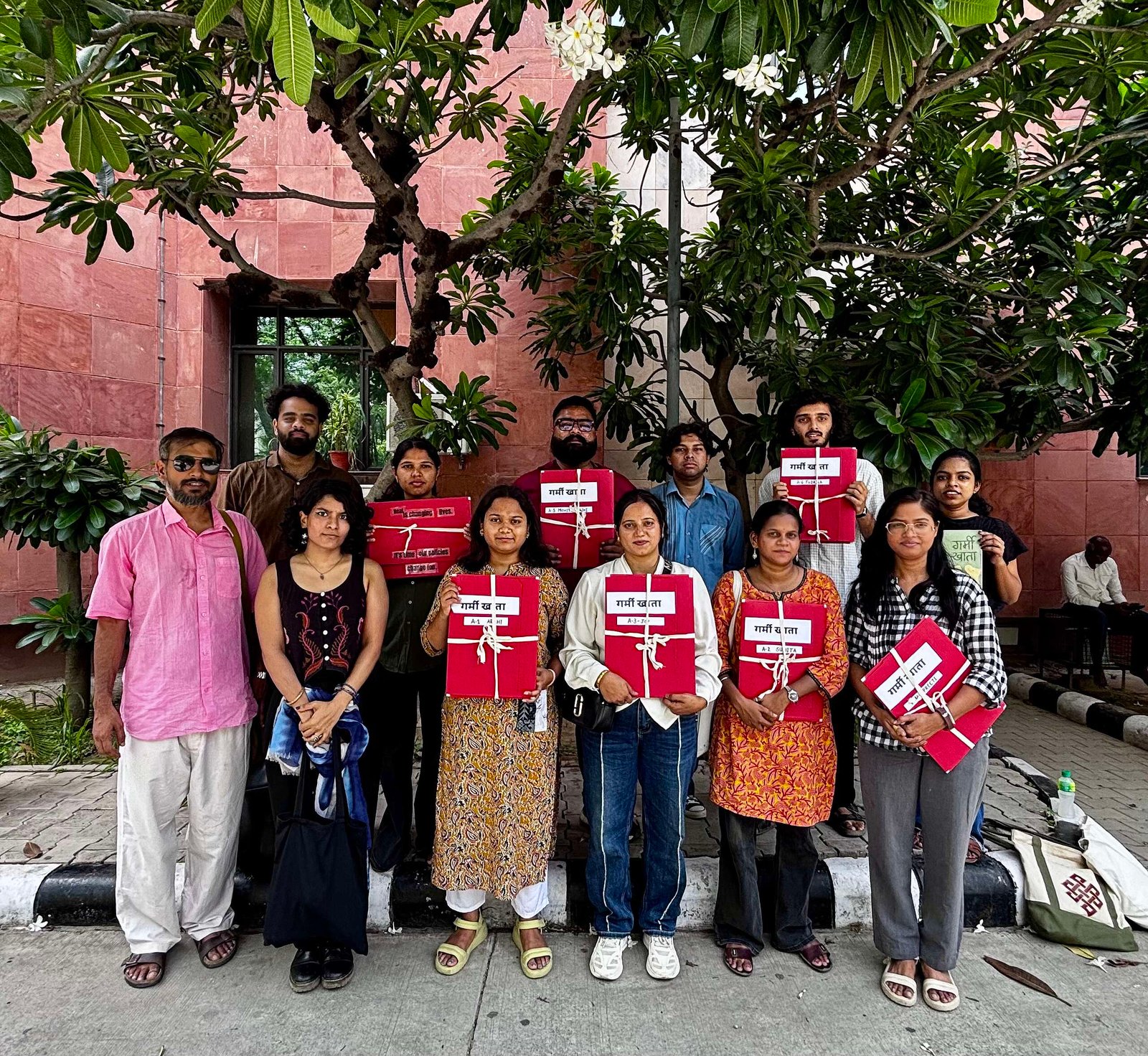

Submission includes first-hand testimonies from some of Delhi’s most heat affected communities, backed by documentary evidence including medical, utility and financial records, as citizens calls for adequate funding of Heat Action Plans
NEW DELHI, July 14, 2026 — A group of Delhi residents today submitted a formal letter to the National Human Rights Commission, along with citizen-documented “Heat Registries,” placing before the Commission first-hand evidence and testimonies of how extreme heat impacts the health, income, livelihoods and dignity of Delhi’s residents.

As part of Delhi Rising campaign, since May 2026, street vendors, gig workers, residents of low-income and middle-income neighbourhoods, the elderly, children, women and students across Delhi have maintained weekly Heat Registries, observing and writing how extreme heat affects their daily lives, supported by documentary evidence like medical bills, utility bills, loss in income.
The submission asks the Commission to take the Heat Registries on record as evidence of human rights harm; formally recognise extreme heat as a human rights concern that the State is obligated to address; and recommend that the Government of National Capital Territory of Delhi, heat vulnerable states [Andhra Pradesh, Assam, Bihar, Chhattisgarh, Gujarat, Haryana, Himachal Pradesh, Jharkhand, Karnataka, Kerala, Madhya Pradesh, Maharashtra, Odisha, Punjab, Rajasthan, Sikkim, Tamil Nadu, Telangana, Tripura, Uttar Pradesh and West Bengal] and the Union of India ensure dedicated, adequate funding for Heat Action Plans — including implementing the Sixteenth Finance Commission’s recommendation to notify heatwaves as a nationally recognised disaster.
“Extreme heat doesn’t only affect the health of informal workers. For street vendors, the most significant loss is their work itself: there is less footfall during extreme-heat days, which leads to a loss of income and livelihood. And there are no social security schemes that can compensate informal workers like street vendors for those losses or protect their livelihood. Extreme heat is taking away both their earnings and their dignity, and there is no system to protect them,” said Mohit Valecha, National Coordinator of the Indian Hawkers Alliance and also maintaining the Heat Registry.
“These testimonies and the evidence submitted alongside the letter show that extreme heat is not just an environmental issue, it is a human rights issue. Through these Heat Registries, citizens are documenting their lived experiences of how extreme heat impacts their health, livelihoods, income, well being, mobility and dignity often with no meaningful protection. We urge the Commission to recognise extreme heat as a human rights issue and ensure that governments adequately fund and implement measures that protect those most at risk,” said Aakiz Farooq, Senior Climate and Energy Campaigner at Greenpeace India.
The submission draws on India’s constitutional protections under Article 21, as affirmed in M.C. Mehta v. Union of India (2000) and M.K. Ranjitsinh v. Union of India (2024), as well as the 2025 advisory opinions of the International Court of Justice and the Inter-American Court of Human Rights, both of which affirmed that protecting people from climate change impacts is a binding human rights obligation.
“Legal systems and jurisprudence are playing catch up when it comes to heatwaves and associated impacts experienced by vulnerable communities. As I research legal responses to heatwaves globally, what stands out is the importance for human rights as a way to understand and frame these adverse climate impacts. There is a need to use the human rights framework as a way to remedy these impacts ranging from the recognition of the right to access cooling, shelter, livelihood and water both before, during and after a heatwave. Globally climate jurisprudence grounded in human rights is paving the way for effective legal action on heat waves as seen in Spain and France on workers rights protective laws. There is a gap to be filled in India’s legal landscape in terms of understanding heat waves through a rights-based lens as well as declaring heatwaves as a national disaster which this letter seeks to bring to light,” said Arpitha Kodiveri, Assistant Professor of Political Science at Vassar College and Climate Law Researcher.
The Heat Registry is part of Greenpeace India’s Delhi Rising campaign to address the gap between official heat data measures and what is lived reality of people. The hand-written diary aims to capture the compounding toll of extreme heat on everyday life–the sleepless nights; the meals skipped because cooking feels unbearable; the day’s wages lost when work simply cannot continue in the sun; children missing school and focus in studies; and the fatigue and illness that never make it into a hospital record. By turning residents into documenters rather than survey subjects, the Heat Registry fills this gap with first-hand, sustained testimony, building an evidence base that reflects the lived, cumulative reality of heat stress in a city where the human cost has so far gone largely unmeasured.
Greenpeace India is demands the government to back Heat Action Plans with adequate funding for adaptation, including linking IMD heatwave warnings to mandatory wage-loss compensation for outdoor and gig workers, converting public parks into heat-resilient community spaces with shade and water access, and scaling up hydration and health interventions in the city’s most heat-vulnerable neighbourhoods.
Please find the full copy of the letter :
Media Contact: Nibedita Saha | [email protected]
Aakiz Farooq | [email protected]

