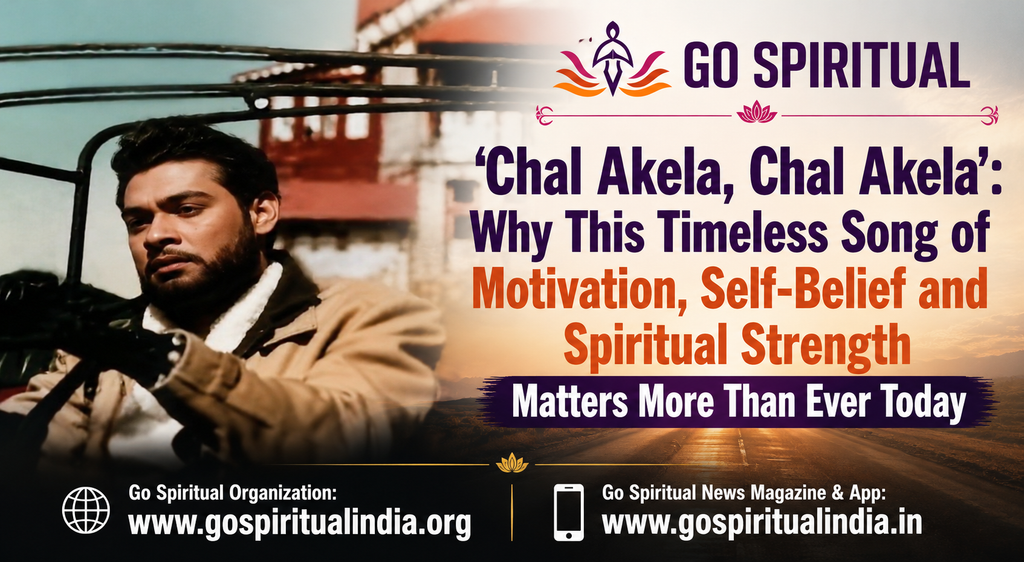

Mukesh, Kavi Pradeep and O.P. Nayyar’s unforgettable song from the 1969 film Sambandh carries a powerful message for everyone in today’s world: when people leave, circumstances change and the crowd disappears, find strength within yourself and keep walking
By Sonu Tyagi
Founder, Go Spiritual & Approach Entertainment
There are songs we listen to for entertainment, songs we remember for their melody, and then there are a few songs that become companions for life. “Chal Akela, Chal Akela” belongs to that rare category. More than five decades after its release, this unforgettable song from the 1969 Hindi film Sambandh remains remarkably relevant. Sung with extraordinary emotional depth by Mukesh, written by legendary poet and lyricist Kavi Pradeep, and composed by O.P. Nayyar, the song is much more than a beautiful creation of Hindi cinema. For me, it is one of our greatest songs of motivation, self-belief, resilience and spiritual strength.

Sambandh, released in 1969, was directed by Ajoy Biswas and featured Deb Mukherjee, Anjana Mumtaz and Pradeep Kumar in prominent roles, along with actors including Sulochana Latkar, Achala Sachdev, Abhi Bhattacharya, Nana Palsikar, Leela Mishra and Jankidas. The film explored relationships, family, separation, identity and emotional struggle. Against this backdrop, Chal Akela acquires a meaning much larger than its cinematic situation. The protagonist’s journey becomes symbolic of the journey each one of us undertakes in life, where circumstances change unexpectedly and people who once walked beside us may not always remain with us.
The central philosophy of the song is simple but profound. Life does not guarantee permanent companionship. Friends may leave, relationships may break, businesses may fail, jobs may disappear and people who once supported us may suddenly become distant. We may lose somebody we love or find ourselves alone while facing a difficult decision. Yet the disappearance of the crowd does not mean that the journey is over. The road remains, and so does our responsibility to continue walking. That is why Chal Akela is not, in my understanding, a song about loneliness. It is a song about finding courage when companionship disappears.
This message has become even more important in today’s highly connected world. We have social-media followers, WhatsApp groups, professional networks, likes, comments, shares and endless opportunities for communication. Yet we are increasingly dependent on external validation. We want approval for our appearance, relationships, careers, achievements and even our happiness. The philosophy of Chal Akela challenges this dependence. When nobody accompanies you, the song asks you to discover a relationship with yourself. Before expecting the world to believe in you, learn to believe in yourself. Before depending entirely upon others for happiness, discover the strength that already exists within you.
Kavi Pradeep’s writing makes the song particularly powerful because it does not pretend that life will always be easy. It acknowledges suffering as a universal human experience. Whether someone is rich or poor, famous or unknown, young or old, everyone experiences pain. Someone loses love, someone loses money, someone loses a career, someone loses a dream, and sometimes a person loses faith in himself. The question is not whether suffering will ever come. The real question is what we do when it comes. The answer of Chal Akela is to keep moving.
Mukesh makes this philosophy deeply human. There is sadness and vulnerability in his voice, but there is no surrender. He does not sing like someone delivering a motivational lecture. He sounds like a fellow traveller who understands pain and still asks us to continue. That is what makes the motivation believable. O.P. Nayyar’s composition beautifully supports this emotion without overwhelming Kavi Pradeep’s words. The music allows the philosophy to breathe, giving the song a reflective quality that has helped it remain timeless.
The song also carries an important lesson for entrepreneurs, professionals, artists, filmmakers, writers and anyone trying to create something meaningful. When you begin something new, everybody may not understand your vision. When you fail, some people may disappear. When you succeed, many may return. I have always believed that the crowd can encourage us, but the crowd cannot become the source of our conviction. That conviction must come from within. One failure is not our complete story, one broken relationship is not the end of love, one rejected idea is not the end of creativity, and one difficult chapter cannot define an entire life.
For me, the deepest meaning of Chal Akela is spiritual. Walking alone does not necessarily mean being lonely. Solitude can become an opportunity to understand ourselves. Spirituality teaches us to look within rather than constantly searching outside. Someone can teach us meditation, but we must meditate. Someone can explain compassion, but we must practise it. A Guru can show us a spiritual path, but ultimately we must walk that path ourselves. Our families, friends and teachers can support us, but nobody else can complete our inner journey on our behalf.
That is why Chal Akela does not belong to any particular generation or age group. It belongs to everyone. The world of 1969 and the world of today may be dramatically different, but human emotions remain similar. We still experience love and loss, companionship and loneliness, success and failure, hope and disappointment. More than half a century later, this masterpiece by Mukesh, Kavi Pradeep and O.P. Nayyar continues to remind us that however difficult the road may become, there is still much of life left to experience. “Chal Akela, Chal Akela” is motivation set to music, spirituality expressed through cinema and a timeless lesson in resilience: when the crowd disappears, do not stop—keep walking.

Sonu Tyagi is an award-winning writer, director and producer and the Founder of Go Spiritual and Approach Entertainment Group, with more than two decades of experience in media, entertainment, films and communications. Approach Entertainment works across Celebrity & Talent Management, Film Productions, Advertising & Corporate Film Productions, Film Marketing, Events and Entertainment Marketing, while Approach Communications is an award-winning PR, Digital and Integrated Communications agency. Approach Bollywood operates as a Bollywood & Entertainment Newswire, Portal & App. Through Go Spiritual, Tyagi works to promote spirituality, spiritual awareness, philanthropy and social causes, mental health and wellness, Ayurveda and holistic living, spiritual tourism, media and events. Go Spiritual also advocates humanity, compassion, non-violence, vegetarianism, animal kindness and a more spiritually conscious approach to modern life.
The post ‘Chal Akela, Chal Akela’: Why This Timeless Song of Motivation, Self-Belief and Spiritual Strength Matters More Than Ever Today first appeared on Go Spiritual News Magazine & App .
Spiritual, spiritual, spiritual magazines, spiritual news Go Spiritual News Magazine & App

