
Preparing for the Assistant Prosecution Officer (APO) Examination requires much more than memorising legal provisions or reading coaching notes. Whether you are appearing for the UP APO, Bihar APO, or any other State APO examination, one resource remains indispensable: the Bare Act.
Every year, a significant number of questions in both the Preliminary and Mains examinations are framed directly from statutory provisions. Examiners expect candidates to possess not only conceptual understanding but also familiarity with the exact language of the law. Therefore, mastering the Bare Acts should be the cornerstone of your preparation.

The challenge, however, is that many aspirants either read Bare Acts casually or rely heavily on guidebooks and commentaries. This often leads to confusion and inaccurate answers. A structured approach to reading Bare Acts can help you improve statutory interpretation, solve objective questions accurately, and write better analytical answers in the Mains examination.
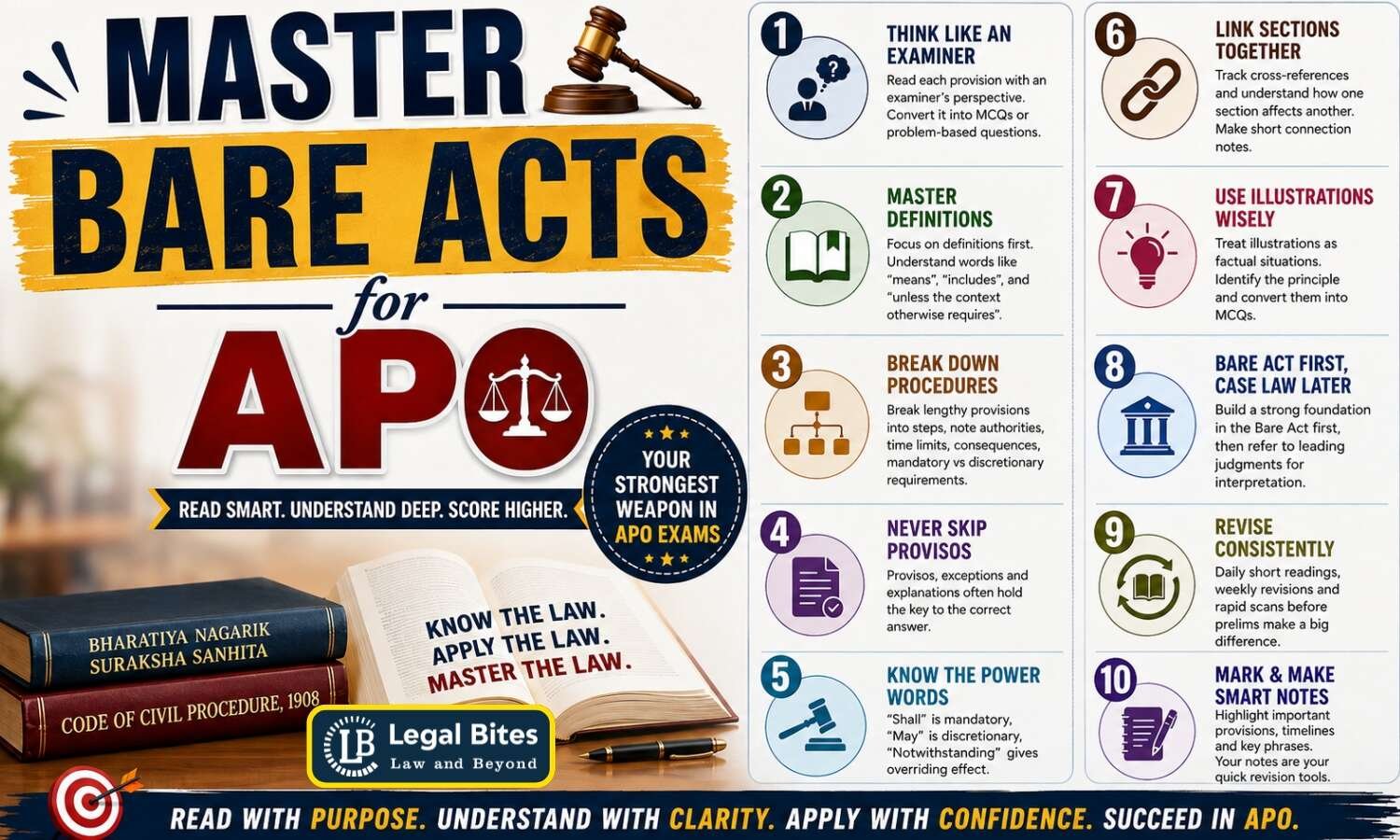
Here are ten practical strategies that can transform the way you study Bare Acts for the APO Examination.
1. Read Every Provision with an Examiner’s Perspective
Instead of reading the Bare Act merely to complete the syllabus, read every section with the mindset of an examiner. Ask yourself how a particular provision can be tested in the examination.
While studying each section, consider the following questions:
- Can this provision be converted into an MCQ?
- Can a factual problem be framed using this section?
- Which words or phrases are most likely to confuse candidates?
This habit helps you identify important statutory language and prepares you for both objective and descriptive questions. Thinking like an examiner also improves your ability to spot commonly tested areas.
2. Begin with the Definition
Definition sections are among the highest-scoring portions of any statute. Many questions in APO examinations directly test statutory definitions or require their application.
Before moving to the substantive provisions:
- Read every definition carefully.
- Understand the significance of words like “means,” “includes,” and “unless the context otherwise requires.”
- Revisit the definitions whenever those terms appear later in the Act.
A clear understanding of defined terms prevents misinterpretation and strengthens your overall understanding of the legislation.
3. Break Down Procedural Provisions into Simple Steps
Procedural laws such as the Bharatiya Nagarik Suraksha Sanhita (BNSS), the Civil Procedure Code (CPC), often contain lengthy provisions.
Instead of memorising them word for word, simplify them by identifying:
- The authority empowered to act.
- The sequence of procedural steps.
- Statutory time limits.
- Conditions that must be fulfilled.
- Legal consequences of non-compliance.
Preparing flowcharts or stepwise notes makes these provisions easier to revise and recall during the examination.
4. Never Ignore Provisos, Exceptions, and Explanations
Many aspirants focus only on the principal provision and skip the qualifying clauses attached to it. This is a common mistake.
Always pay equal attention to:
- Provisos
- Exceptions
- Explanations
- Illustrations (where provided)
These qualifying provisions often modify or restrict the operation of the main section. In many objective questions, the correct answer depends entirely upon an exception or proviso rather than the principal rule.
5. Understand the Legal Significance of Key Legislative Words
Certain expressions used in statutes carry specific legal implications. APO examinations frequently test the effect of these words.
Some important expressions include:
- Shall – generally denotes a mandatory obligation.
- May – generally confers discretionary power.
- Notwithstanding – gives overriding effect over conflicting provisions.
- Subject to – indicates that one provision operates under another.
- Provided that – introduces an exception or qualification.
Recognising the legislative intent behind these expressions enables you to interpret provisions accurately and answer conceptual questions with confidence.
6. Study Related Sections Together
A statute is designed as an integrated legal framework. Individual provisions rarely operate independently.
While reading the Bare Act:
- Follow statutory cross-references.
- Understand how one section supplements another.
- Make short notes such as “Read Section X with Section Y.”
- Observe the logical sequence in which provisions operate.
This integrated approach improves analytical thinking and helps solve application-based questions more effectively.
7. Treat Illustrations as Ready-Made Problem Questions
Some statutes contain illustrations that explain how the law applies to practical situations.
Do not skip them.
Instead:
- Identify the legal issue involved.
- Determine the relevant statutory provision.
- Predict the legal outcome before reading the explanation.
- Convert the illustration into a multiple-choice or descriptive question.
This exercise develops legal reasoning, an essential skill for both the Preliminary and Mains examinations.
8. Study the Bare Act Before Referring to Case Law
Judicial decisions explain the law, but the Bare Act remains the primary source.
Your study sequence should be:
- Read the statutory provision.
- Understand its plain language.
- Memorise important requirements.
- Refer to leading judgments only to understand judicial interpretation.
Candidates who begin directly with case law often struggle because they lack a strong statutory foundation.
9. Revise Bare Acts Regularly
Bare Act reading is not a one-time activity. Repeated revision is essential for developing speed and accuracy.
A practical revision plan may include:
- Daily revision of a few sections.
- Weekly revision of completed chapters.
- Monthly consolidation of important provisions.
- Rapid revision before the Preliminary examination.
Consistent revision familiarises you with statutory language and significantly improves recall during the examination.
10. Highlight Important Provisions and Make Smart Notes
Passive reading rarely produces lasting results. Active reading, on the other hand, improves retention and revision.
Develop the habit of:
- Highlighting important legal terms.
- Underlining limitation periods and procedural timelines.
- Marking frequently tested sections.
- Writing short keywords or memory aids in the margins.
- Maintaining a separate notebook containing important sections from every major statute.
These annotations make your Bare Act a personalised revision resource and help you revise large statutes quickly before the examination.
Common Mistakes to Avoid While Reading Bare Acts
Many aspirants lose marks because of avoidable mistakes. Stay away from the following:
- Reading guidebooks before reading the Bare Act.
- Ignoring definitions and interpretation clauses.
- Skipping provisos and explanations.
- Memorising sections without understanding their purpose.
- Studying provisions in isolation.
- Depending entirely on coaching notes.
- Neglecting regular revision.
Avoiding these mistakes can considerably improve your preparation.
Conclusion
The Bare Act is the most authentic and reliable source of law for every APO aspirant. A disciplined approach to reading statutory provisions not only improves performance in objective examinations but also strengthens legal reasoning, answer writing, and courtroom-oriented thinking.
Read each provision carefully, understand its language, connect related sections, revise consistently, and develop the habit of applying the law to practical situations. Once you master the Bare Acts, commentaries and judicial decisions become much easier to understand.
Remember, successful APO candidates are not those who read the maximum number of books; they are those who understand the Bare Acts thoroughly and can apply them with confidence.

