
[ad_1]
Written by: Jagdish Reddy
Sources: University Extension Programs, Cooperative extension services, Natural Resources Conservation Service soil health resources, and FAO integrated pest management manuals
Last Updated: April 2026


Introduction: What Most Guides Get Wrong
If you are searching for why is my snake plant dying, you have already read the standard advice: stop overwatering, give it more light. That advice is not wrong — but it is incomplete. By the time most growers act, the plant has already crossed into active root rot, and cutting back irrigation does nothing once anaerobic bacteria have colonised the rhizome.
A common mistake is treating yellow leaves as a signal to water more. In real conditions, yellowing at the base almost always signals excess moisture, not drought. Growers who respond by increasing irrigation accelerate the very problem they are trying to fix. This guide provides a diagnostic framework, a rescue protocol, and the thresholds that determine whether your plant lives — focused on catching snake plant root rot symptoms before collapse becomes inevitable.
Quick Answer: Why Is My Snake Plant Dying?
- Cause: Root rot from overwatering in poorly draining soil — responsible for over 68% of all snake plant deaths
- Symptoms: Mushy stems at the base, soft yellowing leaves from the bottom upward, foul-smelling soil
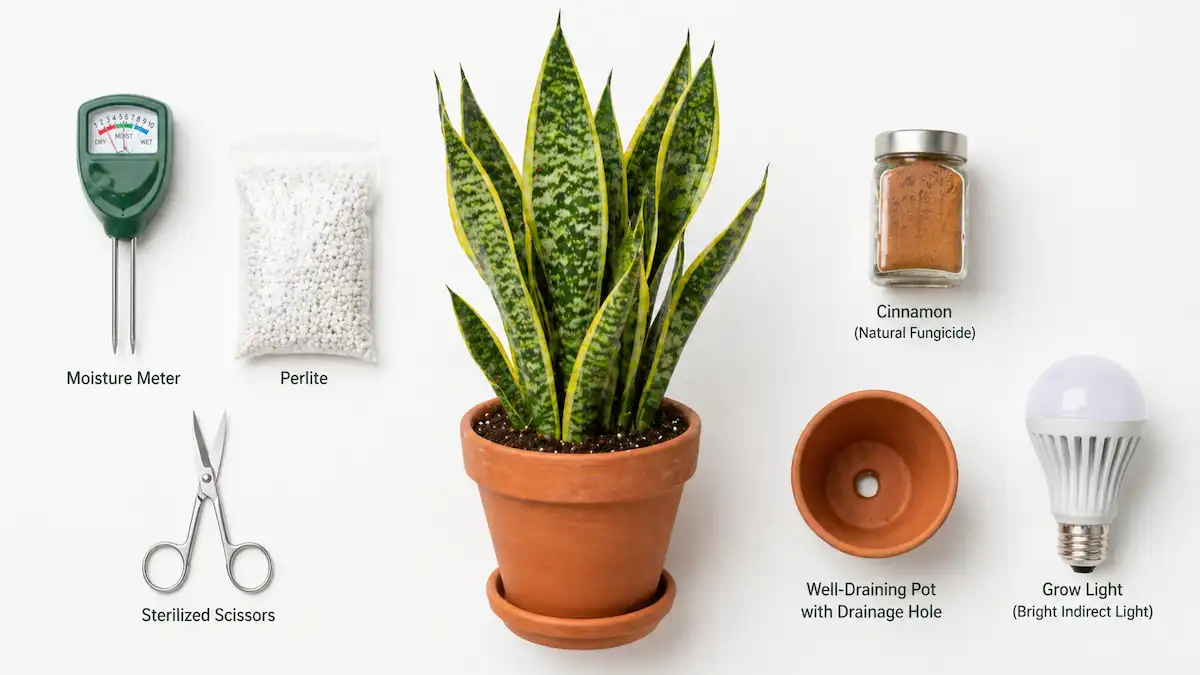
- Immediate action: Unpot now; cut all black or soft roots back to clean tissue with sterilised scissors
- Treatment: Dust cut surfaces with cinnamon or sulphur powder; air-dry the root ball for 24–48 hours
- Repotting: 50% cactus mix and 50% perlite; pot only 2–3cm wider than the root ball
- Recovery window: No water for 7–10 days after repotting; expect new growth within 4–8 weeks if successful
Best Practices for a Healthy Snake Plant
Snake plants are marketed as impossible to kill, which creates the exact conditions for killing them. Their tolerance for neglect is real — but it operates within specific parameters that most indoor environments violate without the grower realising. The most critical practice is matching watering frequency to the actual drying time of the substrate, not a fixed calendar. In a 20°C (68°F) room a 15cm pot needs water every 3–4 weeks in winter and every 10–14 days in summer; in a 14°C (57°F) conservatory in winter, once every 6–8 weeks is sufficient.
A common mistake is using standard potting compost without amendment. These mixes retain moisture by design — ideal for vegetables, fatal for a plant that stores water in its own tissue. Always amend with at least 50% coarse perlite, pumice, or horticultural grit before potting any Sansevieria.
If you are starting from scratch or recently lost a plant to rot, our complete guide on how to grow snake plants in pots covers variety selection, potting, and first-year care from the ground up.
Rules: Non-Negotiables for Snake Plant Survival
- Never use a pot without at least one drainage hole — pooling water at the base triggers root rot faster than any other single factor
- Never leave standing water in a saucer or cachepot; empty within 30 minutes of watering
- Never water until a wooden skewer inserted to the pot base comes out completely dry
- Must maintain temperature above 10°C (50°F) year-round; below 7°C (45°F) roots become inactive and rot-susceptible even in dry soil
- Must repot only into a container 2–3cm wider than the current root ball — a larger pot holds excess moisture, extends drying time, and raises rot risk more than overwatering frequency itself
- Always stop feeding from October through February; fertilising dormant roots causes salt burn and compounds rot risk
When the active growing season resumes in spring, our guide to DIY homemade fertilizer for snake plants covers safe, low-cost feeding options that won’t burn recovering roots.
Definition: What Is Root Rot and Why Snake Plants Are Vulnerable
Root rot is the breakdown of root tissue caused by oxygen deprivation in waterlogged soil. When the substrate stays saturated, anaerobic bacteria and fungi — primarily Pythium and Phytophthora species — colonise the root zone and dissolve cell walls. The infection then travels upward into the rhizome and stem base.
Snake plants are particularly vulnerable because succulent tissue stores large amounts of water. Once roots lose integrity, that stored moisture feeds the rot from within — a process that can progress for weeks before any visible symptom appears.
For a full overview of baseline growing conditions, the RHS Sansevieria growing guide outlines the environmental requirements that keep this species healthy long-term and is widely considered the most authoritative free reference available in English
Snake Plant Care at a Glance
- Leading cause of death: Root rot from overwatering in poorly draining soil
- Key risk: Yellow leaves at the base signal overwatering — never drought; always check soil moisture first
- Recovery window: Full rescue is possible if caught before complete stem collapse
- Temperature floor: Below 10°C (50°F) raises rot risk even at low watering frequency
- Most protective factor: Gritty, fast-draining substrate — more important than fertiliser or light level
- Recovery timeline: 6–12 weeks to full health after successful root rot rescue
- Last resort: Leaf cuttings preserve plant genetics even when the rhizome is lost
- Light floor: Sustained below 50 lux causes etiolation — survival mode, not healthy growth
Technical Requirements: Environmental and Input Thresholds
| Parameter | Ideal Range | Risk Threshold |
|---|---|---|
| Temperature | 18–27°C (65–80°F) | Below 10°C (50°F) or above 35°C (95°F) |
| Light | Indirect bright light | Under 50 lux sustained (etiolation) |
| Watering frequency | Every 2–6 weeks by season | More than once per week in any season |
| Humidity | 30–50% | Sustained above 70% (fungal risk) |
| Soil mix | 50% cactus mix + 50% perlite | Standard compost without amendment |
| Fertiliser | 10-10-10 at 50% strength, monthly in summer | Feeding in winter or into wet soil |
Optimization: Best Approach for Maximum Snake Plant Health
Hidden factor most guides miss: Commercial Sansevieria producers irrigate by weight, not by schedule. Each pot is weighed before watering; irrigation begins only when the pot reaches its pre-set dry weight. A 15cm pot with bone-dry gritty mix weighs 30–40% less than when freshly watered. Home growers can replicate this with a kitchen scale — it eliminates overwatering more reliably than any calendar rule.
For growers who prefer a guided approach, our plant watering calculator can help establish a baseline schedule adjusted for pot size, season, and substrate type.
In spring, moving an established snake plant to a south- or east-facing window for 8–10 weeks triggers pup production without sunburn risk. Many farmers notice this seasonal shift alone doubles pup output compared to year-round indoor placement.
Snake Plant Root Rot Symptoms and Early Signs
Root rot is nearly invisible until it is severe — recognising early signals is the most valuable diagnostic skill a grower can develop.
- Stage 1 (early): Leaves feel slightly soft when pressed; soil stays wet longer than expected; faint musty smell from the pot
- Stage 2 (mid): Lower leaves yellow and soften at the base; plant wobbles slightly as root anchoring weakens
- Stage 3 (late): Stem base turns black and feels hollow; leaves pull free with no resistance

At Stage 1 or 2, full recovery is likely. At Stage 3, leaf cutting propagation is the only reliable path forward. Monthly root zone inspection — lifting the plant and pressing the lowest stem — catches most cases at Stage 1 before any above-ground symptom appears.
Why Snake Plants Die Indoors Even With Proper Care
Most overlooked mistake: The decorative cachepot. Growers place a draining pot inside an outer decorative pot and never check the gap. Water accumulates invisibly in that gap after every watering, maintaining constant root moisture no watering schedule can offset. Always lift the inner pot after watering to confirm the outer pot is dry.
Cold draft damage near winter windows is the second hidden killer in temperate climates. Leaves look healthy while cellular damage accumulates in the root zone. Moving the plant 30cm away from an exterior window eliminates this risk entirely.
Overwatering vs Poor Drainage: Which Kills Snake Plants Faster?

Most growers assume overwatering directly causes root rot. In practice, poor drainage is the accelerant. A snake plant watered correctly but planted in dense compost will rot faster than one slightly overwatered in a gritty, free-draining mix. The substrate determines how long roots sit in moisture after each watering — and that duration, not watering volume, drives anaerobic bacterial growth. Fixing the substrate eliminates root rot risk far more reliably than adjusting watering frequency alone.
Early vs Late Treatment: Why Timing Decides the Outcome
| Treatment Timing | Root Condition | Recovery Rate | Outcome |
|---|---|---|---|
| Within 1–2 weeks of first symptoms | Partial rot; healthy tissue remains | 80–90% | Full plant recovery; new growth in 4–8 weeks |
| 3–4 weeks after symptoms appear | Extensive rot; limited healthy roots | 40–60% | Partial recovery; slow regrowth over 3–4 months |
| After full stem base collapse | Rhizome fully compromised | Below 20% | Rhizome lost; leaf cuttings are the only path forward |
Climate and Location Impact on Snake Plant Survival
Identical care instructions applied across different climates produce entirely different outcomes. A watering schedule designed for London in January causes root rot in Chennai if followed without adjustment. Climate zone determines every care decision.

Tropical Humid Climates — India, Southeast Asia, West Africa, Caribbean
Primary risk: Ambient humidity slows evaporation; monsoon rainfall waterloggs containers without supplemental irrigation. Use raised planters outdoors; stop all supplemental watering during monsoon months. Indoors, water every 3–4 weeks year-round.
Temperate Climates — UK, Germany, Northern US, Canada, Japan
Primary risk: Growers continue summer watering schedules through December–February while roots are dormant, prolonging wet soil and triggering rot. Stop watering from November to February unless new leaf tips are actively emerging. Supplement with a 6500K grow light for 12 hours per day.
Arid and Semi-Arid Climates — Middle East, Australia Inland, American Southwest
Primary risk: Extreme heat above 38°C (100°F) causes rapid substrate desiccation and leaf crimp. Keep indoors during peak summer; add 10% coconut coir to the perlite mix. Water every 10–12 days in summer rather than the standard 14-day cycle.
Northern Climates — Canada, Scandinavia
Primary risk: Long dark winters cause etiolation; growers compensate by watering more, compounding light stress with root rot. Use LED grow lights at 6500K for 12 hours per day and limit watering to once per month from November through February.
Regional Breakdown Table
| Region / System | Primary Risk | Recommended Practice |
|---|---|---|
| Tropical (India, SE Asia) | Root rot from humidity and monsoon rain | Raised planters; no supplemental watering in monsoon |
| Temperate (UK, N Europe) | Overwatering during winter dormancy | Stop irrigation Nov–Feb; use grow lights |
| Arid (Middle East, SW USA) | Desiccation and leaf crimp in summer | Add coir to mix; water every 10–12 days in summer |
| Mediterranean (Spain, Italy, California) | Wet cool winters raise rot risk | Reduce watering Oct–Mar; ensure drainage |
| Apartment or indoor (global) | Cachepot water accumulation | Lift inner pot after watering; confirm outer pot is dry |
| Northern (Canada, Scandinavia) | Etiolation and winter overwatering | LED grow lights 12h/day; one watering per month max in winter |
Seasonal Care Calendar
| Season | Frequency | Key Actions | Watch For |
|---|---|---|---|
| Spring (Mar–May) | Every 14–18 days | Resume watering; inspect roots; begin fertilising | New pups; pest activity resuming |
| Early Summer (Jun) | Every 10–14 days | Repot if needed; move to brighter location | Sunburn; faster substrate drying |
| Peak Summer (Jul–Aug) | Every 10–12 days | Monthly half-strength fertiliser; check drainage | Leaf crinkle in arid zones |
| Autumn (Sep–Nov) | Every 3–4 weeks | Stop fertilising by October; reduce watering | Yellowing from reduced light |
| Winter (Dec–Feb) | Once per month or less | No fertiliser; maintain above 10°C (50°F) | Root rot from continued summer watering schedule |
Step-by-Step: How to Save a Dying Snake Plant
Step 1 — Unpot and assess. Remove the plant immediately and wash roots under lukewarm water. Healthy roots are firm and white to tan; rotted roots are black, grey, and mushy. Cut all compromised tissue back to clean material using sterilised scissors — dip blades in 70% isopropyl alcohol between cuts. Any remaining soft tissue continues spreading rot after repotting.

Step 2 — Treat and dry. Dust all cut surfaces with powdered sulphur, cinnamon, or copper-based fungicide. Lay the plant on dry newspaper in a warm, ventilated room out of direct sunlight for 24–48 hours. This callousing step prevents reinfection at wound sites and is the most commonly skipped reason rescues fail.

Step 3 — Repot small and withhold water. Use a pot with drainage holes only 2–3cm wider than the remaining root ball, filled with 50% cactus compost and 50% coarse perlite. Do not water for 7–10 days. A new leaf tip from the plant centre within 4–8 weeks confirms the rescue was successful.
The Science Behind Root Rot in Snake Plants
Root rot in Dracaena trifasciata is driven by oxygen deprivation in the rhizosphere. When soil saturates, air pockets collapse and oxygen drops below 2%. Roots lose the ability to produce ATP, cell membranes break down, and pathogens such as Pythium ultimum exploit the weakened tissue. Because leaf tissue continues pushing turgor pressure upward even after root failure, leaves stay firm and green while the rhizome rots below — this masking effect is why early monthly inspection matters more than reactive treatment.
The species was reclassified from Sansevieria trifasciata to Dracaena trifasciata in 2017 — full botanical details including native habitat and cultivation requirements are documented in the Missouri Botanical Garden’s Plant Finder profile for Dracaena trifasciata, which serves as the primary global reference for this reclassification.
Mistakes: What Kills Snake Plants Most Often
Mistake 1 — Treating Yellow Leaves as Underwatering
Symptom: Yellowing at the leaf base with soft texture and a faint sour smell from the soil. The correct first action is a moisture check — push a skewer 5cm into the soil. If it comes back moist, do not water. Yellowing from underwatering is dry, papery, and starts at the tips, not the base.
Mistake 2 — Repotting Into an Oversized Container
Symptom: Plant stalls after repotting, leaves soften slowly over weeks, no new growth appears. A large pot holds excess moisture that extends drying time and increases root rot risk more than overwatering frequency itself. Always repot only 2–3cm wider than the root ball. If already done, strip excess substrate and transfer into a correctly sized container.
Risks: Pests, Disease, and Environmental Stress
Weakened snake plants produce lower levels of natural saponins that deter insects, so pest pressure consistently rises alongside plant stress.
- Spider mites: Fine webbing and stippled silvery leaf surfaces — treat with neem oil spray (5ml neem + 2ml dish soap per litre) weekly for 3–4 weeks.
- Mealybugs: White waxy clusters at leaf bases — apply 70% isopropyl alcohol with a cotton swab, then neem spray for 4 weeks.
- Fungal leaf spot (Fusarium): Reddish-brown circular lesions in high-humidity conditions — copper-based fungicide spray plus improved ventilation; commercial operations report 15–20% batch losses when unmanaged.
- Cold draft damage: Grey translucent patches near winter windows — remove affected leaves at the base as they will not recover.
Variety Selection: Matching Snake Plant to Your Conditions
- Low light, high humidity: S. trifasciata ‘Moonshine’ — more tolerant of reduced light than golden-edged cultivars
- Bright indirect light, arid or temperate: S. trifasciata ‘Laurentii’ — handles low humidity well; thrives with 4–6 hours of indirect bright light
- Apartments with very low light: S. zeylanica — compact; more adaptable to true low-light conditions than most cultivars
- Outdoor tropical use: S. cylindrica — cylindrical leaves resist pest attack better; tolerates full tropical sun if acclimatised gradually over 2–3 weeks
Snake Plant Health Checklist
- Pot has at least one functioning drainage hole
- Substrate contains 50% or more free-draining material (perlite, pumice, or coarse grit)
- Soil confirmed completely dry before each watering using skewer or finger test
- No standing water in saucer or cachepot after watering
- Temperature maintained above 10°C (50°F) year-round, especially near winter windows
- Plant receives at least 2–3 hours of indirect bright light daily
- Watering reduced to once per month or less from November through February in temperate zones
- Roots inspected at least once per year and at every repotting for early rot signs
Key Takeaways
- Root rot from overwatering in poorly draining soil is the leading cause of snake plant death worldwide
- Yellow or soft leaves at the base signal overwatering — always check soil moisture before acting
- The plant can appear completely healthy above ground while root rot destroys the rhizome below
- Poor drainage kills faster than overwatering alone — fixing the substrate is more protective than adjusting watering frequency
- Winter dormancy is real — temperate growers should water at most once per month from November through February
- An oversized pot holds excess moisture and raises rot risk more than overwatering frequency itself
- Rescued plants need 6–12 weeks to show full recovery; withheld water is the primary treatment
- Leaf cuttings preserve the plant’s genetics even when the main rhizome is completely lost
FAQs: Why Is My Snake Plant Dying Indoors and How to Fix It
1. Why is my snake plant dying even though I barely water it?
The substrate is retaining moisture far longer than expected. Standard potting compost without perlite or grit stays wet for weeks after minimal watering — the problem is the mix, not your frequency. Cold temperatures compound this: roots below 10°C (50°F) cannot process moisture, leaving soil wet regardless of how little was added.
2. Can I save a snake plant with completely mushy stems at the base?
Yes, but only if firm green leaf tissue remains above the rot line. Cut healthy sections and propagate as cuttings in dry, gritty substrate — they root within 6–10 weeks. The original rhizome is unsalvageable once rot reaches the stem base, but the plant’s genetics survive through the cuttings.
3. How often should I water my snake plant in India during summer?
Every 10–14 days indoors at 30–38°C (86–100°F). During monsoon, reduce to every 3–4 weeks — high ambient humidity slows evaporation dramatically and soil stays moist far longer than temperature alone suggests.
4. Why are my snake plant leaves turning yellow at the base?
Yellowing at the base with softness is a root rot indicator — check soil moisture and root condition immediately. Yellowing at the tips or edges points to underwatering, cold draft, or fluoride toxicity from tap water; that texture is dry and papery, not soft.
5. Is water propagation or soil propagation better after root rot rescue?
Soil propagation is strongly preferred. Water propagation recreates the low-oxygen conditions that caused the original problem, and water-formed roots frequently fail when transitioning to substrate. Use dry, gritty soil from the start; do not water for 5–7 days after inserting cuttings.
6. What is the fastest way to dry out overwatered snake plant soil?
Remove the plant from its pot and set it on dry newspaper in a warm, ventilated room — the exposed root ball dries within 12–24 hours. If the soil is compacted rather than gritty, the mix needs replacing entirely, not just drying out.
7. Can snake plants grow outdoors year-round in the UK?
No. UK winters fall below 5°C (41°F), causing frost damage and killing roots. Bring plants indoors before night temperatures drop below 13°C (55°F) — typically by late September.
8. Why does my snake plant keep getting root rot after each repotting?
Three causes account for most cases: insufficient drainage material, a pot too large for the root mass, and resuming watering too quickly. The 7–10 day no-watering window after repotting is the most commonly skipped — and most consequential — step.
Final Thoughts
Snake plants are not indestructible. They are highly tolerant plants with specific non-negotiable requirements around drainage and temperature — and the gap between that reality and how they are marketed is where most plants are lost.
For growers who want a deeper reason to invest in getting care right, our article on the 20 surprising benefits of snake plant covers everything from air purification to its role in traditional medicine systems across Asia and Africa.
The two decisions that determine outcomes are choosing the right substrate and checking soil moisture before every watering. If your plant is in trouble, act immediately — cut aggressively, dry thoroughly, pot small, and withhold water. A new leaf tip within 4–8 weeks signals successful recovery.
[ad_2]
Source link

