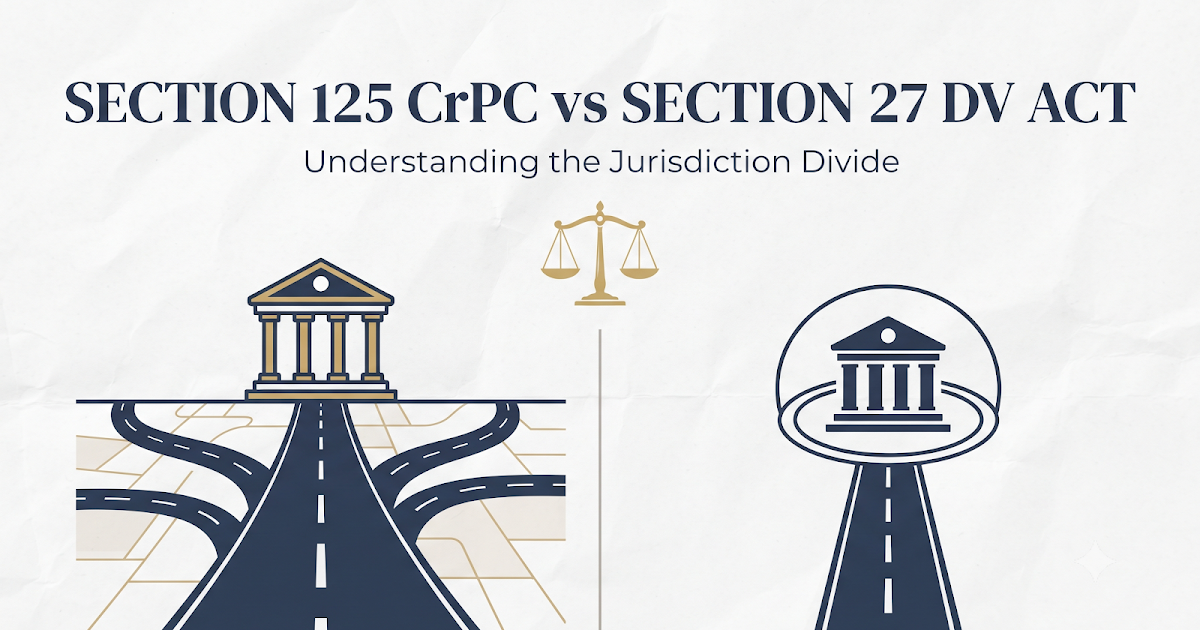


A recurring battleground in matrimonial litigation is the
courtroom itself — quite literally, which court has the power to hear the case.
A recent appellate order arising out of a Protection of Women from Domestic
Violence Act (PWDVA) proceeding throws sharp light on why the territorial
jurisdiction clause under the DV Act is drafted narrower than its cousin
provision for maintenance under Section 125 of the Code of Criminal Procedure
(CrPC). Litigants, and even trial courts, often assume the two provisions
operate identically. They do not, and the difference can determine whether an
application survives a preliminary objection or collapses at the threshold.
The Dispute That Triggered the Question
In the underlying case, a husband challenged an order of a
Judicial Magistrate First Class that had rejected his objection to territorial
jurisdiction in a DV Act application filed by his wife. The wife had shown her
residential address within the town where the magistrate’s court was located,
while the husband contended that neither party actually resided, worked, or
experienced any incident of domestic violence within that town’s limits — both
spouses lived and worked in a different town roughly 70 kilometres away, and
their children studied there too. He also pointed to police complaints she had
lodged giving her address in that other town, and produced evidence that daily
commuting between the two towns for her government teaching job was practically
impossible.
The appellate court found that the wife had failed to demonstrate
any event of domestic violence occurring within the jurisdiction where she
filed the case, and that her claimed “residence” there appeared to be
one of convenience rather than genuine dwelling. The order below was set aside,
and the DV Act application was disposed of for want of jurisdiction — a
textbook illustration of how the jurisdictional test under the DV Act operates
differently from the more liberal standard under Section 125 CrPC.
Two Maintenance Remedies, Two Different
Jurisdictional Tests
Both Section 125 of the CrPC and the DV Act allow a wife (among
others) to claim maintenance-type relief, but the statutes deliberately use
different language to define where a case can be filed. Section 126 of the CrPC
states that proceedings under Section 125 may be initiated in any district
where the person against whom the claim is made resides, or where the claimant
or her husband resides, or where they last resided together. The words
“any district” give this provision a wide territorial sweep — a wife
can approach a court practically anywhere she or her husband has a residential
connection, present or past.
Section 27(1) of the DV Act, by contrast, confers jurisdiction on
a court within the local limits of which the aggrieved person resides or
temporarily resides, or carries on business, or is employed, or where the
respondent resides or carries on business, or where the cause of action arose.
The phrase used is “local limits,” not “any district” — a
narrower geographic anchor tied to the actual limits of a particular court’s
territory rather than an entire administrative district.
|
Aspect |
Section 125 read with Section 126, CrPC |
Section 27, DV Act |
|
Statutory language |
“Any district” |
“Local limits of which” |
|
Geographic breadth |
Broader — an entire district qualifies |
Narrower — confined to a court’s specific local limits |
|
Connecting factors |
Where respondent is; where claimant or respondent resides; where |
Where aggrieved person resides/temporarily resides; where she is |
|
Treatment of “temporary residence” |
Not separately emphasised |
Courts scrutinise whether “temporary residence” is |
|
Vulnerability to forum shopping |
Lower, given wider connecting factors |
Higher scrutiny applied, since a bare claim of residence can be |
Why “Residence” Is the Real
Battleground
Much of the litigation around DV Act jurisdiction turns on the
meaning of “resides” or “temporarily resides.” The Supreme
Court has long held that “reside” implies something more than a
casual stay or a flying visit — it requires a concrete intention to remain at a
place, whether permanently or for a defined purpose, and does not extend to a
fleeting or engineered presence created merely to satisfy a legal requirement.
Bombay High Court rulings have refined this further in the DV Act context,
holding that temporary residence must be residence undertaken in the ordinary
course of life — for education, employment, or similar genuine needs — and
cannot be a residence artificially set up to confer jurisdiction on a chosen
magistrate, since that would let a well-resourced litigant manufacture a forum
simply to inconvenience the other spouse with long travel and expense.
This judicially evolved test does not have a parallel under
Section 125 CrPC, where the wider “any district” language and the
additional ground of “last resided together” already give the
claimant considerable latitude, reducing the need for courts to closely
interrogate the genuineness of a stated residence.
The Practical Takeaway for Litigants and Courts
The distinction is not a mere technicality — it decides whether a
case can proceed at all. Under Section 125 CrPC, a wife has multiple
wide-ranging options for the forum, making jurisdictional objections
comparatively harder to sustain. Under the DV Act, however, courts are expected
to test whether the connecting factor — residence, employment, business, or the
incident itself — is real and substantial, not a convenient fiction.
Respondents facing a DV Act complaint in a distant or unconnected forum retain a
meaningful jurisdictional defence, while applicants must be prepared to
substantiate genuine residence, employment, or the location of the incident
with credible evidence, since bare assertions or interested affidavits may not
survive scrutiny at the appellate stage.
For practitioners, the message is clear: before filing or
defending a DV Act application, map every connecting factor under Section 27
against the actual facts, because the “local limits” test leaves far
less room for a loosely justified choice of forum than Section 125 CrPC does.

