
[ad_1]

Customisation usually beats a one-size-fits-all approach. It’s true in the products we buy, the playlists we listen to, the travel we plan, and even the way we invest. We’ve grown used to personalisation because it feels efficient: you pay for what you value, you skip what you don’t, and you tweak the setup as your life changes.
Health insurance is catching up to that expectation – partly because consumers want more control, and partly because healthcare costs keep rising. When medical inflation runs ahead of regular inflation year after year, the pressure to optimise coverage becomes real. The result is a steady move away from rigid one-plan-fits-all designs and toward two tools that let you shape coverage around your life: modular health plans and add-ons/riders.
They overlap in spirit (both are about customising).
Modular plans: design it yourself coverage
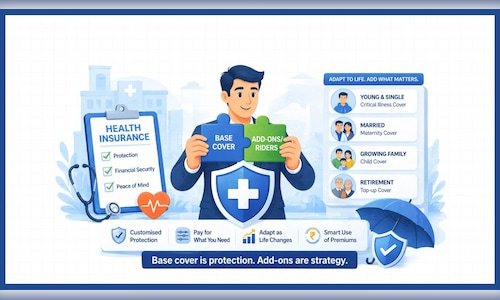
A modular health insurance plan is structured like a base + components model. You start with a core policy (usually hospitalisation-led protection), and then you add modules based on what you actually need – outpatient cover, maternity, chronic care support, critical illness benefits, and so on.
The advantage here is not just flexibility. It’s timing. You don’t need every benefit at every stage of life. A 26-year-old may care about OPD, sports injuries, and diagnostics. A couple in their early 30s may suddenly care about maternity. A 40-year-old may prioritise broader chronic disease protection (although most plans don’t load maternity cover beyond the age of 45). Modular plans let you change the shape of your cover as life changes, instead of paying forever for benefits that don’t apply yet (or don’t apply anymore).
But modularity comes with a quiet assumption: that you will do the work. You have to understand what you’re buying, anticipate what you might need next, and build a cover that won’t leave gaps when real life arrives. For some people, that control feels empowering. For others, it feels like homework.
Add-ons and riders: closing the quiet gaps
If modular plans are chosen for the car model, add-ons are the safety and comfort features you select based on how and where you drive.
A standard health insurance policy can be excellent at covering big-ticket hospitalisation costs – and still leave gaps in areas that hurt in real life: room restrictions, high-end tests, maternity, consumables, waiting periods, accident support, and more. These are the areas that add-ons address. You pay an additional premium to extend the scope of your base policy.
A critical illness rider, for instance, doesn’t just fund hospital bills – it can create breathing room when a diagnosis disrupts income, requires long recovery, or demands expensive choices. An accidental death and disability cover becomes meaningful not because accidents are likely, but because their financial aftermath can be immediate and brutal.
Hospital daily cash fills the quiet gaps that don’t show up in brochures but do show up on day three of a hospital stay – attendant costs, transport, food, and incidentals. A provision for Any Room Availability during hospitalisation is not just about comfort but also about preventing proportionate deductions, without forcing you into basic room categories that may not be available during the time of hospitalisation.
Maternity and newborn add-ons can soften one of the most predictable large expenses in a young couple’s life – but only if you account for waiting periods. And OPD cover matters because the truth is: most healthcare doesn’t happen in hospital rooms. It happens in clinics, labs, and pharmacies, month after month.
Star Health’s own framing is useful here: riders help enhance coverage and complement the coverage terms of the original policy, so you don’t need to buy a separate policy just to plug specific gaps. They’re also time-sensitive: you typically opt in at purchase or renewal. That’s why planning matters.
When add-ons make sense
The value of an add-on depends on your age, life stage, lifestyle, and medical history. They’re meant to prevent two equally common mistakes: being underinsured when it matters, or paying extra for benefits you’ll never use.
For a newly married couple, add-ons can be a way of aligning insurance with what’s realistically on the horizon. If you’re planning a family in the next 2-3 years, maternity and newborn cover – along with OPD for frequent consultations and tests – can be worth considering early, so that the waiting periods can align with your timeline.
For young professionals in their 20s and early 30s, riders can be an inexpensive bridge to better coverage. That’s when a critical illness rider tends to be more affordable, and personal accident cover can act like income protection if an injury disrupts work.
For senior citizens or retirees, the usual pain points are: room rent restrictions, non-medical expenses, and the steady friction of hospital stays. That’s where a room rent waiver and a daily cash benefit can sometimes do more than a long list of policy features you don’t use. Moreover, some senior plans also bundle specific condition management programs that involve long-term hand-holding, providing necessary support as users make the necessary lifestyle changes that enhance their health and well-being.
A quick self-check helps:
If you’re planning a baby in the next two years, maternity + OPD becomes relevant. If you travel frequently or commute long hours, accident cover starts to matter. If there’s a family history of certain diseases (like cancer, stroke, cardiovascular illnesses), critical illness becomes less hypothetical. If you manage chronic conditions like diabetes or thyroid issues, OPD cover can turn into real savings. If privacy and comfort during hospital stays matter to you, room rent waivers matter. And if you’re on a fixed retirement income, hospital daily cash can reduce the steady bleed.
If you tick two or more of these, it’s usually a sign that your base policy deserves an add-on audit.
How to assess what you need (without overbuying)
The self-check gives you direction. Now comes the due diligence.
Now that you know what you need, compare how insurers structure the same add-on. The label may be identical, but the experience can be wildly different. OPD cover is a good example: some versions include dental and vision expenses, others don’t. Some allow cashless OPD within networks, others reimburse later. Limits and access can change whether the add-on feels seamless or irritating – and that matters, because convenience is often the hidden determinant of whether people actually use what they pay for.
Then read the fine print as it matters – because it does. Many riders come with caps, co-payments, and waiting periods that can quietly blunt their usefulness. A rider can look generous on paper and narrow in practice. Misunderstanding these details doesn’t just create disappointment. It can create a claim conflict.
Even strong policies have an upgrade layer
In real life, add-ons earn their keep more as ‘optionality’ than ‘extra coverage’. Take a policy like Star Health’s Super Star Health Insurance Policy, which is already positioned as a strong base plan. The add-ons are what can meaningfully expand what becomes possible when a loved one’s recovery is expensive, prolonged, or unpredictable.
Optional covers such as Limitless Care and Super Star Bonus (Guaranteed Bonus) are examples of how add-ons can widen the room you have to manoeuvre. When treatment doesn’t end with discharge – when it turns into follow-ups, complications, rehab, and longer recovery – it’s not just the first bill that hurts. It’s the second, the third, the twentieth. A growing sum insured and stronger ‘beyond the base’ protection can change where you can seek care, how long you can sustain it, and how quickly you feel cornered by numbers.
And there are riders that matter because they align insurance with predictable life events. Maternity Expenses and High-end Diagnostics are not surprising needs. They’re foreseeable ones – and when the policy supports them, it stops behaving like emergency-only protection and starts supporting life as it actually unfolds.
Design it before you need it
Often, we’re the ones twisting ourselves to fit into clothes bought off the rack, into stop-gap jobs, into tools that don’t deliver the utility we paid for. Health insurance used to sit in that same bucket: standardised, rigid, and easy to outgrow. But it doesn’t have to anymore.
Between modular options, add-ons and riders, you can shape a policy around your life stage, income, and health needs – and revise it as they change. Life changes. Bodies change. Responsibilities change. Your policy should, too.
And when you make the time to research your options, consult experts, and update your cover to fit your life, you’re not only being financially prudent. You’re giving yourself the best shot. You’re setting yourself up to succeed if you ever find yourself facing a diagnosis, in a health crisis, or caught in an accident.
That strength comes from two things: options and agency. When you have both, challenges don’t disappear – but they become far more manageable.
Not one-size-fits-all. Just fit-for-you.
[ad_2]
Source link

