
[ad_1]
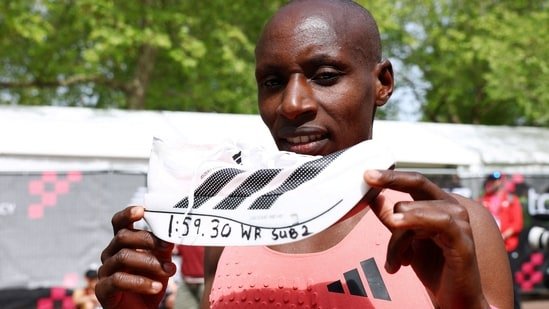
Distance runner Sabastian Sawe, who hails from Kenya, is the talk of the town following his record-breaking achievement on Sunday. The 31-year-old became the first person to break the two-hour mark in the 2026 London Marathon, finishing in 1 hour, 59 minutes and 30 seconds. Moreover, Tigst Assefa of Ethiopia broke the women’s marathon record, clocking 2 hours, 15 minutes and 41 seconds. In the men’s race, Sawe was not the only one to break the two-hour mark, as Ethiopia’s Yomif Kejelcha also did so, finishing in 1 hour, 59 minutes and 41 seconds. What do these three have in common? Well, it comes down to their shoes.


What happened on Sunday?
The 2026 London Marathon will be remembered as the day the ‘impossible’ became the standard. The conditions on the streets of London were near-perfect for distance running – overcast skies, a crisp 11°C (52°F) temperature, and minimal wind resistance along the Thames. This climate provided the ideal backdrop for Sawe’s relentless pace. Spectators lining the Embankment witnessed a level of human performance that many thought was still decades away from an official, non-paced competitive race.
These three wore the recently launched Adidas Adizero Adios Pro Evo 3. First things first, the running gear was unveiled just a week before the London Marathon. At launch, the shoe was touted as the brand’s lightest and fastest Adizero silhouette yet. Well, having light shoes for a marathon is the first thing an athlete does. The running gear directly affects how the body uses energy over a distance of 42.2km.
During a marathon, if one goes out wearing heavy shoes, then one is doomed. There’s no easy way of saying this. Every step in long-distance running requires the athlete to lift and swing their feet forward, and a heavy shoe would require more effort, leading to fatigue. Hence, this is the main reason why different brands try to develop gear that reduces weight as much as possible.
Why the London Marathon is very difficult
The London Marathon is an experience unlike any other. The conditions are very demanding, and runners face severe crowding, which in turn can cause bottlenecks. The weather is also on the warmer and more humid side, and the mental toll of running a 42.2 km course is immense.
How Adidas got Sabastian Sawe on board
Sawe was not a born marathon runner. He initially made a name for himself in shorter track events. If one tracks his early career, he was all about speed rather than stamina. It was then that Adidas stepped in. Ever since the era of ‘super shoes’, the German company has sought to bring on board athletes who can push boundaries. Sawe’s running style made him a perfect candidate for the new footwear innovation.
It is also worth noting that Adidas funded an independent doping-testing regime for Sawe in 2025 and 2026 to ensure he remained clean. According to several reports, the company invested almost USD 50,000 for the Athletics Integrity Unit (AIU), which handles doping control for World Athletics, to conduct 25 out-of-competition tests in two months.
The Adidas Adizero Adios Pro Evo 3 was launched the same week as the London Marathon, and it’s no coincidence that the world record was broken in a matter of a few days. The important trivia here is that Kejelcha was running his first-ever marathon. He had never run a marathon before, but was able to shatter the two-hour mark in his first attempt.
What is running economy?
In the world of elite athletics, this is referred to as Running Economy (RE). Studies have shown that for every 100 grams added to a shoe, the energetic cost of running increases by approximately 1%. For an athlete like Sawe, who is operating at the absolute limit of human aerobic capacity, a 1 per cent difference is the margin between a world record and a podium finish. By stripping away every non-essential gram, Adidas has gifted these runners “free” speed, allowing them to maintain a sub-4:34-minute-per-mile pace without the typical late-stage muscle failure.
This is where Adidas Adizero Adios Pro Evo 3 has turned out to be a game-changer, if early results are anything to go by. The latest shoe is the updated version of the previous one, namely Adios Pro Evo 2. What’s the major difference? You must be wondering. Well, it’s all there in the small and fine details. The big change is the Lightstrike Pro Evo midsole cushioning. In the Adidas Adizero Adios Pro Evo 3, it has been combined with a new Energyrim carbon frame rather than the EnergyRods 2.0 carbon rods used in the prior version.
The pivot from old times
The shift from rods to the Energyrim carbon frame is a significant pivot in footwear engineering. While the previous rods mimicked the metatarsal bones of the foot to provide flexibility, the new frame offers a more cohesive structure that maximises energy return upon foot strike. This “spring-like” effect doesn’t just reduce the weight; it actively propels the runner forward, reducing the eccentric load on the calves and hamstrings.
The Adidas Adizero Adios Pro Evo 3 was launched the same week as the London Marathon, and it’s no coincidence that the world record was broken in a matter of a few days. The important trivia here is that Kejelcha was running his first-ever marathon. He had never run a marathon before, but was able to shatter the two-hour mark in his first attempt.
Kejelcha’s performance is perhaps the most shocking to purists. A specialist in the 5,000m and 10,000m, Kejelcha’s transition to the 42.2km distance was expected to take years of metabolic conditioning. However, the synergy between his high-cadence track style and the responsive tech of the Evo 3 allowed him to bypass the traditional “marathon wall.”
Role of shoes in maintaining metatarsal bones
According to several doctors, shoes are essential for maintaining and protecting the metatarsal bones. If you’re wondering what metatarsal bones are, we have you covered. These are the long bones in the mid-foot/forefoot region. Good footwear will always provide cushioning in this region to absorb shock, and the weight will be redistributed to help reduce pressure on the ball of the foot.
These bones always play a critical role in a marathon, serving as the primary supportive and load-bearing framework during the running phase. It is due to the presence of these bones that one can withstand the intense pressure on the forefoot. According to several studies, the second and third metatarsals experience the highest bending stress.
The big weight difference?
Adizero Adios Pro Evo 3 is Adidas’ first sub-100-gram marathon shoe, making it lighter than a banana, a bar of soap, and a medium-sized apple. The weight is almost the same as a deck of cards, and it is almost half the size of an average running shoe. The UK men’s shoe weighs 97 grams. If you cannot gauge the enormity of the feat achieved, remember that a size 9 Air Force 1 weighs almost 470 grams.
To put this in perspective, over the course of a marathon, a runner takes approximately 25,000 to 30,000 steps. If your shoe is 300 grams lighter than a standard trainer, you are effectively lifting 9,000 kilograms less weight over the course of the race. It is a staggering mechanical advantage.
What went on behind the scenes to create the shoe?
The plan to develop the Adizero Adios Pro Evo 3 was in the works for 3 years. Adidas employees worked tirelessly behind the scenes, also going and staying with the elite athletes to gather their feedback and work on their assessments. All the data was recorded in sync with the athletes’ input during the training camp.
When The Hindustan Times Digital dug a little deeper, it emerged that some employees also went to Africa to gather feedback from athletes. The Adidas innovation team also worked closely with Sabastian, Tigist and Yomif to dish out an unmatched range of innovative running products to support this moment of history. The Adizero Adios Pro Evo has already helped the athletes associated with the brand break three world records and win over 30 key road races, including six World Marathon Major wins, seven national records, five course records, and one Olympic record time.
The African connection
The testing took place primarily in the high-altitude training camps of Iten, Kenya, and Sululta, Ethiopia. Here, the “Innovation Management” team from Adidas’ headquarters in Herzogenaurach lived alongside the runners. They weren’t just looking at speed; they were looking at how the shoe handled the red clay roads and how the foam reacted to the thinning air and specific biomechanics of East African stride patterns. This localised research ensured the shoe was optimised for the very people who would wear it on the world stage.
Not made for everybody
The shoe is designed for one-time use and is intended for running by elite athletes. The one-time use is due to the costs involved, and hence, if a runner uses it for one marathon, the same shoe cannot be used in the next run. Due to the costs involved, a typical runner is unlikely to opt for these shoes, as they are high-maintenance and not everyone can afford them.
The “single-use” nature stems from the Lightstrike Pro Evo foam. To make it so light, the foam is non-compressed and highly porous. While this provides incredible cushioning for 42.2 kilometres, the cell structure begins to collapse shortly thereafter, losing its “pop” and structural integrity. It is the Formula 1 car of footwear: built for a single high-stakes race, not for the daily commute.
Want to get a hold of these?
The shoes cost USD 500, which, converted into Indian currency, becomes INR 48,000. A limited number of pairs were released last week; however, a full rollout is expected sometime later. A wider launch is scheduled for later this year, when the true marathon season begins.
Why does it spell trouble for Nike?
The immediate success of the Adidas Adizero Adios Pro Evo 3 poses a threat to Nike’s dominance, which previously boasted of having the fastest recorded marathon runners. The late Kelvin Kiptum wore Nike’s Air Zoom Alphafly Next% 3 shoes in the 2023 Chicago Marathon and finished in 2 hours and 35 seconds.
In the 2022 record-breaking Berlin Marathon, Kenya’s Eliud Kipchoge sported Nike’s Air Zoom Alphafly Next% 2. For reference, Nike’s Air Zoom Alphafly Next% 3 weighs 201 grams while Nike’s Air Zoom Alphafly Next% 2 weighs 243 grams.
The “Super Shoe” arms race
The disparity in weight is now impossible for Nike to ignore. With Adidas dipping below the 100g mark, Nike’s flagship racers are now more than double the weight of the Adios Pro Evo 3. This has sparked a new arms race in the sports laboratory. Industry insiders suggest Nike is already fast-tracking a “minimalist” prototype, but for now, the momentum has swung firmly toward the three stripes.
As the 2026 season progresses, the question is no longer if the record will be broken, but by how much. With the sub-two-hour barrier now officially shattered in a competitive field, the marathon has entered a new era where human grit is flawlessly augmented by high-performance chemistry.
[ad_2]
Source link

