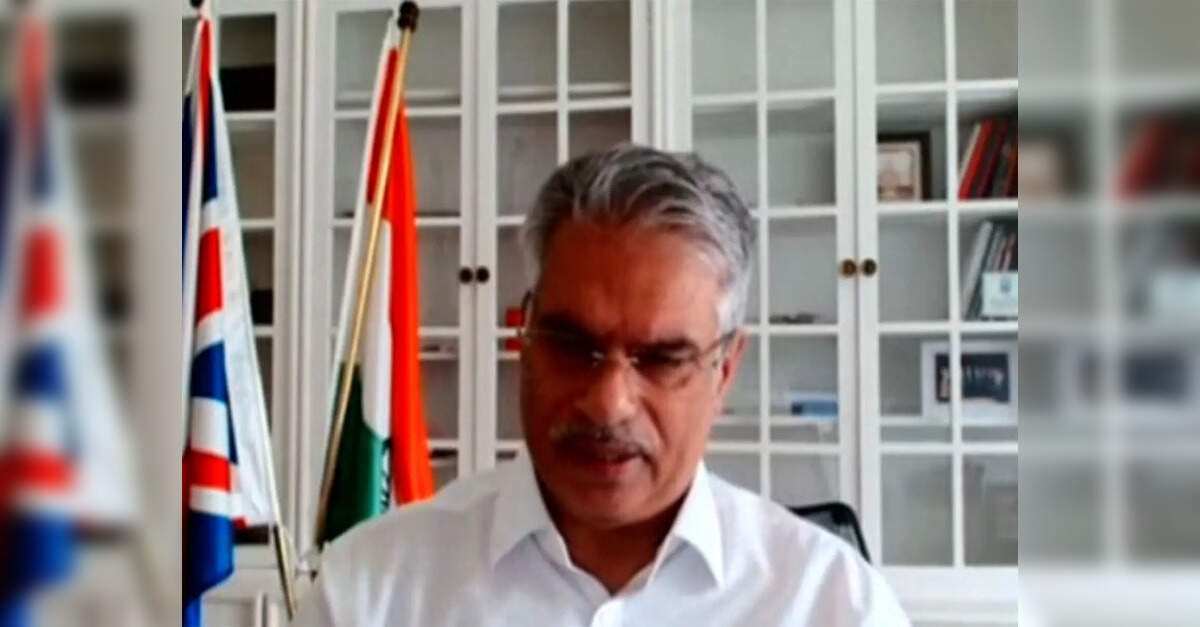


New Delhi [India], July 15 (ANI): The implementation of the Double Contribution Convention under the proposed UK-India Comprehensive Economic Trade Agreement (CETA) is set to lower the cost burden on professionals moving between the two nations and encourage greater bilateral mobility.
Speaking to ANI, Harjinder Kang, the UK’s Trade Commissioner for South Asia and former Chief Negotiator for the India-UK Free Trade Agreement, stated that the mechanism would ease financial strains on temporary workers.
“It would encourage more two-way traffic because the cost burden would be lower,” Kang said. “It directly affects the pockets of individuals moving between countries, as they would no longer have to pay two sets of social security contributions.”
Under the framework, temporary workers are exempt from contributing to the host nation’s social security system, provided they continue payments in their home country. Kang explained that the exemption window has been expanded significantly during the negotiation process.
“If you are a UK worker paying your National Insurance contributions in the UK, you do not then need to contribute to the host country’s social security system if you are there on a temporary basis for a certain number of years,” Kang said.
“The same principle applies to Indian nationals. If they are going to the UK temporarily and continuing to pay into their National Insurance or social security system in India, such as the Provident Fund, they would not have to pay National Insurance contributions in the UK,” he added.
Kang noted that this provision targets professionals on short-term corporate deployments.
“This applies for a specific period. It was originally 36 months, but we agreed to extend it to 60 months, or five years. After that, it no longer applies,” Kang stated. “If a company like Tata or Infosys is sending engineers, managers, or other professionals to the UK for a couple of years on a temporary assignment, this is where they would benefit.”
The broader trade agreement aims to significantly accelerate commerce between the two major markets. Kang emphasised that the structural layout of the deal ensures balanced growth, with current trade figures demonstrating an even split between the two nations.
“It has to be a win-win. If it wasn’t a win-win, no system was going to sign it off,” Kang said. “If you look at our current trade, it’s almost 50-50. It’s not slightly in favour of India, and it’s not heavily skewed either; it is almost evenly balanced.”
The trade official projected substantial economic expansion for both countries, noting that early momentum has already driven up recent trade values ahead of the formal conclusion of the pact.
“The GDP addition to both markets is about USD 5 billion, slightly in India’s favour. So, roughly USD 5 billion each, which again makes it quite balanced,” Kang said.
“The additional bilateral trade is expected to be around USD 25.5 billion between the two countries. Just to give you an idea, the last period that we’ve measured bilateral trade was 2024. It was literally between 2024 and 2025; it’s gone up by USD 4 billion and it’s gone up purely on the energy that’s been created by us doing the trade deal discussion and people anticipate them,” Kang added.
According to Kang, commercial interest is visible in the recent metrics. He noted that making it easier for companies to operate both ways will accelerate growth.