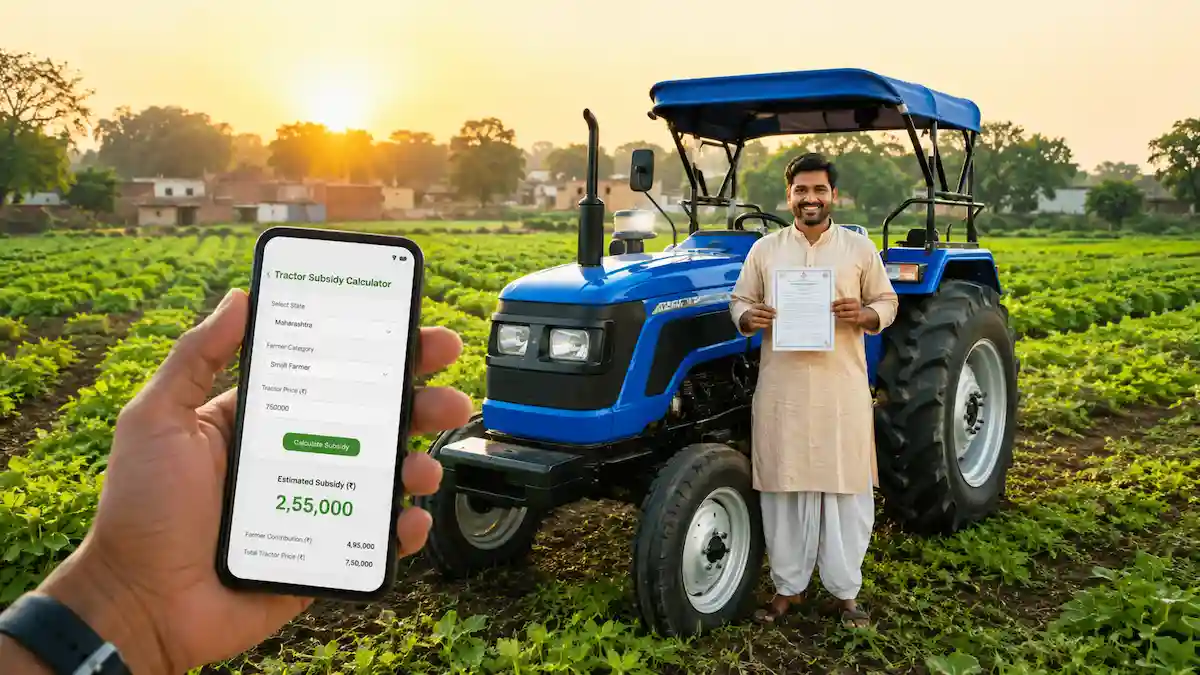

Buying a tractor is one of the biggest investments for most farmers. A government subsidy can significantly reduce the overall cost, making modern farm mechanization more affordable.
This tractor subsidy calculator helps you estimate your eligible subsidy amount before you approach a dealer. Enter your state, farmer category, and tractor price, and the tool estimates your eligible subsidy using the latest available scheme information for your location.

Estimate your subsidy for purchasing a new tractor under India’s state and central farm mechanization schemes (e.g. SMAM). Enter your tractor’s cost and details below.
Scheme
Eligible Subsidy
Subsidy Percentage
Maximum Subsidy
Farmer Contribution
Central Govt. Share
State Govt. Share
Last Updated
Frequently Asked Questions
Tractor subsidies are typically funded jointly by the Sub-Mission on Agricultural Mechanization (SMAM) and matching state-level farm mechanization schemes.
Many states offer a higher subsidy percentage for women, SC/ST, and small/marginal farmers. Select your social category above to see the applicable rate for your state.
Yes, most states cap the subsidy at a fixed maximum rupee amount regardless of tractor cost or percentage. This calculator applies that cap automatically.
No. In most states you must apply and receive approval before purchase. Always check your state agriculture department’s process before buying.
Disclaimer: Figures shown are indicative estimates based on published scheme guidelines and may change without notice. Always verify current subsidy rates, caps, and eligibility with the concerned government department before making financial decisions.
What is a tractor subsidy?
A tractor subsidy is financial assistance from the Central and State Governments that lowers the cost of a new agricultural tractor. The amount depends on your farmer category, state, tractor price, and the scheme that applies to you.

What Is a Tractor Subsidy?
Tractor subsidy is part of India’s farm mechanization programme, helping farmers purchase tractors and other agricultural machinery at a lower cost. It reduces the upfront price a farmer pays for a new tractor.
Most tractor subsidy schemes are implemented through the Sub-Mission on Agricultural Mechanization (SMAM), run by the Department of Agriculture & Farmers Welfare, along with State Government agriculture mechanization programmes. Central and state governments share the cost between them.
Why Does the Government Offer Tractor Purchase Assistance?
Manual farm work eats up time at every stage, from sowing to harvest. A tractor helps farmers complete field operations faster, reduces dependence on manual labour, and makes it easier to cultivate larger areas on time.
Most small landholders cannot buy a tractor without help. The subsidy on a new tractor exists to close that affordability gap, making tractor ownership more affordable.
How the Tractor Subsidy Calculator Works
Enter a few details such as your state, farmer category, and tractor price. The calculator then estimates your eligible subsidy based on the applicable scheme and subsidy limits.

Information You Need to Enter
| Field | What It Means | Why It Matters |
|---|---|---|
| State / UT | Where you will buy and register the tractor | Each state sets its own subsidy rate and cap |
| Farmer Category | Small/marginal or general landholder | Small farmers often qualify for a higher rate |
| Social Category | General, OBC, or SC/ST | SC/ST applicants usually get the top rate |
| Gender | Optional field | Some states add extra benefits for women farmers |
| Tractor Cost | Ex-showroom price of the tractor in rupees | The subsidy percentage is applied to this base amount |
What the Calculator Shows You
| Result | What It Tells You |
|---|---|
| Scheme Name | The exact scheme your subsidy falls under |
| Eligible Subsidy | Your final subsidy amount in rupees |
| Subsidy Percentage | The rate applied to your tractor cost |
| Maximum Subsidy | The upper cap your state allows |
| Farmer Contribution | What you pay after the subsidy is deducted |
| Central Govt. Share | Portion funded by the central government |
| State Govt. Share | Portion funded by your state government |
| Last Updated | When the rate data was last verified |
Below the results, you also get your required documents, eligibility conditions, and the local agriculture department handling your application.
How is tractor subsidy calculated?
- Select your state
- Choose your farmer category and social category
- Enter the tractor’s ex-showroom price
- The calculator applies the applicable scheme percentage
- It compares this against the maximum subsidy cap for your location
- The lower of the two becomes your final eligible subsidy
How Much Tractor Subsidy Can You Get in India?
General category farmers typically see a subsidy in the 20% to 30% range of the tractor’s ex-showroom price. Small and marginal farmers usually get a few percentage points more on top of that.
SC/ST applicants tend to receive the highest rate, often 40% and above, but always within a fixed rupee cap.
These figures are illustrative estimates the calculator uses to give you a working number. They are not a guaranteed payout, since actual rates depend on the government notification in force, the scheme’s annual budget, and sometimes the tractor’s horsepower.
Some schemes classify tractors by horsepower (HP), so a 35 HP tractor and a 55 HP tractor may qualify for different subsidy limits under the same scheme.
Subsidy Percentage by Category
| Category | Typical Subsidy Range | Notes |
|---|---|---|
| General Farmer | 20% to 30% | Standard base rate in most states |
| Small / Marginal Farmer | 30% to 45% | Extra weightage for smaller landholdings |
| SC / ST Farmer | 40% to 60% | Highest rate, often close to the state cap |
Maximum Subsidy Cap
Every state fixes a maximum subsidy amount in rupees. A costlier tractor does not raise your subsidy once you hit this cap, it only raises your farmer contribution.
Central vs State Government Subsidy Share
Most schemes split the subsidy between the Central Government and the State Government, commonly in a 60:40 ratio. North-eastern and hill states usually work on a 90:10 Central to State ratio instead.
State-Wise Tractor Subsidy Snapshot
These figures are broad illustrative ranges, not fixed or guaranteed rates. Actual percentages change with each scheme notification and state budget cycle, so treat this table as a starting reference and confirm your exact figure using the calculator above.

Some states also revise subsidy limits based on annual budgets, eligible tractor models, and local agricultural priorities.
| State | General Category | SC/ST Category |
|---|---|---|
| Andhra Pradesh | ~25% | ~50% |
| Telangana | ~25% | ~50% |
| Karnataka | ~30% | ~50% |
| Tamil Nadu | ~40% | ~50% |
| Kerala | ~25% | ~50% |
| Maharashtra | ~28% | ~55% |
| Gujarat | ~26% | ~52% |
| Rajasthan | ~29% | ~58% |
| State | General Category | SC/ST Category |
|---|---|---|
| Madhya Pradesh | ~29% | ~58% |
| Uttar Pradesh | ~25% | ~49% |
| Bihar | ~29% | ~57% |
| Odisha | ~29% | ~59% |
| Punjab | ~24% | ~48% |
| Haryana | ~22% | ~45% |
| West Bengal | ~23% | ~46% |
| Assam | ~22% | ~43% |
What Factors Affect Your Tractor Subsidy Amount?
- Farmer category: Small and marginal farmers get higher rates than general farmers
- Social category: SC/ST applicants usually get the top rate in every state
- State rules: Each state notifies its own percentage and rupee cap, and these change over time
- Tractor price and horsepower: Some states scale the subsidy cap by HP bracket, so a higher HP tractor may sit in a different cap slab
- Tractor type: Mini tractors and standard utility tractors are sometimes capped differently under the same scheme
- Scheme budget: Once a state’s annual allocation is used up, new approvals slow down until the next budget cycle
Tractor Subsidy Eligibility
Who Can Apply?
- Active farmers registered with their state agriculture department
- Individual landholders with land in their own name
- Tenant farmers, in states that specifically allow this under a valid tenancy agreement, this rule is not uniform across India and must be checked locally
- Farmer Producer Organizations (FPOs), where the state scheme permits group applications
Land and Registration Rules
- Valid land ownership or tenancy documents in the applicant’s name
- Active registration with the state agriculture department
- A valid bank account for Direct Benefit Transfer (DBT) of the subsidy
- Compliance with any cooling-off period between subsidy claims, this gap is set by each state individually and commonly falls somewhere between a few years and a decade, so confirm the exact figure for your state before applying
Who Is Not Eligible?
- Farmers who have already claimed a subsidy within the applicable waiting period
- Applicants submitting incomplete or incorrect documents
- Buyers of used or second-hand tractors
- Farmers purchasing tractors that do not meet the scheme’s approved specifications
- Applicants who purchase before approval in states requiring prior sanction
Documents Required for Tractor Subsidy
- Aadhaar card, for identity verification
- Land ownership or tenancy papers, to prove you are an active cultivator
- Bank passbook with IFSC code, for the DBT credit
- Caste certificate, needed only for OBC or SC/ST claims
- Passport-size photograph, for the application form
- Dealer quotation or invoice, to confirm the tractor’s cost and model
How to Apply for Tractor Subsidy
Online Application Process
- Register on your state agriculture department’s portal
- Fill in your personal, land, and bank details
- Select the tractor subsidy scheme you want to apply under
- Upload Aadhaar, land documents, and other required files
- Submit the form and note down your application or token number
- Wait for document verification by the department
- Get approval before you finalize your tractor purchase
- Submit the dealer invoice after purchase to trigger the subsidy transfer
How to Check Your Tractor Subsidy Application Status
Most state portals let you track your application using your registration number or Aadhaar-linked login. Look for a “track application” or “application status” option on the same portal where you applied, since a separate national tracking page does not exist for every state.
When Is the Subsidy Credited?
Once your purchase invoice is verified, the subsidy amount is usually credited through Direct Benefit Transfer (DBT) straight to your linked bank account. Timelines vary by state, ranging from a few weeks to a couple of months depending on department workload and fund availability.

Government Schemes That Provide Tractor Subsidies
- SMAM (Sub-Mission on Agricultural Mechanization): The main central scheme, run by the Department of Agriculture & Farmers Welfare, funding farm equipment subsidies
- RKVY (Rashtriya Krishi Vikas Yojana): Supplements state agriculture infrastructure funding
- State Agriculture Mechanization Schemes: State-specific top-ups and category-based rate adjustments
- Custom Hiring Centre Scheme: An alternative for farmers who want tractor access on rent instead of buying
Central Scheme vs State Scheme, What Is the Difference?
The Central Government scheme, SMAM, sets the broad framework and contributes the larger funding share in most states. The State Government scheme then adds its own percentage, caps, and category rules on top, which is why the same tractor purchase gets a different subsidy amount depending on which state you apply from.
Example: How Tractor Subsidy Is Calculated
Say a small and marginal farmer in Maharashtra buys a tractor priced at ₹6,50,000 ex-showroom. At an illustrative 40% rate for this category, the raw subsidy works out to ₹2,60,000.
If the state’s fixed cap is lower than that figure, the calculator applies the cap instead, and that capped number becomes the final eligible subsidy shown to the farmer.
Subtract the eligible subsidy from the tractor price, and what is left is the farmer contribution, the amount you need to arrange through savings or a loan.
Before investing in a new tractor, it’s also helpful to estimate your expected returns with our Crop Profit Calculator to understand how mechanization may affect farm profitability.
Bank Loan and Subsidy Workflow
Most farmers do not pay the full farmer contribution in cash. A common path looks like this: get subsidy approval first, apply for a tractor loan for the balance amount, complete the purchase, then let the subsidy credit reduce your effective loan burden once it lands in your account.

Banks usually ask for the subsidy sanction letter as supporting proof when processing the loan, so keep that document ready. Some banks also finance the amount remaining after deducting the expected subsidy, subject to their lending policies.
Common Mistakes to Avoid When Applying
- Submitting incorrect documents: Mismatched names or expired certificates cause delays
- Choosing the wrong farmer category: This directly changes your subsidy percentage
- Incomplete application forms: Missing fields often lead to automatic rejection
- Missing deadlines: Scheme windows close once the annual budget is used up
- Buying before approval: Purchasing the tractor before your application is approved can make you ineligible in states that require prior sanction
Common Reasons Applications Get Delayed or Rejected
- Land records not matching the applicant’s name
- Duplicate applications from the same farmer or household
- Incorrect bank details blocking the DBT credit
- Scheme funds for the year already exhausted, pushing your file to the next budget cycle
Tractor Loan vs Tractor Subsidy
| Factor | Tractor Subsidy | Tractor Loan |
|---|---|---|
| Purpose | Reduce purchase cost | Finance the purchase |
| Repayment | Not required, it is a grant | Repaid over time |
| Interest | None | Applicable |
| Funding Source | Government | Bank or NBFC |
| Best For | Lowering the purchase price | Paying the remaining balance |
Why Use This Tractor Subsidy Calculator?
It gives you a state-specific estimate instead of a generic national average. You enter your exact category and tractor price, and it shows the central and state split, along with your documents and eligibility, in one place, free and usable from your phone.
Frequently Asked Questions
How much tractor subsidy can I get?
Most states offer between 20% and 30% of the tractor cost for general farmers, and 40% to 60% for SC/ST or small and marginal farmers, subject to a fixed rupee cap that varies by state and scheme notification.
Who is eligible for tractor subsidy?
Active, registered farmers with valid land ownership or tenancy documents are generally eligible. Tenant farmer eligibility and cooling-off periods between claims differ by state, so confirm the local rule before applying.
Do I need to buy the tractor before applying?
No. In most states you must apply and get approval first, then purchase the tractor. Always check your state’s exact sequence before buying, since applying after purchase can disqualify you.
Can I get a tractor loan and subsidy together?
Yes. The subsidy reduces the tractor’s effective cost, and a bank loan can cover the remaining farmer contribution. Many banks ask for your subsidy sanction letter as supporting proof.
Is there a maximum subsidy amount?
Yes. Every state fixes a maximum rupee cap. Even if your percentage-based subsidy works out higher, the cap decides your final eligible amount.
Is GST included in the tractor subsidy calculation?
This depends on the state notification. Some schemes calculate the subsidy on the ex-showroom price before GST, while others use the invoice value after tax, so check your state’s guidelines or dealer quotation format.
Is the subsidy calculated on ex-showroom price or invoice value?
Most schemes use the ex-showroom price or the dealer’s quoted base cost as the starting figure, then apply the subsidy percentage to that amount.
Can I buy a second-hand or used tractor under the subsidy scheme?
No. Nearly all state and central tractor subsidy schemes apply only to new tractors purchased from an authorized dealer.
Can I choose any tractor model?
Most schemes allow only eligible tractor models purchased from authorized dealers. The approved list and specifications vary by state and scheme.
Can one farmer claim tractor subsidy more than once?
Generally no, within the cooling-off window set by the state. Once that period passes, a farmer may become eligible again, subject to the scheme’s current rules.
Can I get subsidy on more than one tractor?
Most schemes allow one subsidized tractor per farmer per cooling-off cycle. Buying additional tractors beyond that typically will not qualify for a fresh subsidy in the same period.
Can women farmers get a higher subsidy?
Some states add an extra benefit or priority weightage for women applicants. This is not universal, so check your state’s scheme for a specific women farmer provision.
Can Farmer Producer Organizations (FPOs) apply?
In several states, FPOs and registered farmer groups can apply under group or institutional categories, though the process and paperwork differ from an individual farmer application.
Which government department provides tractor subsidy?
Tractor subsidies are generally administered by the State Agriculture Department, with financial support from the Department of Agriculture & Farmers Welfare under applicable central and state schemes.
Conclusion
A tractor purchase gets a lot easier once you know your likely subsidy number in advance. Use the calculator above, enter your state and category, check the documents you will need, and plan your purchase around a realistic budget instead of guesswork.
You may also want to check our Solar Pump Subsidy Calculator, Borewell Subsidy Calculator, and for other farm investment planning.
Official references: Department of Agriculture & Farmers Welfare, SMAM portal and National Government Services Portal, SMAM scheme page.
Disclaimer: Information on this page is for educational purposes only and is based on published scheme guidelines available at the time of writing. Subsidy percentages, maximum caps, and eligibility conditions vary by state, scheme notification, and budget availability, and can change without notice. For accurate, current figures, verify with your State Agriculture Department or the Sub-Mission on Agricultural Mechanization (SMAM) portal before making a purchase decision.

