



In the Acharya Balkrishna personality rights case, the Delhi High Court had an opportunity to rein in the overreach of personality rights. In this post, Shubham Thakare argues that rather than correcting course, the decision deepens an already concerning pattern of privileging reputational claims over free speech. Shubham is a third-year B.A., LL.B. (Hons.) student at the National Law School of India University, Bengaluru, with an interest in copyright and trademark law.

A Course Correction That Wasn’t: The Balkrishna Order and the Persistence of Overbroad Personality Rights
By Shubham Thakare

Over the last few years, through a series of expansive interim orders, the Delhi High Court has allowed personality rights to drift steadily away from their commercial origins and towards something closer to a general licence for public figures to control how they are depicted at the cost of free speech (see, for instance, the orders in the cases of Abhishek Bachchan, Ankur Warikoo, Karan Johar, Mohan Babu, Sadhguru, amongst many others). The recent order dated March 24, by the court in a suit filed by Patanjali’s MD, Acharya Balkrishna, is perhaps the most egregious instance of this tendency yet.
Balkrishna had approached the Delhi High Court asking for memes, caricatures, and news reports to be scrubbed from platforms like Instagram, Facebook, and Google. The material in question was a satirical commentary on his public conduct and journalistic coverage of the Supreme Court’s adverse orders against him and Patanjali over misleading health claims. The Court’s order granted him substantially all of it: a sweeping ex parte injunction restraining all defendants from creating, uploading, sharing, or disseminating any content pertaining to the plaintiff across social media, websites, blogs, the Metaverse, blockchain, and “any Artificial Intelligence program”; a direction to Meta to unmask the anonymous critics behind the listed accounts; and an immediate takedown order covering the memes, caricatures, and satirical posts compiled in an annexure.

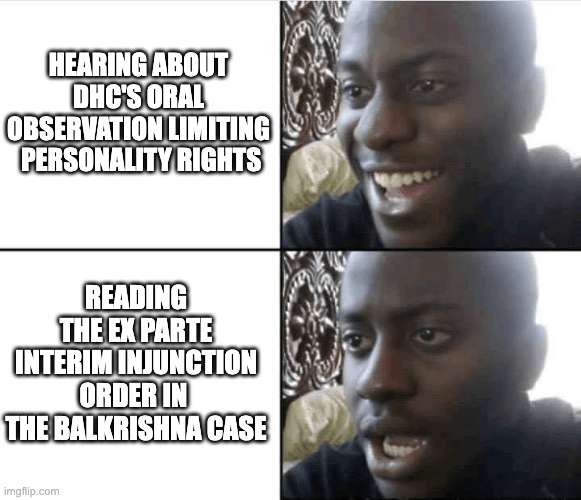
Set against this, however, while hearing the parties on March 23, Justice Gedela had orally remarked to Balkrishna’s counsel: “If you are going to be a public figure, please be ready for brickbats too.” Had the order followed this line, it could have served as a much-needed course correction to the Court’s trajectory in personality rights matters. That opportunity was not taken. I show in this post how the order instead falls in line with, and in some respects further aggravates, the pattern of problematic decisions the Court has been issuing in such cases.
How We Got Here
Before I examine the Court’s reasoning, it is worth briefly tracing the course taken by the Delhi High Court that created the conditions for a suit like this in the first place.
As has been discussed by Anushka Aggarwal on this blog previously, and addressed in detail in the first episode of SpicyIP’s podcast Let’s IPsa Loquitur, the Delhi High Court’s personality rights jurisprudence over the past three years has shown quite a troubling pattern. It has increasingly granted ex parte injunctions on the mere finding that a person is identifiable in the impugned content (whether through name, image, likeness, or even loosely suggestive attributes) without examining whether there is any real misrepresentation, consumer confusion, or commercial misappropriation. This has been done despite the absence of any statutory basis for personality rights in India, and without distinguishing between the right of publicity, which addresses commercial exploitation of identity, and privacy, which is concerned with dignity and personal autonomy.
The interim injunction orders in Rajat Sharma and Vishnu Manchu perhaps most clearly reflect the increasingly troubling willingness of the Delhi High Court to block, at the interim stage, even satire and parody under the guise of IPR enforcement without engaging with settled free speech jurisprudence. In Rajat Sharma, the Court restrained parodic uses like “Baap ki Adalat”, ignoring trademark doctrines such as nominative fair use and its own reasoning in Tata Sons v. Greenpeace and Ashutosh Dubey v. Netflix that recognise exaggeration and parody as protected expression (a critique explored by Aarav Gupta here). In Vishnu Manchu, the Delhi High Court went a step further and issued what was effectively a sweeping, dynamic-style injunction against memes, criticism, and even trolling. This order sat uneasily with precedents on free speech such as Shreya Singhal and Maneka Gandhi, which emphasise that public figures must tolerate a degree of criticism, satire, and even ridicule in public discourse (discussed by Yukta Chordia and Praharsh Gour on this blog here).
These orders opened the door to a troubling trend that the Balkrishna suit follows closely. If the Delhi High Court was willing to restrain entire parodies or the use of clips under personality rights, it was not a large leap to extend that logic to memes, caricatures, and news-linked commentary. The court’s order confirms that the leap has now been made.
A comparison with the Madras High Court’s approach is instructive. In T. Rangaraj, the Court declined to restrain news reports and public discussion around a controversy, recognising that the mere circulation of information about an identifiable individual does not, by itself, implicate personality rights unless it is tied to commercial exploitation. Similarly, in Kamal Haasan, relief was narrowly tailored to instances of clear commercial misuse, such as unauthorised merchandise using morphed images, while explicitly preserving space for satire, caricature, and creative expression (interested readers may read this piece by Arjun Ishaan on these two orders). The Balkrishna order does not engage with either of these precedents. It does not ask whether the content complained of involves commercial exploitation. It does not ask whether a narrower remedy would suffice. It simply finds that the plaintiff is well-known, that the content is “disparaging,” and grants the injunction.
What the Order Actually Does (and What It Does Not) Say
The order is notable as much for what it omits as for what it contains. The reasoning occupies a handful of paragraphs (see ¶36 – ¶40). After setting out the plaintiff’s claimed persona at length, drawing on his social media following, Himalayan expeditions, publications, and Patanjali ventures, the Court states that the plaintiff has a prima facie case, that the balance of convenience favours him, and that irreparable injury would result if the injunction is not granted.
What I’ve written in the above paragraph is the entirety of the court’s analysis. No precedent was cited in support of the grant of the injunction. Neither was any attempt made to engage with the free speech concerns raised by Meta’s counsel during the hearing. She had submitted that the listings in the plaintiff’s compilation appeared to be “pure parody or at best lampooning” and that “the fundamental right of speech may be taken into account before passing any direction of such nature.” Both she and Google’s counsel had placed reliance on the Delhi High Court’s own judgment in D.M. Entertainment Pvt. Ltd., which is the Court’s leading precedent on personality rights and which explicitly drew the right’s contours around commercial exploitation rather than mere protection of public representation. The order disposed of this entire line of argument in a single sentence, stating that certain links and websites in the compilation appeared derogatory, defamatory, disparaging, and violative of the plaintiff’s personality rights, before reproducing screenshots of the impugned content and directing their takedown.
This is a significant failure of reasoning. Pranjali Sahni and Souradeep Mukhopadhyay have previously argued on this blog about how the Delhi High Court’s personality rights jurisprudence has long been characterised by a reluctance to articulate the legal basis for its decisions, leaving the right to develop on the flimsy pillars of unreasoned orders. The Balkrishna order sits squarely within that tradition. D.M. Entertainment was cited by both defendants specifically because it delimits the scope of personality rights to commercial exploitation, that is, the unauthorised use of a person’s likeness to sell goods or services or to create a false impression of endorsement. The memes and caricatures complained of in Balkrishna do not, under any interpretation, fall within this category. They involve social commentary, political satire, and critical humour directed at a public figure whose conduct has been the subject of Supreme Court proceedings. The Court’s response to the precedent cited was not to distinguish it or to offer a competing reading of it. It simply chose to ignore and move past it.
Equally absent is any engagement with the precedent of Shreya Singhal, in which the Supreme Court made clear that restrictions on speech under Article 19(2) must be narrowly tailored to constitutionally permissible heads, and that “annoyance,” “inconvenience,” and reputational discomfort do not qualify. The content restrained by the order, such as memes, satirical posts, and commentary on a public figure’s legal troubles, does not come close to meeting the constitutional threshold for restriction. It is the kind of expression that the Supreme Court’s free speech jurisprudence has consistently, if not always successfully, sought to protect. Yet the order does not address this. It proceeds as though the only question is whether the plaintiff has a recognisable personality and whether the content is unflattering.
The problem here is structural, and is one that Anushka Aggarwal has identified in the Delhi High Court’s personality rights jurisprudence more broadly on this blog. The court treats a celebrity plaintiff’s dignitary interest, now constitutionalised through Puttaswamy, as a value of constitutional weight (under Article 21), while the competing interest in free expression (under Article 19) is effectively treated as a lesser, statutory concern to be acknowledged and set aside. The Balkrishna order exemplifies this problem. There is not a single sentence in the injunction reasoning that asks what the defendants or the public at large lose if the content is taken down. The irreparable harm inquiry runs entirely in one direction.
As I conclude, I believe it is worth pondering what the order would have looked like had Justice Gedela’s oral observations found their way into the written reasoning. The “brickbats” remark, read seriously, implies a recognition that public figures occupy a different position in free speech jurisprudence from private individuals: they have chosen to enter public life, they wield significant influence, and their conduct is legitimately a subject of public scrutiny and satirical commentary. Had this found expression in the order, it could have served as a meaningful corrective to the drift this post has traced, and anchored personality rights back within their commercial bounds and preserving space for the kind of expression that democratic public life requires.
Conclusion
Google’s counsel had called the reliefs sought by Balkrishna “very dangerous.” The danger has now been realised. The order grants sweeping ex parte relief against content that is, on its face, satirical and political in nature; it orders platform-level disclosure of the identities of anonymous critics; and it extends the injunction to AI and blockchain without a word of reasoning.
There remains, however, a narrow window for correction. Balkrishna had not impleaded the actual content creators as parties, confining the suit at this stage to the intermediary platforms. The Court has since directed him to remedy this. With the matter listed before the Joint Registrar on May 26, 2026, and before the Court on September 24, 2026, the defendants, once served, will have the opportunity to seek vacation of the ex parte order. Whether Justice Gedela’s view that public figures must be ready for brickbats finds its way into a reasoned ruling at that stage remains to be seen. It is a question that will have implications well beyond this case for the course of personality rights in Indian courts.