
[ad_1]

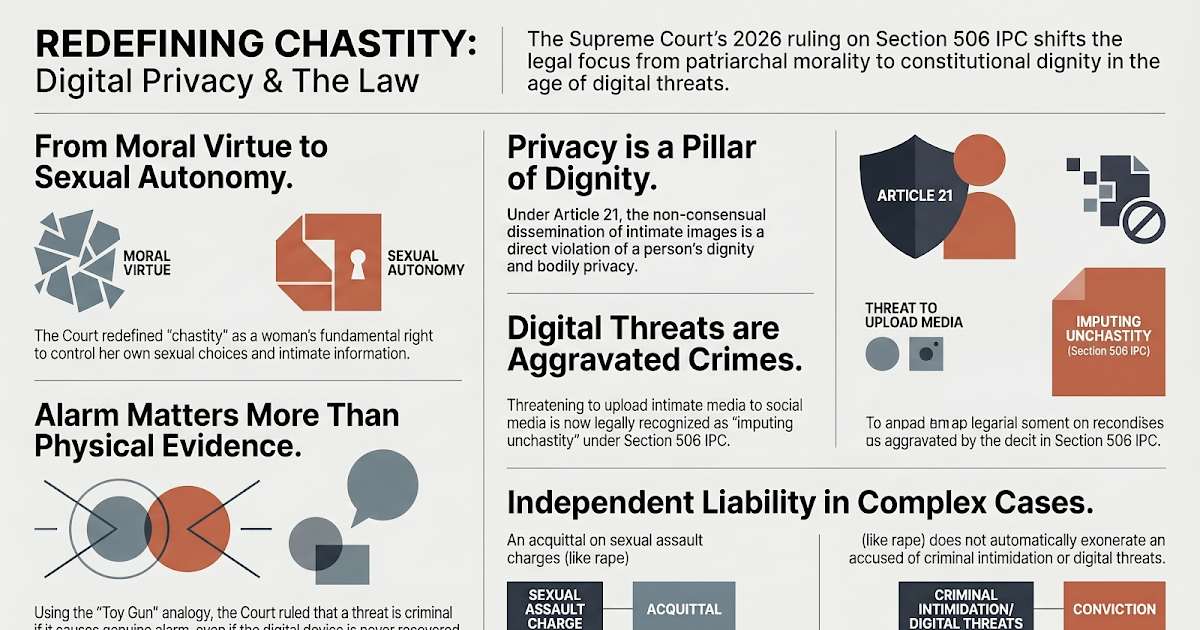
The Court made the observation while upholding the conviction of a man under Part II of Section 506 of the Indian Penal Code for threatening to upload a woman’s private bathing video on Facebook, holding that such conduct amounts to “imputing unchastity” to a woman within the meaning of the provision which penalises criminal intimidation.

…the act of video-recording the victim in a naked state while she was taking a bath and the threat to upload it on digital social media can be construed to be an act amounting to a threat to impute unchastity within the meaning of Part II of Section 506 IPC.”, observed a bench of Justice Sanjay Karol and Justice Nongmeikapam Kotiswar Singh.
REPORTABLE
IN THE SUPREME COURT OF INDIA
CRIMINAL APPELLATE JURISDICTION
CRIMINAL APPEAL NO. 2859 OF 2025
VIJAYAKUMAR Vs STATE OF TAMIL NADU, REPRESENTED
BY THE INSPECTOR OF POLICE
Author: NONGMEIKAPAM KOTISWAR SINGH, J.
Citation: 2026 INSC 525
Dated: May 22, 2026.
1. The present appeal has been preferred against the
Judgment and Order dated 28.02.2024 passed by the High
Court of Judicature at Madras in Crl. A. No. 325 of 2017,
whereby the conviction of the appellant under Part II of
Section 506 of the Indian Penal Code (hereinafter referred
to as “IPC”) by the Sessions Judge, Magalir Neethi Mandram
(Fast Track Mahila Court), Villupuram, was confirmed and
upheld, and the appellant was directed to undergo rigorous
imprisonment of three years and to pay a fine of Rs.3,000/,
in default, to undergo simple imprisonment of three
months.
2. As per the prosecution case, a complaint was lodged
by the victim-prosecutrix alleging that the appellant
established a sexual relationship with her on a false
promise of marriage and also threatened the prosecutrix
with uploading a video on social media of her taking a bath,
which was allegedly recorded by the appellant. After the
investigation was completed, the appellant was charged
with committing offences of rape and sexual intercourse by
deceitfully inducing a belief of lawful marriage, and criminal
intimidation with intent to impute unchastity to the victim,
punishable under Sections 376, 493, Part II of 506, and
354C of the IPC. As the appellant did not plead guilty to the
charges framed, the trial was held. On conclusion of the
Page 3 of 78
trial, the appellant was acquitted of the charges under
Sections 376, 493, and 354C IPC but was found guilty of
the charge under Part II of Section 506 of the IPC.
3. Being aggrieved by the aforesaid conviction under
Part II of Section 506 IPC, the appellant preferred an appeal
before the High Court of Judicature at Madras, being
Criminal Appeal No. 325 of 2017, which was disposed of by
the High Court by the impugned Judgment and Order dated
28.02.2024, dismissing the appeal and confirming the
conviction and sentence passed by the Trial Court. The
appellant is now before this Court challenging the said
conviction.
4. The appellant has argued before this Court that once
the charges under Sections 376, 493, and 354C IPC were
held not proved against him, the question of conviction
under Part II of Section 506 IPC does not arise, as all these
incidents were inter-related. Further, no recovery had been
made of the mobile phone or the videography alleged to have
been recorded by the appellant, on the basis of which the
appellant was accused of intimidating the victim. Hence, in
Page 4 of 78
the absence of recovery of such evidence, the conviction
under Part II of Section 506 IPC cannot be sustained. It is
further the plea of the appellant that the complaint was filed
by the prosecutrix out of spite after a failed relationship
between them, as the appellant refused to marry her.
RELEVANT FACTS
5. In order to appreciate the contentions of the
appellant, it is necessary to revisit the relevant facts of the
case. The complaint was lodged by the prosecutrix before
All Women Police Station, Gingee on 10.08.2015, on the
basis of which offences under Sections 417, 376, and 354C
of the IPC were registered. The prosecution examined 13
witnesses and as many as 11 Exhibits were marked.
6. The star-witness is the prosecutrix herself, who was
examined as PW-1. She deposed that she became
acquainted with the appellant sometime in 2013, which was
about two years prior to the date of the complaint. He used
to work in the field of the complainant and had frequently
interacted with her. She stated that she helped him in his
studies, including by lending books, and through this they
Page 5 of 78
came to know each other. According to her, the appellant
sent messages to her over the phone expressing his love for
her. However, the victim, who belongs to the Christian
community, informed the appellant that he being a Hindu,
their relationship could create problems because of the
difference in their religion, and that he should remain only
a friend. She further stated that the appellant had on some
occasions helped her, including by taking her in his vehicle
in connection with a land dispute. The victim alleged that
on one occasion the appellant reiterated that he loved her
and that he would speak to her mother, and he then had
sexual intercourse with her against her will. It was further
stated that in the year 2013, when the appellant did not
secure a job in the Police Department and was upset, PW-1
pacified him. According to PW-1, despite her reluctance,
they had a sexual relationship in the house where PW-1 was
staying with her sister in Villupuram.
7. PW-1 alleged that one day the appellant, after taking
a bath in the bathroom, left his cell phone with the mobile
camera switched on. Thus, as she was taking her bath, the
Page 6 of 78
scene was recorded on the cell phone, of which she was not
aware at that time. After two days of the said incident, the
appellant allegedly told PW-1 that her bathing scene was
recorded in his cell phone, whereupon she wept, but the
appellant assured her that he would delete the said video.
Subsequently, the appellant, after getting a job in the Police
Department towards the end of 2013, left for training, and
PW-1 provided him with Rs. 2,000/- and also purchased
shoes and clothing for his training. After the appellant left
for training, PW-1 went to Pondicherry to stay with her
sister in 2014, and the appellant used to talk to her over the
phone. On returning to Pondicherry on 05.09.2014, when
PW-1 was staying with her sister, the appellant had sex with
PW-1 against her will but assured her that he would marry
her after she finished her education. Prior to that also they
had sexual intercourse on 12.05.2014.
8. After PW-1 informed the appellant that she had been
receiving several marriage proposals, the appellant told her
that he would come and discuss the matter. Accordingly,
the appellant came to PW-1’s place on 08.04.2015 and told
Page 7 of 78
her that if she married anyone else, he would show the video
that had been taken. According to PW-1, they had also gone
to Ayyanar Temple, Kondiankuppam, where the appellant
tied a yellow-coloured rope around her neck as a
Mangalsutra and thereafter had sex with her. He told her
that she should stay at his house for two days and that he
would find a house in Chennai and take her there. However,
when she asked him to take her along, he stated that the
members of his family would agree to the marriage only if a
huge amount was given as dowry, and he further asked her
to come to his place bringing all her jewellery. When the
prosecutrix informed the appellant that she would come to
his house, the appellant insisted that she remove the
Mangalsutra tied by him.
9. Later, when she informed him of the stoppage of her
menstruation, the appellant asked her to terminate the
pregnancy and brought her pills for the same. He further
advised her that if her menstruation did not resume, she
should go to a hospital. This conversation was recorded in
her cell phone, which the appellant asked her to erase. He
Page 8 of 78
further insisted that she remove the Mangalsutra and tear
off the photo taken together. He warned her that if she failed
to do so, he would upload her bathing video on the network.
Being distressed with the acts of the appellant, PW-1
contacted one Mr. Jothi, working as a Reporter in the
magazine Puthiya Thalaimurai, and told him of the
aforesaid incidents. Mr. Jothi then contacted the
Superintendent of Police, Villupuram, who asked her to
lodge a complaint, to which she hesitated, apprehending
that it would create problems for her and her family.
However, Mr. Srinivasan, Assistant Inspector, contacted the
appellant, and the appellant assured him that he would
delete the bathing scene from his cell phone. Thereafter, the
appellant contacted PW-1 and asked her to come to
Chennai immediately. She went to Chennai on 18.07.2015
but could not meet the appellant. Though the appellant
assured her that he would sort out the matter, he never
turned up. Given the circumstances, feeling betrayed and
exploited by the appellant, PW-1 lodged the complaint
before the Police Station.
Page 9 of 78
10. During the trial, two local prosecution witnesses,
Angelin (PW-2) and Sureshkumar (PW-4), did not support
the prosecution case, claiming ignorance of the incidents,
and were accordingly declared hostile witnesses. Another
local witness, Arokiyadass (PW-6), though he admitted to
have seen both the appellant and PW-1 together, denied
having executed any Mahazar (Ext.2) and was also declared
hostile. Two other witnesses, S. Arokiyadass (PW-8) and
Sakthivel (PW-9), though they admitted to have known both
the appellant and PW-1, denied having any knowledge of
the relationship between them or the allegations made by
PW-1, and were thus declared hostile.
11. On the other hand, the two sisters of the prosecutrix
sought to corroborate her testimony. PW-1’s elder sister,
Edwinrani (PW-5), who was staying in Pondicherry with
whom the prosecutrix used to stay occasionally, was aware
of the relationship between the prosecutrix and the
appellant. PW-5, in her testimony, mentioned the recording
of a video while the prosecutrix was taking a bath and the
Page 10 of 78
threat to expose it to others, as narrated to her by the
prosecutrix.
12. The younger sister of the victim,
Pushpadhanaeldamary (PW-10), also deposed that she
came to know from the prosecutrix that the appellant had
secretly recorded her while she was taking a bath and
threatened to publish the same on Facebook. PW-10 also
stated that the prosecutrix told her that the appellant had
tied a Mangalsutra around her neck at a place called
Kallanguthu and had also pressured her to terminate the
pregnancy. PW-10 stated that she heard the conversation
between the appellant and PW-1 as recorded in the mobile
phone of PW-1.
13. The prosecutrix’s sister-in-law, Suguna (PW-7),
testified about observing the prosecutrix talking nervously
through the phone, stating words to the effect of “no such
thing is there, do not release it on Facebook” and “don’t
leave it on Facebook.”
14. The Prosecution also examined the Panchayat
President of the village, Kumar (PW-3), where the victim was
Page 11 of 78
residing. PW-3 stated that on 20.07.2015, the victim, along
with two persons from the victim’s family, approached him
and informed him about the appellant’s conduct. At their
request, PW-3 took them to the house of the appellant and
spoke to his parents about the allegations. The parents of
the appellant told him that they would speak to their son to
arrive at a proper decision. However, there was no further
communication from them, and PW-3 later came to know
that a complaint had been lodged by the prosecutrix. The
other prosecution witnesses were mainly formal and official
witnesses.
15. Thus, what can be gathered from the record is that
the prosecutrix and the appellant were friends for a period
of about two years and it was not a fleeting relationship.
They were known to each other, and prior to the occurrence,
the appellant had allegedly promised the prosecutrix of
marrying her and had sexual intercourse with her on
several occasions over the said period of two years. When
the family members of the prosecutrix began looking for a
suitable alliance, the prosecutrix claimed that the appellant
Page 12 of 78
had married her in a Temple, but when she wanted to live
with him, he backtracked and threatened her that he would
upload the video recording on Facebook which he had
captured while she was taking a bath if she insisted on
continuing the relationship. Thus, according to the
Prosecution, the appellant committed the offences under
Sections 420, 376, 354C and Part II of Section 506 of the
IPC.
DECISIONS OF THE COURTS BELOW
16. The Trial Court, on consideration of the evidence on
record, held that the materials indicated that the parties
were in a romantic relationship for considerable period,
during which they were also in physical relationship. The
Trial Court held that the prosecutrix, being a grown-up, was
aware of the nature and consequences of her acts. The Trial
Court further held that the Prosecution failed to establish
beyond reasonable doubt that the consent for the sexual
relationship was obtained solely on a false promise of
marriage so as to attract the offence of rape. On the basis of
the testimony of the prosecutrix, the Trial Court concluded
Page 13 of 78
that the physical relationship had developed with her
consent, as there was no evidence of resistance from her
side nor any alarm raised by her at any point of time, and
she was a woman having adequate intelligence and
maturity to understand the significance and morality
associated with the acts she was engaged in. The Trial Court
accordingly concluded that the sexual encounters could not
constitute the offence of rape. It also held that at the
relevant time there was no adequate evidence to show that
the appellant had no intention to marry her and that it was
difficult to establish that but for the misconception, the
prosecutrix would not have consented to sexual
intercourse. The Trial Court observed that the prosecutrix
had agreed to have sexual intercourse with the appellant on
account of her love and passion for the appellant and the
provisions of Section 90 IPC could not be invoked.
Accordingly, the Trial Court held that no case was made out
for offences under Sections 376 or 493 of the IPC.
17. As regards the charge under Part II of Section 506 of
the IPC, though the Prosecution had not produced the
Page 14 of 78
videography or the mobile phone before the Court, the Trial
Court held that the charge had been proved by the evidence
of PW-1 as well as PW-5 and PW-10. The Trial Court
observed that such a threat to upload content on social
media would not normally be known to persons other than
the immediate family members, such as PW-5 and PW-10,
who are the sisters of the victim. Thus, The Trial Court held
that the evidence of PW-1 cannot be disbelieved. The Trial
Court accordingly held that the charge under Part II of
Section 506 IPC was proved, while the charges under
Sections 376, 493, and 354C IPC were not proved beyond
reasonable doubt.
18. The said finding of the Trial Court was upheld by the
High Court, the appellate court. Since no appeal was
preferred by the prosecutrix or the State against the
acquittal of the appellant under the aforesaid charges under
Sections 376, 493, and 354C IPC before the High Court, but
only against the conviction under Part II of Section 506 IPC
by the appellant, that was the only issue for consideration
before the High Court.
Page 15 of 78
19. The High Court upon appreciation of the evidence
held that it is discernible that the intention of the appellant
was to cause alarm to the prosecutrix to the effect that she
should not demand to live a married life with him. For this
purpose, the appellant had intimidated the prosecutrix by
stating that he would upload the video taken through the
cell phone which amounts to threatening to impute the
chastity of the prosecutrix. For arriving at this conclusion,
the High Court primarily relied on the evidence of PW-1,
the prosecutrix, by observing that her testimony was
corroborated by the evidence of PW-5, PW-7 and PW-10 who
were not inimical to the accused and that their testimony
was natural, cogent, contextual and trustworthy.
Accordingly, the High Court held that the Prosecution was
able to prove that the appellant had committed the offence
under Part II of Section 506 of the IPC. The High Court
rejected the plea of the appellant that since he stood
acquitted for charges under Sections 376, 493 and 354C of
the IPC, the charge under Part II of Section 506 could not
stand alone. The High Court held that each offence has to
Page 16 of 78
be examined independently and in a proper prospective.
Accordingly, the High Court dismissed the appeal filed by
the appellant.
THE ISSUE
20. In view of the above, the only issue which requires to
be examined by this Court is whether the Prosecution can
be said to have proved beyond reasonable doubt the charge
against the appellant for committing the offence under Part
II of Section 506 IPC.
CONSIDERATION BY THIS COURT
I. Independent Examination of Charges
21. As a threshold matter, we affirm the position, as
correctly observed by the High Court, that even where
multiple offences are alleged to have been committed arising
out of a series of transactions relating to the same persons,
the accused and the victim, it is necessary to examine each
charge separately and independently. It is true that some
offences may be so intrinsically connected that it may not
be possible to separate one from the other, in which case a
Page 17 of 78
finding in respect of one offence may have an effect on the
finding in respect of the other. Yet, it would be necessary to
examine each offence separately, as the ingredients may not
be same. If the evidence so gathered can prove the existence
of separate offences, merely because the incidents are
related and in respect of some of them the accused has been
acquitted, it would not invariably lead to acquittal in the
other offences. Facts involved in a series of transactions,
though related, may independently exist to provide the
foundational ingredients for a distinct offence. As such, if
the evidence in respect of an offence is separable and, can
exist on its own, and if proved, the accused can certainly be
fastened with criminal liability in respect of such offence
which can be independently proved.
22. Charges under Sections 376 and 493 IPC involve
certain sexual acts and activities, but whether these acts
are consensual or not has to be examined, as one can
visualize both the situations in a case. However, when it
relates to criminal intimidation involving imputing
unchastity or infringing upon the dignity of women, it would
Page 18 of 78
be very difficult to contemplate that a woman, even in a
consensual relationship, would consent to or condone any
act by her partner of releasing images of a very private act
in the public domain, which would have the effect of
violating her privacy and dignity, causing acute
embarrassment.
23. In the present case, as regards the offences under
Sections 376 and 493 IPC, the Trial Court had rendered a
finding that the relationship was consensual in nature and
hence no offence was committed. As regards Section 354C
IPC, it was held to be not proved. There was no appeal
against the acquittal under Sections 376, 493, 354C IPC
before the High Court. Therefore, the correctness or
otherwise of these findings is not in issue before this Court.
The only issue before us is to consider whether the charge
under Section 506 IPC has been proved or not as challenged
by the appellant.
Page 19 of 78
II. The Offence of Criminal Intimidation: Sections 503
and 506 IPC
(A) The Legal Framework
24. As to what amounts to criminal intimidation
punishable under Section 506 IPC is defined under Section
503 of the IPC. Section 503 IPC states:
“503. Criminal intimidation.— Whoever
threatens another with any injury to his person,
reputation or property, or to the person or reputation
of any one in whom that person is interested, with
intent to cause alarm to that person, or to cause that
person to do any act which he is not legally bound
to do, or to omit to do any act which that person is
legally entitled to do, as the means of avoiding the
execution of such threat, commits criminal
intimidation.”
25. Section 506 IPC provides for punishment for the
offence committed under Section 503 IPC.
Section 506 reads as follows:
“506. Punishment for criminal intimidation –
Whoever commits the offence of criminal intimidation
shall be punished with imprisonment of either
description for a term which may extend to two
years, or with fine, or with both.”
“If threat be to cause death or grievous hurt,
etc.- and if the threat be to cause death or grievous
hurt, or to cause the destruction of any property by
fire, or to cause an offence punishable with death or
(imprisonment for life), or with imprisonment for a
term which may extend to seven years, or to
Page 20 of 78
impute unchastity to a woman, shall be
punished with imprisonment of either description for
a term which may extend to seven years, or with
fine, or with both.”
(Emphasis added)
Section 506 IPC thus prescribes two kinds of
punishments. First, a lesser punishment for committing the
offence generally, as defined under Section 503 IPC, for
which the punishment may extend to two years, or with
fine, or with both. Second, where the criminal intimidation
relates to a threat to cause death or grievous hurt, or to
impute unchastity to a woman, it is considered an
aggravated form of the offence of criminal intimidation
which is punishable with imprisonment for a term which
may extend to seven years, or with fine, or with both.
26. In order to sustain a charge under Section 503 IPC,
punishable under Section 506 IPC, the following ingredients
must be established:
Firstly, there must be issuance of a threat to another
person.
Secondly, the threat must be for causing injury to the
person, or reputation or property of the person, or to the
Page 21 of 78
person or reputation of anyone in whom that person is
interested.
Thirdly, the threat must be issued with the intention
to cause:
(i) alarm to that person; or
(ii) to cause that person to do any act which he is not legally
bound to do, as the means of avoiding the execution of such
threat; or
(iii) to omit to do any act which that person is legally entitled
to do, as the means of avoiding the execution of such threat.
In the light of the charge framed against the appellant, the
threat of injury is by way of imputing unchastity to the
prosecutrix.
27. The charge framed against the appellant relevant to
the aforesaid offence under Section 506 IPC reads as
follows:
“THIRDLY (Accused)
In continuation of the aforesaid incident, you the accused,
when the 1st witness had telephoned to you, since you had
threatened her by saying that in case she makes any further
phone call to you, you would tarnish her chastity by releasing
Page 22 of 78
her photo taken at a time when she bathed, in the Facebook,
you have committed an offence punishable under Section
506(2) of IPC and to be enquired by this Court.”
28. Thus, in terms of the aforesaid charge framed against
the appellant, it must be established: firstly, that a
photo/video was taken by the appellant when the
prosecutrix was bathing and that he threatened the
prosecutrix to release on Facebook the video which would
result in injury to her reputation by imputing unchastity to
her; and thirdly, that the said threat was made with the
intent to prevent her from making any further phone calls
to the appellant, so that in the event she does not desist,
the photo/video would be uploaded on Facebook.
(B) Whether the Alleged Threat Amounts to Imputing
Unchastity
29. For convenience, we will first examine whether the
act of video-recording the prosecutrix while she was taking
a bath and the threat to upload it on Facebook would
amount to imputing unchastity to her so as to constitute
some of the ingredients for the offence under Section 503
IPC.
Page 23 of 78
30. There can be no doubt that what is alleged to have
been video-recorded is not any particular act or activity of
the prosecutrix involving a sexual act, so as to impute
unchastity under the traditional notion of chastity.
However, while it may not be a scene that involves overtly
sexual acts, recording of a woman in a naked condition in
the modern context can create heightened vulnerability in
the digital world. Such a content in the possession of
another person can immediately be warped and altered to
create sexual connotations in a manner where the victim
will not be in a condition to control the narrative around it.
31. Unchastity, as opposed to chastity, though not
defined under the Indian Penal Code, is certainly a feminine
attribute, and imputing unchastity would involve casting
aspersions on the woman’s virtue and modesty, particularly
with reference to her sexual behaviour and conduct. Over
the decades, Indian jurisprudence has understood chastity
in different ways. This Court finds it prudent to lay out an
evolved understanding of chastity.
Page 24 of 78
32. During the colonial times, the courts in India,
primarily following traditional Hindu law, connected
unchastity with a woman’s sexual conduct, even going to
the extent of holding that if a woman was living in adultery
or was leading a life of unchastity, she stood disqualified
from inheriting property, as was held in Minor Ramaiya
Konar Alias Ramasami Konar v. Mottayya Mudaliar,
AIR 1951 Mad 954. This view held sway for a long period,
as was noted by this Court as late as in 1999 as can be
noticed in Velamuri Venkata Sivaprasad (Dead) by LRs
v. Kothuri Venkateswarlu (Dead) by LRs and Others,
AIR 2000 SC 434.
33. However, there has been a paradigm shift in recent
times with the gendered approach to chastity and
differentiation of sexuality based on gender, as is noticeable
in Joseph Shine v. Union of India, (2019) 3 SCC 39,
wherein the constitutional validity of Section 497 IPC, by
which adultery was criminalised, was challenged. The
Constitution Bench held that Section 497 IPC is founded on
the antiquated notion by treating the wife as the property of
Page 25 of 78
her husband. While law punishes only the men, it makes
the sexual freedom of the wife depended upon the consent
of the husband. The Constitution Bench thus declared that
this classification between men and women lacks rational
nexus with the legitimate object of the statute and declared
it unconstitutional. Consequently, the provisions of Section
198(2) CrPC which made only the husband the aggrieved
person for offence under Section 497 or Section 498 IPC was
also held invalid.
34. This changed perspective in the traditional notion of
sexuality with the assigned role of women as the torchbearer
of virtues and morality can observed in the aforesaid
decision of Joseph Shine (supra) in the following words,
“191. Patriarchy has permeated the lives of women
for centuries. Ostensibly, society has two sets of
standards of morality for judging sexual behaviour.
One for its female members and another for males.
Society ascribes impossible virtues to a woman and
confines her to a narrow sphere of behaviour by an
expectation of conformity… Anachronistic
conceptions of ‘chastity’ and ‘honour’ have dictated
the social and cultural lives of women, depriving
them of the guarantees of dignity and privacy,
contained in the Constitution.”
35. The changed perception of the sexual autonomy of
women was further noticed in Pawan Kumar v. State of
H.P., (2017) 7 SCC 780, wherein this Court observed that:
Page 26 of 78
“47.……The right to live with dignity as guaranteed
under Article 21 of the Constitution cannot be
violated by indulging in obnoxious act of eve-teasing.
It affects the fundamental concept of gender
sensitivity and justice and the rights of a woman
under Article 14 of the Constitution. That apart it
creates an incurable dent in the right of a woman
which she has under Article 15 of the Constitution.
One is compelled to think and constrained to
deliberate why the women in this country cannot be
allowed to live in peace and lead a life that is
empowered with dignity and freedom. It has to be
kept in mind that she has a right to life and entitled
to love according to her choice. She has an individual
choice which has been legally recognised. It has to
be socially respected. No one can compel a woman
to love. She has the absolute right to reject.
48. In a civilised society male chauvinism has no
room. The Constitution of India confers the
affirmative rights on women and the said rights are
perceptible from Article 15 of the Constitution. When
the right is conferred under the Constitution, it has
to be understood that there is no condescension. A
man should not put his ego or, for that matter,
masculinity on a pedestal and abandon the concept
of civility. Egoism must succumb to law. Equality
has to be regarded as the summum bonum of the
constitutional principle in this context.”
36. Chastity, accordingly, is not to be considered purely
from a moral perspective focused on virtue alone; it has to
be seen from the prism of dignity and autonomy of the
individual woman to decide her sexual preferences and
habits, and empowering her to reprobate what is not
desirable and approbate what is acceptable to her. This
autonomy to decide what is acceptable or not is to be based
on inner self-determination and not dictated by external
societal norms which had been the determining factor for
centuries.
Chastity, thus, has to be determined not only by
societal values but also based on her individual sensitivities
as regards her sexuality. Chastity of a woman should be
understood as a person’s control over their own sexual
choices, in light of freedom of self-determination. It is the
ability to determine one’s own sexual choices and one’s own
sexual relationships without interference from another. It
would encompass the ability to freely decide who to
establish a sexual relationship with on their own terms
without any undue pressure or interference. As described in
K.S. Puttaswamy v. Union of India, (2017) 10 SCC 1, the
dignity of an individual encompasses autonomy over
fundamental personal choices and control over
dissemination of personal information.
In Puttuswamy (supra) it was observed that:
“524. Privacy enables the individual to retain the
autonomy of the body and mind. The autonomy of
the individual is the ability to make decisions on
vital matters of concern to life. Privacy has not been
couched as an independent fundamental right. But
that does not detract from the constitutional
protection afforded to it, once the true nature of
privacy and its relationship with those fundamental
rights which are expressly protected is understood.
Privacy lies across the spectrum of protected
freedoms. The guarantee of equality is a guarantee
against arbitrary State action. It prevents the State
from discriminating between individuals. The
destruction by the State of a sanctified personal
space whether of the body or of the mind is violative
of the guarantee against arbitrary State action.
Privacy of the body entitles an individual to the
integrity of the physical aspects of personhood. The
intersection between one’s mental integrity and
privacy entitles the individual to freedom of thought,
the freedom to believe in what is right, and the
freedom of self-determination.
525. But most important of all is the cardinal value
of fraternity which assures the dignity of the
individual. The dignity of the individual
encompasses the right of the individual to develop to
the full extent of his potential. And this development
can only be if an individual has autonomy over
fundamental personal choices and control over
dissemination of personal information which may be
infringed through an unauthorised use of such
information. It is clear that Article 21, more than any
of the other articles in the fundamental rights
chapter, reflects each of these constitutional values
in full, and is to be read in consonance with these
values and with the international covenants that we
have referred to. In the ultimate analysis, the
fundamental right of privacy, which has so many
developing facets, can only be developed on a caseto-
case basis. Depending upon the particular facet
that is relied upon, either Article 21 by itself or in
conjunction with other fundamental rights would get
attracted.”
37. Seen from the above perspective, any consensual
sexual act is one that an individual, more particularly a
woman would reasonably want to keep private and retain
autonomy over, and is, therefore, an act that deserves
protection. ‘Unchastity’ should then be read also as an
action that interferes with the privacy and autonomy of
one’s own consensual sexual activities. Any such
interference would be a violation of the constitutional
understanding of both privacy and dignity under Article 21.
Any unwarranted interference with such sexual autonomy
can be said to impute unchastity, insofar as it prevents the
affected person from controlling the information and
choices that she chooses to make with respect to her sexual
life. Such a reading protects the dignity of all persons,
regardless of their sexual history.1
38. The threat to the reputation of the prosecutrix and
thus to her chastity must be understood in the context of
the dignity of individuals.
In Charu Khurana v. Union of India, (2015) 1 SCC
192 this Court held that:
“33.….Be it stated, dignity is the quintessential
quality of a personality and a human frame always
1Section 53-A of the Indian Evidence Act (now Section 48 of the Bharatiya SakshyaAdhiniyam) states that a person’s previous sexual experience is not relevant to the prosecution of sexual offences. We must borrow from this provision the principle that a sexually active person is no less deserving of their dignity being protected than someone who is not sexually active.desires to live in the mansion of dignity, for it is a highly cherished value.”
In K.S. Puttaswamy (supra), it was stated that:
“298. Privacy of the individual is an essential aspect
of dignity. Dignity has both an intrinsic and
instrumental value. As an intrinsic value, human
dignity is an entitlement or a constitutionally
protected interest in itself. In its instrumental facet,
dignity and freedom are inseparably intertwined,
each being a facilitative tool to achieve the other. The
ability of the individual to protect a zone of privacy
enables the realisation of the full value of life and
liberty. Liberty has a broader meaning of which
privacy is a subset. All liberties may not be exercised
in privacy. Yet others can be fulfilled only within a
private space.”
39. In the age of the internet, the dignity of a person is
intrinsically tied to their person and reputation as perceived
online. Any private content circulated online with intent to
negatively impact their reputation can be understood to
cause harm to one’s reputation. It also causes harm to their
person by directly violating one’s privacy, which is a
recognised and protected right. Thus, chastity is not to be
seen from the narrow perspective of sexual behaviour
cloistered by traditional moral values only, but also from the
vantage point of dignity and autonomy associated with the
sexual autonomy of a woman. Any such reprehensible act
which seeks to lower or tarnish the dignity of a woman
relating to her sexual autonomy and identity, which she
seeks to jealously guard, can be said to be an assault on her
chastity amounting to imputing unchastity to the woman.
40. It is natural that a person would have a reasonable
expectation of privacy when disrobing in a bathroom, and
any publication of images depicting nakedness taken in the
bathroom would violate the privacy and dignity of the
individual and thus sully her chastity. Therefore, there can
be no doubt that such a video as is alleged to exist and the
making of a threat to upload it on Facebook would
reasonably be considered to impute unchastity to the
prosecutrix by publication, as it would amount to
transgressing her sexual autonomy, undermining her
dignity, invading her cherished privacy, and insulting her
sexual character, even though they may in a relationship
for such relationship would not end on any right to bring in
public domain.
41. We have noted that the charge under Section 354C
IPC was held not to be proved by the Trial Court as well as
by the High Court on the ground that the videography was
not produced before the Court. However, we need not
examine the correctness of such a finding, as neither the
prosecutrix nor the State has preferred any appeal against
the acquittal for the offence charged under Section 354C
IPC. Be that as it may, we are of the opinion that in the light
of the changed perspective of women’s sexuality, the act of
video-recording the victim in a naked state while she was
taking a bath and the threat to upload it on digital social
media can be construed to be an act amounting to a threat
to impute unchastity within the meaning of Part II of Section
506 IPC.
(C) Examination as to the other Ingredients of the
Offence
42. We will now proceed to examine the various other
ingredients of the offence in the present case.
43. In the light of our above referred discussion, there
can be no doubt that if the video recorded by the appellant
is uploaded to social media, as threatened by the appellant,
it can certainly injure the reputation of the prosecutrix by
imputing unchastity to her by violating her privacy of a very
Page 33 of 78
personal and intimate moment concerning her sexual
identity.
44. The next consideration is whether such a threat was
meted out by the appellant with the intent to cause the
prosecutrix to omit to do any act which she is legally entitled
to do, as a means of avoiding the execution of such threat.
As noted above, the third charge against the appellant
stems from the allegation that when the prosecutrix
telephoned him, the appellant threatened her, saying that if
she made any further phone calls to him, he would tarnish
her chastity by releasing her photo, taken when she was
bathing, on the Facebook.
45. In this regard, it may be noted that the execution of
the threat has to be examined primarily from the
perspective of the victim, rather than of the accused, and as
to how the victim perceived such a threat. However, whether
such a threat could actually be carried out or not may not
be so relevant in considering this offence.
46. To illustrate the above position, if a stranger points a
real-looking toy gun to a chowkidar and threatens him to
Page 34 of 78
open the gate at the pain of death, and the chowkidar opens
the gate on the genuine belief that the person is holding a
real gun, the said person can be said to have committed
criminal intimidation against the chowkidar. In reality, the
toy gun could not have caused any harm, yet, as the person
had been able to instil the fear of harm and even death to
the chowkidar and compelled him to open the gate, which
he is not legally bound to do, the offence of criminal
intimidation has been committed. Under such
circumstances, it becomes irrelevant whether the threat
could actually be executed or not. What is relevant is that
the threat was issued, and the chowkidar truly believed and
felt threatened that such a threat could be carried out, and
opened the gate to avoid the execution of the threat.
47. This view is also supported by the first part of Section
503 IPC, which provides that whoever threatens another
with any injury to his person, reputation, or property, with
intent to cause alarm to that person, commits criminal
intimidation. What is important is that the threat must have
been issued to cause injury to a person or reputation, and
Page 35 of 78
the same must be issued with the intention to cause alarm.
Similarly, if the threat is made to make a person do or omit
to do certain things which he would not have done or
omitted but for the threat, it would amount to criminal
intimidation.
48. A person can be said to be “alarmed” when one is
seized with panic, fear, apprehension, fright, or gets
terrified. Thus, if, because of a threat issued to that person,
he is visited with any such mental condition and if such a
threat is made to cause such a condition, the person issuing
the threat can be said to have committed the offence of
criminal intimidation.
49. Thus, if an alarm is intentionally caused to another
person by issuance of a threat, it would amount to criminal
intimidation. For this, what is required to be established is
the factum of issuance of a threat and also to prove that it
was intended to cause alarm, and if alarm had indeed been
caused, the offence of criminal intimidation is established.
Further, if the person was compelled to do certain things
which he was not legally bound to do, or was prevented from
Page 36 of 78
doing what he was legally bound to do, the offence of
criminal intimidation can be said to have been established.
50. In the present case, the mere threat that the
appellant would upload the video of the prosecutrix in a
nude state on social media is quite a distressing and
frightening proposition for a woman. If acute shame,
distress, and embarrassment are visited upon a woman due
to fear that her nude picture would be displayed to the
public, there can be no doubt that such an act would
certainly be a cause for alarm, which is what Section 503
IPC speaks of and to the extend, the ingredient for the
offence under the first part of Section 503 IPC is clearly
made out.
51. Further, if it can be proved that the prosecutrix was
threatened by the appellant to upload the video, and that
the said threat was intended to prevent her from
communicating with the appellant at the disturbing
prospect of the video being uploaded, it can be said that
criminal intimidation was committed by the appellant,
which will come under the second part of Section 503 IPC.
III. Whether Non-Recovery of the Mobile
Phone/Videography is Fatal?
52. The appellant contends before this Court as also
contended before the Trial Court and High Court that no
photo or video material had been recovered during the
investigation to prove the existence of such a video and
hence in absence of the videos, it cannot be said that offence
under Section 503 IPC punishable under Section 506 IPC
has been made out.
It is noticeable that the Trial Court had also noted its
absence, and on that ground had acquitted the appellant of
the charges under Section 354C IPC. Certainly, had the
objectionable video been produced in the trial, the case
against the appellant would have been greatly strengthened
as far as the criminal liability under Sections 503/506 IPC
is concerned.
53. However, it cannot be said with absolute certainty in
all cases that merely because the video could not be
produced during the trial, it would be fatal to the
Prosecution case and that the Prosecution has not been
able to prove the case beyond reasonable doubt as insisted
by the appellant.
Law does not mandate that recovery of an article of
crime is sine qua non for conviction of an offence, though
production of the same would strengthen the prosecution
case. Non-recovery of the same will not be fatal to the
prosecution case if there are other credible evidence to prove
the existence of such object of crime/material, and it would
depend on the peculiar facts obtaining in the case.
In Goverdhan v. State of Chhattisgarh, (2025) 3
SCC 378, this Court observed that it is now well settled that
non-recovery of the weapon of crime is not fatal to the
prosecution case and is not sine qua non for conviction, if
there are direct reliable witnesses available.
54. In the present case, even though the mobile phone
was not seized or recovered, if the existence of the video in
the mobile phone can be clearly inferred, it may not be fatal
to the prosecution’s case. We must, therefore, examine
whether the testimonial evidence on record, even in the
absence of recovery of the videography, is credible enough
to hold that such a videography was recorded.
IV. On Assessment of Evidence
55. As far as the law relating to evidence is concerned,
the court must first determine whether any evidence sought
to be relied upon is admissible or not. Once the
admissibility of the evidence is favourably decided, the court
must proceed to examine whether such admissible evidence
is relevant to the issues or not. If it is found to be relevant,
the court must then examine its credibility and determine
how much weight is to be attached to such evidence.
56. In the present case, there is no doubt that the oral
deposition of the prosecutrix before the Trial Court relating
to the recording of the video by the appellant while she was
taking a bath, and the threat made by the appellant in her
presence and knowledge, is not hearsay evidence and is
therefore admissible in law. There can also be no doubt that
her testimonial evidence is relevant to the said issue.
The only question to be determined is how much
weight should be attached to the said oral evidence to be
credible enough to prove the existence of the videography
and the threat to sustain the charge.
57. Assessing the credibility of the evidence of a witness,
unlike the issue of admissibility and relevance of evidence,
is a highly subjective task, depending on several attending
factors and surrounding circumstances, including
consistency with the prosecution case. It is thus,
contextual. As regards the credibility of witnesses, this
Court in Vadivelu Thevar: Chinniah Servai v. State of
Madras, 1957 AIR(SC) 614, observed as follows:
“11….Hence, in our opinion, it is a sound and well established
rule of law that the court is concerned
with the quality and not with the quantity of the
evidence necessary for proving or disproving a fact.
Generally speaking, oral testimony in this context
may be classified into three categories, namely:
(1) Wholly reliable;
(2) Wholly unreliable;
(3) Neither wholly reliable nor wholly unreliable.
12. In the first category of proof, the court should
have no difficulty in coming to its conclusion either
way — it may convict or may acquit on the testimony
of a single witness, if it is found to be above reproach
or suspicion. In the third category of cases, the court
has to be circumspect and has to look for
corroboration in material particulars by reliable
testimony, direct or circumstantial…..”
58. It may be also kept in mind that merely because the
evidence of the prosecutrix was not accepted by the courts
below on the allegation of rape by falsely promising to marry
her, it does not necessarily mean that her evidence has to
be thrown out in its entirety as wholly unreliable. It cannot
be said that if the evidence is not reliable in one respect, it
will be false in all other respects. This Court in Sohrab v.
State of M.P., (1972) 3 SCC 751, held that the maxim
falsus in uno falsus in omnibus is not a sound rule,
observing that hardly one comes across a witness whose
evidence does not contain a grain of untruth or at any rate
exaggeration, embroideries, or embellishments.
The above principles are to be kept in mind as we
proceed to assess the evidence.
(A) Applicability of Sections 106 and 114 of the
Evidence Act
59. In the present case, the evidence primarily relates to
a romantic relationship between the appellant and the
prosecutrix and pertaining to incidents happening within
the said relationship, mostly in the private domain. For that
reason, most of the allegations and thus evidence pertain to
their intimate and private moments, which are ordinarily
not known to third parties. Only the appellant and the
prosecutrix would be privy to much of the conversations
and transactions between them, and it would be
unreasonable to expect others to have knowledge of the
same, to provide corroborative evidence. Under these
circumstances, a question may arise as to whether the
provisions of Section 106 of the Indian Evidence Act, 1872
(hereinafter referred to as, “Evidence Act”) which deals with
“especial knowledge” would be attracted or not.
60. Section 106 of the Evidence Act states that:
“106. Burden of proving fact especially within
knowledge.— When any fact is especially within the
knowledge of any person, the burden of proving that
fact is upon him.”
61. The law relating to the scope of Section 106 of the
Evidence Act is well settled. The burden of proof in a
criminal trial is always on the prosecution, and Section 106
is certainly not intended to relieve it of that duty. It can be
invoked only in circumstances where certain facts are
‘especially within the knowledge’ of the accused. In the
landmark judgment in Shambu Nath Mehra v. State of
Ajmer, (1956) 1 SCC 337, the scope of Section 106 was
explained as follows:
“9. Section 106 is an exception to Section 101.
Section 101 lays down the general rule about the
burden of proof:
“101. Burden of proof.—Whoever desires any
court to give judgment as to any legal right or liability
dependent on the existence of facts which he
asserts, must prove that those facts exist.”
10. …………..
11.This lays down the general rule that in a criminal
case the burden of proof is on the prosecution and
Section 106 is certainly not intended to relieve it of
that duty. On the contrary, it is designed to meet
certain exceptional cases in which it would be
impossible, or at any rate disproportionately
difficult, for the prosecution to establish facts which
are “especially” within the knowledge of the accused
and which he could prove without difficulty or
inconvenience. The word “especially” stresses that.
It means facts that are pre-eminently or
exceptionally within his knowledge. If the section
were to be interpreted otherwise, it would lead to the
very startling conclusion that in a murder case the
burden lies on the accused to prove that he did not
commit the murder because who could know better
than he whether he did or did not. It is evident that
that cannot be the intention and the Privy Council
has twice refused to construe this section, as
reproduced in certain other Acts outside India, to
mean that the burden lies on an accused person to
show that he did not commit the crime for which he
is tried. These cases are Attygalle v. R. [Attygalle v. R., 1936 SCC
OnLine PC 20 : AIR 1936 PC 169] and Seneviratne v. R. [Seneviratne v. R., 1936 SCC OnLine PC 57 : (1936) 44 LW 661]”
62. Section 106 of the Evidence Act thus provides that
when any fact is especially within the knowledge of any
person, the burden of proving that fact is upon him. In our
opinion, this knowledge, however, need not be confined to
acts happening within a certain physical space; it can also
extend to interpersonal relationships which form an
intangible space formed by the relationship and any
incident happening within that interpersonal realm will be
known only to the individuals forming the space.
Consequently, it will be within the especial knowledge of
only those involved. Thus, whether, what the appellant had
stated to the prosecutrix was true or not, whether the
prosecutrix was telling a lie or not, only the appellant can
state. Only he could explain the allegation or deny it, as he
was in a romantic and intimate relationship with the
prosecutrix, forming the very private space between them
only.
63. Usually, the provision is invoked in cases involving
crimes taking place within the four walls of a domestic
house or a private space, where only the intimate or family
members would have knowledge, or in cases of the “last
seen” together, where the person last seen with the
deceased can only explain what happened thereafter.
However, this “especial” knowledge need not be confined to
time and physical space only. It can also extend to
interpersonal relationships where only the accused and the
victim would be privy to any incident arising out of or within
their intimate relationship, for only they would be in a
position to explain or state what transpired between them
in their private moments. In an intimate relationship
founded on romance and physical intimacy and that too, if
not legally wedded, there will be a tendency to keep such a
relationship under wraps as far as possible, and they would
not openly share what happens within their intimate
moments with others. In such circumstances, only they
would be privy to what they say or do to each other, and
hence, what transpires between them during these
moments in their relationship will be within their “especial
knowledge” within the meaning of Section 106 of the
Evidence Act. It may be also noted that in the present case,
the relationship went on for a fairly long period of about two
years and was not a chance acquaintance or a fleeting
relationship or a relationship separated by distance. There
cannot be any doubt that they had built a personal and
private space between themselves to which ordinarily other
third party would not have access.
64. At the same time, one must not lose sight of Section
114 of the Evidence Act, which provides that the court may
presume the existence of any fact which it thinks likely to
have happened, regard being had to the common course of
natural events, human conduct, and public and private
business, in their relation to the facts of the particular case.
65. As discussed above, if the prosecutrix and the
appellant had developed a romantic relationship involving
sexual intercourse and since, they were not formally
married and they had not publicly announced this
relationship, it would be natural that they would not
discuss what transpires between them with others unless
circumstances compel them to do so and certain
presumption about the relationship can be drawn based on
certain accepted facts.
Further, the alleged fallout between the couple
wherein the appellant didn’t want the prosecutrix to contact
him and insisted that the prosecutrix remove the
Mangalsutra as well as tear off the photo taken together and
the reasons attached to the same does not seem unusual or
unprecedented in the context of romantic relationships.
66. This Court in Anees v. State (NCT of Delhi), (2024)
15 SCC 48, referring to the earlier case in Tulshiram
Sahadu Suryawanshi v. State of Maharashtra (2012)
10 SCC 373, reiterated the settled principle governing the
application of Section 106 of the Evidence Act, namely that
once foundational facts are established by the prosecution,
the Court may draw reasonable inferences under Section
114 of the Evidence Act, and in such circumstances, the
burden shifts on the accused to furnish an explanation in
respect of facts within his especial knowledge. It was thus,
observed in Anees (Supra) as follows:
“40. In Tulshiram Sahadu
Suryawanshi v. State of Maharashtra
(2012) 10 SCC 373, this Court observed as
under:
23.It is settled law that presumption of fact is a rule
in law of evidence that a fact otherwise doubtful
may be inferred from certain other proved facts.
When inferring the existence of a fact from other set
of proved facts, the court exercises a process of
reasoning and reaches a logical conclusion as the
most probable position… In these circumstances, the
principles embodied in Section 106 of the Evidence
Act can also be utilised. We make it clear that this
section is not intended to relieve the prosecution of
its burden to prove the guilt of the accused beyond
reasonable doubt, but it would apply to cases where
the prosecution has succeeded in proving facts from
which a reasonable inference can be drawn
regarding the existence of certain other facts, unless
the accused by virtue of his special knowledge
regarding such facts failed to offer any explanation
which might drive the court to draw a different
inference….”
67. It may be also noted that for Section 106 of the
Evidence Act to be invoked, it will suffice if the prosecution
is able to “make out a prima facie case”. In Shivaji
Chintappa Patil v. State of Maharashtra, (2021) 5 SCC
626, it was observed that:
“23. It could thus be seen that it is well-settled that
Section 106 of the Evidence Act does not directly
operate against either a husband or wife staying
under the same roof and being the last person seen
with the deceased. Section 106 of the Evidence Act
does not absolve the prosecution of discharging its
primary burden of proving the prosecution case
beyond reasonable doubt. It is only when the
prosecution has led evidence which, if believed, will
sustain a conviction, or which makes out a prima
facie case, that the question arises of considering
facts of which the burden of proof would lie upon the
accused.”
(emphasis added)
68. We may now analyse the facts of the case in light of
the above settled principles. The appellant was in an
intimate and physical relationship with the prosecutrix for
a fairly long period of about two years is a fact which stands
established as we read the findings of the Trial Court
concurred by the High Court. This is the foundational fact
which stands established, on which the allegation qua the
third charge is built. In such circumstances, keeping in
mind human conduct, the allegations made by the
prosecutrix that the appellant recorded the video of the
prosecutrix while taking bath, cannot be brushed aside as
improbable and as a product of fictional imagination of the
prosecutrix. Therefore, ascertain to that effect by the
prosecutrix cannot be rejected off hand.
However, the Court also should not rush to draw any
conclusion of the existence of the aforesaid allegation as a
fact without subjecting the evidence of the prosecutrix to
scrutiny as contemplated under the law. Only when the
evidence adduced on behalf of prosecution has stands
scrutiny, and that a prima facie case is made out, the
burden of proof can be shifted on the appellant as per
Section 106 of the Evidence Act.
(B) Significance of “proviso” to Section 162 CrPC and
Section 145 of Evidence Act.
69. For assessing the oral evidence adduced before the
court, it is necessary to understand the statutory
mechanisms provided to scrutinise the evidence. One such
is to examine whether the evidence has been discredited in
any manner, including by way of contradiction as provided
under Section 162 of CrPC. Section 162 CrPC provides that
no statement made by any person to a police officer in the
course of investigation, if reduced to writing, shall be used
for any purpose, save as provided in the proviso. The proviso
thereto enables the accused to use such a statement to
contradict a witness in the manner provided by Section 145
of the Evidence Act. Importantly, the Explanation to Section
162 CrPC makes it abundantly clear that an omission to
state a fact or circumstance in a statement recorded under
sub-section (1) may amount to a contradiction if the same
appears to be significant and otherwise relevant having
regard to the context in which such omission occurs.
70. Section 145 of the Evidence Act provides that a
witness can be questioned during cross-examination about
previous written statements they made, or statements that
were recorded in writing. These writings are not required to
be shown or proven at that moment. However, if the
intention is to use the writing to contradict the witness,
their attention must first be directed to the specific parts
that will be used for that contradiction before the writing
can be proved.
71. Thus, while there is a prohibition on the use of
statement made to the police in evidence under Section 162
CrPC, there is an exception as provided under the proviso to
the said Section which is to be applied read with Section 145
of the Evidence Act.
The proviso, thus, is applicable under the following
conditions :
(i) Statement must have been reduced to
writing and made to a police officer in course of
an investigation.
(ii) The written statement must be duly
proved.
(iii) The witness must have been called for the
prosecution and does not apply to a defence
witness.
(iv) It must be used only in the manner laid
down in Section 145 of the Evidence Act, 1872.
72. The manner in which Section 145 of the Evidence Act
is to be applied in conjunction with the proviso to Section
162 CrPC has been elaborated by this Court in Bhagwan
Singh v. State of Punjab, (1952) 1 SCC 514, in the
following words,
“18. ……… Resort to Section 145 would only be
necessary if the witness denies that he made the
former statement. In that event, it would be
necessary to prove that he did, and if the former
statement was reduced to writing, then Section 145
requires that his attention must be drawn to those
parts which are to be used for contradiction. But that
position does not arise when the witness admits the
former statement………..”.
73. In Tahsildar Singh & Another v. State of U.P., AIR
1959 SC 1012 this Court further elucidate as follows:
“13. …………The procedure prescribed is that, if it is
intended to contradict a witness by the writing, his
attention must, before the writing can be proved, be
called to those parts of it which are to be used for
the purpose of contradicting him. The proviso to
Section 162 of the Code of Criminal Procedure only
enables the accused to make use of such statement
to contradict a witness in the manner provided by
Section 145 of the Evidence Act. It would be doing
violence to the language of the proviso if the said
statement be allowed to be used for the purpose of
cross-examining a witness within the meaning of the
first part of Section 145 of the Evidence Act. Nor are
we impressed by the argument that it would not be
possible to invoke the second part of Section 145 of
the Evidence Act without putting relevant questions
under the first part thereof. The difficulty is more
imaginary than real. The second part of Section 145
of the Evidence Act clearly indicates the simple
procedure to be followed. To illustrate: A says in the
witness box that B stabbed C; before the police he
had stated that D stabbed C. His attention can be
drawn to that part of the statement made before the
police which contradicts his statement in the witness
box. If he admits his previous statement, no further
proof is necessary; if he does not admit, the practice
generally followed is to admit it subject to proof by
the police officer. On the other hand, the procedure
suggested by the learned counsel may be illustrated
thus: If the witness is asked “did you say before the
police officer that you saw a gas light?” and he
answers “yes”, then the statement which does not
contain such recital is put to him as contradiction.
This procedure involves two fallacies: one is it
enables the accused to elicit by a process of crossexamination
what the witness stated before the
police officer. If a police officer did not make a record
of a witness’s statement, his entire statement could
not be used for any purpose, whereas if a police
officer recorded a few sentences, by this process of
cross-examination, the witness’s oral statement
could be brought on record. This procedure,
therefore, contravenes the express provision of
Section 162 of the Code. The second fallacy is that
by the illustration given by the learned counsel for
the appellants there is no self-contradiction of the
primary statement made in the witness box, for the
witness has yet not made on the stand any
assertion at all which can serve as the basis. The
contradiction, under the section, should be between
what a witness asserted in the witness box and
what he stated before the police officer, and not
between what he said he had stated before the
police officer and what he actually made before him.
In such a case the question could not be put at all:
only questions to contradict can be put and the
question here posed does not contradict; it leads to
an answer which is contradicted by the police
statement. This argument of the learned counsel
based upon Section 145 of the Evidence Act is,
therefore, not of any relevance in considering the
express provisions of Section 162 of the Code of
Criminal Procedure……….”
Thus, Section 162 of CrPC read with Section 145 of
the Evidence Act provides a very important mechanism to
test the veracity of the testimony of a witness made in the
court.
74. We have noted that the prosecutrix (PW-1) was
extensively cross-examined by the defence/appellant.
However, the cross-examination was in the nature of denial
and in the form of suggestions only to the effect that the
details stated in her examination-in-chief were not
mentioned in the complaint filed by the prosecutrix. No
suggestion was made proposing a possible alternative
scenario. Thus, there was nothing to discredit or
fundamentally shake the prosecutrix’s testimony by
invoking the mechanism contemplated under the proviso to
Section 162 CrPC.
It is the settled principle of evidence law that even the
reply made to the suggestions put forth by the defence has
evidentiary value. The same was also observed by this Court
in Balu Sudam Khalde v. State of Maharashtra, (2023)
13 SCC 365 :
“42. Therefore, we are of the opinion that
suggestions made to the witness by the defence
counsel and the reply to such suggestions would
definitely form part of the evidence and can be relied
upon by the Court along with other evidence on
record to determine the guilt of the accused.
43. The main object of cross-examination is to find
out the truth on record and to help the Court in
knowing the truth of the case. It is a matter of
common experience that many a times the defence
lawyers themselves get the discrepancies clarified
arising during the cross-examination in one
paragraph and getting themselves contradicted in
the other paragraph. The line of cross-examination
is always on the basis of the defence which the
counsel would keep in mind to defend the accused.
At this stage, we may quote with profit the
observations made by a Division Bench of the
Madhya Pradesh High Court in Govind v. State of
M.P. [Govind v. State of M.P., 2004 SCC OnLine MP
344 : 2005 Cri LJ 1244] The Bench observed in para
27 as under : (SCC OnLine MP)
“27. The main object of cross-examination is to find
out the truth and detection of falsehood in human
testimony. It is designed either to destroy or weaken
the force of evidence a witness has already given in
person or elicit something in favour of the party
which he has not stated or to discredit him by
showing from his past history and present
demeanour that he is unworthy of credit. It should
be remembered that cross-examination is a duty, a
lawyer owes to his clients and is not a matter of
great personal glory and fame. It should always be
remembered that justice must not be defeated by
improper cross-examination. A lawyer owes a duty
to himself that it is the most difficult art. However,
he may fail in the result but fairness is one of the
great elements of advocacy. Talents and genius are
not aimed at self-glorification but it should be to
establish truth, to detect falsehood, to uphold right
and just and to expose wrongdoings of a dishonest
witness. It is the most efficacious test to discover the
truth. Cross-examination exposes bias, detects
falsehood and shows mental and moral condition of
the witnesses and whether a witness is actuated by
proper motive or whether he is actuated by enmity
towards his adversaries. Cross-examination is
commonly esteemed the severest test of an
advocate’s skill and perhaps it demands beyond
any other of his duties exercise of his ingenuity.
There is a great difficulty in conducting crossexamination
with creditable skill. It is undoubtedly
a great intellectual effort. Sometimes crossexamination
assumes unnecessary length, the Court
has power to control the cross-examination in such
cases. (See Wrottescey on cross-examination of
witnesses). The Court must also ensure that crossexamination
is not made a means of harassment or
causing humiliation to the victim of crime [See State
of Punjab v. Gurmit Singh [State of Punjab v. Gurmit
Singh, (1996) 2 SCC 384 : 1996 SCC (Cri) 316] ].”
44. During the course of cross-examination with a
view to discredit the witness or to establish the
defence on preponderance of probabilities
suggestions are hurled on the witness but if such
suggestions, the answer to those incriminate the
accused in any manner then the same would
definitely be binding and could be taken into
consideration along with other evidence on record in
support of the same.”
75. Such is the importance of cross-examination in the
evaluation of evidence. However, what we have noticed is
that the only question asked from the prosecutrix was
whether she had stated in the complaint what she was
deposing before the court, as evident from the following, as
recorded in her cross-examination:
“Similarly, if it is stated that I have not mentioned in
the complaint about the details of the accused
having taken my photos when I was bathing in the
house of my elder sister at Vizhuppuram, the same
is correct”.
76. The said question was with reference to the
complaint, and no question was asked as regards any
previous statement of the prosecutrix recorded under
Section 161 CrPC during the investigation. If the
prosecutrix had stated anything new in her deposition
before the Trial Court which she did not mention in her
statement recorded under Section 161 CrPC, the
defence/appellant could have invoked the proviso to Section
162 CrPC and Section 145 of the Evidence Act to contradict
her and discredit her testimony. The Explanation to Section
162 CrPC makes it abundantly clear that an omission to
state a fact or circumstance in the statement referred to in
sub-section (1) may amount to a contradiction if the same
appears to be significant and otherwise relevant having
regard to the context in which such omission occurs.
However, no such contradiction was sought to be
demonstrated by the defence/appellant by referring to the
previous statement of the prosecutrix recorded under
Section 161 CrPC. Instead, the defence merely referred to
the contents of the FIR, which cannot be equated with a
statement recorded under Section 161 CrPC. It may also be
kept in mind that the FIR or the complaint filed is primarily
to set the criminal investigation into motion and may not
necessarily contain all the details of the case. It is not an
encyclopaedia of all the relevant facts and omission to
mention all the facts in the PIR, unless fundamentally goes
to the root of the prosecution case cannot be faulted with.
77. Cross-examination under Section 145 of the
Evidence Act is not the only enabling provision to impeach
the credibility of a witness. By invoking Sections 140
(witness of character), 146 (lawful questions in crossexamination),
and 155 (impeaching credit of witness) of the
Evidence Act, the credibility of the prosecutrix could have
been impeached. However, no endeavour was made to
impeach the credibility of the prosecutrix by invoking any
of these statutory provisions which the appellant was
entitled to.
(C) Significance of Section 313 CrPC – Examination of
the Accused
78. It is well settled that the exercise undertaken under
Section 313 CrPC (examination of the accused) is not an idle
formality. It is a procedural safeguard provided to an
accused to meet the requirement of the principle of natural
justice by providing him an opportunity to explain the facts
and circumstances appearing against him in the evidence.
In Paramjeet Singh v. State of Uttarakhand, (2010) 10
SCC 439, it was held that:
“22. Section 313 CrPC is based on the fundamental
principle of fairness. The attention of the accused
must specifically be brought to inculpatory pieces of
evidence to give him an opportunity to offer an
explanation if he chooses to do so. Therefore, the
court is under a legal obligation to put the
incriminating circumstances before the accused and
solicit his response. This provision is mandatory in
nature and casts an imperative duty on the court
and confers a corresponding right on the accused to
have an opportunity to offer an explanation for such
incriminatory material appearing against him.
Circumstances which were not put to the accused in
his examination under Section 313 CrPC cannot be
used against him and have to be excluded from
consideration.”
79. It is also settled that no adverse inference can be
drawn against the appellant for not adducing any defence
evidence or for maintaining a studied silence, which the
appellant is entitled to. However, when a prima facie case is
made out by the prosecution on the basis of the evidence
led, Section 106 of the Evidence Act could be invoked
against the accused, whereupon it becomes incumbent
upon the accused to discharge his burden on the basis of
preponderance of probability that the prosecution case may
be doubtful. In Parminder Kaur v. State of Punjab,
(2020) 8 SCC 811, it was observed:
“22. Under the Code of Criminal Procedure, 1973,
after the prosecution closes its evidence and
examines all its witnesses, the accused is given an
opportunity of explanation through Section 313(1)(b).
Any alternate version of events or interpretation
proffered by the accused must be carefully analysed
and considered by the trial court in compliance with
the mandate of Section 313(4). Such opportunity is a
valuable right of the accused to seek justice and
defend oneself. Failure of the trial court to fairly
apply its mind and consider the defence, could
endanger the conviction itself [ Reena
Hazarika v. State of Assam, (2019) 13 SCC 289,
para 19 : (2019) 4 SCC (Cri) 546]. Unlike the
prosecution which needs to prove its case beyond
reasonable doubt, the accused merely needs to
create reasonable doubt or prove their alternate
version by mere preponderance of probabilities [M.
Abbas v. State of Kerala, (2001) 10 SCC 103, para
10 : 2002 SCC (Cri) 1270]. Thus, once a plausible
version has been put forth in defence at the Section
313 CrPC examination stage, then it is for the
prosecution to negate such defence plea.”
(emphasis added)
80. When the appellant was confronted with the
incriminating evidence of the prosecutrix during his
examination under Section 313 CrPC, he merely responded
with two words, “False evidence”. When asked whether he
would like to lead any evidence in his defence or say
anything concerning the case, he declined to examine any
defence witness and merely stated that the allegations are
false. Thus, he chose not to utilise the full opportunity
granted to him to defend himself by examining himself or
any other witness in his defence.
Page 62 of 78
81. As noted above, the appellant, by his conduct in
remaining silent and merely stating generally that the
prosecution evidence is false, missed an important
opportunity to discredit or contradict the evidence of the
prosecutrix on material aspects or to proffer an alternative
version on the basis of preponderance of probability which
would have been fatal to the prosecution case. The aforesaid
opportunity becomes vital for the reason that what
transpired between the appellant and the prosecutrix was
mostly within the private realm between them, to which
normally a third party will not have any access. Thus, when
the prosecutrix made certain specific allegations against the
appellant relating to a very private moment, which only the
two of them could have known, it cast a legal obligation on
the appellant under Section 106 of the Evidence Act to give
his own version of the incident to throw a doubt on the
version of the prosecutrix. If the appellant had done so, the
Court would be faced with two possible scenarios, which
would have rendered the version of the prosecutrix
doubtful. Once a reasonable doubt could be raised on the
Page 63 of 78
version of the prosecutrix, the defence would have
accomplished its ultimate objective of getting the
prosecution case thrown out.
V. Assessment of the Credibility of the Prosecution
Witnesses
82. In light of the above discussion, we have no reason to
disbelieve the evidence of the prosecutrix, PW-1. Even if her
oral testimony may not fall in the first category, as
contemplated in Vadivelu Thevar (supra), it certainly does
not fall in the second category either, in which event it
would fall in the third category requiring careful scrutiny.
For this reason, we have carefully perused her testimony
and her cross-examination and juxtaposed them with the
response of the appellant and statement made under
Section 313 CrPC and found the evidence of the prosecutrix
to be natural and reliable, having been not impeached and
discredited in any manner.
83. The Trial Court gave a specific finding that the
prosecutrix voluntarily developed sexual relationship with
the appellant and was aware of the morality involved in the
Page 64 of 78
said acts and the inherent risk involved. The Trial Court
held that it had been established that there was a love affair
between the prosecutrix and the accused, and that there
was no element of a forced sexual act against her consent.
Thus, when the relationship broke down and the appellant
allegedly declined to maintain the relationship, not only
allegations of rape, but also of criminal intimidation were
levelled against the appellant. It is in this context of proven
physical and intimate relationship between the appellant
and prosecutrix that the evidence of the prosecutrix has to
be examined to determine whether the appellant had indeed
threatened her.
84. While the Trial Court held that the offences under
Sections 376, 493, and 354C IPC had not been made out,
there is a clear finding that the prosecutrix and the
appellant had an intimate physical relationship which
lasted for a long period of about two years. The Trial Court
considered as to whether the sexual relationship was based
on a false promise to marry so as to constitute the offence
of rape under Section 376 IPC, which it held not to be so.
Page 65 of 78
However, there is finding by the Trial Court that there was
physical relationship between them which it held to be
consensual. What is noticeable is that there was no attempt
at all on the part of the appellant to discredit the prosecutrix
on this aspect of physical relationship. Neither did he
specifically deny the sexual relationship.
85. In view of the established fact of relationship between
the appellant and the prosecutrix, which is of a physical and
intimate nature, which has not been categorically denied by
the appellant, taking into account the normal human
conduct as contemplated under Section 114 of the Evidence
Act coupled with the failure of the appellant to discredit the
evidence of the prosecutrix in any manner known to law,
the allegation of the prosecutrix against the appellant of
making criminal intimidation after the prosecutrix insisted
on continuing the relationship cannot be disbelieved as
fabricated or concocted.
86. Considering their relationship they were maintaining,
the prosecutrix genuinely believed that the appellant was in
possession of a video of her recorded while she was taking
Page 66 of 78
a bath, which obviously will be in a state of nakedness or
semi-nakedness. This belief of the prosecutrix in the alleged
recording was born out of the intimate relationship she had
with the appellant for a long period. The appellant was not
a chance acquaintance who met her briefly. She claimed to
have seen the mobile phone in the bathroom, though she
did not see the details of what was being recorded. However,
since the appellant had told her about it and she had an
intimate relationship with him based on trust, there was no
reason why she would not have believed him about the
existence of such a video recording. In fact, when she was
told about it by the appellant, she, believing him, cried, and
the appellant assured her that the video would be deleted.
87. Thus, from the perspective of the prosecutrix, she
genuinely believed that there was a video of her taken while
she was bathing. That the appellant later threatened the
prosecutrix with uploading the videography on social media
would further convince her of the existence of such
videography. She thus, held the bona fide belief that such a
video was in existence. It was when the relationship broke
Page 67 of 78
up that the appellant threatened to upload the video if the
prosecutrix persisted in seeking to continue the
relationship. In our opinion, the genuine perception of the
prosecutrix that such a video exists and that the appellant
threatened to upload in social media would constitute key
ingredients for the purpose of invoking Section 503 IPC. The
failure of the prosecution to procure and produce the mobile
phone or video would not be fatal, so long as the prosecutrix
was under the genuine belief that it existed.
88. We have also noted that the Trial Court before whom
the prosecutrix testified had the opportunity to examine the
demeanour of the witnesses under Section 280 CrPC, and
the Trial Court, on appreciation of the evidence, did not
consider the evidence of the prosecutrix to be unreliable and
unbelievable.
89. In this regard, the observations of this Court in
Jagdish Singh v. Madhuri Devi, (2008) 10 SCC 497, are
apposite:
“28. At the same time, however, the appellate court
is expected, nay bound, to bear in mind a finding
recorded by the trial court on oral evidence. It should
Page 68 of 78
not forget that the trial court had an advantage and
opportunity of seeing the demeanour of witnesses
and, hence, the trial court’s conclusions should
not normally be disturbed. No doubt, the appellate
court possesSses the same powers as that of the
original court, but they have to be exercised with
proper care, caution and circumspection. When a
finding of fact has been recorded by the trial court
mainly on appreciation of oral evidence, it should not
be lightly disturbed unless the approach of the trial
court in appraisal of evidence is erroneous, contrary
to well-established principles of law or
unreasonable.
29. ***
30. In Sara Veeraswami v. Talluri Narayya [Sara
Veeraswami v. Talluri Narayya, 1948 SCC OnLine
PC 48 : (1947-48) 75 IA 252 : AIR 1949 PC 32] the
Judicial Committee of the Privy Council, after
referring to relevant decisions on the point, stated
“…But if the evidence as a whole can reasonably be
regarded as justifying the conclusion arrived at the
trial, and especially if that conclusion has been
arrived at on conflicting testimony by a tribunal
which saw and heard the witnesses, the appellate
court will bear in mind that it has not enjoyed this
opportunity and that the view of the trial Judge as
to where credibility lies is entitled to great weight.
This is not to say that the Judge of first instance can
be treated as infallible in determining which side is
telling the truth or is refraining from exaggeration.
Like other tribunals, he may go wrong on a question
of fact, but it is a cogent circumstance that a Judge
of first instance, when estimating the value of verbal
testimony, has the advantage (which is denied to
courts of appeal) of having the witnesses before him
and observing the manner in which their evidence is
given.”
Having perused the oral evidence of the prosecutrix
which has not been discredited, there appears to be a ring
of truth in it, and hence, the finding made by the Trial Court,
which has also been endorsed by the High Court, the
Page 69 of 78
Appellate Court, as regards this charge, this evidence of the
prosecutrix does not appear to be perverse.
90. When we closely scrutinise the evidence of the elder
sister of the prosecutrix, PW-5, she says that when she
enquired from the prosecutrix, the prosecutrix told her that
when she was bathing, the appellant had taken a
photograph, and he was threatening her with the said
photograph. Thereafter, she contacted one Jyothi who was
working in a television channel, who went to the police
station and complained about the incident. Then the
Superintendent of Police telephoned one Srinivasan, who
was working as an Assistant Inspector of Police, who called
the appellant and warned him. This interaction between
PW-5 and PW-1 took place before the filing of the complaint,
after the relationship between the prosecutrix and the
appellant had broken down. The evidence of PW-5 also
appears to be natural, and she stated what a sister would
ordinarily do in such circumstances.
91. PW-7, the sister-in-law of the prosecutrix, testified
that one day, PW-1 was heard conversing over the phone
Page 70 of 78
and was heard nervously saying that there was nothing like
that and not to release it on Facebook.
92. PW-10, the younger sister of the prosecutrix, stated
that she was informed to come home as there was some
problem, and when she went home, her elder brother, elder
sister, and everyone were present. At that time, PW-1 was
crying, and PW-10 was told that the appellant had taken
pictures when PW-1 was bathing and that he had
threatened her by saying he would upload it on Facebook.
PW-10 thus corroborated the testimony of the prosecutrix
regarding the video recording and the threat issued by the
appellant. Though PW-5, PW-7, and PW-10 may not have
spoken in the same or similar language, their evidence
appears to be natural and generally corroborates the
evidence of the prosecutrix, and no serious inconsistencies
or contradictions are visible. There is nothing to suggest
that they were inimical to the appellant and they had
deposed to falsely implicate the appellant.
93. The evidence of the prosecutrix does not appear to be
a concocted tale merely to malign the appellant. There is a
Page 71 of 78
history behind the allegations made. Both the prosecutrix
and the appellant were in a romantic relationship and
physically involved which has been held established by the
Trial Court and High Court. Thus, when the prosecutrix had
given her version, the appellant could have cast a doubt on
her version either by leading evidence, or by bringing out
contradictions and inconsistencies in her evidence, or by
impeaching the credibility of her evidence. However, as
discussed above, that was not forthcoming from the
appellant. Had the appellant denied any such close
relationship and denied the allegations by claiming that the
prosecutrix had made these allegations out of spite after he
did not want to continue the relationship, he could have
stated so. But he remained silent as if nothing even
happened between them and that they were strangers.
Unfortunately, in view of the finding of the courts below that
there was a physical relationship between them, his studied
silence does not help him. The appellant appears to have
relied his defence solely on the failure of the prosecution to
recover the mobile phone and by maintaining a studied
Page 72 of 78
silence, and by merely denying the allegations as if nothing
had happened between them. To every incriminating
evidence of the prosecution put to the appellant, his stock
reply is “false evidence”, nothing less and nothing more.
Since the testimony of the prosecutrix who appeared before
the Court and testified in front of the appellant and was
cross-examined, has not been discredited, reliance on the
said evidence would justify conviction of the appellant on
the third charge.
This oral evidence of the prosecutrix had passed
through the statutory filtrations of, and was tested on the
anvil of Sections 162(2) and 145 of Evidence Act, Sections
280 and 313 CrPC during the trial and emerged unscathed,
thus can be acted upon.
VI. Standard of Proof
94. At this stage we must also address the standard of
proof in a criminal trial. We are mindful that the prosecution
case, which is primarily based on oral testimony, must pass
the test of “proof beyond reasonable doubt”. However,
Page 73 of 78
reasonable doubt which criminal law contemplates is not an
imaginary, trivial, or merely possible doubt, but a fair doubt
based upon reason and common sense. It must be actual
and substantial, and not a mere apprehension devoid of
suppositional speculation, as observed in Ramakant Rai v.
Madan Rai, (2003) 12 SCC 395 as under:
“24. Doubts would be called reasonable if they are
free from a zest for abstract speculation. Law cannot
afford any favourite other than the truth. To
constitute reasonable doubt, it must be free from an
overly emotional response. Doubts must be actual
and substantial doubts as to the guilt of the accused
persons arising from the evidence, or from the lack
of it, as opposed to mere vague apprehensions. A
reasonable doubt is not an imaginary, trivial or a
merely possible doubt; but a fair doubt based upon
reason and common sense. It must grow out of the
evidence in the case.”
In Goverdhan (Supra), this Court reiterated that the
law requires the prosecution to establish the case “beyond
reasonable doubt” and not “proof beyond all doubts” and it
was observed as follows:
“25. At this point, it may be also relevant to
mention an observation made by Lord Denning, J.
in Miller v. Miller of Pensions (1947) 2 All ER 372,
373 H:
“That degree is well settled. It need not reach
certainty, but it must carry a high degree of
probability. Proof beyond reasonable doubt does not
mean proof beyond the shadow of a doubt. The law
would fail to protect the community if it admitted
fanciful possibilities to deflect the court of justice….”
26. Thus, the requirement of law in criminal trials is
not to prove the case beyond all doubt but beyond
reasonable doubt and such doubt cannot be
imaginary, fanciful, trivial or merely a possible
doubt but a fair doubt based on reason and common
sense. Hence, in the present case, if the allegations
against the appellants are held proved beyond
reasonable doubt, certainly conviction cannot be
said to be illegal.”
95. Applying the aforesaid standard, the oral testimonial
evidence of the prosecutrix, when scrutinised on the
crucible of the statutory provisions to test the veracity and
credibility as discussed above, we are satisfied that the
evidence of the prosecutrix has successfully passed the test
of “beyond reasonable doubt”.
96. Under the circumstances, there is no reason to
disbelieve the statement of the prosecutrix. Nothing has
been shown to doubt the veracity of her testimony. She
broached the subject with her sisters and proceeded to
lodge the complaint against the appellant, and she
remained steadfast in her accusation against the appellant.
It is a different matter that the Trial Court and the High
Court did not agree with her accusation of rape on the
promise of marriage. However, the Trial Court and the High
Court noted the factum of long physical relationship they
had together, which provides the backdrop to the offence of
which the appellant was convicted. In the light of the above,
it cannot be said that the prosecution has failed to prove
the case beyond reasonable doubt.
VII. Concurrent Findings: Scope of Interference
97. It may also be noted that we are dealing with an
appeal where there are concurrent findings of fact and law
by the Trial Court and the Appellate Court. Under such
circumstances, unless there is some manifest illegality or
grave and serious miscarriage of justice on account of
misreading or ignoring material evidence, which is absent in
the present case, this Court ought not interfere with such
findings of fact, as observed in Mekala Sivaiah v. State of
A.P., (2022) 8 SCC 253, as follows:
“15. It is well settled by judicial pronouncement that
Article 136 is worded in wide terms and powers
conferred under the said Article are not hedged by
any technical hurdles. This overriding and
exceptional power is, however, to be exercised
sparingly and only in furtherance of cause of justice.
Thus, when the judgment under appeal has resulted
in grave miscarriage of justice by some
misapprehension or misreading of evidence or by
ignoring material evidence then this Court is not only
Page 76 of 78
empowered but is well expected to interfere to
promote the cause of justice.
16. It is not the practice of this Court to reappreciate
the evidence for the purpose of examining whether
the findings of fact concurrently arrived at by the
trial court and the High Court are correct or not. It is
only in rare and exceptional cases where there is
some manifest illegality or grave and serious
miscarriage of justice on account of misreading or
ignoring material evidence, that this Court would
interfere with such finding of fact.”
98. Though we are satisfied that in spite of non-recovery
of the mobile phone/video recording, the charge against the
appellant has been established beyond reasonable doubt in
the present case, there can be no doubt that had the
Investigating Officer (IO) recovered the same, it would have
bolstered the case of the Prosecution. Unfortunately, there
is nothing on record to show that the (IO) even tried to
recover the same from the appellant. We also do not know
what steps had been taken by the IO to recover and what
prevented the IO to recover the same. This lapse on the part
of IO is disappointing to say the least.
In a case like the present one, where the offence
involves digital evidence, it is the onerous responsibility of
the IO to recover such an evidence and failure to do so may
be attributable to incompetency of the IO or lack of expertise
or professionalisation, of which we do not wish to make any
conjecture in the present case, but certainly requires to be
brought to the notice of the competent authorities to ensure
that the IOs do not commit such lapses.
CONCLUSION
99. For the reasons discussed above, we are in
agreement with the finding rendered by both the courts
below that the offence of under Section 503 IPC punishable
under Section 506 IPC against the appellant has been
proved beyond reasonable doubt. Hence, we are inclined to
dismiss the appeal and uphold the conviction of the
appellant on the third charge.
100. However, considering the peculiar facts of the case
and also the fact that the incident happened in 2015, we
are of the view that the interest of justice will be served if
the sentence is reduced to the period of custody already
undergone by the appellant.
101. Consequently, the impugned Judgment and Order
dated 28.02.2024 passed by the High Court of Judicature
at Madras in Crl. A. No. 325 of 2017 is confirmed and the
appeal is accordingly dismissed with the modification in the
sentence as above. As the appellant had already been
released on bail during the pendency of this appeal, the bail
bond and surety shall stand discharged.
……………………………J.
(SANJAY KAROL)
….…………….…………………………J.
(NONGMEIKAPAM KOTISWAR SINGH)
NEW DELHI;
May 22, 2026.
[ad_2]
Source link

