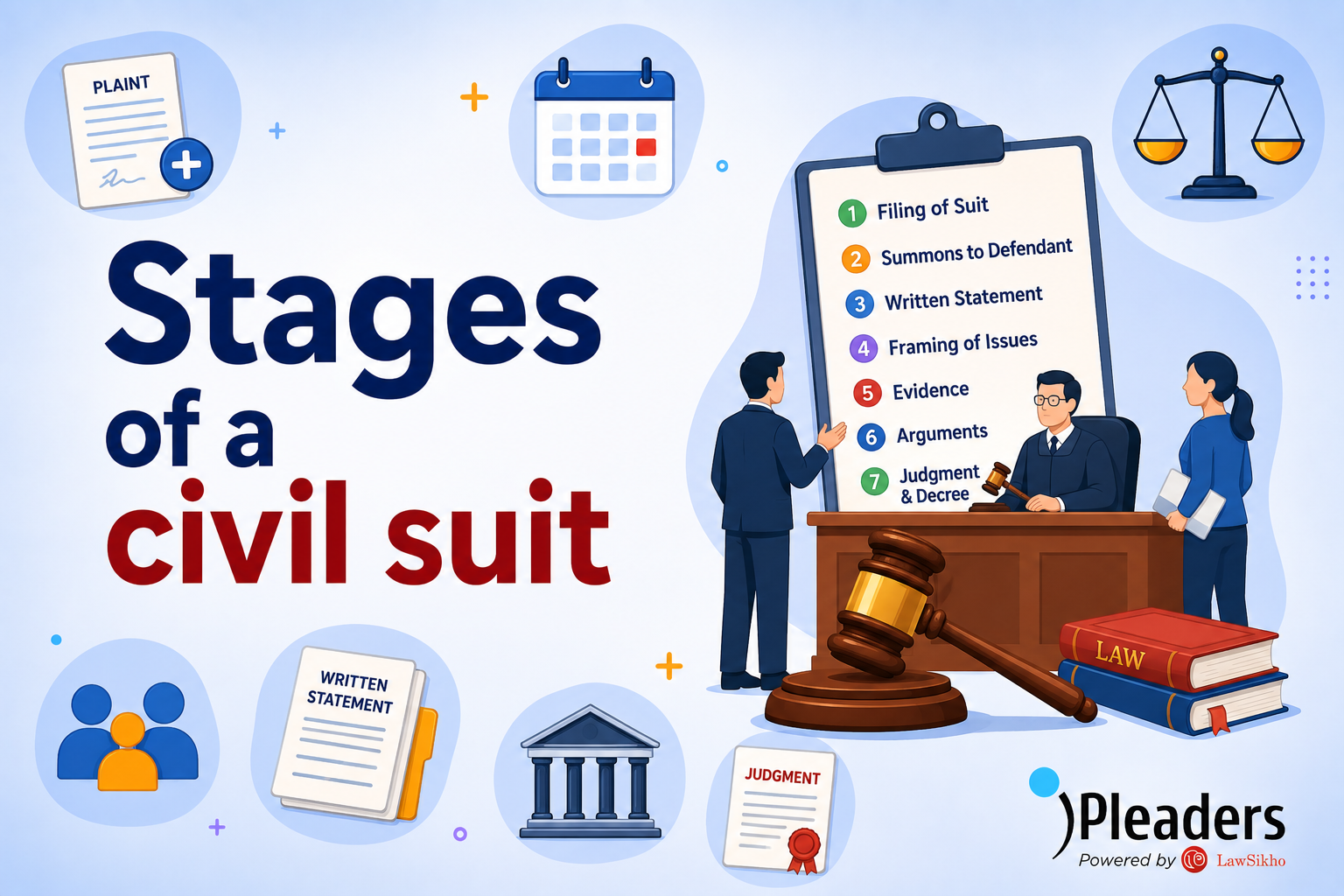


The stages of a civil suit under the Code of Civil Procedure, 1908 run in three phases: institution (plaint to written statement), adjudication (framing of issues, evidence, judgment and decree), and execution of the decree. Each phase has fixed steps and timelines.
In a 2025 ruling, the Supreme Court, in Periyammal (Dead) through LRs v. V. Rajamani, 2025 INSC 329, directed that execution proceedings should ordinarily be completed within six months of filing, and that the presiding officer must record reasons in writing for any delay beyond that. The Court held that a party cannot stall execution with belated objections under Order XXI, and that the executing court must give effect to the decree as it stands. The ruling is a reminder that winning a decree is only the mid-point of a civil suit, not its end.

This article sets out the stages of a civil suit in the order they occur, from filing the plaint to executing the decree, with the governing sections of the Code of Civil Procedure, 1908 at each step.
The three stages of a civil suit at a glance
The stages of a civil suit fall into three phases: institution of the suit, adjudication of the dispute, and execution of the decree. The Code of Civil Procedure, 1908 (CPC) governs each phase, splitting the substantive framework into its Sections and the procedural mechanics into its Orders and Rules.

Institution covers everything from choosing the right court to the close of pleadings: the plaint, the summons, and the defendant’s written statement. Adjudication is the court’s work: framing the issues in dispute, recording evidence, hearing arguments, and delivering a judgment followed by a decree. Execution is the enforcement phase, where the successful party recovers what the decree awarded.
Commentators often break these three phases into a longer list, and some study notes count as many as eighteen separate stages. The longer lists are the same lifecycle cut more finely; the three-phase map is the frame that holds them together. For a section-by-section tour of how the Orders are arranged, iPleaders’ primer on the basics of civil procedure from Order 1 to 21 is a useful companion.
The stages run in sequence, and a step skipped or done badly narrows what is possible later. A plaint filed in the wrong court can be returned; a plea not taken in the written statement can be shut out; a decree left unexecuted can lapse into a dead letter. The order of the stages is the logic of the suit.
Stages of a civil suit: the three phases
From institution of the suit to execution of the decree under the CPC, 1908
1
Institution of the suit
Plaint filed in the court with jurisdiction (Section 26, Order VII) → summons to the defendant (Order V) → written statement within 30 to 90 days (Order VIII) → replication and close of pleadings.
2
Adjudication: from issues to judgment
Framing of issues (Order XIV) → discovery and admissions (Orders XI to XII) → evidence and cross-examination (Order XVIII) → final arguments → judgment and decree (Order XX).
3
Execution of the decree
Execution application by the decree-holder (Order XXI) → mode chosen: delivery, attachment and sale, arrest, or receiver → objections decided by the executing court (Section 47).
Stage one: institution of the suit
A civil suit is instituted by presenting a plaint to the court that has jurisdiction to try it. The plaint is the plaintiff’s written statement of claim, and its presentation, under Section 26 and Order VII of the CPC, is the formal act that starts the suit.
Jurisdiction and where to file
Jurisdiction decides which court can hear the suit, and getting it wrong sends the plaint back before it is even numbered. A civil court’s competence is tested on three axes: pecuniary jurisdiction (the value of the suit), territorial jurisdiction (where the cause of action arose or the defendant resides, under Sections 15 to 20), and subject-matter jurisdiction (whether that class of court can try that kind of dispute).
Section 9 of the CPC gives civil courts the power to try all suits of a civil nature except those expressly or impliedly barred. The plaintiff must place the suit in the lowest court competent to try it. iPleaders’ explainer on the jurisdiction of civil courts works through the pecuniary and territorial tests with examples.
The plaint and court fees
The plaint must state the facts constituting the cause of action, the relief claimed, and the particulars required by Order VII, and it must carry the requisite court fee. A defective plaint can be rejected under Order VII Rule 11, so the drafting matters as much as the filing. The plaintiff files the plaint with the court, pays the court fee calculated on the value of the relief, and the suit is entered in the register of civil suits.
Drafting the plaint is where a claim is won or lost on paper, because the relief the court can grant is bounded by what the plaint asks for. For a worked example of building a money claim from the cause of action up, LawSikho’s guide on drafting a money recovery suit shows how the pleadings translate a dispute into a suit. iPleaders’ step-by-step walkthrough of how to file a civil suit in India covers the vakalatnama, the court-fee mechanics and the filing counter in more detail.
Limitation and pre-litigation mediation
Limitation fixes the outer time limit for filing, and a suit filed after it is liable to be dismissed even if no one raises the point. The Limitation Act, 1963 prescribes the period for each kind of suit, running from the date the cause of action accrued, and Section 3 requires a court to dismiss a time-barred suit whether or not limitation is pleaded as a defence.
For commercial disputes that do not need urgent interim relief, a further step comes before institution. Section 12A of the Commercial Courts Act, 2015 makes pre-institution mediation mandatory, and the Supreme Court has held the requirement to be binding. The wider Mediation Act, 2023 now provides the general framework for mediated settlements, which take effect as if they were a court decree.
Stage two: summons, written statement and pleadings
Once the plaint is admitted, the court issues summons to the defendant, and the pleadings stage begins. Summons is the court’s formal notice to the defendant that a suit has been filed and that they must appear and answer it.
Summons to the defendant
Summons is issued under Section 27 and Order V of the CPC, and it is the step that brings the defendant before the court. It is served by the court, and the mode of service, whether personal, by post, or by electronic means where the rules allow, must be one the CPC recognises, because defective service can unravel everything built on it. If the defendant is served and still does not appear, the court can proceed ex parte and decide the suit in their absence.
Written statement, set-off and counterclaim
The written statement is the defendant’s reply to the plaint, and it must be filed within thirty days of service, extendable to ninety days with the court’s leave. Under Order VIII of the CPC, the defendant must deal specifically with each allegation in the plaint, because a fact not denied is treated as admitted. The written statement is also where the defendant raises a set-off (a cross-claim for money that adjusts the plaintiff’s demand) or a counterclaim (an independent claim the defendant presses against the plaintiff in the same suit).
For commercial suits, the ninety-day outer limit is treated as mandatory, and courts have refused written statements filed beyond it. This is one of the places where the general track and the commercial track of a civil suit diverge sharply, so the type of suit dictates how much slack the timeline carries.
Replication and completion of pleadings
Replication is the plaintiff’s reply to new matter raised in the written statement, and it closes the pleadings. It is not filed as of right; the plaintiff needs the court’s leave, and it is confined to answering the defendant’s new pleas rather than repeating the plaint. Once the plaint, the written statement and any replication are on record, the pleadings are complete and the suit is ready for the court to identify what is actually in dispute.
Stage three: framing of issues and the trial
After pleadings close, the court frames the issues and the suit proceeds to trial. Issues are the specific questions of fact and law on which the parties disagree, and they set the agenda for the entire trial.
Framing of issues
Issues are framed by the court under Order XIV of the CPC, from the plaint, the written statement, and the examination of parties. Before framing them, the judge can examine the parties under Order X to pin down admissions and narrow the dispute. Each issue is a distinct point the court must decide, and the burden of proving each one is assigned to a party. A well-framed set of issues tells everyone in the courtroom exactly what has to be proved and by whom.
Discovery, inspection and admissions
Discovery lets each side compel the other to disclose documents and answer questions before trial, so that neither is ambushed by evidence they have never seen. Under Orders XI and XII of the CPC, a party can seek discovery of documents, administer interrogatories (written questions the other side must answer on oath), and call on the opponent to admit facts or documents. Admissions obtained at this stage cut down what has to be proved at trial, which shortens the evidence phase.
Evidence and examination of witnesses
The trial is where the parties lead evidence to prove the issues, and the plaintiff ordinarily goes first. Evidence is recorded under Order XVIII of the CPC, and it is governed by the Bharatiya Sakshya Adhiniyam, 2023, which replaced the Indian Evidence Act, 1872. A witness gives evidence-in-chief (the party’s own version, now usually filed as an affidavit), then faces cross-examination by the opposing side, and may be re-examined to clear up points raised in cross.
Documentary evidence is exhibited and proved alongside the oral testimony, and the court records it issue by issue. Cross-examination is the engine of the trial, because it is where the reliability of a witness and the weight of a document are actually tested. Once both sides have led their evidence, the recording of evidence is closed.
Final arguments
Final arguments are where each side takes the recorded evidence and the framed issues and argues how the court should decide each one. Counsel for the plaintiff and the defendant address the court on the facts proved and the law that applies, often supported by written submissions and cited judgments. The arguments do not add evidence; they interpret what is already on record. After hearing them, the court reserves the matter for judgment.
Stage four: judgment and decree
The court pronounces judgment on the issues, and a decree follows from it. Judgment is the court’s reasoned decision; the decree is the formal expression of the rights the judgment determines.
Judgment
Judgment is the statement of the court’s decision on every issue, together with the reasons for it, delivered under Section 33 and Order XX of the CPC. It sets out the findings on each issue, the relief granted or refused, and the costs. The judge signs and dates the judgment when pronouncing it, and it is pronounced in open court. From the judgment, the operative relief is carried into the decree.
The decree and how it is drawn up
A decree is the formal, enforceable adjudication of the parties’ rights, defined in Section 2(2) of the CPC as the conclusive determination of the rights of the parties on the matters in controversy. It is drawn up under Order XX Rules 6 and 7, bears the date of the judgment, and states precisely what each party must do. The distinction between the three key documents matters at execution: a judgment reasons to the result, a decree is the enforceable order that flows from it, and an “order” is the formal expression of any other decision that does not conclusively determine the suit. Only a decree (or an order made executable) can be executed, which is why the decree is drawn up with such care.
Stage five: execution of the decree
Execution is the stage where the successful party actually recovers what the decree awarded. It is the process by which the court compels the losing party, the judgment-debtor, to carry out the decree in favour of the winning party, the decree-holder.
How execution is applied for and which court executes
Execution begins with an application by the decree-holder to the court that passed the decree or to the court to which it is sent for execution. Sections 36 to 38 and Order XXI of the CPC govern the machinery, and the application sets out the decree, the relief sought, and the mode of execution requested. The court that passed the decree can execute it, or can transfer it to a court within whose jurisdiction the judgment-debtor or their property is located. iPleaders’ detailed treatment of the execution of a decree under the CPC traces the application procedure end to end.
Modes of execution
A decree can be executed in several ways, and the decree-holder chooses the mode that fits the relief. Order XXI allows the court to enforce a decree by delivery of the property decreed, by attachment and sale of the judgment-debtor’s property, by arrest and detention of the judgment-debtor in civil prison in limited cases, or by the appointment of a receiver. The right mode depends on what the decree is for: a decree for possession is executed by delivery, a money decree by attachment and sale, and a decree for specific performance by a direction to execute the required document. The full menu, with the limits on each, is set out in iPleaders’ guide to the modes of execution.
Objections and delay
Objections in execution are decided by the executing court itself, and they cannot be used to reopen the decree or to stall enforcement indefinitely. Section 47 of the CPC requires all questions between the parties relating to the execution, discharge or satisfaction of the decree to be decided by the executing court, not by a separate suit. In Periyammal (Dead) through LRs v. V. Rajamani, the Supreme Court held that belated objections under Order XXI cannot be allowed to defeat a decree, directed executing courts to conclude execution within six months, and reiterated that the executing court cannot go behind the decree. Execution has long been the stage where decrees go to die, and the 2025 directions are aimed squarely at that delay.
Modes of execution under Order XXI
How a decree-holder can enforce a decree against the judgment-debtor
1Delivery of property
The court delivers the specific property the decree awards. Used for a decree for possession of movable or immovable property.
2Attachment and sale
The judgment-debtor’s property is attached and sold, and the proceeds satisfy the decree. The standard route for a money decree.
3Arrest and detention
The judgment-debtor is arrested and detained in civil prison. A limited, last-resort mode, hedged with safeguards against a debtor who cannot pay.
4Appointment of a receiver
The court appoints a receiver to manage the property and realise its income for the decree-holder. An equitable mode used where the others do not fit.
How long do the stages of a civil suit take, and can any be shortened?
A contested civil suit in India commonly runs for several years across its stages, and while specific stages can be compressed, none can be skipped. The bulk of the time is usually consumed by the evidence stage and by execution, where adjournments and objections accumulate. The three-phase structure is fixed by the CPC, but the Code itself builds in faster tracks for particular kinds of cases.
Summary suits under Order XXXVII are the clearest example: for certain debt and negotiable-instrument claims, the defendant cannot defend as of right and must first obtain the court’s leave, which cuts out much of the ordinary trial. Commercial disputes above the specified value run on the commercial courts track, with tighter timelines for written statements, case management hearings, and disposal. Pre-institution mediation, interim relief, and well-drafted admissions can each shorten the road, but they work within the sequence of stages, not around it.
Delay is heaviest at the two ends the litigant cares about most: getting to a judgment, and enforcing it. The 2025 execution directions address the second; case-management timelines under the commercial track address the first. For an ordinary civil suit outside these tracks, realistic planning still assumes a multi-year horizon from plaint to satisfied decree.
Appeals, review and revision after judgment
A party dissatisfied with the judgment can challenge it through appeal, review or revision, each within its own limits. These remedies sit after the decree but are part of the same lifecycle, because a decree under challenge may not be the last word.
A first appeal lies under Section 96 of the CPC against an original decree, and it can reexamine both the facts and the law. A second appeal lies under Section 100 only on a substantial question of law, which is a far narrower gate. Reference under Section 113 lets a subordinate court refer a question of law to the High Court, and revision under Section 115 lets the High Court correct a subordinate court that has exercised a jurisdiction it did not have, or failed to exercise one it did.
Review under Section 114, read with Order XLVII, is different in kind, because it asks the same court to reconsider its own decree, and it is confined to narrow grounds such as a mistake apparent on the face of the record or the discovery of important new evidence. Appeal goes up, review stays put, and revision is a supervisory check. Which remedy fits depends on what went wrong: an error of fact points to appeal, an error apparent on the record points to review, and a jurisdictional error points to revision.
Frequently asked questions
What are the three main stages of a civil suit?
The three main stages of a civil suit are institution of the suit (filing the plaint through to the close of pleadings), adjudication of the dispute (framing of issues, evidence, arguments, judgment and decree), and execution of the decree (enforcing what the court has awarded). The Code of Civil Procedure, 1908 governs all three.
What is the first stage of a civil suit?
The first stage of a civil suit is its institution, which happens when the plaintiff presents a plaint to the court that has jurisdiction and pays the court fee. Under Section 26 and Order VII of the CPC, the presentation of the plaint is the act that formally starts the suit.
What is the difference between a judgment and a decree?
A judgment is the court’s reasoned decision on the issues, while a decree is the formal, enforceable expression of the rights that judgment determines, as defined in Section 2(2) of the CPC. The judgment reasons to the result; the decree is the operative order that can be taken to execution.
How is a decree executed under the CPC?
A decree is executed on an application by the decree-holder under Order XXI of the CPC, through modes such as delivery of property, attachment and sale of the judgment-debtor’s property, arrest and detention, or appointment of a receiver. The executing court decides all objections relating to execution under Section 47, and, following the 2025 Supreme Court directions, is expected to conclude execution within six months.
How many stages are there in a civil suit under CPC, 1908?
There is no fixed statutory count; commentators variously describe eight, twelve or eighteen stages, but they are all subdivisions of the same three phases of institution, adjudication and execution. The longer lists simply separate steps such as summons, framing of issues, evidence and final arguments into their own entries.
References
Case Law
- Periyammal (Dead) through LRs v. V. Rajamani, 2025 INSC 329: [2025] 3 SCR 540; Supreme Court, 6 March 2025.
Statutes
- Code of Civil Procedure, 1908: Sections 9, 15-20, 26, 27, 33, 36-38, 47, 96, 100, 113, 114, 115; Orders V, VII, VIII, X, XI, XII, XIV, XVIII, XX, XXI, XXXVII, XLVII.
- Limitation Act, 1963: Section 3.
- Commercial Courts Act, 2015: Section 12A.
- Mediation Act, 2023.
- Bharatiya Sakshya Adhiniyam, 2023: governs evidence in civil trials.
Disclaimer
This article is for informational and educational purposes only and does not constitute legal advice. The stages, timelines and provisions described are general in nature and may vary with the type of suit, the court, and later amendments. For advice on a specific dispute, consult a qualified advocate.

