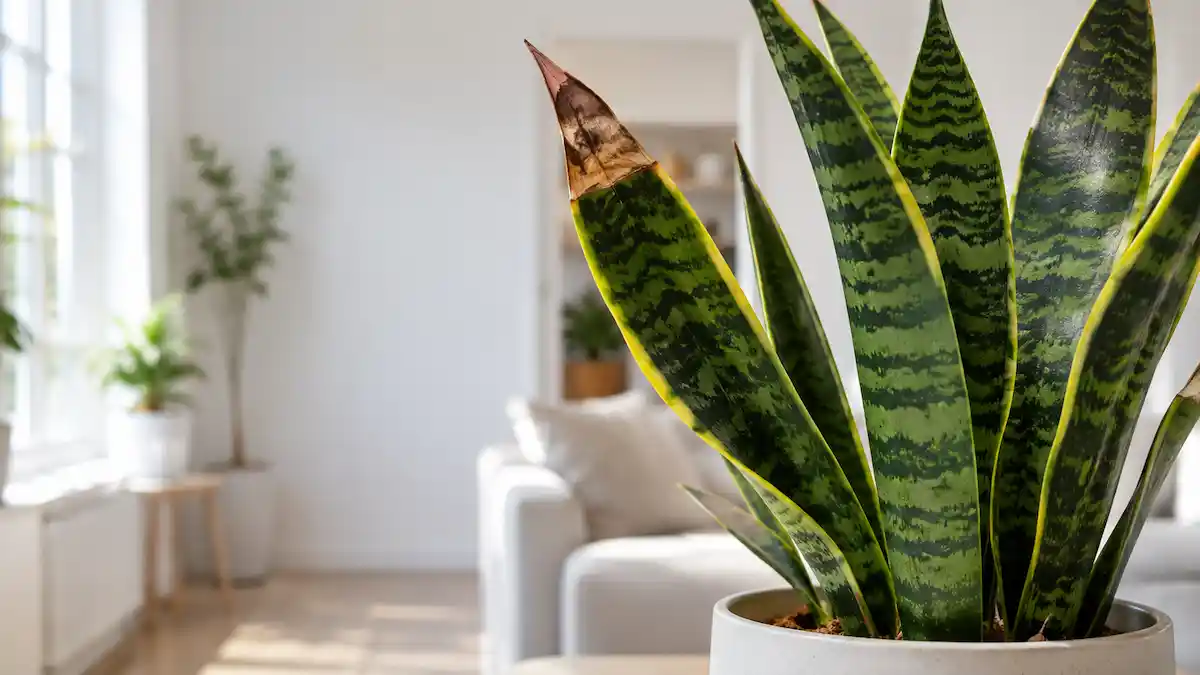

Brown tips on a snake plant are usually a sign of watering stress, root problems, salt buildup, environmental stress, or physical damage. The brown tissue won’t turn green again, but identifying and correcting the cause can keep healthy leaves and new growth from developing the same problem.
This applies to Dracaena trifasciata, formerly classified as Sansevieria trifasciata, and its many common varieties. Almost every case traces back to watering habits, water quality, salt buildup, or root stress.


Brown tissue is dead tissue and it won’t turn green again. But it also won’t spread on its own unless the original cause keeps repeating, and most cases are simple to stop once you know what caused them.
Quick Diagnosis: Match Your Symptom to the Cause
Start here. Find what your leaves look like, then jump to that section for the full fix.
| Symptom | Most Likely Cause | Solution |
|---|---|---|
| Brown, dry, curling tips | Underwatering | Water deeply, then wait |
| Brown, soft tips or base | Root rot | Unpot and inspect roots |
| Brown tips with white crust | Salt buildup | Flush the soil |
| Brown after fertilizing | Fertilizer burn | Stop feeding, flush pot |
| Brown edges, bleached patches | Sunburn | Move to indirect light |
| Sudden brown after a cold spot | Cold draft damage | Move away from vent |
| Only oldest leaves affected | Natural aging | Trim, no action needed |
If you are unsure about it, try our plant doctor interactive tool.
Severity Scale: How Urgently Should You Act?
| Cause | Severity | Action Timing |
|---|---|---|
| Natural aging | Low | Ignore or trim anytime |
| Low humidity | Low | Monitor over weeks |
| Salt buildup | Medium | Fix within a month |
| Fertilizer burn | Medium | Fix within a month |
| Root rot | High | Act within days |
Visual Diagnosis: What Your Brown Tips Look Like
If a photo comparison would help more than a description, match the appearance here first.
| Brown Tip Appearance | Likely Cause |
|---|---|
| Dry and crispy | Underwatering |
| Soft and dark | Root rot |
| White crust at the edge | Salt buildup |
| Bleached or papery | Sunburn |
| Sudden, after cold air | Cold draft |
How Long Does It Take to Fix Snake Plant Brown Tips?
Existing brown tissue never heals, no matter what causes it. What can change is how soon the underlying problem stops progressing and clean new growth starts to appear. These are rough, approximate ranges, not guarantees, since actual timing depends heavily on light, temperature, and the plant’s overall condition.
| Problem | When Improvement May Become Noticeable |
|---|---|
| Underwatering | Roughly 1 to 2 weeks |
| Salt buildup | Roughly 2 to 4 weeks |
| Fertilizer burn | Roughly 3 to 6 weeks |
| Root rot | Roughly 1 to 2 months |
| New, clean growth | Roughly 1 to 2 months |
When Not to Worry About Brown Tips
- Only one old, outer leaf is affected
- It appeared shortly after repotting
- It appeared shortly after shipping or a move
- It appeared after a cold winter stretch
- Only the very tip is damaged, not the wider leaf
- The stem or base feels mushy
- There’s a foul or sour smell from the soil
- The base of the leaves is turning yellow
- Brown or black rot is spreading, not staying at the tip
- Roots are black and mushy when checked
Why Does My Snake Plant Have Brown Tips?
Brown tips form when the leaf margin loses water faster than the plant, a CAM-type succulent, can replace it, or when minerals concentrate at the tip and damage the tissue. Snake plants push moisture and salts toward the leaf edges as they transpire, so the tip shows stress first.
If you’ve kept the same snake plant for several years, you’ll usually notice the oldest, outermost leaves develop brown tips first while newer growth stays clean. That pattern is normal aging, not disease, and it’s one of the clearest signs experienced growers learn to recognize.
How to Recognize Brown Tips Before They Spread Across the Leaves
Early damage looks like a thin tan or brown line right at the leaf tip, sometimes with a faint yellow halo. Catch it here and the rest of the leaf usually stays healthy.
Left alone, the brown zone widens down the leaf and turns crisp and papery. That’s the point where trimming becomes necessary instead of optional.
Can Brown Snake Plant Tips Turn Green Again or Are They Permanent?
No. Brown leaf tissue is dead and won’t recover, since Sansevieria doesn’t regrow damaged sections the way some plants do. New, healthy growth appears once the underlying cause is corrected, usually within four to eight weeks.
12 Common Causes of Snake Plant Brown Tips
Nearly every case can be traced to one of these common causes, covering everything from watering to pests.
| Cause | Quick Sign | Fast Fix |
|---|---|---|
| Underwatering | Dry, curling leaves | Water deeply, then wait |
| Overwatering | Soft, mushy base | Let soil dry fully |
| Low humidity | Crispy tip edges | Group plants, add tray |
| Salt buildup | White soil crust | Flush pot with water |
| Too much fertilizer | Burn on new growth | Flush, feed less often |
| Tap water minerals | Tip burn over time | Switch to filtered water |
| Direct hot sun | Bleached, scorched patches | Move to indirect light |
| Cold drafts | Sudden tip damage | Move away from vents |
| Root-bound pot | Roots circling, poking out | Repot one size up |
| Poor drainage | Water sits on top | Add drainage, better mix |
| Pests | Sticky residue, webbing | Treat with soap spray |
| Natural aging | Only oldest leaves affected | Trim, no action needed |
How Underwatering Causes Brown and Crispy Leaf Tips
Snake plants store water in thick, succulent leaves, but they still need a real drink occasionally. Wait too long between waterings, especially in a small pot, and the tips dry out first since they sit farthest from the root system.

Leaves often look slightly wrinkled or dull before the tips brown. A small plastic pot dries out faster than terracotta, so the same schedule can leave one plant fine and another drying out.
Image suggestion: close-up of a dry, curling snake plant leaf tip. Alt text: “snake plant brown tips from underwatering.”
Expert Tip: Snake plants tolerate underwatering far better than consistently wet soil. If you’re unsure whether to water, checking soil dryness first is safer than watering on schedule.
Why Overwatering Can Lead to Brown Tips and Root Damage
This sounds counterintuitive, but it’s the most common cause overall. Overwatering suffocates the root ball, and damaged roots can’t move water up to the leaf tips, so edges brown even while the soil stays wet.

A sour or swampy smell from the potting mix is a stronger warning sign than the leaves, since roots fail before damage shows up top.
Image suggestion: snake plant root ball showing dark, mushy roots. Alt text: “snake plant brown tips from root rot.”
Expert Tip: A pot with no drainage hole turns an otherwise reasonable watering schedule into overwatering. Fixing the pot often solves the problem faster than adjusting how often you water.
How Low Indoor Humidity Affects Snake Plant Leaf Tips
Heating and air conditioning both strip moisture from indoor air. Snake plants tolerate dry air better than most houseplants, but very low relative humidity near vents or radiators still stresses the thinnest part of the leaf.
This shows up seasonally, worse in winter with heating running. Rooms under 30 percent humidity for weeks at a stretch are where this becomes a real factor.
Salt Buildup in the Soil and Its Impact on Leaf Health
Every watering leaves trace minerals from tap water and fertilizer behind. Over months, those minerals concentrate in the potting mix and at the leaf tips through osmotic stress, since that’s where water exits the plant.
A white or crusty layer on the soil surface or pot rim is the clearest sign. Terracotta pots make this easy to spot since the crust shows through the porous clay.
Expert Tip: Flushing the pot every couple of months is easier and cheaper than switching water sources entirely, and it solves salt buildup regardless of what’s causing it.
Can Too Much Fertilizer Burn Snake Plant Leaf Tips?
Yes, and it’s an easy mistake since snake plants need so little feeding. Excess fertilizer salts build up faster than the plant can use them, burning tender new leaf tips first through the same osmotic stress that drives salt buildup damage.

A slow grower simply doesn’t need monthly full-strength feeding, no matter what a general houseplant label recommends.
Image suggestion: yellow-brown burn marks on new snake plant growth. Alt text: “snake plant brown tips from fertilizer burn.”
How Tap Water Containing Fluoride or Chlorine Causes Brown Tips
Dissolved salts and minerals in irrigation water, including chlorine and fluoride compounds found in some municipal supplies, can contribute to tip burn in certain situations, particularly once those minerals accumulate in the potting medium over repeated waterings.
Suspect this cause when you’re doing everything else right and tips still keep browning. This pattern is worth investigating regardless of your water source, since the accumulation happens gradually rather than from any single watering.
Can Too Much Direct Sunlight Scorch Snake Plant Leaves?
Snake plants handle bright indirect light well, but harsh direct afternoon sun through glass can scorch leaf surfaces and tips, especially on a plant recently moved from lower light.

Scorch marks look bleached or papery rather than simply brown, often on the sun-facing side only. A plant moved outdoors for summer without a gradual adjustment period is especially prone to this.
Image suggestion: snake plant leaf with a bleached, papery sunburn patch. Alt text: “snake plant brown tips from sunburn.”
How Cold Drafts and Temperature Changes Damage Leaf Tips
Sansevieria is a tropical succulent and reacts badly to cold air, whether from a drafty window, an exterior door, or an air conditioning vent blowing directly on it.
Cold damage often appears suddenly, within a day or two of exposure. Temperatures below 50°F (10°C) for extended periods are typically where cold stress starts.
Why Root-Bound Snake Plants Develop Brown Leaf Tips
A snake plant that has outgrown its pot has less potting mix available to hold moisture and nutrients evenly. Roots and rhizomes circling the pot base struggle to take up water efficiently, and tip browning follows.
Roots visibly poking through the drainage hole are the clearest sign it’s time to repot. A plant that dries out faster than it used to is showing the same signal.
Poor Drainage Problems That Often Lead to Brown Tips
A pot without a drainage hole, or a dense mix that holds too much water, creates the same root stress as overwatering, even on a reasonable watering schedule.
Water sitting visibly on the soil surface an hour after watering is a strong sign drainage needs fixing, often by adding perlite or pumice.
Common Pests That Can Damage Snake Plant Leaves
Spider mites and mealybugs are the two pests most likely to affect Sansevieria. Both feed on leaf tissue and can cause browning, especially near tips and edges where tissue is thinnest.
Fine webbing or small cottony clusters near the leaf base are the giveaway signs, distinct from the uniform tip-only pattern of watering or mineral issues.
When Brown Tips Are Simply a Sign of Natural Leaf Aging
Snake plant leaves live for years but not forever. The oldest, outermost leaves naturally brown and die back as the plant channels energy into newer growth.
If only the oldest one or two leaves are affected and the rest of the plant looks healthy, this is normal and needs no intervention beyond a trim.
Brown Tips After Repotting, Propagation, or a Recent Move
Brown tips also show up after specific events rather than ongoing care habits. These cases confuse a lot of growers because the plant was previously fine.
Brown Tips After Repotting or Dividing the Plant
Cutting rhizomes to divide a snake plant, or disturbing roots during repotting, causes short-term stress that can brown a few tips within a week or two. This usually resolves on its own without further action.

Hold off on watering for several days after repotting so any cut root surfaces can dry and callus over before sitting in moist soil.
Brown Tips After Propagation or Cuttings
Leaf cuttings and pups sometimes show tip browning while establishing new roots, since the cutting is drawing on limited stored moisture. Water propagation especially can leave roots poorly adapted to soil, so tip stress after transplanting into potting mix is common.
Brown Tips After Moving the Plant Indoors for the Season
A snake plant moved from an outdoor patio to indoor light experiences a sudden drop in light intensity and humidity. A few tips browning in the following weeks is a normal adjustment reaction, not a new problem.
Brown Tips After Buying From a Nursery or Garden Center
Nursery-grown plants are often kept in higher humidity and brighter light than most homes provide. The move home is its own transition, and a bit of tip stress in the first month is common even with correct care.
Brown Tips After Shipping, Transport, or Transplant Shock
Plants ordered online travel through cold cargo holds, dark boxes, and days without light or airflow. Cold transport and the stress of transplant shock together commonly cause tip browning in the first few weeks after arrival, even from a healthy supplier.
Give a newly shipped plant two to three weeks in stable, indirect light before making any care changes. Judge it on new growth, not on tips that were already stressed in transit.
Does Snake Plant Variety Affect Brown Tips?
All Sansevieria varieties are prone to the same causes, but leaf shape changes how visible and how serious tip damage looks.
| Variety | Brown Tip Tendency | Note |
|---|---|---|
| Laurentii | Common, visible | Yellow leaf edges hide early browning |
| Moonshine | Very visible | Pale leaf shows contrast quickly |
| Whale Fin | Serious if it happens | Single large leaf, damage is prominent |
| Cylindrical | Less common | Round leaves resist tip drying |
| Black Gold | Common, visible | Dark leaf hides browning less |
Expert Tip: If you grow more than one variety, don’t assume identical care will produce identical results. Judge each plant by its own soil dryness, not by how its neighbor is doing.
Pet Damage and Mechanical Injury vs Brown Tips
Not every damaged tip is a care issue. Cats chewing on leaf tips leave ragged, torn edges rather than the smooth, uniform brown line caused by watering or mineral stress.
Bent or broken leaves from furniture, foot traffic, or a fall also brown at the injury site, but the damage follows the break, not the leaf tip specifically. Neither of these needs a change in watering or feeding, just physical protection or relocation.
Pot Material Comparison: Plastic vs Terracotta vs Ceramic
| Material | Drainage Behavior | Watering Adjustment |
|---|---|---|
| Plastic | Retains moisture longest | Water less often |
| Terracotta | Dries fastest, porous | Water more often |
| Ceramic (glazed) | Retains moisture, no wicking | Check soil closely |
Expert Tip: If brown tips keep returning despite correct watering, the pot material may be working against your habits rather than the schedule itself being wrong.
Best Water Type for Snake Plants
| Water Type | Mineral Content | Tip Burn Risk |
|---|---|---|
| Tap water | Variable, often high | Higher over time |
| Filtered water | Reduced | Low |
| Distilled water | Very low | Very low |
| RO (reverse osmosis) | Very low | Very low |
| Rainwater | Naturally low | Very low |
Brown Tips in Winter vs Summer
| Season | Main Risk | Watering Note |
|---|---|---|
| Winter | Low humidity, cold drafts | Soil dries slowly; check before watering |
| Summer | Direct sun, faster drying | Soil dries faster; check more often |
Indoor vs Outdoor Snake Plants: Different Brown Tip Risks
| Setting | Main Cause | Prevention Tip |
|---|---|---|
| Indoor | Overwatering, dry heat | Check soil, avoid vents |
| Outdoor (mild climate) | Direct sun, rain-soaked soil | Partial shade, drainage |
How to Tell Exactly What’s Causing Brown Tips on Your Snake Plant
Matching symptoms to cause takes a few minutes and saves you from guessing. Here’s the decision path, followed by the detailed checks.
Brown tips? Check the soil first.
Soil wet? Yes: check the roots. No: check for mineral crust or dry soil.
Roots healthy and firm? Yes: likely too much fertilizer or salt buildup. No: root rot.
Soil dry and roots fine? Underwatering or low humidity.
White crust on soil? Salt buildup, regardless of watering habits.
- Feel the soil two inches down. Wet means overwatering or drainage; dry means underwatering or mineral buildup.
- Unpot and check the roots. Dark and mushy means rot; tightly coiled and pale means root-bound.
- Check leaf bases for webbing or cottony spots. If present, it’s pests, not watering.
- Recall any recent change: new fertilizer, new water source, a move, or a repot. Match the timing.
- Check light exposure. Several hours of direct sun points to scorch alongside any watering issue.
Check the Soil Moisture Before Changing Your Watering Routine
Push a finger or wooden skewer two inches into the soil. Bone dry points to underwatering; consistently damp points to overwatering or drainage.
If the skewer comes out clean and dry every time regardless of watering, drainage may be too fast, and mineral buildup becomes the more likely suspect.
Inspect the Roots for Rot, Damage, or Poor Drainage
Gently remove the plant from its pot. Healthy roots are firm and pale. Dark, mushy, or foul-smelling roots confirm rot, almost always tied to overwatering or poor drainage.
Thick, tightly coiled roots with barely any visible soil confirm the plant is root-bound rather than rotting.
Look Closely for Spider Mites, Mealybugs, and Other Pests
Check the leaf base and undersides with a magnifying glass if needed. Fine webbing, tiny moving dots, or white cottony spots point to pests rather than watering or water quality.
Review Your Watering Schedule and Recent Plant Care Changes
Think back over the last month. A new fertilizer, a change in tap water, a move to a sunnier spot, or a recent repot are common triggers worth ruling out first.
Evaluate Whether the Plant Is Getting the Right Amount of Light
Check whether direct sun hits the leaves for several hours daily, particularly in summer. South and west-facing windows without a sheer curtain are the most common spots this happens indoors.
How to Treat Snake Plant Brown Tips Successfully
Once you’ve identified the cause, use the matching solution below.
| Problem | Action to Take | Approximate Timeline |
|---|---|---|
| Overwatering | Stop watering until soil is dry | Roughly 2 to 4 weeks |
| Root rot | Repot, trim dead roots | Roughly 4 to 8 weeks |
| Salt buildup | Flush pot thoroughly | 1 to 2 waterings |
| Mineral-heavy tap water | Try filtered water | New growth only |
| Existing brown tips | Trim with clean scissors | Immediate, cosmetic |
| Poor growing setup | Adjust light, pot, drainage | Ongoing |
Adjust Your Watering Schedule to Prevent Further Leaf Damage
Water only when the top two to three inches of soil are completely dry. That can take anywhere from two to six weeks or longer, depending on pot size, potting mix, light, and season, so check the soil itself rather than watering on a fixed calendar date.

Watering by the calendar instead of by soil moisture is the most common reason a fix doesn’t work on the first try.
Repot the Plant if Root Rot Is Affecting Healthy Growth
Remove the plant, trim dark or mushy roots with clean scissors, and repot into fresh, fast-draining mix. Let cut surfaces air dry for an hour before repotting to reduce infection risk.
Choose a pot only slightly larger than the root ball. An oversized pot holds excess moisture and can restart the same rot problem.
Flush Excess Fertilizer Salts from the Potting Mix
Run water through the pot slowly until it drains freely from the bottom, roughly three times the pot’s volume. This pulls accumulated salts and soil salinity out of the root zone.
Do this every two to three months if you fertilize regularly, even before visible salt crust appears.
Switch to Filtered, Distilled, or Rainwater for Better Results
If tip burn keeps returning despite correct watering habits, dissolved minerals in your water supply are worth considering as a contributing factor. Filtered, distilled, RO, or collected rainwater carries fewer dissolved salts than most tap water.
Leaving tap water out overnight in an open container lets some chlorine evaporate, though it has little effect on dissolved mineral content overall.
Trim Brown Leaf Tips Without Damaging Healthy Tissue
Use clean, sharp scissors and cut at a slight angle, following the leaf’s natural point shape. Cut just into the brown zone, leaving a thin margin rather than cutting flush against green tissue.
Wipe blades with rubbing alcohol between plants to avoid spreading pests or disease.
Improve Growing Conditions to Help New Leaves Stay Healthy
Once the underlying cause is corrected, new leaves should emerge healthy and free of brown tips. Consistent light, correct watering, and occasional flushing stop the same damage from repeating on fresh growth.
Track what you change and when. If tips stop browning within a few weeks, that confirms the real cause.
Should You Cut Off Brown Tips on a Snake Plant?
Yes, trimming brown tips is safe and won’t harm the plant. It’s a cosmetic fix, not a medical one, since the tissue is already dead and disconnected from the plant’s active systems.
The Best Way to Trim Brown Tips While Keeping Leaves Looking Natural
Follow the existing tip shape when cutting rather than making a flat, blunt cut across the leaf. A pointed trim blends in far better than a straight line.

When It Is Better to Remove an Entire Damaged Leaf
If more than a third of the leaf is badly damaged, removing the entire leaf at the soil line may give the plant a cleaner appearance and eliminate severely compromised tissue.
Simple Changes That Stop Brown Tips from Coming Back
Keeping brown tips away is usually easier than fixing them later, and it comes down to five habits.
Water Your Snake Plant Only When the Soil Has Dried Out
Checking soil moisture before every watering, rather than watering on autopilot, prevents more brown tip cases than any other habit.
Expert Tip: A wooden skewer left in the pot between waterings works as a quick built-in soil moisture gauge. Pull it out, and if it’s clean and dry, it’s time to water.
| Season | How Fast Soil Typically Dries | What to Check First |
|---|---|---|
| Spring | Moderate | Top 2 inches of soil |
| Summer | Fastest | Light and heat levels |
| Fall | Slowing down | Slower drying soil |
| Winter | Slowest | Heating vent proximity |
These are general tendencies, not a schedule. Pot size, potting mix, light, airflow, and room temperature all affect drying speed, so check the soil itself before watering every time rather than following a fixed interval.
Choose a Well-Draining Potting Mix for Healthy Root Growth
A cactus or succulent mix, or regular potting soil amended with perlite or pumice, drains fast enough to prevent the constant dampness that damages roots and leaf tips.
A rough mix of two parts potting soil to one part perlite, pumice, or coco coir works well for most home setups.
Use Fertilizer Sparingly to Avoid Leaf Tip Burn
Feed at most once every four to six weeks during spring and summer, at half the label’s suggested strength. Skip feeding entirely in fall and winter.
Protect the Plant from Extreme Heat, Cold, and Drafts
Keep snake plants a few feet from heating vents, air conditioning units, and drafty doors or windows. Stable conditions matter more than any single temperature number.
A room between 60°F and 85°F (15°C to 29°C) year round covers the comfortable range for most Sansevieria varieties.
Create the Ideal Indoor Environment for Long-Term Plant Health
Bright, indirect light, a well-draining pot, and a hands-off watering approach together keep brown tips rare rather than routine.

Signs Your Snake Plant Is Recovering
- New leaf growth appears within four to eight weeks
- New leaves emerge with clean, undamaged tips
- Existing green tissue stays firm, not soft
- No new brown spots form on older leaves
Signs the Problem Is Getting Worse
- Brown zones expanding down the leaf, not just at the tip
- Softness or yellowing spreading from the base upward
- Multiple leaves affected within the same week
- A sour smell from the soil or pot
When to Repot: A Quick Checklist
- Roots visibly circling the pot or poking through the drainage hole
- Soil dries out much faster than it used to
- It’s been two to three years since the last repot
- Water runs straight through without being absorbed
Snake Plant Care Calendar
A month-by-month starting point for relative watering and feeding intensity, not a fixed schedule. Always check actual soil dryness before watering, since pot size, light, and home conditions shift the real timing.
| Month | Water | Fertilizer |
|---|---|---|
| Jan | Low | None |
| Feb | Low | None |
| Mar | Medium | Begin feeding |
| Apr | Medium | Light feeding |
| May | Medium | Light feeding |
| Jun | Medium to high | Light feeding |
| Jul | Medium to high | Light feeding |
| Aug | Medium to high | Light feeding |
| Sep | Medium | Last feeding |
| Oct | Low to medium | None |
| Nov | Low | None |
| Dec | Low | None |
7 Common Snake Plant Care Mistakes That Cause Brown Tips
Watering Too Frequently Without Checking Soil Moisture
Watering on a fixed schedule, like every Sunday, ignores how much actual water needs shift with season, light, and pot size.
Using Heavy Garden Soil Instead of a Fast-Draining Mix
Regular garden soil or dense potting mix holds far more water than Sansevieria roots tolerate, setting up root stress from the start.
Applying Too Much Fertilizer Throughout the Year
Snake plants are slow growers with minimal nutrient needs. Year-round feeding at full strength almost guarantees salt buildup and tip burn.
Ignoring Early Warning Signs of Stress and Leaf Damage
A single browning tip is easy to dismiss, but it’s the plant’s earliest signal. Catching it early stops the damage from spreading to more leaves.
Using the Wrong Pot Material for Your Watering Style
Heavy waterers do better in terracotta, which dries faster. Forgetful waterers often do better in plastic, which holds moisture longer. Mismatching the two is a quiet, ongoing cause of tip stress.
Treating Every Snake Plant Variety the Same Way
A cylindrical variety and a Whale Fin don’t dry out or scorch at the same rate. Applying one generic care routine across different leaf shapes leads to avoidable tip damage on the more sensitive types.
Skipping Seasonal Watering Adjustments
Watering the same amount in January as in July overwaters the plant in winter, when growth and water use both slow down considerably.
Brown Tips vs Other Snake Plant Problems
| Compare | Key Difference | Quick Tell |
|---|---|---|
| Brown tips vs root rot | Rot affects the base first | Check for soft, mushy stems |
| Brown tips vs sunburn | Sunburn bleaches, not just browns | Check for papery patches |
| Brown tips vs pest damage | Pests leave webbing or spots | Check leaf base closely |
| Brown tips vs natural aging | Aging affects oldest leaves only | Check which leaves are affected |
| Brown tips vs fertilizer burn | Burn hits new growth first | Check timing after feeding |
Frequently Asked Questions About Snake Plant Brown Tips
Why does my snake plant have brown tips?
Snake plant brown tips are usually caused by underwatering, overwatering, fertilizer salt buildup, dissolved mineral buildup in the potting soil, or low humidity. Brown tissue can’t turn green again, but correcting the cause stops future damage.
Should I cut off brown tips from my snake plant?
Yes. Trim only the brown tissue with sterilized scissors, following the leaf’s natural point shape, so the leaf keeps its natural look.
Can brown tips spread to healthy leaves?
Brown tissue itself doesn’t spread, but the underlying cause, like overwatering or salt buildup, keeps damaging new tips until it’s fixed. Treat the cause, not just the symptom.
Is tap water bad for snake plants?
Most tap water is fine for occasional use, but dissolved minerals can accumulate in the soil over time and contribute to tip burn. If tip burn keeps recurring, filtered or distilled water is worth trying.
How long does it take for a snake plant to recover?
Existing brown tips never heal, but new, healthy leaves typically appear within four to eight weeks once the underlying cause is corrected.
Can brown tips be caused by overwatering or underwatering?
Yes, both extremes cause brown tips through different mechanisms. Underwatering dries the tip directly, while overwatering damages roots and blocks water delivery to the tip.
Does snake plant variety affect brown tips?
All snake plant varieties can develop brown tips, although their susceptibility and how visible the damage appears can vary with leaf shape, growing conditions, and care. Pale or large-leafed varieties like Moonshine and Whale Fin tend to show tip damage more visibly than darker or cylindrical types.
Why does my new snake plant have brown tips after shipping?
Cold transport, days without light, and transplant shock commonly cause a few brown tips in the first few weeks after arrival. Give it two to three weeks in stable conditions before changing anything.
Key Takeaways for Healthy Snake Plant Leaves
- Brown tips are permanent, but new growth comes in clean once the cause is fixed
- Water only when the top two to three inches of soil are fully dry
- Salt buildup and fertilizer burn are easy to prevent with occasional flushing and light feeding
- If dissolved minerals continue to cause recurring tip burn, switching to filtered, distilled, or rainwater may help reduce future damage
- Brown tips after repotting, shipping, or a recent move are usually temporary stress, not a care mistake
- Trim damaged tips anytime; it’s cosmetic and won’t harm the plant
For a deeper look at root-level issues, see this guide on why snake plants develop root rot and mushy stems. If you’re repotting, dividing, or setting up a new plant, this step-by-step potting and care guide covers soil, pot size, and propagation in detail. And if you want the full case for why this plant is worth the effort, here are 20 benefits of growing snake plants indoors.
For additional science-based guidance, see the Iowa State University Extension guide to Sansevieria care and the Colorado State University Extension snake plant fact sheet.
Disclaimer: Information on this site is for educational purposes only. Results vary by climate, soil, weather, and growing conditions. For region-specific advice, consult your local Cooperative Extension Service before making major gardening or soil changes.

