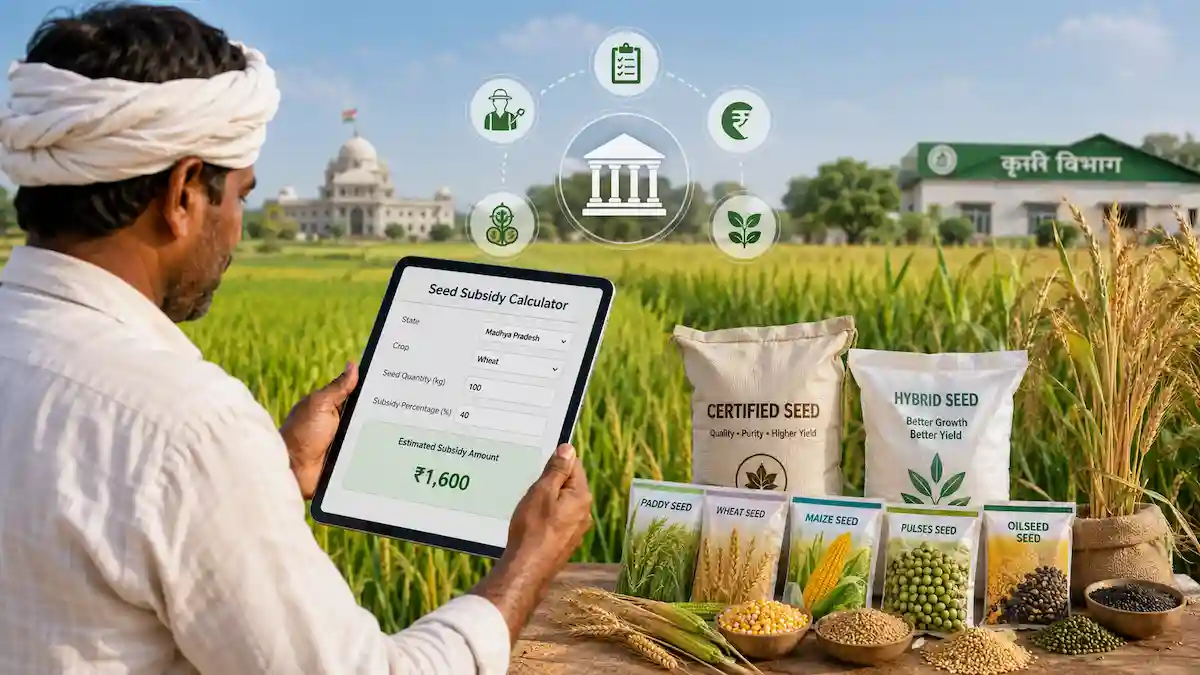

Last updated according to the latest available Central and State Government notifications.
Seed subsidy is financial assistance given by central and state governments to lower the cost of certified or hybrid seeds for farmers. The amount depends on your state, crop, seed category, and farmer type, usually paid through Direct Benefit Transfer.

Estimate your subsidy for purchasing certified/quality seeds under state seed distribution schemes.
Scheme
Eligible Subsidy
Subsidy Percentage
Maximum Subsidy
Farmer Contribution
Central Govt. Share
State Govt. Share
Last Updated
Frequently Asked Questions
Certified or quality seed of notified varieties, purchased through authorized government or state seed corporation outlets, generally qualifies under seed distribution schemes.
Seed subsidy is typically available every cropping season, since seed is a recurring input, subject to per-farmer quantity limits set by the state.
Disclaimer: Figures shown are indicative estimates based on published scheme guidelines and may change without notice. Always verify current subsidy rates, caps, and eligibility with the concerned government department before making financial decisions.
Government notifications are updated regularly, and the numbers differ by district in some cases. Because of that, many farmers are unsure how much subsidy they will actually receive before buying seeds. A seed subsidy calculator removes that guesswork. Enter your state, crop, and seed quantity, and you get a working estimate before you spend a rupee.

Quick Facts: Seed Subsidy in India
| Item | Details |
|---|---|
| Eligible Farmers | Small, Marginal, Tenant (as per state rules) |
| Seed Types Covered | Certified, Hybrid, Foundation |
| Typical Subsidy Range | Up to 80% of seed cost, varies by state and crop |
| Payment Mode | Direct Benefit Transfer (DBT) |
| Lead Authority | State Agriculture Department |
| Central Schemes Involved | NFSM, RKVY, Seed Village Programme |
Calculate Your Seed Subsidy
The calculator below (shortcode
Estimate your subsidy for purchasing certified/quality seeds under state seed distribution schemes.
Scheme
Eligible Subsidy
Subsidy Percentage
Maximum Subsidy
Farmer Contribution
Central Govt. Share
State Govt. Share
Last Updated
Frequently Asked Questions
Certified or quality seed of notified varieties, purchased through authorized government or state seed corporation outlets, generally qualifies under seed distribution schemes.
Seed subsidy is typically available every cropping season, since seed is a recurring input, subject to per-farmer quantity limits set by the state.
Disclaimer: Figures shown are indicative estimates based on published scheme guidelines and may change without notice. Always verify current subsidy rates, caps, and eligibility with the concerned government department before making financial decisions.
) runs on four inputs. Each one narrows the estimate closer to what your district agriculture office would actually approve.
✓ Estimate subsidy instantly
✓ Compare state-wise benefits
✓ Calculate your farmer contribution
✓ Plan your seed purchase budget
Select Your State
Your state decides which department runs the scheme and what base percentage applies. Andhra Pradesh and Telangana, for instance, often notify higher rates than several other states for the same crop.
Choose the Crop
Rice, wheat, and coarse cereals usually fall under NFSM. Oilseeds and pulses run on a separate rate table, often with a higher percentage to encourage more acreage under these crops.
Enter Seed Quantity and Price
Enter the quantity in kilograms or quintals along with the price on your seed invoice or vendor quote. This becomes your base seed cost for the calculation.
Tip: Use the actual billed price, not a rough estimate. Subsidy is calculated on your invoice value or the approved state cost norm, whichever is lower.
View Your Estimated Subsidy
You get the estimated subsidy amount, the percentage applied, and what you would still pay after subsidy. Final approval still happens through your state’s DBT portal or district office.
What Will the Calculator Show?
- Estimated subsidy amount
- Farmer contribution
- Subsidy percentage applied
- Central vs state government share
- State scheme used for the calculation
How to Calculate Government Seed Subsidy in India
Steps to Calculate Seed Subsidy
- Select your state.
- Choose the crop.
- Enter seed quantity.
- Enter seed price per kg.
- View your estimated subsidy amount.
Formula for Seed Subsidy
Every state calculation reduces to the same three lines:
Seed Cost = Quantity × Price
Estimated Subsidy = Seed Cost × Subsidy %
Farmer Contribution = Seed Cost − Subsidy
If your quantity crosses the state’s per-hectare or per-farmer ceiling, the subsidy stops at that cap regardless of how much more you buy.
Worked Example
A farmer buys 20 kg of certified paddy seed at Rs. 400 per kg. Seed cost works out to Rs. 8,000. At a 50% subsidy rate, the estimated subsidy is Rs. 4,000, leaving Rs. 4,000 as farmer contribution.
An SC/ST farmer buying the same quantity under a scheme offering 75% subsidy would get Rs. 6,000 back, paying only Rs. 2,000 out of pocket for the identical purchase.

Crop-Wise Seed Subsidy in India
Subsidy percentage is never a flat number across crops. Cereal, pulse, oilseed, and commercial crops each carry a different rate table under NFSM and state schemes.
| Crop | Typical Subsidy Rate | Common Scheme |
|---|---|---|
| Paddy (Rice) | 50% of seed cost | NFSM, Seed Village Programme |
| Wheat | 50% of seed cost | NFSM |
| Maize | 50% to 60%, higher for hybrid | NFSM, State schemes |
| Cotton | State-notified, varies widely | State Agriculture Department |
| Pulses (gram, arhar, moong) | 60% of seed cost | NFSM Pulses |
| Oilseeds (groundnut, soybean, mustard) | 50% to 60% | NFSM Oilseeds |
| Millets | 50% to 60% | NFSM Nutri-Cereals |
| Vegetable seeds | State-notified, often 50% | Horticulture Department schemes |

Many state governments encourage farmers to grow groundnut and soybean by offering higher seed subsidies under oilseed promotion programs, since India still imports a large share of its edible oil. Mustard gets similar treatment in the Rabi season.
Cotton subsidy is the least standardized. Some states route it through a separate commercial crop scheme rather than NFSM, so the rate can look completely different from your neighboring cereal crop subsidy.
Seed Subsidy for Kharif and Rabi Crops
Seed subsidy is not a one-time, year-round number. It is announced separately for the Kharif season and the Rabi season, since the crop mix and budget allocation change between the two.
Kharif seed subsidy usually covers paddy, maize, cotton, groundnut, and pulses sown with the monsoon. Rabi seed subsidy covers wheat, mustard, gram, and other winter crops, and is notified a few months later in the same financial year.
Farmers growing a short summer crop between the two main seasons should check separately, since summer crop subsidy is not automatic and depends on whether your state has issued a specific notification for that window.
State-Wise Government Seed Subsidy Rates in India
Subsidy Rates by State
Under the central Seed Village Programme, certified cereal seed generally carries a 50% subsidy, and certified pulse, oilseed, and fodder seed around 60%, up to one acre per farmer. States add their own layers on top.
| State | Typical Subsidy Range | Lead Department |
|---|---|---|
| Andhra Pradesh | 40% to 80% | AP State Seeds Development Corporation |
| Telangana | 50% to 75% | Telangana Agriculture Department |
| Karnataka | Up to 50%, Seed Village Scheme | Karnataka State Seeds Corporation |
| Maharashtra | Up to 50%, Seed Village Scheme | Maharashtra Agriculture Department |
| Tamil Nadu | Up to 50%, Integrated Seed Development Scheme | TN Agriculture Department |
| Kerala | Up to 50% on certified seed | Kerala State Seed Farm Corporation |
| Punjab | Up to 50% on notified varieties | Punjab Agriculture Department |
| Haryana | Up to 50% on certified seed | Haryana Seeds Development Corporation |
| Rajasthan | 40% to 60% | Rajasthan State Seeds Corporation |
| Gujarat | Up to 50% under state schemes | Gujarat State Seeds Corporation |
| Madhya Pradesh | 40% to 60% under NFSM | MP Department of Farmer Welfare |
| Uttar Pradesh | Up to 50%, plus state top-up | UP Agriculture Department |
| Bihar | Up to 90% for select crops and categories | Bihar Agriculture Department |
| Odisha | 40% to 60% | Odisha State Seeds Corporation |
| West Bengal | Up to 50% under state schemes | WB Agriculture Department |
| Chhattisgarh | 40% to 60% under NFSM | Chhattisgarh Agriculture Department |
| Assam | Up to 50%, Seed Village Programme | Assam Agriculture Department |
| Jharkhand | Up to 50% under NFSM | Jharkhand Agriculture Department |
| Himachal Pradesh | Up to 50%, higher for hill crops | HP Agriculture Department |
| Uttarakhand | Up to 50% under state schemes | Uttarakhand Agriculture Department |
Note: Subsidy percentages shown are typical ranges based on published scheme guidelines. Actual rates vary by crop, season, eligible seed variety, and the latest state government notification, so confirm the current figure with your district agriculture office before purchase.
Departments and Authorities Involved
The State Agriculture Department and State Seed Corporation handle most disbursement. The National Seeds Corporation (NSC) supports supply at the central level, while ICAR institutes develop many of the released varieties eligible for subsidy.
Seed quality itself is certified by the State Seed Certification Agency. The Ministry of Agriculture and Farmers Welfare sets overall scheme guidelines, and your local Krishi Vigyan Kendra (KVK) can guide you on variety selection and paperwork.
Seed Subsidy Eligibility in India
Eligible Farmers
Small and marginal farmers with up to 2 hectares form the primary target group. NFSM assistance is itself capped at 2 hectares per farmer, regardless of your total landholding, and you need an active registration with your state agriculture department.
Women Farmers
Women farmers, registered Self-Help Groups, and Farmer Producer Organizations (FPOs) often get preference in beneficiary selection, and in some states a better rate. FPOs can apply as a single entity, covering multiple member farmers under one cluster application.
Tenant Farmers
Tenant farmers can apply with a valid lease agreement or a gram panchayat cultivation certificate, even without owning the land. The document only needs to show that you are the one actually growing the crop on that plot.
Eligible Seed Types
Certified seed, hybrid seed, and in select states foundation or truthfully labeled seed qualify, provided the variety and dealer both appear on your state’s approved list for that season.
Common Reasons for Rejection
Applications are commonly rejected for buying from an unapproved dealer, mismatched Aadhaar and bank details, an expired or unclear land record, or applying for a crop or variety not on the current year’s notified list.
Types of Seeds Covered Under Subsidy
Certified Seeds
Certified seeds carry the broadest subsidy coverage across states. A certification tag confirms genetic purity and germination standards tested by the State Seed Certification Agency.
Hybrid Seeds
Hybrid seeds, especially for rice, maize, and bajra, often get a separate and sometimes higher per-quintal rate because of their higher market price and yield advantage. Hybrid seed cannot be saved for reuse, so support here targets fresh purchase every season.
| Certified Seed | Hybrid Seed |
|---|---|
| Lower purchase cost | Higher purchase cost |
| Wider subsidy coverage across states | Often a higher subsidy rate per quintal |
| Can sometimes be saved and reused | Needs fresh purchase every season |
| Suitable for most field crops | Chosen mainly for higher yield potential |
Foundation and Truthfully Labeled Seeds
Foundation seed, used mainly by registered seed producers, and truthfully labeled seed, a step below certified, both get subsidy support in select states, usually at a lower rate than certified seed.
Common Mistakes That Delay Seed Subsidy Approval
- Buying seed from an unapproved or unregistered dealer
- Losing or misplacing the original purchase invoice
- Incorrect or unlinked Aadhaar-bank account details
- Applying after the state’s notified deadline
- Selecting the wrong crop or seed category on the application
Most of these are avoidable with a five-minute check before you buy. Confirm your dealer is on the approved list, verify your Aadhaar-bank link, and note the season’s application deadline in advance.

SEO Filename
Before Buying Seed
✓ Confirm dealer approval
✓ Verify Aadhaar linkage
✓ Check the latest notification
✓ Keep the original invoice
✓ Apply before the deadline
How to Apply for Government Seed Subsidy in India
Register with State Agriculture Department
Sign up on your state’s agriculture department portal or DBT portal using your Aadhaar, land record, and bank details. This registration is a one-time step that most later subsidy claims will reuse.
Purchase Approved Seed
Buy your seed from a listed dealer, cooperative, or State Seed Corporation outlet. Purchases from outside this approved network are usually rejected at the claim stage, so confirm dealer status before you pay.
Submit Documents
Upload or submit your seed invoice, land record, Aadhaar, and bank passbook at your block or district agriculture office, or through the online portal where that option exists.
Receive DBT Payment
Once your documents are verified, the subsidy amount is credited directly to your linked bank account through Direct Benefit Transfer. Processing time varies by state, typically a few weeks to a couple of months.

Documents Required for Government Seed Subsidy Application
Aadhaar and Identity Proof
Aadhaar linked to your bank account is mandatory for DBT-based subsidy transfer in nearly every state program.
Land Ownership or Cultivation Records
Land records, patta, or tenancy proof confirm you are cultivating the crop for which you are claiming subsidy on that specific plot.
Seed Purchase Invoice
A valid invoice from an approved seed dealer or corporation is required to process reimbursement or point-of-sale subsidy adjustment.
Document Checklist
✓ Aadhaar card
✓ Bank passbook
✓ Land record or lease proof
✓ Seed purchase invoice
✓ Registered mobile number
✓ Farmer registration ID (state portal)
| Document | Purpose | Where to Get It |
|---|---|---|
| Aadhaar card | Identity and DBT linkage | UIDAI or bank branch |
| Land record or lease proof | Confirms cultivation | Revenue office or gram panchayat |
| Seed invoice | Proof of purchase | Approved seed dealer |
| Bank passbook | DBT transfer | Your bank branch |
What Affects Your Seed Subsidy Amount?
Crop Category
Cereals, pulses, oilseeds, and commercial crops sit under different scheme umbrellas with different base rates. The same rupee spend on two crops rarely returns the same subsidy.
Seed Variety
Older varieties, generally past 10 years since release, usually carry a lower per-kg subsidy than newer high-yielding or hybrid varieties, since schemes are built to push adoption of improved seed.
State Government Guidelines
Each state issues its own annual notification setting rates, caps, and eligible crop lists. This overrides the general central figures, so your state circular is the final word.
When Do Seed Subsidy Rates Change?
Rates get revised at the start of every Kharif and Rabi season, usually through a fresh state notification. A rate valid in June can shift by October for the next sowing cycle.
Caution: Budget allocations under NFSM and RKVY also get reviewed each financial year, which can lower the per-quintal ceiling mid-scheme once funds run out. Check the current circular before finalizing a large purchase.
Why Use This State-Wise Seed Subsidy Calculator?
Estimate Your Financial Assistance
You get a realistic number before committing to a purchase, instead of paying full price and finding out the subsidy amount later.
Compare Subsidy Across States
If you cultivate land across state borders, or are deciding where to source seed, you can compare rates side by side in one place.
Plan Your Seed Purchase Budget
Knowing your likely payable cost in advance helps you budget for the full sowing season. Pair it with our Fertilizer Calculator and Crop Profit Calculator to plan your complete input budget, not just the seed line.
Frequently Asked Questions
How much subsidy is available on certified seeds?
Certified cereal seed generally gets 50% subsidy, and certified pulse, oilseed, or fodder seed around 60%, subject to your state’s cap and farmer category.
What is the seed subsidy amount per acre or hectare?
NFSM assistance is capped at 2 hectares per farmer. Beyond that, quantity keeps rising but the subsidy calculation stops scaling at the ceiling.
Can tenant farmers receive seed subsidies?
Yes, in most states, with a valid lease agreement or a gram panchayat cultivation certificate confirming you are the actual grower.
Is Aadhaar mandatory for seed subsidy?
Yes. Nearly every state now requires Aadhaar linked to your bank account to process the DBT transfer.
Can I apply for seed subsidy online?
Most states offer online registration through the agriculture department portal or DBT portal, though some districts still require an in-person visit for document verification.
What if I lose my seed purchase invoice?
Contact your seed dealer for a duplicate copy. Most subsidy applications get rejected without an original or dealer-attested duplicate invoice.
Is subsidy available on seeds from private companies?
Only if the company and variety are on your state’s approved dealer and variety list. Unlisted private brands typically do not qualify.
Can FPOs or farmer groups receive seed subsidy?
Yes. Registered FPOs, cooperatives, and Self-Help Groups can apply as a single entity, often simplifying paperwork for multiple member farmers.
Can I claim seed subsidy twice in one season?
No. Most schemes allow one subsidized purchase per crop per season, tied to your Aadhaar and land record to prevent duplicate claims.
Does the calculator provide official subsidy approval?
No. It gives an estimate only. Final approval and disbursement happen through your state agriculture department or the official DBT portal.
Seed subsidy for paddy · Hybrid seed subsidy India · Certified seed subsidy · Seed subsidy percentage · Seed subsidy per acre · Agriculture subsidy calculator · Seed subsidy registration · Seed subsidy eligibility · Government subsidy on certified seeds · Seed subsidy online application · Seed subsidy amount calculator · Seed subsidy for small farmers
For related reading, see our seed subsidy schemes and NFSM guide, our DBT and agriculture subsidy guide, the Subsidy Eligibility Checker, the Paddy Seed Rate Calculator, and the Maize Seed Rate Calculator for crop planning.
For official scheme details, refer to the National Food Security Mission portal and Seednet India, maintained by the Government of India.
Disclaimer: Information on this site is for educational purposes only. Subsidy rates, caps, and eligibility vary by state, crop, season, and farmer category, and change with each Kharif and Rabi notification. For current, region-specific figures, consult your State Agriculture Department, State Seed Corporation, nearest Krishi Vigyan Kendra (KVK), or ICAR institute before making major seed purchase decisions.

