
[ad_1]
The Government’s new fee waiver for “sports-related” IP registrations appears, at first glance, to be straightforward. But beneath the news lies a deeper question: what exactly is “Sports IP,” and what kinds of ownership, exclusivity, and control is the State choosing to subsidise through this policy? Aryan Agrawal argues that the waiver is significant not just as an innovation measure but as part of a broader movement toward the enclosure of sporting culture, fandom, and access. Aryan is a final-year BA LLB (Hons.) student at Jindal Global Law School. He is also an alumnus of SpicyIP Academy and has attended the inaugural edition of the SpicyIP Summer School.


Ready, Set, Enclose? India’s Sports-IP Waiver and the Problem of Turning Play into Property
By Aryan Agrawal
On April 26, we celebrated the 26th World IP Day, which had the theme, ‘IP and Sports: Ready, Set, Innovate’ this year. This year, the Indian Government announced a three-year fee waiver for “sports-related” IP registrations. Framed as aiming to drive innovation and commercial growth, the move appears, prima facie, uncontroversial. After all, who could object to encouraging sports innovation? Yet the announcement raises a more fundamental question: what exactly counts as “sports IP”, and what forms of control is the State choosing to subsidise through it?
The Sports-IP Push and the Unasked Question
While many commentators appreciated the move (see for instance these LinkedIn posts by Adv. Abhijit Bhand, AnalystIP, Adv. Jatin Trivedi, IP Reporter) most have missed one crucial point that the announcement left unanswered: what exactly is “Sport IP,” and what exactly is it that the Government wants to encourage, control, and enclose through its announcement of a waiver? Indian Law nowhere defines the term ‘Sport IP’, thus the scope, impact and benefits of the waiver still remain unclear. This post explores how the waiver is significant not merely because it promotes innovation, but because it accelerates the conversion of sport, fandom, identity, data and access into proprietary legal assets.
‘Sports IP’ Is Not a Legal Category
Let us first explore the issue of ‘what’s Sports IP’. While the term sounds coherent rhetorically, it is doctrinally very fragmented. News reports say, “The waiver applies to a wide range of IP categories, including trademarks, patents, copyrights, designs, traditional knowledge and geographical indications, and will come into effect immediately.” Sports IP, as we know it, could include myriad of things such as broadcasting rights, trademarks over team names and athlete nicknames, copyright in broadcasts, commentaries and promotional material, patents over wearables and analytics tools, GIs such as Kashmir willow bats, personality/publicity rights, fantasy sports data ecosystems, etc. The category is broad enough to encompass radically different kinds of legal claims and commercial interests.
The category is not defined in Indian law. In that case, the intentions behind clubbing so many different categories and IPs into a single category and waiving the fees of this broad and ambiguous singular entity become very questionable. At this stage, the fee waiver stops looking like a narrow innovation policy and starts looking like a broad subsidy for proprietary expansion across the sports economy.
Enclosure, Not Merely Innovation
Legal scholar Yochai Benkler conceptualises enclosure as the process of subjecting previously free information to exclusive private control. He states that “society increasingly perceives information as an owned commodity,” and notes that the enclosure movement relies on laws that “are removing uses of information from the public domain and placing them in an enclosed domain where they are subject to an owner’s exclusive control.”
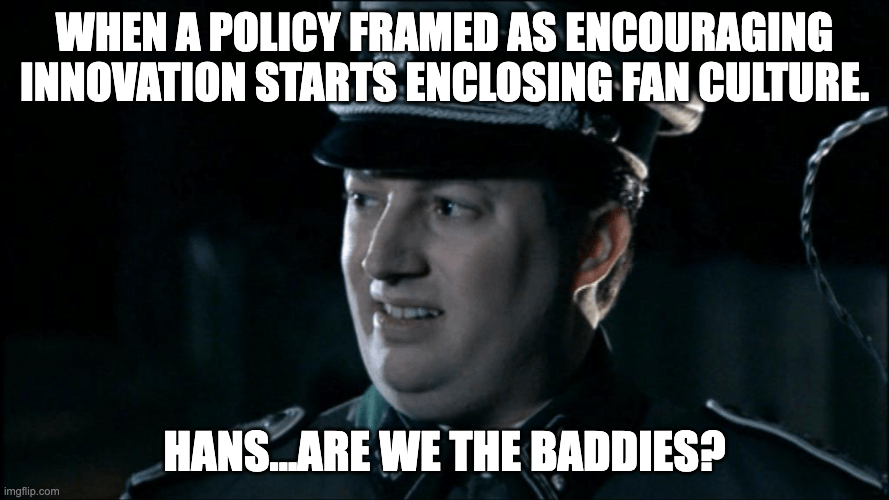
In our context, enclosure refers to the conversion of communal aspects of sports, like fandom, broadcasts, identity, data, access and cultural participation, into privately controlled legal assets. One great example is the broadcasting rights and the exclusivity thereof. Even WIPO acknowledges that broadcasting and media rights are central to sports commercialisation and that copyright-related rights generate revenue streams necessary for sports ecosystems. For example, earlier it was mandatory for Cricket World Cup matches, like all International Sporting events where India participates, to be telecast on Doordarshan, the one free, government-owned TV channel (See S.03 Sports Act 2007). Now, with the advent of private channels and commercialisation of sports, we see exclusive telecasts of World Cup matches on specific sponsor channels and OTT Platforms This post by Ashwini Vaidialingam talk about this development in detail. Thus, we can say that modern sports economies are built as much around controlling access to sport as around sport itself. In fact, some sources suggest that the broadcasting rights become the biggest source of earnings for sports clubs, making the sport commercially viable precisely due to the possibility of its access being fenced off and licensed.
Another example can be that of trademark registrations by sportspersons of their fan-given nicknames or catchphrases. Recently, MS Dhoni registered the trademark for the nickname given to him by fans, that is, ‘Captain Cool’. While these trademarks make commercial sense for the sportsperson, they may also have a chilling effect on the broader ways in which fans express affiliation, admiration and participation within sporting fandoms, particularly through creative, informal and community-driven forms of engagement. One related example can be copyright registrations of the celebration styles of sportspersons. This post by Kedar Ganesh Dhargalkar explores that topic in detail. These are other common routes to enclose communal aspects of sports, like fan culture.
The Patent Paradox
In the event announcing the waiver, Minister Piyush Goyal encouraged the stakeholders to “innovate, patent, produce and prosper”. With this special emphasis on patents, one must ask what the patents and inventions are related to sports that the Minister aims to encourage with the announcement. This is especially relevant in India, as many forms of modern sports innovation fall within areas where Indian patent law itself has historically been cautious about monopolisation.
For example, if there are AI-based sports analytics software, AI-based coaching tools, wearable analytics, tactical prediction systems, athlete-performance dashboards, etc., they will mostly be software-based inventions. Indian Patents Act, especially Section 3(k), explicitly bars patents on most software, algorithms, and computer programs.
Similarly, if the ‘invention’ is in the form of new rehabilitation protocols, physiotherapy systems, injury-prevention methods, recovery technologies, etc., they might fall in the exception created by Section 3(i) of the Patents Act, which bars patenting therapeutic methods. Also, it might be difficult to term the inventions in this category as “sports patents” due to their broad utility and usability.
Lastly, innovations in sports equipment can be within a very limited scope, based on the rules of the sport. With the limited scope of innovation, the new equipment might face difficulty proving novelty and crossing the threshold of ‘inventive steps’ established by Indian Patents jurisprudence. Even for the equipment which does so, it might be a new Design governed by the Designs Act. This, along with all the above examples, shows how limited the scope of ‘sports patents’ is and raises questions about the possibility of increased sports innovation, invention and more importantly, an increase in sports patents attributable to the waiver.
A Brief TRIPS and Competition Caveat
A further complication arises under Article 27.1 of the TRIPS Agreement, which requires patents to be available “without discrimination as to the field of technology.” At first glance, a sports-specific patent fee waiver appears to create precisely the kind of sector-specific preference that Article 27 seeks to avoid by making patent acquisition easier in one technological field than in others. However, WTO jurisprudence, particularly Canada – Patent Protection of Pharmaceutical Products, has clarified that not every form of differentiation necessarily amounts to prohibited discrimination. So, one could argue that the waiver is more about short-term promotion or industrial policy than a real discriminatory restriction on the patent rights of others. Still, it doesn’t sit comfortably with the idea of technological neutrality, especially in sports, where everything’s built on exclusivity: broadcasting deals, sponsorships, franchises, merchandising, licensing, etc. The issue, therefore, is not merely whether the waiver is formally TRIPS-inconsistent. It’s whether the State should keep propping up more private interests in a sports industry that’s already deeply commercial.
Conclusion
The fee waiver, prima facie, seems like an easy win by being low-cost to the State, having high optics value, and being aligned with WIPO’s World IP Day theme for the year. But this post has tried to show that the simplest policies are often the ones most worth scrutinising. When the State chooses to subsidise a hypothetical category of IP without defining it, it effectively delegates the boundary-drawing to rights-holders themselves, who will, obviously, give the broadest definitions possible, to benefit themselves. “Sports IP” will mean whatever a trademark applicant, a patent filer, or a broadcaster’s counsel argues it means.
The deeper problem is not legal ambiguity but structural incentive. The waiver does not distinguish between IP that generates genuine innovation and IP that simply converts pre-existing communal goods into private assets: fan nicknames, celebration styles, broadcast feeds that were once freely accessible and enjoyed communally. By treating both as equally deserving of state subsidy, the policy accelerates enclosure without any corresponding guarantee of public benefit. In a sports economy already built on exclusivity, the question the government failed to ask before announcing the waiver is the most important one: innovation for whom? Until that question is seriously engaged, the waiver is less a ready-set-innovate moment and more a ready-set-enclose one.
[ad_2]
Source link

