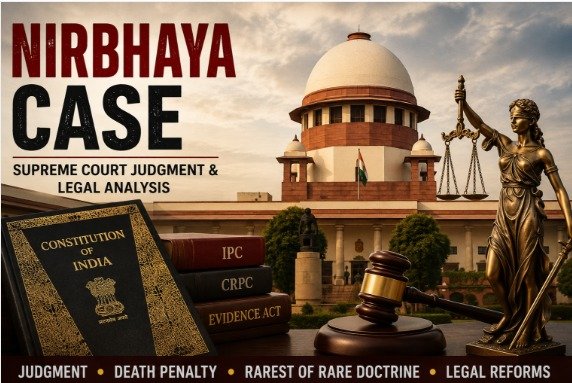

Case Citation and Details
Supreme Court of India decided the Nirbhaya case on 5 May 2017.
| Particular | Details |
| Case Name | Mukesh & Anr. v. State for NCT of Delhi & Ors. |
| Citation | (2017) 6 SCC 1 |
| Court | Supreme Court of India |
| Date of Judgment | 5 May 2017 |
| Case Number | Criminal Appeal Nos. 607–608 of 2017 |
| Related Appeals | Criminal Appeal Nos. 609–610 of 2017 |
| Bench | Justice Dipak Misra, Justice R. Banumathi, Justice Ashok Bhushan |
| Nature | Criminal appeal against conviction and death sentence |
| Popular Name | Nirbhaya Case |

Introduction
Mukesh & Anr. v. State for NCT of Delhi & Ors. is the landmark Supreme Court judgment popularly known as the Nirbhaya case. It is particularly important for understanding gang rape, criminal conspiracy, death penalty, the “rarest of rare” doctrine, and the post-2012 reforms in Indian criminal law.
Facts of the Case
The facts of the case in Mukesh & Anr. v. State (NCT of Delhi) & Ors., (2017) 6 SCC 1 (commonly known as the 2012 Delhi Gang-Rape Case or Nirbhaya Case) are as follows:
Incident Date and Location: On the night of 16 December 2012, a 23-year-old physiotherapy intern and her male friend boarded an off-duty private bus at Munirka, New Delhi, around 9:30 PM to travel to Dwarka after watching a movie.
The Offence: Inside the bus, six occupants (including a juvenile and the bus driver) lured them in. The male companion was beaten unconscious with an iron rod after an altercation. The female victim was subjected to brutal gang rape and inflicted with severe physical injuries, including severe trauma caused by the use of an iron rod.
Abandonment: The perpetrators stripped both victims of their belongings and clothes, and threw them out of the moving bus near the Mahipalpur flyover. The driver attempted to run over the victim, but her male friend managed to pull her out of harm’s way.
Hospitalization and Death: Both victims were discovered and admitted to Safdarjung Hospital, Delhi. Due to the catastrophic nature of her internal organ injuries, the victim was later airlifted to Mount Elizabeth Hospital in Singapore for advanced life support, where she succumbed to her injuries on 29 December 2012.
Apprehension: All six accused were arrested within days based on CCTV footage of the bus, recovery of personal belongings, and descriptions given by the male survivor. One accused, Ram Singh (the driver), committed suicide in Tihar Jail during the trial; the juvenile was tried separately under the Juvenile Justice Board.
Procedural History
The case went through several stages:
Trial Court
The Trial Court convicted the four adult accused and imposed the death penalty.
Delhi High Court
The Delhi High Court confirmed the convictions and death sentences.
Supreme Court
The accused approached the Supreme Court challenging:
- their conviction;
- appreciation of evidence;
- findings regarding criminal conspiracy;
- their individual participation;
- and the imposition of the death penalty.
The Supreme Court ultimately dismissed the appeals and confirmed the death sentences.
The Supreme Court judgment is reported as (2017) 6 SCC 1.
Arguments of the Appellants/Accused
The accused challenged both their conviction and sentence.
Challenge to the prosecution evidence
The defence questioned the reliability and consistency of the prosecution evidence and sought to create doubts regarding the individual role of the accused.
Identification of accused
The defence questioned the identification of the accused and attempted to challenge the prosecution’s version concerning their participation in the incident.
Criminal conspiracy
The accused disputed the finding that they had acted pursuant to a common plan or conspiracy.
They argued, in substance, that the prosecution had not sufficiently established the agreement necessary for criminal conspiracy.
Recovery of articles
The defence also challenged the evidentiary value of recoveries made pursuant to disclosure statements.
Death penalty
One of the most important arguments was against the imposition of the death penalty.
The appellants argued that the case did not satisfy the strict requirements of the “rarest of rare” doctrine and that the possibility of reform or rehabilitation should be considered.
Arguments of the Prosecution/State
The State argued that the evidence established the guilt of the accused beyond reasonable doubt.
Consistent evidence
The prosecution relied upon the victim’s statements/dying declarations, the testimony of the surviving witness, medical evidence and other circumstantial evidence.
Criminal conspiracy
The prosecution contended that the accused had acted together pursuant to a common design.
The Supreme Court found that the circumstances and conduct of the accused established the existence of the conspiracy. The judgment particularly considered the coordinated nature of the acts and the conduct of the accused during and after the offence.
Medical evidence
The prosecution relied heavily on the devastating internal injuries suffered by the victim.
Recovery of articles
Articles belonging to the victims were recovered from the accused, which the prosecution relied upon as corroborative circumstances.
Rarest of rare
The prosecution argued that the brutality, depravity and circumstances of the offence made it a classic “rarest of rare” case warranting capital punishment.
Laws Applied
The case was primarily decided under the Indian Penal Code, 1860, because the offence occurred in 2012.
Important IPC provisions
| Provision | Offence |
| Section 120-B | Criminal conspiracy |
| Sections 365/366 | Kidnapping/abduction |
| Section 307 | Attempt to murder |
| Section 376(2)(g) | Gang rape |
| Section 377 | Unnatural offences |
| Section 302 | Murder |
| Section 395 | Dacoity |
The Supreme Court judgment specifically dealt with these provisions.
Evidence Act
Section 10 of the Indian Evidence Act, 1872 was relevant to the issue of acts/statements relating to conspiracy.
The Court also examined the evidentiary significance of recoveries and the surrounding circumstances.
Legal Issues
The Supreme Court essentially had to determine:
Issue 1
Whether the prosecution had established the guilt of the accused beyond reasonable doubt.
Issue 2
Whether the accused were acting pursuant to a criminal conspiracy.
Issue 3
Whether the evidence, including medical evidence, dying declarations, testimony and recoveries, sufficiently established their involvement.
Issue 4
Whether the case qualified as a “rarest of rare” case justifying the death penalty.
Judgment
The Supreme Court dismissed the appeals and upheld the convictions and death sentences.
The Court found that the evidence established the guilt of the accused and that the circumstances demonstrated their participation in the criminal conspiracy.
The Court placed particular emphasis on:
- the extreme brutality of the offence;
- the manner in which the victim was assaulted;
- the coordinated conduct of the accused;
- the devastating injuries inflicted upon the victim;
- the absence of circumstances sufficient to justify reducing the sentence; and
- the exceptional gravity of the crime.
The Supreme Court concluded that the case fell within the rarest of rare category and therefore warranted the death penalty.
1.Rarest of Rare Doctrine
This is one of the most important aspects of the judgment.
The death penalty in India is constitutionally permissible but must be imposed only in exceptional circumstances.
The doctrine originates principally from:
2.Bachan Singh v. State of Punjab (1980)
The Supreme Court held that death penalty should be imposed only in the “rarest of rare” cases where the alternative option of life imprisonment is unquestionably foreclosed.
In Mukesh, the Court applied this principle to the facts of the Nirbhaya case.
The Court considered the aggravating circumstances to be extraordinarily grave.
Therefore:
Life imprisonment was considered inadequate and the death penalty was upheld.
This makes Mukesh an important modern application of the Bachan Singh doctrine.
Why the Case Became a Turning Point in Criminal Law
The Nirbhaya incident generated unprecedented public pressure for reform.
Following the incident, the Government constituted the Justice J.S. Verma Committee to examine laws relating to sexual violence.
This resulted in major legislative reforms through the Criminal Law (Amendment) Act, 2013.
The 2013 reforms significantly strengthened India’s sexual-offence framework.
Changes in Criminal Law After the Nirbhaya Case
Broader definition of rape
Section 375 IPC was substantially expanded.
Rape was no longer restricted to conventional penile-vaginal penetration.
The law recognised various forms of penetration, including penetration involving:
- vagina;
- mouth;
- urethra;
- anus;
- objects; and
- other forms of sexual penetration.
This was a major shift in the understanding of sexual violence.
Gang rape – Section 376D IPC
The 2013 amendment introduced a specific and significantly stricter provision for gang rape.
Under Section 376D IPC, gang rape was punishable with rigorous imprisonment of at least 20 years, extendable to imprisonment for life, along with compensation.
The reform was directly significant in the context of offences such as the Nirbhaya case.
Rape causing death – Section 376A IPC
A new provision was introduced for situations where rape resulted in:
- death; or
- a persistent vegetative state.
The punishment could extend to imprisonment for the remainder of the offender’s natural life or death.
Sexual harassment
The 2013 reforms specifically criminalised several forms of sexual harassment.
This included conduct such as:
- unwelcome physical contact;
- demands for sexual favours;
- showing pornography against a woman’s will; and
- sexually coloured remarks.
Stalking
Section 354D IPC was introduced to criminalise stalking.
This was important because repeated unwanted following or monitoring of a woman was previously not specifically recognised as an independent offence in the IPC.
Voyeurism
Section 354C IPC criminalised voyeurism.
It addressed watching or capturing images of a woman engaged in a private act in circumstances where she would reasonably expect privacy.
Acid attacks
The 2013 reforms specifically addressed acid attacks through Sections 326A and 326B IPC.
This recognised acid violence as a distinct and serious offence.
Changes Under the New Criminal Laws – BNS, BNSS and BSA
There is an important distinction here:
The Nirbhaya case itself was decided under the IPC, CrPC and Evidence Act because the incident occurred in 2012.
India subsequently replaced the three major criminal laws with:
- Bharatiya Nyaya Sanhita, 2023 (BNS) – substantive criminal law;
- Bharatiya Nagarik Suraksha Sanhita, 2023 (BNSS) – criminal procedure;
- Bharatiya Sakshya Adhiniyam, 2023 (BSA) – evidence.
They came into force on 1 July 2024.
Important BNS changes relevant to the Nirbhaya case
| Earlier IPC | BNS 2023 | Subject |
| Section 375 | Section 63 | Rape |
| Section 376 | Section 64 | Punishment for rape |
| Section 376A | Section 66 | Rape causing death/persistent vegetative state |
| Section 376B | Section 67 | Sexual intercourse by husband during separation |
| Section 376C | Section 68 | Sexual intercourse by person in authority |
| Section 376D | Section 70 | Gang rape |
| Section 376E | Section 71 | Repeat offenders |
| Section 302 | Section 103 | Murder |
The BNS consolidates offences against women and children in a dedicated chapter and retains severe punishments for serious sexual offences. The Government has specifically highlighted that gang rape of a woman below 18 can attract life imprisonment for the remainder of the convict’s natural life or death.
Most Important Difference: Nirbhaya Law vs Present Law
The evolution can be understood like this:
Nirbhaya incident (2012)
↓
Justice Verma Committee
↓
Criminal Law (Amendment) Act, 2013
↓
Stricter rape and sexual-offence laws
↓
Bharatiya Nyaya Sanhita, 2023
↓
New criminal-law framework from 1 July 2024
Thus, the Nirbhaya case did not merely result in a judicial decision. It became an important catalyst for structural changes in India’s criminal law.
Conclusion
Mukesh & Anr. v. State for NCT of Delhi & Ors., (2017) 6 SCC 1, popularly known as the Nirbhaya case, is a landmark judgment concerning gang rape, murder, criminal conspiracy and the death penalty. The Supreme Court, comprising Dipak Misra, R. Banumathi and Ashok Bhushan JJ., upheld the conviction and death sentence of the appellants, holding the case to fall within the “rarest of rare” category. The case had significance beyond the judgment itself, as the public and institutional response to the 2012 incident led to the Justice Verma Committee and the Criminal Law (Amendment) Act, 2013, which introduced stronger provisions relating to rape, gang rape, stalking, voyeurism, sexual harassment and acid attacks. The later BNS, BNSS and BSA framework further reorganised India’s criminal law from 1 July 2024.
One correction worth remembering: the Mukesh Supreme Court judgment is not itself the source of the 2013 statutory amendments. The amendments followed the Nirbhaya incident and the Justice Verma Committee process; Mukesh was decided in 2017, applying the law applicable to the 2012 offence.

