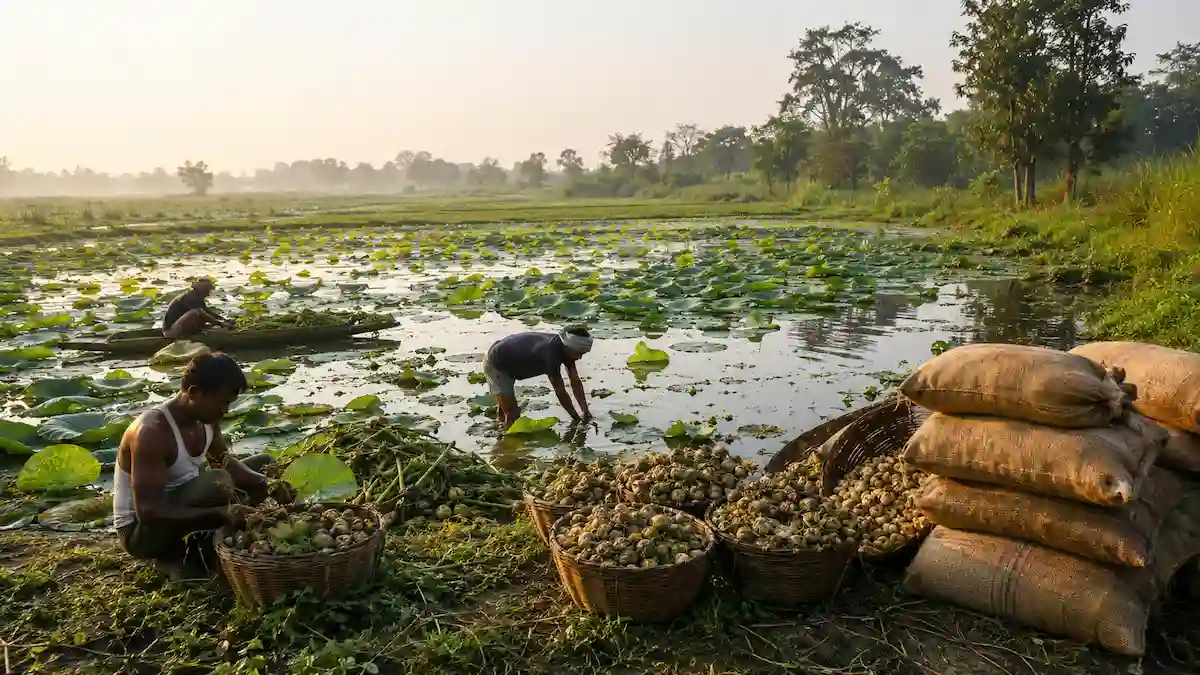

Makhana Farming Profit Per Acre is not one fixed number, and that’s exactly why the figures online don’t agree. One report says ₹15,000 an acre. Another says ₹10 lakh. Both can be true, depending on one decision.
That decision is whether you sell raw seed to a trader or process it into popped makhana yourself. This guide walks through the actual cost, yield, subsidy, and regional data behind makhana farming profit per acre, so you can work out your own numbers instead of guessing between two conflicting figures.

| Quick Facts | Value |
|---|---|
| Crop duration | 7 to 8 months (4 months in field system) |
| Investment (existing pond) | ₹26,000 to ₹48,000/acre annual |
| Investment (new pond) | +₹1.5 lakh to ₹3 lakh one time |
| Raw seed yield | 700 to 1,050 kg/acre |
| Net profit range | ₹11,000 (raw sale) to ₹3 lakh+ (processed) |
| Water depth needed | 1 to 2 ft (field) or 3 to 6 ft (pond) |
| Best states | Bihar, Assam, UP, MP, West Bengal |
Key Takeaways
- Selling raw seed typically returns ₹11,000 to ₹20,000 per acre.
- Processing and direct marketing can push net profit to ₹1 to 3 lakh or more per acre.
- Field-system cultivation generally delivers higher yield than the traditional pond system.
- Labor availability and buyer access affect profit more than yield alone.
Makhana farming is the commercial cultivation of Euryale ferox (fox nut) in ponds or shallow waterlogged fields in eastern India, mainly Bihar. Farmers grow it for edible seeds that are dried, roasted, and popped into the snack sold in stores as makhana or fox nut, which is why this is often called fox nut cultivation or fox nut farming in export and trade circles.
Profit per acre runs about ₹11,000 to ₹20,000 when a farmer sells raw seed to a trader, and can cross ₹1 lakh to ₹3 lakh when the farmer processes and sells popped makhana directly.

Farmers often get confused because university studies, government project reports, and market write-ups use different assumptions about who processes the seed. The sections below explain where each figure comes from, along with cost, yield, subsidy, and regional data most fox nut farming guides leave out.
Why Makhana Farming Is Becoming a Profitable Business
Bihar supplies over 85 percent of the world’s makhana, mostly from the Mithila belt: Darbhanga, Madhubani, Purnia, Katihar, Saharsa, and Araria. Demand has grown fast because makhana is marketed as a gluten free, high protein snack in health focused markets.
Domestic wholesale prices for popped makhana rose from around ₹500 per kg in 2020-22 to roughly ₹1,250 per kg in 2025, based on APEDA market tracking. Export shipments to the US, Canada, UAE, and the UK have grown every year since 2023, and India now exports through more than 1,100 registered exporters.
Is Makhana Farming a Good Investment?
Many first time growers look only at the selling price and skip the labor math. Harvesting and popping are still done mostly by hand, and together they eat up 55 to 60 percent of total cultivation cost in most farm surveys.
If you underestimate harvesting labor, your expected profit drops fast. In practice, growers who only sell raw seed earn much less than those who clean, pop, grade, and package their harvest before selling, which is really the whole story behind fox nut farming profit in India.
Who Can Start a Makhana Farm?
Anyone with a pond, a low lying field that holds water for 4 to 8 months, or access to rent one. You do not need to own inherited pond land. Field system cultivation on regular farmland is now common in Bihar, UP, and Assam.
History of Makhana Cultivation
Makhana farming traces back over 200 years to Madhubani in Bihar’s Mithila region, where the Mallah fishing community first turned wild pond growth into an organized crop. The King of Darbhanga is credited with encouraging systematic cultivation in the 18th century.
For most of that history, seed collection meant diving to the pond floor and holding your breath, sometimes at 10 to 12 feet depth. Rural electrification changed this in the last two decades, since farmers can now pump ponds down before harvest, cutting diving time sharply.
Mithila Makhana received its Geographical Indication tag in 2022, and the National Makhana Board, set up under the 2025 union budget, is the first dedicated central institution for the crop.
Makhana Plant Information, Climate, Soil, and Water Requirements
| Factor | Requirement |
|---|---|
| Scientific name | Euryale ferox |
| Temperature | 20°C to 35°C, no frost tolerance |
| Soil | Clayey or loamy, high organic matter |
| Water pH | Slightly acidic to neutral |
| Water depth | 1-2 ft (field) or 3-6 ft (pond) |
Get your pond or field water tested once before the season for pH and organic content. A basic soil and water test at your nearest Krishi Vigyan Kendra costs very little and prevents blind fertilizer use later.
Major Producing States in India
Bihar leads with over 85 percent of national output. Assam, Manipur, Madhya Pradesh, Uttar Pradesh, and West Bengal grow it on a smaller but expanding scale, helped by new state government schemes launched after 2025.
Best Makhana Varieties for Commercial Farming
Commercial fox nut farming today relies on improved varieties rather than the farmer-saved seed used a generation ago, since the yield gap between them is large. Improved Euryale ferox varieties have significantly increased commercial yields compared with traditional farmer-saved seed.
| Variety | Developed By | Key Trait |
|---|---|---|
| Swarna Vaidehi | ICAR-RCER, Darbhanga (2013) | 2.8-3.0 t/ha yield, 50-55% pop recovery |
| Sabour Makhana-1 | Bihar Agricultural University, Sabour (2016) | 3.2-3.5 t/ha yield, thinner seed coat, early maturing |
| Local Mithila selections | Traditional farmer-saved lines | Lower yield, but well adapted to local ponds |
Swarna Vaidehi and Sabour Makhana-1 both out-yield traditional farmer-saved seed by a wide margin, yet adoption is still low across most districts because certified seed is not always easy to find locally. Ask your nearest Krishi Vigyan Kendra or the Bihar Agricultural University extension office before the sowing season if you want to switch from local seed.
Makhana Market Price Trends
| Year | Domestic Wholesale Price (₹/kg, popped) |
|---|---|
| 2020-22 | ~500 |
| 2023 | ~650-750 |
| 2024 | ~900-1,000 |
| 2025 | ~1,250 |
Prices have climbed steadily since 2020 on rising domestic and export demand, though grade, packaging, and region cause wide swings around this average. Treat this table as a direction indicator, not a quote for your own harvest.
Can Makhana Be Grown Organically?
Yes. Traditional pond cultivation already uses minimal chemical input, which makes the jump to certified organic easier than for most row crops.
Small growers usually start with PGS-India, a free, government-run certification suited to domestic and direct sale. NPOP certification, run under APEDA, costs roughly ₹15,000 to ₹50,000 a year and is worth it only once you are exporting or supplying an institutional buyer that demands third-party certification. Group certification through an FPO brings this cost down sharply per farmer.
Intercropping Possibilities
| Combination | How It Works |
|---|---|
| Makhana + fish | Air-breathing fish species share the same pond, adding a second income stream |
| Makhana + singhara (water chestnut) | Grown in adjoining plots or rotated in the same water body |
| Makhana + lotus | Compatible aquatic crop, sometimes grown at pond margins |
| Makhana + rabi crop | Wheat, lentil, or gram planted after makhana is harvested in the field system |
ICAR-RCER Darbhanga has documented makhana-fish-water chestnut integrated cultivation as a way to raise total income per acre without adding new land. This combination model, not a bigger single crop, is often the fastest legitimate route from the raw-sale profit range to something closer to the processed-sale range.
Farmers interested in adding singhara to the same farming system can also read our detailed guide on Water Chestnut Cultivation, which explains pond preparation, crop management, and harvesting practices.
Traditional Pond System vs Field System: Which Is More Profitable?
| Factor | Pond System | Field System |
|---|---|---|
| Duration | 7-8 months | 4 months |
| Raw yield/acre | 700-750 kg | 1,000-1,050 kg |
| Cost/acre | ₹26,000-38,000 | ₹32,000-44,000 |
| Net return/acre | ₹14,000-19,000 | ₹19,000-25,000 |

Field system wins on both yield and net return in most published farm studies, and it frees the land for a second crop later in the year. Pond system still suits farmers with an existing natural pond that is not usable for regular field crops anyway.
How to Prepare a Pond for Makhana Farming
One Acre Layout and Pond Design
A workable single unit is about 1 acre of water surface, either a rectangular excavated pond or a bunded low field. Keep an inlet and outlet channel on opposite sides so you can flush and refill without disturbing the whole plot.
Pond Excavation and Water Source
New pond excavation costs roughly ₹1.5 lakh to ₹3 lakh per acre depending on soil type and depth. A reliable water source, either a borewell, canal, or monsoon recharge, is non negotiable since makhana cannot tolerate the pond drying out mid season.
Soil Testing and Preparation
Clear weeds and old vegetation from the bed before sowing. Work well rotted farmyard manure into the mud, and get the soil and water tested for pH and organic carbon before the first season.
Makhana Farming Cost Per Acre
Cost splits into one time capital cost and recurring annual cost. Most guides only show the annual figure and skip the pond construction, machinery, and processing side entirely.
| Cost Head | Amount (₹/acre) |
|---|---|
| Pond excavation (new pond only) | 1,50,000 – 3,00,000 one time |
| Seed | 3,000 – 6,000 |
| Labor, sowing to harvest | 15,000 – 28,000 |
| Fertilizer and manure | 2,000 – 5,000 |
| Pond/field upkeep | 3,000 – 6,000 |
| Transport to market | 2,000 – 5,000 |
| Electricity (pumping) | 1,500 – 3,500 |
| Annual maintenance (bunds, nets) | 1,500 – 3,000 |
| Miscellaneous | 2,000 – 5,000 |
| Total annual cost | 30,000 – 48,000 |
Processing and Packaging Cost (If You Process Yourself)
| Item | Cost |
|---|---|
| Manual popping labor | ₹20-25/kg of raw seed |
| Basic packaging (pouches, sealing) | ₹15,000-25,000/acre worth of output |
| Small popping machine (shared/FPO use) | ₹1.5 lakh-3 lakh one time |
| Mid-size processing unit | ₹8 lakh-15 lakh one time |

Buying your own ₹10 lakh processing machine for a single acre almost never pays back. Makhana processing machine price scales with capacity, so that equipment only makes sense at cooperative, FPO, or multi-acre scale, where several growers share one processing unit. A single acre farmer is usually better off hand-processing or paying a nearby unit per kg.
Labor Requirement (Man-Days)
Expect roughly 90 to 120 man-days per acre across the season, weighted heavily toward harvesting and popping. Sowing and weeding use comparatively few days.
Makhana Cultivation Step by Step
Sowing Calendar
| Month | Activity |
|---|---|
| December-January | Pond cleaning, bed preparation |
| February-April | Nursery raising, transplanting (field system) |
| April-May | Direct sowing (pond system) |
| May-August | Water and weed management |
| August-October | Harvesting |
| October-November | Drying, roasting, popping, sale |
Seed Selection and Treatment
Use certified seed from your state horticulture department or the ICAR research center at Darbhanga. A brief pre-sowing soak improves germination noticeably over dry sown seed.
Weed and Water Management
Check depth weekly for the first two months, since young plants are sensitive to sudden changes. Exchange a portion of the water every 10 to 15 days during hot weeks to control algae and keep dissolved oxygen up, and skim floating weeds by hand rather than letting them build up.
Pest and Disease Control
| Pest/Disease | Sign | Action |
|---|---|---|
| Aphids | Curling leaves | Remove affected leaves, neem spray |
| Leaf beetles | Holes in leaf surface | Hand-pick, light insecticide if severe |
| Snails | Chewed leaf edges | Manual removal, avoid overcrowding |
| Fungal leaf spot | Brown-black spots | Improve water exchange, remove infected leaves |
Makhana Yield Per Acre in Pond and Field Systems
| System | Raw Seed | Popped Makhana |
|---|---|---|
| Pond system | 700-750 kg | 245-300 kg |
| Field system | 1,000-1,050 kg | 350-420 kg |
The seed-to-pop conversion runs 35 to 40 percent by weight, so 100 kg of raw seed gives only about 35 to 40 kg of the finished pop. This ratio is the main reason popped makhana costs far more per kg than the raw seed a trader buys from you.
Makhana Farming Profit Per Acre: Why the Numbers Disagree
University farm surveys report ₹11,000 to ₹20,000 net profit per acre. Government scheme documents quote ₹2 lakh to ₹10 lakh. Both are measuring different things.
| Source Type | Profit Quoted | What It Assumes |
|---|---|---|
| University/ICAR farm surveys | ₹11,000-20,000/acre | Farmer sells raw seed to a trader |
| State/central scheme literature | ₹2 lakh-10 lakh/acre | Farmer processes, brands, and sells direct or exports |
| This report’s realistic range | ₹15,000 (raw) to ₹1-3 lakh (processed) | Either route, depending on your setup |
Treat the ₹4-10 lakh figure as a ceiling case tied to full processing and export, not a starting expectation. It is a real outcome for some growers, but it assumes branding, grading, and buyer access that take a season or two to build.
Raw Seed vs Processed Makhana Comparison
| Factor | Raw Seed Sale | Processed Makhana |
|---|---|---|
| Investment | Low, cultivation cost only | Higher, plus processing labor/equipment |
| Income | Lower, trader sets price | Higher, retail/export pricing |
| Profit | ₹11,000-20,000/acre | ₹1 lakh-3 lakh+/acre |
| Risk | Low, quick sale | Higher, storage and quality risk |
| Labor | Moderate | High, skilled roasting needed |
Makhana vs Other Water-Based Crops: Profit Comparison
| Crop | Net Profit/Acre | Notes |
|---|---|---|
| Makhana (raw sale) | ₹11,000-20,000 | Fast, low labor |
| Makhana (processed) | ₹1 lakh-3 lakh+ | Needs processing and buyer access |
| Paddy (rice) | ₹12,000-25,000 | MSP backed, lower risk |
| Fish farming (pond) | ₹50,000-1,50,000+ | Depends heavily on species and stocking density |
| Lotus (stem and seed) | ₹1.5 lakh-2 lakh+ | Real farmer cases report this range |
| Water chestnut (singhara) | ₹20,000-50,000 | Lower margin, often rented pond |
Makhana’s raw-sale profit sits close to paddy, but its processed-sale ceiling is far higher than any of these alternatives. The catch is that reaching that ceiling needs processing skill and market access that paddy and fish farming do not require.
If you’re comparing different aquaculture businesses before investing, also read our guide on Fish Farming Profit Per Acre in India to understand its investment, operating costs, and expected returns.
Regional Profitability: Bihar, Assam, West Bengal, UP, and MP
| State | Status | Profit Outlook |
|---|---|---|
| Bihar | Established, 85%+ of national output | Best infrastructure, subsidy, and buyer access |
| Assam | Traditional wild growth in beels, expanding | Good potential, weaker processing infrastructure |
| West Bengal | Emerging, waterlogged districts | Similar to Bihar’s pond system, less scheme support |
| Uttar Pradesh | New state scheme since 2025-26 | Rising, subsidy-backed pond development |
| Madhya Pradesh | Small scale, overlaps with singhara belts | Workable as intercrop with water chestnut |

Outside Bihar, the biggest constraint is not climate, it is the lack of a local processing and buyer network. A farmer in UP or MP growing good makhana can still lose margin if the nearest processing unit or trader is far away.
One Acre Makhana Farming Project Report
This makhana cultivation project report assumes an existing pond and covers the core makhana farming economics banks usually ask for: fixed capital, working capital, and expected return.
| Item | Amount (₹) |
|---|---|
| Fixed capital (existing pond, minor repair) | 15,000-30,000 |
| Working capital (seed, labor, inputs) | 35,000-45,000 |
| Processing cost (self processed) | 20,000-25,000 |
| Total investment (processed route) | 70,000-1,00,000 |
| Gross income (processed route) | 2,00,000-3,50,000 |
| Net profit (processed route) | 1,30,000-2,50,000 |
Monthly Cash Flow Pattern
| Period | Cash Flow |
|---|---|
| Dec-Apr (prep, sowing) | Outflow, ₹20,000-25,000 |
| May-Aug (maintenance) | Small outflow, ₹8,000-12,000 |
| Sep-Oct (harvest, processing) | Large outflow, ₹25,000-35,000 |
| Oct-Nov (sale) | Large inflow, ₹2,00,000-3,50,000 |
Working capital is tied up for nearly ten months before the main sale inflow arrives, which is why a KCC limit or short term loan matters more than a big one time subsidy for most first-time growers.
Depreciation and Sensitivity
A shared or FPO-owned popping machine (₹1.5 lakh-3 lakh) depreciates over roughly 7 to 10 years of use. On the sensitivity side, a 10 percent drop in popped makhana price still leaves most processed-route growers profitable, while a 10 percent drop in raw seed price can wipe out most of the raw-sale margin, since that margin is already thin.
Break-Even Analysis
Raw seed sale reaches break even within the first season, since input cost is low and the trader pays on delivery.
Processed sale with new pond capital typically takes 2 to 3 seasons to break even. Internal rate of return improves sharply once a farmer has direct buyers instead of relying on a single middleman.
Makhana Farming Bank Loan and Subsidy
| Scheme | Coverage | Run By |
|---|---|---|
| National Makhana Board | ₹476 crore, 2025-31, processing hubs, export branding | Central Govt, HQ Purnea |
| Bihar Makhana Avayav Scheme | Subsidized seed at ₹225/kg, tool kits, area expansion | Bihar Horticulture Dept |
| PMFME | 25-35% credit-linked subsidy for processing units | Ministry of Food Processing |
| PMEGP | Project loan for new processing ventures | KVIC/banks |
KCC, Mudra, and Credit Guarantee
A Kisan Credit Card covers seasonal input cost and is collateral free up to ₹1.6-2 lakh, with interest subvention that brings the effective rate down close to 4 percent for prompt repayment. This is the most practical tool for the working capital gap shown in the cash flow table above.
Mudra loans, under the Shishu or Kishor category, suit small processing or packaging setups and do not need collateral for smaller amounts. Larger processing units can combine PMFME’s credit-linked subsidy with a bank term loan backed by CGTMSE credit guarantee cover.
Documents Required
Land ownership or pond lease papers, Aadhaar, bank passbook, and a simple project cost estimate cover most of these schemes. Non-landholding farmers can often apply with a valid cultivation agreement instead.
Where to Sell Makhana for Maximum Profit
The fox nut market runs through several channels, each with a different margin depending on how much processing you have done before the sale.
| Channel | Typical Margin | Best For |
|---|---|---|
| Local trader | Lowest | Fast cash, no processing needed |
| APMC/local mandi | Low-moderate | Bulk raw seed sale |
| FPO marketing | Moderate-high | Shared processing and better price discovery |
| Direct/online retail | High | Small growers with branding effort |
| Export (APEDA registered) | Highest | Processed, graded, certified stock |
Makhana currently has no notified MSP, unlike paddy or wheat. Price discovery runs through mandis, traders, FPOs, and direct buyers, which is exactly why joining an FPO or cooperative changes your realized price more than almost any other single decision.
Export Registration Steps
Register for an IEC code with the Directorate General of Foreign Trade (DGFT), then get an APEDA RCMC certificate, GST registration, and an FSSAI Central License. Popped makhana now moves under HS code 20081921 and makhana flour under 20081922, both effective from July 2025.
A popped makhana business built around export needs these registrations before the first shipment, not after. The Ministry of Agriculture and Farmers Welfare’s scheme network, along with APEDA, is the reference point for updated documentation requirements.
Makhana Processing, Roasting, Packaging, and Value Addition
Fox nut processing is where most of the value in this crop actually gets created. The stages below turn a low-value raw seed into the high-value pop that sells in stores.
| Stage | What Happens |
|---|---|
| Seed collection | Manual harvest from pond bed after draining |
| Washing | Removes mud and debris |
| Drying | Sun-dried over several days to fixed moisture |
| Tempering | Controlled resting period before roasting |
| Roasting | Heated in batches to trigger popping |
| Popping | Sudden pressure/heat change expands the seed |
| Grading | Sorted by size, called soot grading in the trade |
| Packaging | Airtight pouches or containers for shelf life |

Roasting alone can add 15 to 20 percent to sale price over raw seed. Branded, packaged makhana sells for ₹1,200 to ₹1,600 per kg against ₹500 to ₹900 for unbranded loose stock, and the Mithila Makhana GI tag adds further trust for export buyers.
Risks in Makhana Farming
| Risk | Impact |
|---|---|
| Flood damage | Can wash out young plants or seed banks |
| Drought/water shortage | Pond drying mid-season kills the crop |
| Poor water quality | Algae buildup, low oxygen, disease spread |
| Labor shortage | Delayed harvest, higher wage cost at peak season |
| Price fluctuation | Raw seed price swings with trader demand |
| Processing failure | Bad batch roasting wastes the harvest |
| Disease outbreak | Fungal spread in humid, still water |
Real Farmer Experience: Practical Observations
Harvesting is still the hardest part of this crop. Divers historically worked underwater by feel in ponds up to 10-12 feet deep, and even with pumped-down water levels today, it stays physically demanding, skilled work.
Labor shortage during peak harvest weeks is common, since neighboring farms all need harvest labor in the same narrow window. Growers who lock in labor early, rather than waiting for harvest week, avoid the worst wage spikes.

Processing bottlenecks show up fast if you do not have roasting capacity lined up before harvest. Storage losses are also real: poorly dried or poorly packed popped makhana can lose 15 to 40 percent of its shelf life and quality within weeks.
Can Beginners Start Makhana Farming?
| Question | Answer |
|---|---|
| Can beginners start? | Yes, starting with raw seed sale first is the lower-risk entry point |
| Is experience needed? | Not mandatory, but a season with an experienced grower or KVK training helps |
| Minimum investment? | ₹30,000-45,000/acre on an existing pond, no processing |
| Minimum land needed? | Even a small pond under 1 acre can work as a trial plot |
| Can women SHGs do this? | Yes, several Bihar SHGs already run processing units with scheme support |
| Can FPOs start it? | Yes, FPOs are the preferred model for shared processing and export access |
Advanced: Certification and Export Standards
- FSSAI Central License, mandatory for any exporter
- APEDA RCMC registration, required for export incentives and buyer-seller meets
- Organic certification, commands a price premium in export markets
- HACCP, expected by many overseas buyers for food safety compliance
- Mithila Makhana GI tag, protects authenticity and supports branding
Tips to Increase Makhana Profit Per Acre
- Use certified seed instead of saved seed from an unknown source
- Keep water depth steady through the full growing period
- Book harvest and processing labor early, before the peak-season rush
- Process at least part of your harvest instead of selling all of it raw
- Join a Farmer Producer Organization for shared processing and better price discovery
Frequently Asked Questions
How much profit does makhana farming make per acre?
Selling raw seed to a trader typically nets ₹11,000 to ₹20,000 per acre. Processing and selling popped makhana directly can push net profit to ₹1 lakh to ₹3 lakh or higher per acre.
How much does it cost to start makhana farming?
On an existing pond, annual cultivation cost runs ₹30,000 to ₹48,000 per acre. Building a new pond adds a one-time ₹1.5 lakh to ₹3 lakh capital cost.
Is makhana farming profitable?
Yes, but profitability depends almost entirely on whether you sell raw seed or process it. Raw sale gives modest, quick returns. Processing captures far more value but needs skill, equipment access, and buyer connections.
How many kilograms of makhana are produced per acre?
Raw seed yield ranges from 700 kg per acre in the pond system to over 1,000 kg per acre in the field system, converting to roughly 245 to 420 kg of popped makhana.
Can farmers get a bank loan for makhana farming?
Yes, through Kisan Credit Card limits, Mudra loans for small processing setups, PMEGP project loans, and state schemes such as Bihar’s Makhana Avayav Scheme, which also supplies subsidized seed.
Final Thoughts
Makhana farming offers modest returns when farmers sell raw seed, but value addition through processing, grading, packaging, and direct marketing can substantially improve profitability. Before investing, prepare a realistic project report, evaluate local buyer access, and seek technical guidance from your nearest KVK or horticulture department.
Reviewed against data from ICAR-RCER Darbhanga, Bihar Agricultural University Sabour, the Bihar Directorate of Horticulture, NABARD, and published farm economics studies on makhana cultivation.
Sources referenced: ICAR Research Complex for Eastern Region, Research Centre for Makhana, Darbhanga (icarrcer.icar.gov.in) and NABARD (nabard.org).
Disclaimer: Information on this article is for educational purposes only. Actual cost, yield, and profit vary by district, soil, water source, variety, and season. For region-specific advice, consult your local Krishi Vigyan Kendra (KVK), State Agriculture or Horticulture Department, or a NABARD-affiliated bank before making major investment decisions.

