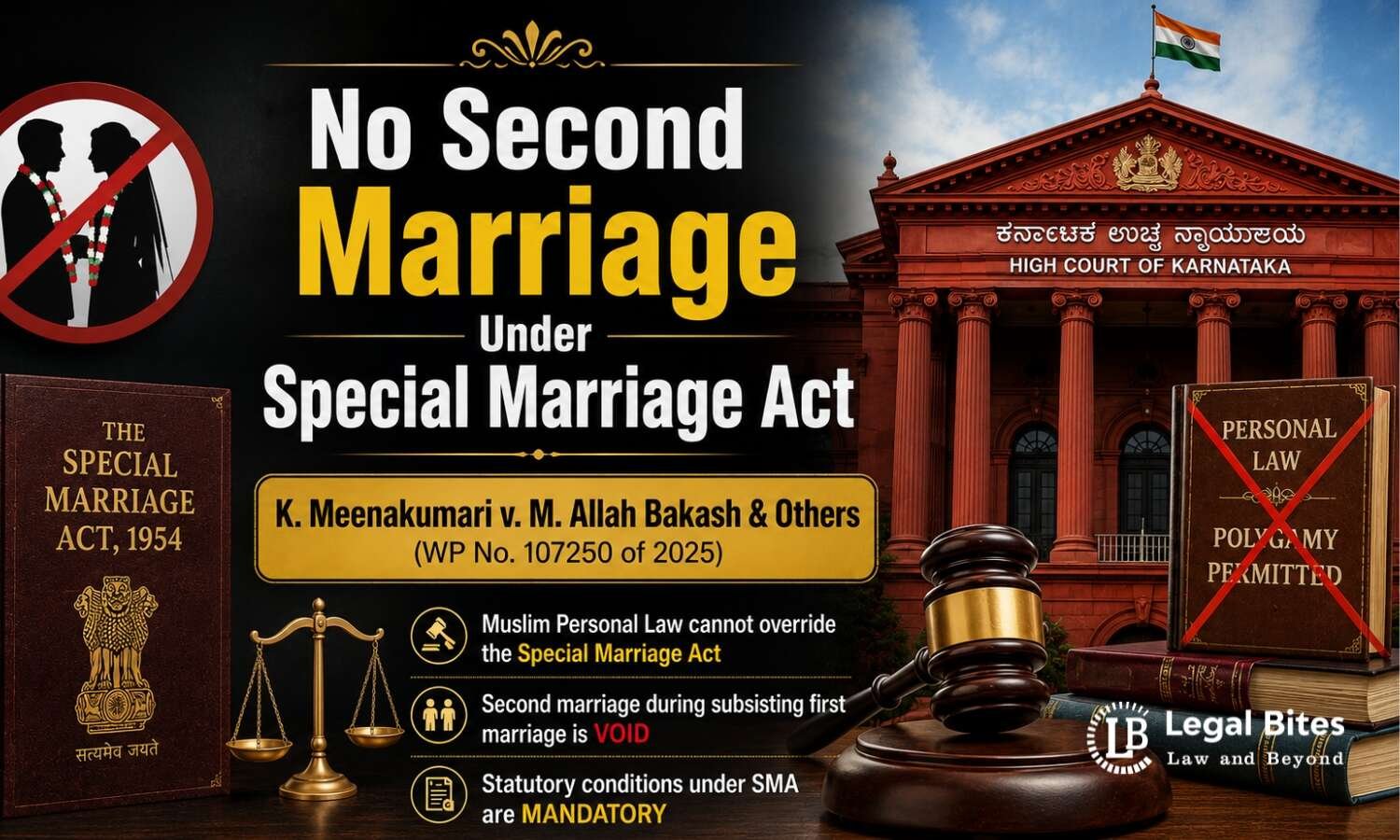

In a significant order in [K. Meenakumari v. M. Allah Bakash & Others (WP No. 107250 of 2025)], the Karnataka High Court reaffirmed that the Special Marriage Act, 1954 (SMA) prevails over personal law in determining the validity of marriages solemnised under the Act. The Court held that a Muslim man cannot invoke Muslim personal law permitting polygamy to validate a second marriage performed under the Special Marriage Act while his first marriage is still subsisting. It emphasised that once parties voluntarily choose to marry under the Special Marriage Act, they are bound by its mandatory conditions, including the requirement that neither party should have a living spouse at the time of marriage.
Background of the Case

The dispute arose from a partition suit pending before the Principal Senior Civil Judge, Ballari. The original suit had been instituted by the brother of one of the defendants seeking partition and separate possession of family properties. During the pendency of the suit, the concerned defendant died on 14 March 2024.
Following his death, persons claiming to be his legal heirs were brought on record. Subsequently, K. Meenakumari approached the Trial Court asserting that she was the deceased’s legally wedded wife and that a daughter had been born from their marriage. According to her, the marriage had been solemnised on 24 April 2008 under the Special Marriage Act, 1954. She alleged that despite being the wife of the deceased, she had not been informed about the pendency of the partition proceedings, nor had she been impleaded as one of the legal representatives.
She therefore filed applications seeking to implead herself and her daughter as legal representatives of the deceased defendant.
Initially, the Trial Court allowed the applications. However, the order was challenged before the Karnataka High Court, which remanded the matter back to the Trial Court with directions to conduct an inquiry into the status of the applicants before deciding whether they could be impleaded.
Proceedings Before the Trial Court
Pursuant to the remand order, the Trial Court examined documentary evidence and admissions made by the parties. During this inquiry, it emerged that the deceased had already contracted a valid marriage with another woman, which continued to subsist when the petitioner allegedly married him under the Special Marriage Act.
The Trial Court therefore held that the petitioner’s marriage was void ab initio because it violated Section 4(a) of the Special Marriage Act. While rejecting her application for impleadment, the Court nevertheless permitted her daughter to be brought on record, recognising the legal protection available to children born from void marriages.
Aggrieved by this decision, the petitioner approached the Karnataka High Court.
Issues Before the High Court
The principal issue before the Court was whether the Trial Court had committed any jurisdictional error by refusing to implead the petitioner as the legal representative of the deceased while allowing the daughter born from the relationship to be impleaded.
The dispute required the Court to examine:
- Whether the petitioner’s marriage under the Special Marriage Act was legally valid.
- Whether Muslim personal law permitting multiple marriages could override the mandatory provisions of the Special Marriage Act.
- Whether the petitioner could claim the status of a widow despite the existence of a prior valid marriage.
Contentions of the Parties
Petitioner’s Arguments
The petitioner argued that she had lawfully married the deceased under the Special Marriage Act on 24 April 2008 and possessed a valid marriage certificate. On this basis, she claimed that she was entitled to represent the estate of her deceased husband and contest the pending partition proceedings.
She further contended that the Trial Court had wrongly examined the validity of her marriage at the stage of deciding the impleadment application and had denied her the opportunity to participate in the proceedings.
Respondents’ Arguments
The respondents opposed the petition by emphasising that the petitioner herself admitted that she was the second wife of the deceased.
Since the deceased’s first marriage admittedly continued to subsist on the date of the alleged marriage under the Special Marriage Act, the respondents argued that the marriage violated Section 4(a) of the Act and was therefore void.
Consequently, the petitioner acquired no legal status as wife and could not claim to be a legal representative entitled to defend or prosecute the suit.
Section 4 of the Special Marriage Act: The Cornerstone of the Judgment
The Karnataka High Court began its analysis by reproducing Section 4(a) of the Special Marriage Act, which lays down one of the essential conditions for solemnization of a valid marriage:
Neither party should have a spouse living at the time of the marriage.
The Court emphasised that this requirement is:
- mandatory,
- absolute,
- admits no exception, and
- forms the very foundation of a valid marriage under the Act.
Unlike procedural requirements, this condition goes to the root of the validity of the marriage itself.
Petitioner’s Own Admission Became Decisive
One of the most significant aspects of the judgment was the Court’s reliance on the petitioner’s own affidavit. In her impleading application, the petitioner specifically described herself as the “2nd wife” of the deceased and acknowledged the existence of the first wife, Fiza Begum. She also alleged that the first wife had ensured that her name was omitted from the deceased’s death certificate.
The Court treated this statement as a clear admission that:
- the first marriage was subsisting,
- the petitioner knowingly entered into a second marriage,
- the second marriage was solemnised under the Special Marriage Act despite the existence of a living spouse.
These admitted facts left little room for factual controversy.
Why the Marriage Was Declared Void
Having found that the deceased’s first marriage continued to exist, the High Court held that the second marriage directly violated Section 4(a) of the Special Marriage Act.
The Court observed that the inevitable legal consequence of violating this mandatory statutory condition is that the marriage becomes void ab initio, meaning void from the very beginning.
A void marriage under the Special Marriage Act does not create the legal relationship of husband and wife. It therefore cannot confer the status of widow upon the surviving spouse.
Accordingly, the petitioner could not claim any legal right to represent the estate of the deceased merely because a marriage certificate had been issued under the Act.
Special Marriage Act Prevails Over Muslim Personal Law
The most significant aspect of the Karnataka High Court’s judgment is its unequivocal declaration that the Special Marriage Act, 1954 prevails over Muslim personal law where parties voluntarily choose to solemnise their marriage under the Act.
The petitioner attempted to rely on the fact that the deceased professed the Muslim faith. Under Muslim personal law, a Muslim man may, subject to certain conditions, contract more than one marriage. However, the Court rejected this argument by drawing a clear distinction between marriages governed by personal law and marriages governed by the Special Marriage Act.
The Court observed that the permissibility of multiple marriages under Mohammedan law operates only within the sphere of marriages solemnised under personal law. Once parties consciously elect to marry under the Special Marriage Act, they abandon the personal law framework for that marriage and submit themselves entirely to the statutory requirements enacted by Parliament.
In other words, a person cannot selectively invoke the benefits of the Special Marriage Act while simultaneously claiming exemptions available under personal law.
The Special Marriage Act is a Self-Contained Code
The High Court described the Special Marriage Act as a “secular and self-contained code” governing:
- conditions for marriage,
- solemnization,
- rights and obligations of spouses,
- legal consequences arising from marriage.
Once a marriage is solemnised under this Act, every aspect of its validity must be tested solely with reference to the Act itself and not by reference to religious personal laws.
The Court further explained that Section 4 is not a procedural provision but lays down the very foundation of a valid marriage under the statute.
Consequently, where one party already has a living spouse, any subsequent marriage under the Special Marriage Act is void from its inception.
Why Personal Law Cannot Override the Statute
The Court provided a detailed explanation for rejecting the petitioner’s reliance on Muslim personal law. It held that allowing parties to invoke personal law after voluntarily choosing the statutory regime would undermine the legislative scheme of the Special Marriage Act.
According to the Court:
- Parliament intended the Act to operate uniformly across all religions.
- The Act insists upon monogamy as an indispensable condition.
- Parties cannot pick favourable provisions from two different legal systems.
- Doing so would render Section 4 meaningless and defeat the object of the Act.
Thus, the Court reaffirmed the principle that statutory law prevails where parties have consciously subjected themselves to it.
Reliance on the Jharkhand High Court Decision
The Karnataka High Court also relied upon the decision of the Jharkhand High Court in Md. Akhil Alam v. Tumpa Chakravarti (AIR 2026 JAR 12).
In that case, the Jharkhand High Court had rejected the contention that a Muslim man could escape criminal liability for bigamy by relying upon Mohammedan law after contracting his second marriage under the Special Marriage Act.
The Jharkhand High Court observed that:
- Mohammedan law does not override the Special Marriage Act.
- A person marrying under the Special Marriage Act must satisfy all statutory conditions.
- There is no saving clause permitting reliance on Muslim personal law once the marriage is performed under the Act.
The Karnataka High Court found this reasoning directly applicable to the present dispute and adopted the same principle.
Why the Petitioner Could Not Become a Legal Representative
The petitioner argued that even if the validity of her marriage was disputed, she should nevertheless be impleaded in the pending partition proceedings. The Court rejected this submission.
It observed that a person seeking impleadment as the legal representative of a deceased litigant must first establish a legally recognised relationship with the deceased. Since the petitioner’s marriage was void, she could not claim the legal status of widow.
Without that legal status, she had no right to represent the estate of the deceased merely because she had lived with him or possessed a marriage certificate issued under the Special Marriage Act. The Court therefore held that the Trial Court had rightly refused her impleadment.
Rights of the Daughter Protected
While dismissing the petitioner’s claim, the Karnataka High Court carefully distinguished her legal status from that of her daughter.
The Court noted that children born from void marriages enjoy statutory protection and are competent to represent their legal rights in appropriate proceedings.
Keeping this principle in mind, the Trial Court had permitted the daughter to come on record as one of the legal representatives, and the High Court found no reason to interfere with that decision.
This part of the judgment reflects the settled legislative policy of protecting innocent children from suffering legal disabilities merely because the marriage of their parents is void.
Scope of Interference under Article 227
The writ petition had been filed under Articles 226 and 227 of the Constitution. The High Court reiterated that while exercising supervisory jurisdiction under Article 227, it does not act as an appellate court.
Interference is warranted only where the Trial Court’s findings suffer from:
- patent perversity,
- jurisdictional error,
- manifest illegality.
Since the Trial Court had carefully examined the pleadings, admissions and documentary evidence before arriving at its conclusion, the High Court found no reason to interfere.
Final Decision
The Karnataka High Court dismissed the writ petition and affirmed the Trial Court’s order.
The Court held that:
- the petitioner’s marriage under the Special Marriage Act was void because the deceased already had a living spouse;
- she could not claim the legal status of wife or widow;
- she was not entitled to be impleaded as the deceased’s legal representative;
- the daughter born from the relationship would continue on record and the partition suit would proceed accordingly.
Key Takeaways
- The Special Marriage Act is a secular law applicable irrespective of religion.
- Section 4(a) requires that neither party should have a living spouse.
- A second marriage under the Special Marriage Act during the subsistence of the first marriage is void.
- Muslim personal law permitting polygamy cannot override the mandatory provisions of the Special Marriage Act.
- A void marriage does not confer the legal status of husband or wife.
- Children born from void marriages continue to enjoy statutory protection.
- Courts will not interfere with well-reasoned factual findings under Article 227 unless there is patent illegality.
Conclusion
The Karnataka High Court’s order is a significant reaffirmation of the principle that statutory law governs marriages solemnised under the Special Marriage Act irrespective of the parties’ religion. The order makes it abundantly clear that once individuals voluntarily choose a secular statutory framework, they must comply with every mandatory condition contained in that legislation. Religious personal laws cannot subsequently be invoked to circumvent those statutory requirements.
By holding that the petitioner’s second marriage was void under Section 4(a) of the Special Marriage Act, the Court has strengthened the principle of statutory certainty and uniformity. At the same time, by preserving the rights of the daughter born from the relationship, the judgment strikes a careful balance between enforcing statutory mandates and protecting the interests of children who bear no responsibility for the legal status of their parents’ marriage.
Important Link

