
[ad_1]
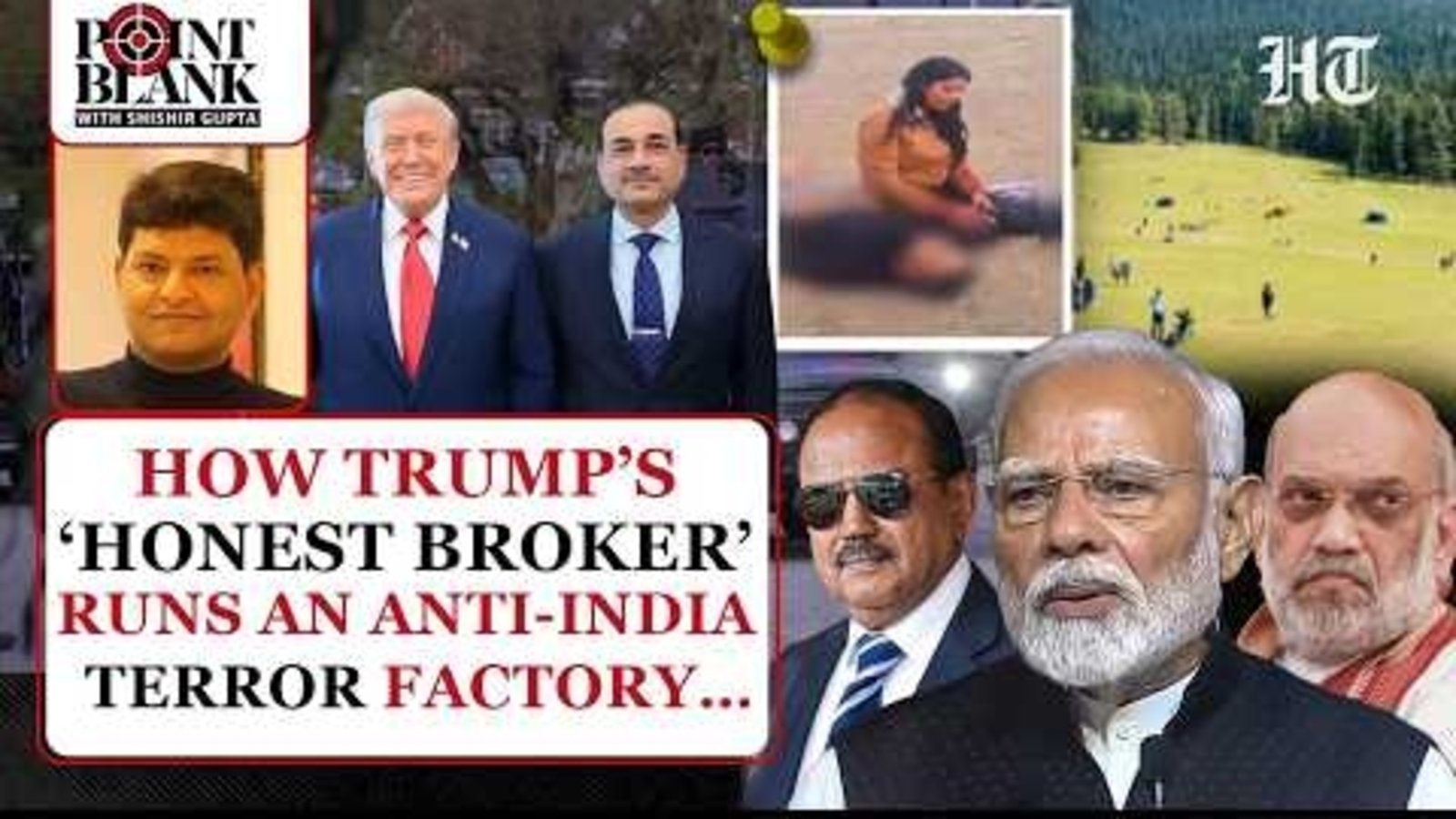
Hindustan Times Executive Editor Shishir Gupta and Senior Anchor Aayesha Varma discuss the Pahalgam terror attack and its wider geopolitical fallout. During the conversation, they look back at the massacre, interrogate Pakistan’s terror ecosystem, and ask what India must do to prevent another such tragedy.

A massacre that scarred Pahalgam
One year ago, 26 Hindu tourists were singled out and gunned down by Lashkar‑e‑Taiba terrorists in the Baisaran valley near Pahalgam, in one of the most brutal communal massacres in recent years. The attackers identified Hindu men and shot them in front of their families, turning a holiday into a scene of horror.
Gupta describes the “cost of terrorism” as humongous: lives lost, families destroyed, and a country forced to confront the failure of its security architecture in the face of a “rogue state” on India’s western border. In hindsight, he argues, every link in the security chain—from intelligence to local police response—was found wanting.
Three Lashkar operatives, operating under the façade of “The Resistance Front”, carried out the Pahalgam attack. All three—Faizal Jatt, Hamza Afghani and Jibran—were Pakistani nationals who infiltrated through the Gurez–Tulai sector in north Kashmir between 2022 and 2023. Faizal Jatt, Gupta notes, was a former Pakistan Army para‑commando, armed with an AK‑103, while the group also carried an M4/M9 rifle, GPS devices, satellite phones and ultra‑high‑frequency radios to stay in constant touch with handlers across the Line of Control.
The trio struck on 22 April and managed to survive for more than three months in the glaciated upper reaches of the valley, before being neutralised on 28 July 2025 in Harwan forest near Dachigam National Park. For Gupta, that long gap between attack and elimination is itself an indictment of the system.
Where India’s security grid failed
Gupta lays out the ideal chain of defence in four stages: better intelligence for pre‑emption, strong enforcement for prevention, robust tactical capability for rapid reaction, and finally investigation. At Pahalgam, he believes, the sequence collapsed at multiple points.
He points first to local policing. The Jammu and Kashmir Police station responsible for the area was barely six kilometres away, yet the response on the ground was delayed and inadequate, despite the fact that this is familiar terrain for security forces. Counter‑insurgency responsibilities in the belt were shared between the CRPF and Rashtriya Rifles, while the Army guarded the LoC to prevent infiltration, but the system failed to translate this deployment into real‑time response when it mattered.
Gupta is clear that the political leadership since 2014—naming Prime Minister Narendra Modi, Defence Minister Rajnath Singh and Home Minister Amit Shah—has been willing to empower security forces and give them the required capabilities. The problem, he says, lies with “institutional leadership” within the security grid, which must now be held accountable if it fails to pre‑empt, prevent or rapidly react to such threats.
Everyone in Srinagar knew about infiltrated terrorists in the Valley, Gupta points out, with estimates of 60–70 such fighters present at the time. That prior awareness makes the failure to anticipate a mass‑casualty attack on soft Hindu tourist targets even more glaring, in his assessment.
Asim Munir: “arsonist” as mediator
The Pahalgam massacre unfolded days after then Pakistan Army Chief General Asim Munir delivered an anti‑Hindu hate speech on 16 April, a link Gupta sees as more than coincidental. Today, Munir has been elevated to Field Marshal and is publicly feted by U.S. President Donald Trump as an “honest mediator” between Washington and Tehran.
Gupta is scathing about this image makeover. In his view, “only his rank has changed; the man remains the same.” He argues that Pakistan has long perfected the art of playing arsonist and fire‑fighter at the same time: the same army that offers to mediate between the US and Iran is accused of backing the Sunni group Jaish‑ul‑Adl to attack Iran’s Sistan province, prompting Iranian ballistic‑missile retaliation against Balochistan.
This duplicity, he notes, has a long history. He recalls how Pakistan allowed US U‑2 spy planes to operate from its soil in the 1950s, backed Washington during the 1971 Bangladesh liberation war, and then played both sides with the Taliban and the US after 9/11. In each phase, Islamabad extracted strategic rents while nurturing jihadist proxies, and Gupta believes Munir is now trying to cut similar “deals” in a new era.
Pakistan’s jihad factory is “alive and kicking”
Asked whether groups like Lashkar‑e‑Taiba and Jaish‑e‑Mohammed are still thriving, Gupta’s answer is blunt: the terror set‑up in Pakistan is “alive and kicking.” Lashkar remains principally active against India, while Jaish continues to operate out of Bahawalpur; both are Punjabi‑based Pakistani outfits focused on targeting India, especially Jammu and Kashmir.
Beyond these India‑centric outfits, Gupta sketches a wider ecosystem of Pakistani groups targeting Afghanistan, Iran and the United States, describing Pakistan as a “global jihad factory.” Cosmetic narratives of mediation or moderation, he argues, cannot hide the reality that “terror factories are alive and kicking” and will inevitably manifest in fresh attacks when the ISI chooses to unleash them.
The illusion of Track‑2 and a “changed” Pakistan
In this context, Gupta is deeply sceptical of the periodic buzz around India‑Pakistan Track‑2 dialogues. He dismisses them as “junkets” for retired bureaucrats and military officers whose official shelf life is over, with little real impact unless directly empowered by political leadership.
He reminds viewers that Modi himself took a dramatic political gamble by landing in Lahore on 25 December 2015 to meet then Prime Minister Nawaz Sharif, only to be rewarded days later with the Jaish‑e‑Mohammed attack on Pathankot airbase. Expecting talks to fundamentally transform Pakistan, he suggests, is delusional.
Gupta draws a parallel with the US opening to China in the 1970s under Richard Nixon and Henry Kissinger, which was driven by the hope that engagement would nudge Beijing towards democracy. Half a century later, he says, American leaders admit this assumption failed as China emerges as a peer rival. For him, the lesson is clear: deal with the “absolute facts” of Pakistan—where leadership, both political and military, thrives on anti‑India rhetoric and a radicalised society—rather than fantasies about its imminent transformation.
US–Pakistan–India: a delicate triangle
Does Munir’s equation with both Washington and Beijing mean the US will now go soft on Pakistan’s terror record? Gupta expects Washington to retain a “soft corner” for Pakistan for transactional reasons. He points to cooperation on Iran, cryptocurrency channels, and reported side deals with figures like Steve Witkoff and Jared Kushner as factors that could translate into IMF support, Gulf funding, or even military aid flowing to Islamabad.
Yet he simultaneously underlines that the US–India relationship is “equally strong”, and that any perception of Trump going soft on Pakistan after a major terror attack on India would damage bilateral ties with New Delhi. In other words, Washington’s balancing act between an opportunistic partnership with Pakistan and a strategic embrace of India will only become trickier if another Pahalgam‑style atrocity takes place.
Preventing the next Pahalgam
In the final segment, Varma brings the discussion back to the core question: how can India prevent another Pahalgam? Gupta breaks the answer into concrete steps.
First, stop infiltration across the LoC in Kashmir. He acknowledges the mountainous, glaciated terrain but insists there can be “no excuses” given the density of Army deployment.
Second, strengthen the counter‑insurgency grid so that CRPF and Rashtriya Rifles keep terrorists under continuous pressure, forcing them to run rather than sit, plan and execute.
Third, dramatically improve intelligence—both from Pakistan and inside Kashmir—to locate and neutralise terrorists before they strike.
Fourth, ensure robust ground response by the Jammu and Kashmir Police, who are the real eyes and ears on the ground. They must not only pass information upwards but also react swiftly, rather than allowing attackers a free run for hours.
Gupta warns against a misplaced invocation of human rights when confronted with terrorists who asked victims to pull down their trousers and killed them purely on the basis of religious identity. In such circumstances, he argues, the state’s primary responsibility is to protect innocents through “continuous pressure, pre‑emption and prevention”, backed by strong institutional leadership across all security arms.
As the conversation ends, Varma closes the episode of “Point Blank” by remembering the 26 lives lost in the “horrific Pahalgam terror attack”, even as the discussion looks ahead to the hard choices India and the world must make in dealing with Pakistan’s enduring jihad enterprise.
[ad_2]
Source link

