
Arunav Ghosh and Shreyansh

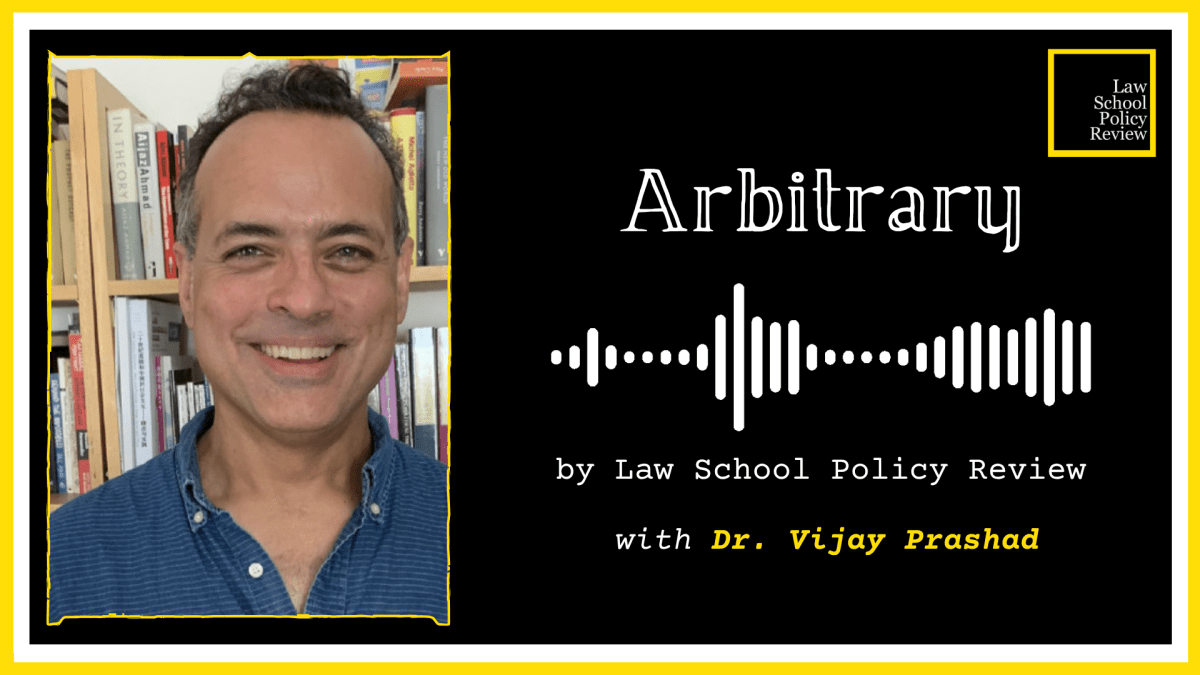
Arunav Ghosh and Shreyansh, members of the Editorial Board at the Law School Policy Review, sit down with Dr. Vijay Prashad, historian, journalist, and Executive Director of Tricontinental: Institute for Social Research, for a wide-ranging conversation on India’s foreign policy, democratic culture, and the shrinking space for dissent. Through an examination of India’s muted response to US and Israeli strikes on Iranian and Indian vessels, its pattern of abstention at the UN on Gaza and Ukraine, and its deepening security and surveillance ties with Israel, the conversation probes whether India’s “strategic autonomy” is a genuine posture or a performance calibrated to appease Washington. Dr. Prashad reflects on the selective targeting of civil society organisations, the entrenchment of caste as a barrier to genuine democracy, the constraints of IMF conditionality and big capital’s capture of the state, and the depoliticisation of Indian campuses under pressure from both market demand and state control. The episode concludes with Dr. Prashad’s reflections on Calcutta, the unfinished legacy of the Left Front, and the case for building independent, philanthropically-funded institutions of research and education in India.
LISTEN TO THE PODCAST

Arunav: I’ll briefly introduce myself before we start. I’m Arunav, in the second year at National Law School, Bangalore — going into the third year. This is Shreyansh, my observer; he’s in the first year at the same law school, going into the second.
Dr. Vijay Prashad: You know, I used to teach at NUJS, Calcutta — years ago, I can barely remember it now.
Arunav: At NUJS — that’s surprising. I almost went there, since I’m from Calcutta originally. It’s surprising because of what National Law School is today: almost a factory that produces corporate lawyers. Though it’s not entirely surprising either — we have legendary labour organisers. I recently interviewed Professor Babu Matthew, who works on gig and platform workers and was one of the founding members of NLS.
Dr. Vijay Prashad: You need to fight to improve things. As students, you need to demand more — more intellectual work. A law school isn’t a place to produce lawyers. That’s the misunderstanding of the national law schools. It’s not to produce lawyers, it’s to produce legal minds.
Arunav: That was Madhava Menon’s intention too — to create social engineers. But in the era of privatised education, with fees at roughly five lakh per annum, and given India’s income distribution, it becomes a very closed-off space. There are reports calling it the “elusive island of excellence.”
Dr. Vijay Prashad: The price is horrendous. No, it’s horrendous. All right, let’s get going — I don’t want to lose your time. Nice to see you both, and congratulations.
Arunav: Thank you. Shreyansh has a question to begin with, on more recent events.
Shreyansh: On March 4, the IRIS Dena — India’s guest at the MILAN 2026 defence exercise in Vizag, where President Murmu had posed with its sailors — was torpedoed by a US submarine off Sri Lanka, killing over 87 Iranian sailors. India barely protested. Then, between June 8 and 11, the US struck three more vessels carrying Indian crews, killing three Indian citizens. India summoned a diplomat and said “these attacks must stop,” but neither the Prime Minister nor the External Affairs Minister has said a single public word. And the government keeps qualifying its protest by calling these “sanctioned, foreign-flagged vessels” — terminology that implicitly legitimises the very blockade that killed its own citizens, conveniently just before a Modi–Trump meeting at the G7. Is this a strong protest, or a performance of protest calibrated not to embarrass Washington? And what does it tell us about the real limits of India’s strategic autonomy — even in its purported sphere of influence — while it talks of being the Vishwaguru?
Dr. Vijay Prashad: Firstly, this is a really important subject, and it deserves much more discussion and debate within India. These are Indian citizens. When the United States and Israel provoked the war against Iran, Iran retaliated against US military bases in the Gulf — bases populated by lots of Indian citizens. The Indian government never said anything.
If the three of us were in the Indian government, the statement I would have released on the first day of the attack on Iran is: this war is uncalled for, because it jeopardises the lives of Indian citizens — some in Iran itself, students in Qom, for instance. I know Indian students in Qom. There was no real consular statement, let alone a political one.
There are levels of action. The first is that you have to defend your own citizens — that’s a consular obligation. If you have a national in another country, you must defend that national; you can’t allow them to be killed. That obligation was invalidated when this conflict began. I never saw anything from the Ministry of External Affairs about Indian citizens in the Gulf. They “expressed concern.” Expressing concern is what you do about Sudan. When you have millions of Indian citizens in a region, “concern” is a pathetic response.
The Iranian vessel struck in Sri Lankan waters was a guest of India — a ceremonial ship. An Indian guest was attacked. Forget international legal obligations: what has happened to our notions of hospitality? If a guest leaves my house and is shot outside, I feel an obligation — I run outside, I call the police. My guest came to my neighbourhood. That entire idea of hospitality was invalidated by India saying essentially nothing. It was Sri Lankan vessels that went to help those in peril.
And when Indian nationals are killed, as they were recently, at the very least there should be a protest — not an expression of concern. International law provides space for protest. You can send a letter of protest: your armed action knowingly killed our citizens — it was a direct hit on a vessel — and we protest this, and we demand retribution for the families. When US nationals are killed abroad, the US government fights, seizes assets for the families. It has seized Iranian assets, Cuban assets, over the years on those grounds. Why can’t the Indian government at the very least demand retribution on behalf of families who have lost perhaps their only breadwinner, in a perilous economy?
Arunav: That leads me to India’s role at the United Nations. I’m a big fan of Washington Bullets — the first LeftWord book I read. It opens with the idea that international law was defined early on as being for “civilised states.” As Global South nations enter the UN, we see India exercising abstentions, called strategic: the March 2022 resolution demanding Russian withdrawal from Ukraine, the October 2023 resolution calling for a humanitarian ceasefire in Gaza, and again on an arms embargo on Israel. India has historically invoked strategic autonomy. But is abstention a strategy, or a new form of compliance — are we adapting to an eventually multipolar order, or still complying with a rules-based one?
Dr. Vijay Prashad: Firstly, I’m very happy you pay attention to UN votes — they’re generally ignored nowadays. Abstention has an interesting history. Why not just have a yes-or-no vote? When you join a debate team at school, there’s no room to abstain — you stand for the motion or against it.
An abstention is a diplomatic feint. It lets a country say, “We don’t necessarily agree with the motion, but we’re not willing to say we disagree.” So then why not just allow them not to show up? Because an abstention is itself a position. Take a Gaza vote on arming — most of these resolutions actually say “stop arming both sides.” When you abstain from that, what you’re really saying is that you want the arming to continue. In very few cases is an abstention a kind of phantom positive vote. If you are for a resolution, you vote for it. Most abstaining countries actually oppose the resolution but don’t want to go on record opposing it, because they don’t want to appear in a bad light.
In India’s case, it has nothing to do with easing toward a rules-based order. It’s India’s typical attempt to appease the United States and Israel while making sure the oil-exporting Arab countries don’t get too angry — because India is a net importer of oil. It’s unprincipled to abstain on a vote to do with genocide. Votes on genocide should not allow for an abstention. You should have to go on record, yes or no, and you should not be permitted to skip the vote — if you don’t show up, you’re voting against.
The 1948 Genocide Convention is very badly written. It should have been written so that any vote based on it does not permit space for an abstention. Then you’d get an interesting problem in the UN system, because states like India would have to take a position. Are you okay with the genocide or not? We know what Germany would do — Germany would say there is no genocide. Jerry Seinfeld was asked something about Palestine and said Palestine doesn’t exist; John Cusack replied, if it doesn’t exist, why do you need to destroy it? It makes no sense. Abstention is not a vote for non-alignment. It’s a way to pacify everybody. It’s utterly unprincipled.
Arunav: I have a friend at an institute in Geneva — there was an attempt to rewrite the Genocide Convention, but it didn’t happen, because there wasn’t enough interest. The broad consensus was that it isn’t being followed anyway, so why waste the effort?
Dr. Vijay Prashad: I don’t agree with that assessment. Rewrite it. Do it as a practice — put it on the table, say we want to strengthen these aspects. Take my idea of removing the right to abstain on a genocide resolution. I could go down the UN treaties and say the same for anything under Chapter VII, where a state is permitted to take armed action against another — there should be no allowance for abstention.
When Resolution 1973 came on Libya in 2011, China and Russia abstained. Had they vetoed it, France and the United States couldn’t have gone and destroyed Libya. But they used an abstention on a Chapter VII resolution. So write a paper for a journal: these are the ten treaties, or parts of the UN Charter, where abstention should not be permitted. The US attack on Iran is illegal — there’s no Security Council resolution authorising it. The attack on Libya appeared legal, although it wasn’t, because the resolution only authorised a no-fly zone; they totally exceeded the mandate. But it gave a patina of legitimacy. How can you abstain on that? It’s like telling a judge in a death-penalty case, “I have no opinion.” How can a panel of five have one member sit back and say, “I neither condemn the person to death nor allow them to live”? Is that the latitude you’d give someone with that much authority? It’s insane.
Arunav: That’s an interesting example — I just did jurisprudence last semester, and we studied the Speluncean Explorers, where one judge does exactly that: he criticises the law’s formalism, says he’s at a crossroads, and abstains. It was almost a comical point in class.
My next question is about surveillance law and India’s growing security relationship with Israel. India is the largest purchaser of arms from Israel — it absorbs roughly 34% of Israel’s exports — at a time of growing militarisation worldwide. There’s also the 2021 bilateral innovation agreement between the DRDO and its Israeli counterpart. And then there’s the Pegasus revelation, where the NSO Group’s spyware targeted opposition leaders, journalists, constitutional officials. How do we understand this deepening surveillance and security partnership at a time of genocide, while India maintains an outward posture of strategic autonomy?
Dr. Vijay Prashad: You’ve used “strategic autonomy” a number of times — it’s the term of the day in the Indian security establishment. I wonder what precisely they understand autonomy to mean. There are fleeting examples — Jaishankar saying, “You can’t tell us not to buy Russian oil.” But was that strategic autonomy, or the economics of it? India imports Russian crude, refines it, sells it on the open market, and makes a lot of money. I don’t think India was saying, “We won’t change our source of oil because we’re committed to Russia.” There was no strategic autonomy there. I admit I misread that statement at first — I read it as the Indian government refusing to walk with the United States, but it was mostly economic. So I’d put it to those who believe in strategic autonomy: give us a real, concrete sense of it.
On surveillance — and we need to pay attention to this globally and in India. I was one of the people who helped create NewsClick, with Prabir Purkayastha and others. We built an incredible media platform and faced a lot of attacks. During the anti-CAA protests and the farmers’ movement, our viewership grew astronomically — and then the government cracked down. Fake ED cases. The Delhi High Court has now said this was simply the practice of journalism, that it was unconscionable. They bankrupted us, put young people out of work. We had young journalists doing interesting reporting — sleeping in the camps with the farmers, writing from their perspective. They cracked down. They went into people’s WhatsApp groups, extracted meaningless statements, and put people in jail. We saw the same in the Bhima Koregaon case.
But that’s superficial surveillance — the easiest kind. My issue is not with surveillance as such. It happens all the time; there are cameras everywhere. In a digital age it’s very hard to keep your materials from being looked at. We’re talking on this platform right now — someone’s accumulating this conversation, the metadata, the transcript. It doesn’t matter. My problem is what governments do with the information. Malicious use of information is far worse than the accumulation of it.
In fact, I’d welcome some surveillance in cities to reduce crime — the terrible sexual violence against women, for instance. A few more cameras could take away the licence men feel they have to grab a woman; if it’s on tape, you pay for what you did. I’m not one of those people who says surveillance is always bad. There’s value in a balanced approach. It’s the malicious use of information I object to.
Here’s an example. I once emailed Prabir saying we were doing a project, very interested in how the Chinese dealt with the COVID pandemic. A colleague replied to the chain saying, “Vijay is in charge.” When the emails were leaked, the TV channels highlighted “Vijay is in charge” and called me the mastermind. The person who said he was in charge of a project on the COVID pandemic — we produced a text, China and Corona Shock, a good one, you can find it online — I was in charge of that text. Not a mastermind of a criminal conspiracy. Malicious use of information, not only by governments but by the so-called media, is equally bad. It’s reputation-destroying. It’s clear I don’t like this government — but is that illegal in a democratic society? I read the 1950 Constitution. Maybe it reads differently in Gujarati; I don’t know.
Arunav: That connects to civil society in India. We see the selective cancellation of FCRA licences — roughly 21,933 organisations, tending to be those working on environmental and minority causes: Amnesty International, Greenpeace India, the Centre for Policy Research. NewsClick’s FCRA ties were questioned too. Yet other bodies — Brookings, Chatham House, ORF — continue to function. So there’s a selective functioning, an indirect control over discourse and over who is allowed to speak. How can India develop an independent policy ecosystem when your discourse determines whether you get to operate at all?
Dr. Vijay Prashad: First, the very concept of “civil society” needs a lot of thinking. The literature in India is derivative — it borrows the concept from abroad. It would be a good idea to rework it based on India’s own experience since the 1930s, within the national movement: what was the emergence of non-state actors, and how much was actually allowed? Because from the Nehru era onward there were guardrails against critics of the state. It’s not as if Indira Gandhi welcomed critics of the state. The space was limited, and Indian law derives much of its understanding here from colonial law.
So it would be worth doing a history of non-state institutions — I avoid “civil society” because the term presumes the existence of something. The concept is Hegelian idealism; it comes out of German idealism and assumes the society is already democratic. There’s no democratic society in the world. So let’s build real concepts. Let’s first ask: what is the democratic potential of Indian society?
Look at the court system — say anything about a judge and you can be held in contempt. There’s no democratic room to debate judicial findings. Look at the digital-bullying laws — post a cartoon of a politician and you’re in trouble. In Bengal, people were arrested for sharing a cartoon of Mamata Banerjee on Facebook. We have to assess the democratic potential of Indian society and state formation today, and frankly I don’t think we know.
Most of what the BJP government has done in the last fourteen-odd years is legal — that’s what’s scary. Whether or not to grant an FCRA licence is within its purview; it’s not illegal, so it’s not a scandal. The scandal is the lack of democratic culture in India. This is not a BJP problem — the BJP is exercising its rights. What’s illiberal is our democratic culture; we haven’t built one. If you have a society where it’s perfectly okay to lynch a Dalit on the streets, or kill a Muslim, or rape a woman, and nothing happens — no consequences — then we don’t have a democratic society. And I’ll say something I’ll probably regret: a society with an entrenched hierarchical caste system can never be democratic. Full stop.
Arunav: Dr. Ambedkar said something similar — that you can’t build on the foundations of caste, and he was ready to burn the Constitution if there were no equal civil society. Caste even becomes an international problem with migration — the largest temple outside India, in New Jersey, was built under allegations of bonded, slave-like labour. And caste, as Ambedkar understood it, could become a framework for understanding other oppressed communities worldwide, though that’s debated within anti-caste politics itself.
I’d like to tie these threads to how much freedom India has to decide its own policy — because civil society is only effective to that extent. Your work on IMF conditionality has shown how structural-adjustment requirements constrain the legislative autonomy of Global South states. The Washington Consensus framework — privatisation, fiscal consolidation, current-account liberalisation — is now embedded in domestic statutes and in the rationalisations we give ourselves. And the WTO appellate body has been paralysed since 2019 because the US blocked appointments; India is a frequent complainant and respondent, and the parallel arbitration mechanism is a less-equal, negotiating sphere — being before a judicial body and negotiating are different things. So how free is India to formulate its own economic, environmental, or social policy under these constraints? Should we move from a nation-state framework to a world-systems one?
Dr. Vijay Prashad: You’re asking very good questions, and some simply don’t have answers, because they’re about how a society develops — you can’t rationalise things that are still on the table. We have to wait and see how Indian society develops, and how you, as young people, enter that sphere to transform things. Nothing is static; everything is moving. That’s why I set aside the term “civil society” — it’s too static. We need a much more active term, though I don’t know exactly what.
It’s not that the IMF tells the Indian government to maintain a colonial-era political police — the Enforcement Directorate, the CBI. How the political police is used against political opponents is well known. You don’t need an Emergency; the eighteen-month Emergency wasn’t really an exception. Sending the ED or CBI to raid politicians’ homes happens all the time — recently Pinarayi Vijayan, but it’s routine.
At the same time, we have scandals at the level of big capital and nothing happens. A billionaire’s child keeps exotic animals, illegally, on a publicly provided plot of land — a violation of all kinds of importation and animal laws — and nothing happens. There are credible reports abroad, in the Financial Times and elsewhere, about another major Indian billionaire’s violations, and I don’t see the ED getting involved. You’re raiding some politician’s house you want to destroy, but big capital no longer sees these raids.
So when we say, “We’re under these IMF compulsions,” are we really? Governments have made choices. They want stable rule — long periods in power. So much corporate money goes to the ruling party; somewhere I read that 80% of known election funds go to it, and I’d guess 90% of unaccounted money. Capital has made a bet. It said, “We bet nine red,” and the roulette wheel keeps landing on nine red because they put all the money there and tip the scale, so they keep winning. They want what they call stability — a hassle-free environment, no political problems, no awkward questions about some port they’re building or fish dying from it. That’s not the IMF. The WTO appellate body didn’t cause that. Indian big capital — and foreign capital operating in India — is under zero scrutiny.
Who scrutinised the last major laws affecting big capital? The farmers — they went on a massive protest. And the workers, fighting the labour codes. Not any state institution with enough authority. I’d like to have such an institution in a liberal-democratic state: a body that scrutinises laws before they reach the legislature and provides an independent assessment of their impact on the whole population. Why don’t we have that? Perhaps an office within the Planning Commission that beta-tests every law — “if this law passes, here’s what happens in ten years to informal workers, to this, to that” — and publishes a report that can be used in the parliamentary debate. A beta-tested law can carry many opinions, even contradictory ones; different members can use different parts. At least they’d have an informed argument. In the United States, in fact, they have a body that tests the financial accuracy of laws. I’m thinking about impact on society. Why not?
Arunav: Interesting that you mention Vantara — now Vantara University. That segues into the responsibility of students and young people in academia to dream, to change things, and how that’s affected when academia itself changes. The promise of the liberal academic institution is failing in India — arrests on campus over discourse, private universities backing away from protecting marginalised people, faculty harassed en masse online, institutions bending to capital. There’s now a JSW Centre for the Future of Law and a JSW academic block opening at the National Law School — still legislatively a state university — and it’s not even controversial to say the same group makes drones shipped to Israel. So to what extent are academic spaces, and the space for students to speak, affected by all this? And how do we protect these institutions from capture?
Dr. Vijay Prashad: I’ll say something reflective and then leave it to you to finish the sentence — because this is for you to think about. In India there’s a massive pent-up demand for improving life and life choices. A very large number of people — hundreds of millions of young people — want to enter the middle class and make a living. That demand will define Indian education for some time. You have a wretchedly poor society with people pushing to improve their lives; they won’t immediately have the space to come to college and say, “I want to make the world better.” They’ll come in saying, “I’m from a landless family, I’m from the informal world, I want a career.” That pressure on the Indian academy is a structural feature, and I empathise with it.
So the question for you is: given that, what should the debates on campus be? What’s happening is a depoliticisation from two sides. One is this incoming student body that says, “I just want my degree so I can make a living.” Don’t underestimate that apolitical pressure — I empathise with it, because we live in a wretchedly unequal society. The second is the government and private capital saying, “No politics on our campus.” Ashoka — a private school, no student unions. JNU — a public school, and they want to crush student politics as a waste of time. These two pressures are converging. Now it’s for young people to ask what kind of world they want to live in. It’s your world.
And I’m fed up with all this Gen Z, Gen X talk. In India there is no Gen Z. There’s a generational caste system — the buzurg and the baccha, elders and children, only two sections. You’re a baccha for years, then you cross into the other. This goes back to the old understanding — you are a student, then a householder, then a sanyasi. India is hierarchical in so many ways — the necessity of calling people “sir.” Even you calling me sir is ridiculous; I’m the last “sir” in the world. But you feel compelled, because you’re polite and you defer to your elders. Nothing wrong with that — but deference has a price. You’re being deferential to the whole structure. How do you break that? These are conversations you have to have. I’m just giving you the structure of your problem: a mass of people entering university for a career, uninterested in politics; a government smashing politics; private capital smashing politics; and on top of it all a society of deference. How are you going to change that? You need serious conversations about whether there can be a post-deferential society.
Arunav: That brings me to a two-part closing question, since we’re short on time. First — even the dream of economic prosperity, of joining the professional-managerial class, is slipping away. Companies are pushing automation through generative AI at great environmental cost, and not even efficiently. In February, India effectively signed away rights to its land and water resources through a twenty-year tax break for big tech firms that will do this automation. We recently had a protest on campus over the lack of water in hostels — a women-led movement, since the concerns were women-centric, and it was met with misogyny. But there was no institutional space to discuss how the macro-politics of water shortage will reach campus, then homes, then South Bombay and South Delhi. So even that dream — genuine entrepreneurship and innovation, not the exploitation of labour through gig work — seems impossible in India’s current ecosystem. How do we reform that economically, learning from the history of industrialising societies? And second: the Tricontinental Institute is pitched as a movement-driven research institution. How do we model that kind of institute, or policy think tank, within or beyond academic spaces in India?
Dr. Vijay Prashad: That’s not a two-part question — it’s two different questions. The first is long and difficult. In India we’ve so devalued labour that machines are often a labour substitute — we substitute machines for labour rather than labour for machines. What’s the point of buying a vacuum cleaner when you can hire someone for almost nothing to come every day and do the pochha? That’s been a serious problem for a long time.
Now, with generative AI entering — yes, the issues of land and water are real — but it also mechanises the one area where India had developed some space: business-process outsourcing. BPO was, in the digital world, about the only place where people were hired; the internet world is not a huge job creator for India. Small shopkeepers create more jobs than that. We’re now undercutting BPO — generative AI will take over so many of those jobs, and many people will lose work.
But the real issue with the entry of AI is the classic Indian issue: India doesn’t fight for its right to build anything. We just want to import and to manufacture for somebody else. Where’s the good-quality Indian smartphone? When India banned Chinese apps, it was a joke — there are no Indian apps. Where’s the Indian technology that’s eye-catching, used abroad? What we never talk about is that India built a public-sector high-speed rail — some two hundred kilometres an hour, entirely a public-sector product, and it works pretty well. I don’t know why we don’t put that on the map, explain it, try to export it. Somehow we just want to import technology. That’s a shame. That, in a rambling way, is the answer to the first question.
On the second — we have lots of institutes in India trying to do similar things to what we do. The problem is that nobody supports them. You don’t get government support for anything like this, and philanthropy is extremely poorly developed. When the rich decide to give, they want their brand on it — Shiv Nadar this, Ambani that, Tata this — they want to own it. It’s a form of private property, even for non-private matters. The idea of simply giving is poorly developed, and among the middle class it hasn’t been developed at all. The middle class doesn’t give, say, ten thousand rupees a year — a small share of income that could do something positive. There’s religious philanthropy — temples and so on — but secular philanthropy isn’t well developed, and it isn’t discussed.
You can’t build these institutes, particularly with a state relatively hostile to open discussion, without some form of philanthropy. You don’t want foreign funding — I agree. So where’s the domestic funding? Where’s the middle class? Why isn’t it producing its own research institutes?
Arunav: That reminds me of a piece we’re working on at LSPR, with the Gaurav Foundation, on the privatisation of schools. It’s run by my friend Priyadarshan Kumar, who quit his job and moved to Darbhanga, Bihar — a place with no school within a 200-kilometre radius — and now runs a school funded entirely by philanthropic contributions, providing high-school education.
Dr. Vijay Prashad: You should write about this. Lift it up.
Arunav: We’re writing about how the privatisation of schools, and the way the competition between government and private schools is structured — a cartel of textbook and uniform publishers — prevents philanthropic schools from flourishing.
Dr. Vijay Prashad: Make sure you highlight that this is philanthropically funded within India. That’s super important.
Arunav: It is. And, since we share a Calcutta history — given the recent political change, do you have any thoughts on it? And how did growing up in Calcutta shape your thinking? A city shapes us in many ways.
Dr. Vijay Prashad: It’s a great city, and I’m glad you’re from there. I enjoyed growing up there. When I was ten, the Left Front came to power and stayed for thirty-four years — so from the age of ten to forty-four, there was a Left Front government in the city. Bengali society is very turbulent, with a lot of internal problems. The Left solved some things but couldn’t fix a lot of others. It tried to solve things for the peasantry but couldn’t crack the industrial knot — and that was its downfall.
If you go along the Hooghly, there’s one factory after another effectively locked — from Titagarh all the way down — a huge amount of real estate, all under litigation. At one point I felt the Left should have had a big march, factory to factory, broken the locks, occupied the land, and said, “Let’s build factories here.” Don’t suspend the litigation — let it continue — but put the land to use. After twenty, forty, sixty years of litigation, there has to be government action; there’s a compelling social interest. Even now that land is still closed. Unless the next government solves Bengal’s industrial issue, forget it. Trinamool couldn’t do it. The BJP definitely won’t. You’ve got a peasantry that’s doing better than it was, but the industrial sector is the key, because there’s huge unemployment.
Arunav: Another key failure of the Left was not addressing the evil of caste within Bengali society — and that came back to bite us, in the form of Hindutva, in the recent elections.
Dr. Vijay Prashad: Absolutely. I agree completely. It needs a frontal challenge, but most of us are afraid, because we don’t know what a frontal challenge would even mean. So we have to experiment in small ways — build schools in Darbhanga, see what happens, see what the landlords do.
Arunav: Thank you so much for joining us. This was really enlightening.
Dr. Vijay Prashad: Stay in touch with me. Bye.

