

Last verified: July 2026
Hurt and grievous hurt are the graded offences against the human body that sit just below culpable homicide, and since 1 July 2024 they are governed by Chapter VI of the Bharatiya Nyaya Sanhita, 2023 (“BNS”), Sections 114 to 125, which replaced Sections 319 to 338 of the Indian Penal Code, 1860. The scheme turns on two distinctions. The first is between hurt, which is bodily pain, disease or infirmity, and grievous hurt, which is any one of eight specifically listed serious injuries. The second, applied to each, is whether the injury was caused voluntarily, meaning with the intention or the knowledge that hurt or grievous hurt was likely. Where an injury is inflicted with the intention or knowledge required to kill, the offence climbs out of this chapter and into attempt to murder under Section 109, or culpable homicide under Sections 100 to 105.

The structure of the chapter is straightforward once the two definition sections are separated from the punishment sections. Section 114 defines hurt and Section 116 lists the eight kinds of grievous hurt, but neither carries a sentence on its own. The punishable offences are Section 115, voluntarily causing hurt, which carries up to one year, and Section 117, voluntarily causing grievous hurt, which carries up to seven years. Section 117 also carries two provisions the old Penal Code never had: a minimum ten-year term where the grievous hurt leaves the victim in permanent disability or a persistent vegetative state, and a group-liability provision for five or more persons who cause grievous hurt on grounds of identity. Sections 118 to 125 then raise the offence according to the means used or the motive behind it: dangerous weapons, extortion, deterring a public servant, provocation, poison, acid, and rash or negligent conduct.
Whether a particular section is cognizable, bailable or compoundable decides how a case behaves once an FIR is registered, and those labels change from section to section. The question that decides most contested trials, though, is not what the injury looked like but what the accused intended. The Supreme Court restated this in Roshan Lal v. State of Haryana (2026), holding that the seriousness of an injury by itself cannot convert grievous hurt into attempt to murder unless the prosecution proves the intention or knowledge to cause death. The sections below take each provision in turn, map it to its old IPC number, set out the punishment and classification, and draw the boundary lines against assault, attempt to murder and culpable homicide, with links to the companion guides on each.

Under the Bharatiya Nyaya Sanhita, 2023, “hurt” (Section 114) means causing bodily pain, disease or infirmity, and “grievous hurt” (Section 116) is any one of eight serious injuries, including loss of sight, hearing, a limb or joint, permanent disfiguration of the head or face, a fractured or dislocated bone or tooth, and any hurt that endangers life or keeps the sufferer in severe pain for fifteen days. Voluntarily causing hurt (Section 115) is punishable with up to one year, or a fine of up to ten thousand rupees, or both. Voluntarily causing grievous hurt (Section 117) is punishable with up to seven years and a fine, rising to a minimum of ten years where it causes permanent disability or a persistent vegetative state.
Key changes to Hurt and Grievous Hurt provisions under BNS
The short answer is that the numbers changed and most of the substance did not. When the BNS replaced the Indian Penal Code, the offences relating to hurt were lifted out of Sections 319 to 338 of the old Code and re-enacted, in the same order and largely the same language, as Sections 114 to 125. A reader who knew this area as “Section 323” or “Section 325” now has to think in terms of “Section 115” and “Section 117”, because that is what a fresh FIR, a charge sheet, and a judgment will cite.
The renumbering is clean and almost one-to-one, which makes the map easy to learn. Hurt (old Section 319) is now Section 114. Voluntarily causing hurt (old Sections 321 and 323) is now Section 115. Grievous hurt (old Section 320) is Section 116, and voluntarily causing grievous hurt (old Sections 322 and 325) is Section 117. The aggravated offences follow in the same sequence, so causing hurt by a dangerous weapon moves from Section 324 to Section 118, the acid-attack provisions move from Sections 326A and 326B to Section 124, and the rash-or-negligent offences from Sections 336 to 338 to Section 125.
Three things are genuinely new rather than merely renumbered. Section 117 now contains sub-section (3), which prescribes a minimum of ten years, extending to imprisonment for life, where the grievous hurt leaves the victim permanently disabled or in a persistent vegetative state. Section 117 also adds sub-section (4), a group-liability provision that punishes five or more persons who cause grievous hurt on grounds such as race, caste, community, sex, place of birth, language or personal belief, echoing the mob-violence logic added to the murder provision in Section 103(2). The acid-attack provisions, first inserted into the Penal Code in 2013, are carried into the BNS intact.
The practical rule for deciding which law applies is timing. An act of hurt committed and reported on or after 1 July 2024 is charged under the BNS. A case where the FIR was registered under the IPC before that date continues under the old sections until it concludes, because a repeal does not disturb proceedings already on foot. For a few years, then, courts will run IPC and BNS hurt trials side by side, applying the same substantive law under two sets of numbers. The wider recodification is set out in our comparison of the BNS and the IPC, and the pre-2024 detail survives in the older explainer on Section 320 of the IPC.
Section 114: what the law counts as hurt
Section 114 of the BNS defines hurt in a single line: whoever causes bodily pain, disease or infirmity to any person is said to cause hurt. The definition is deliberately wide, and each of its three limbs does separate work. Understanding them matters because the whole chapter is built on this foundation; every later offence is a species of causing hurt or grievous hurt.
The first limb, bodily pain, covers any physical suffering caused to another person, however brief. A slap, a punch, a pinch that causes pain, or a blow that leaves no mark can all be hurt, because the law asks whether pain was caused, not whether an injury is visible afterwards. The pain has to be to the body; mere mental anguish or emotional distress, without more, is not hurt under this section.
The second limb, disease, covers communicating an illness to another person, such as knowingly transmitting an infection. The third limb, infirmity, means a state of temporary or permanent inability of an organ to perform its normal function, including a condition of weakness or malfunction brought about by the accused’s act. Infirmity is wider than a visible wound: administering a substance that makes a person unwell, or an act that induces a temporary loss of a faculty, can amount to hurt through this limb.
Hurt is not the same as assault or the use of criminal force, which are separate offences now found in Sections 129 to 131 of the BNS. Assault is the threat or attempt that puts a person in fear of criminal force, and criminal force is the application of force itself; hurt is the bodily pain, disease or infirmity that results. A single incident can involve all three, but they are distinct in law, and a charge of causing hurt requires proof that pain, disease or infirmity actually followed.
Section 115: voluntarily causing hurt
Section 114 only defines hurt; Section 115 makes voluntarily causing it an offence. The word that carries the section is “voluntarily”. A person voluntarily causes hurt when they do an act with the intention of causing hurt, or with the knowledge that they are likely to cause hurt, and hurt actually results. Accidental injury, without that intention or knowledge, does not fall within the section; the negligence track is dealt with separately in Section 125.
This distinction between an intended result and a merely foreseeable one runs through the entire chapter, so it is worth fixing here. “Intention” means the accused meant to cause the injury. “Knowledge” means the accused knew that the injury was a likely consequence of what they did, even if they did not specifically desire it. Either state of mind satisfies the requirement of voluntariness, which is why a person who lashes out in a crowd, knowing a blow is likely to land and hurt someone, is treated as having voluntarily caused the resulting hurt.
Section 115(2) sets the punishment for voluntarily causing hurt at imprisonment of up to one year, or a fine of up to ten thousand rupees, or both. This is the direct successor to Section 323 of the IPC, and the maximum is unchanged. It is the least serious offence in the chapter and the one most commonly seen in everyday altercations, scuffles and minor assaults.
The classification matches the low gravity. Voluntarily causing hurt under Section 115 is a non-cognizable offence, meaning the police cannot register an FIR and investigate without a Magistrate’s order, a bailable offence, meaning bail is a matter of right, and a compoundable offence, meaning the person hurt can lawfully settle and withdraw the case. It is triable by any Magistrate. In practice, a large share of Section 115 matters are settled or resolved without a trial.
Section 116: the eight kinds of grievous hurt
Grievous hurt is not a question of degree left to a judge’s impression. Section 116 lists eight, and only eight, kinds of hurt that the law designates as grievous, and an injury that does not fall within one of these clauses is legally just hurt, however painful. This closed-list approach is what makes the grievous-hurt inquiry precise: the court checks the injury against the eight clauses rather than asking whether it “felt” serious.
The first seven clauses describe specific, lasting harms. They are: emasculation; permanent loss of the sight of either eye; permanent loss of the hearing of either ear; loss of any limb or joint; destruction or permanent impairing of the powers of any limb or joint; permanent disfiguration of the head or face; and fracture or dislocation of a bone or a tooth. The common thread is permanence or the loss of a significant bodily function, which is why a fracture qualifies but a bruise does not, and why disfiguration is grievous only when it affects the head or face and is permanent.
The eighth clause is the residual one, and it is the most heavily litigated. It designates as grievous any hurt which endangers life, or which causes the sufferer to be in severe bodily pain for fifteen days, or unable to follow their ordinary pursuits for fifteen days. This clause catches serious injuries that do not fit the first seven but are plainly grave, and it introduces the language of endangering life. Courts have drawn a careful distinction here: “endangers life” is a stronger expression than an injury that is merely dangerous or serious, and it is this clause that sits closest to the line with culpable homicide.
Because the eighth clause turns on either a threat to life or a fifteen-day period of severe pain or incapacity, medical evidence usually decides it. A doctor’s assessment of whether an injury endangered life, and the record of how long the victim was in severe pain or unable to work, are what move an injury from Section 115 hurt into Section 116 grievous hurt, with the far higher punishment that follows under Section 117.
Section 117: voluntarily causing grievous hurt
As with hurt, the definition and the offence are in different sections. Section 116 tells you what grievous hurt is; Section 117 punishes causing it voluntarily. Section 117(1) provides that a person voluntarily causes grievous hurt when they intend or know themselves to be likely to cause grievous hurt, and the hurt actually caused is grievous. The section’s illustration makes the point precisely: a person who, intending or knowing it likely that they will permanently disfigure another’s face, strikes a blow that does not disfigure the face but causes the victim severe bodily pain for twenty days, has voluntarily caused grievous hurt.
Section 117(2) sets the ordinary punishment. Whoever voluntarily causes grievous hurt is punished with imprisonment of up to seven years and is also liable to a fine. This is the successor to Section 325 of the IPC, and the seven-year maximum is unchanged. It is the provision under which the great majority of serious assault cases, the ones involving fractures, lasting injury, or hospitalisation, are charged.
Section 117(3) is new to the BNS and marks the most serious form of the offence short of the weapon-specific and acid provisions. Where a person, in causing grievous hurt, leaves the victim in permanent disability or in a persistent vegetative state, the punishment is rigorous imprisonment for a term not less than ten years, which may extend to imprisonment for life, meaning imprisonment for the remainder of that person’s natural life. The provision recognises that a grievous injury which destroys a victim’s capacity to live independently deserves punishment closer to that for taking life than the ordinary seven-year ceiling allows.
Section 117(4) is the other addition, and it imports group liability. Where five or more persons, acting together, voluntarily cause grievous hurt to a person on the ground of race, caste, community, sex, place of birth, language, personal belief or a similar ground, each member of that group is punished with imprisonment of up to seven years and a fine. The provision mirrors the identity-based mob-violence logic that the BNS also wrote into the murder section, and it allows every participant in such an assault to be held liable without the prosecution having to attribute the specific blow to a specific hand. The classification shifts with the gravity: the ordinary offence under Section 117(2) is cognizable and bailable and triable by any Magistrate, while the group offence under Section 117(4) is cognizable, non-bailable and triable by a Court of Session.
Hurt, grievous hurt, and attempt to murder: where the line falls
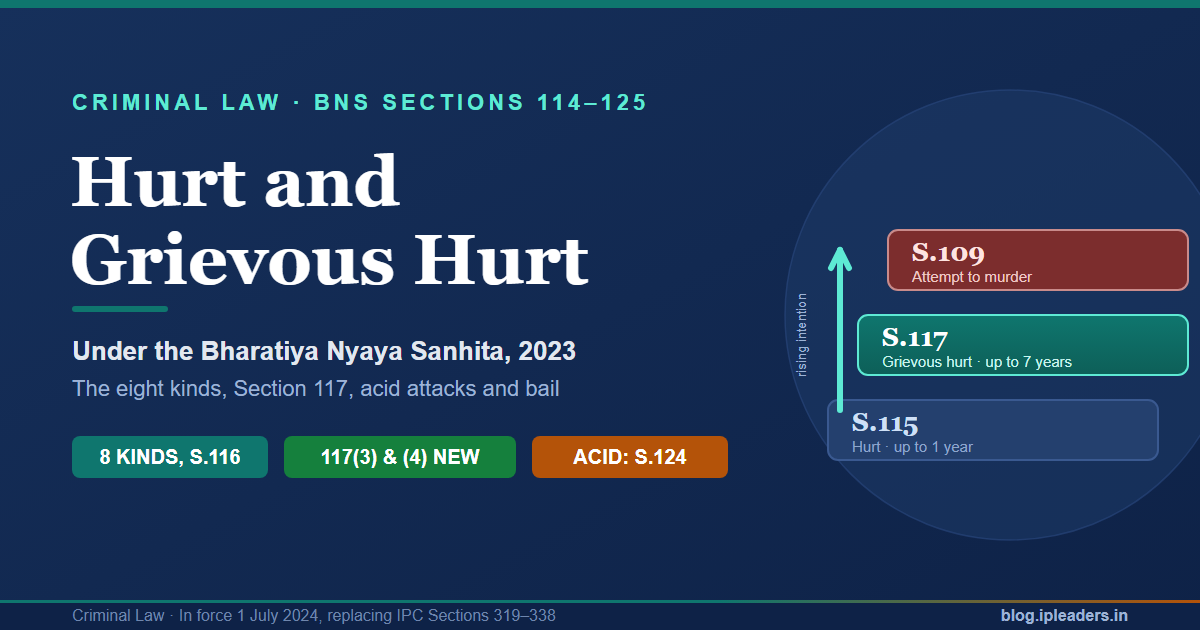
The offences in this chapter form a ladder, and placing a case on the right rung is where most of the legal argument happens. At the bottom is assault or criminal force with no injury. Above it is voluntarily causing hurt under Section 115, then voluntarily causing grievous hurt under Section 117. Above that is attempt to murder under Section 109, and at the top is culpable homicide, which may or may not amount to murder under Sections 100 to 103. The same physical act, a single blow to the head, can sit on any of these rungs depending on one variable: the accused’s intention or knowledge.
This is the single most important point in the whole area, because it is counter-intuitive. The severity of the injury does not by itself decide the offence. A grievous injury inflicted without any intention or knowledge of causing death is grievous hurt, not attempt to murder, no matter how badly the victim was hurt. Conversely, a relatively minor injury inflicted with a genuine intention to kill can be attempt to murder. What separates the rungs is the mental element, read from the weapon used, the part of the body targeted, the force applied, and the surrounding circumstances.
The Supreme Court applied exactly this reasoning in Roshan Lal v. State of Haryana, 2026 INSC 524, decided on 22 May 2026. The accused had been convicted of attempt to murder for an assault that fractured both parietal bones of the victim’s skull and led to neurological complications and prolonged hospitalisation. The Court held that although the injuries were undoubtedly grievous, their gravity alone could not establish the intention or knowledge required for attempt to murder, and that the prosecution had not proved that element independently. It found that all the ingredients of voluntarily causing grievous hurt were made out, and altered the conviction from attempt to murder to grievous hurt, from Section 307 to Section 325 of the IPC, which are Sections 109 and 117 of the BNS.
The line between grievous hurt and culpable homicide is drawn by the same instrument. The dividing line is thin: in culpable homicide the injuries are such as are likely to cause death, while in grievous hurt they may endanger life without being likely to cause it. This is why the eighth clause of Section 116, with its language of endangering life, is the frontier of the chapter. Where the injuries are likely to cause death and are inflicted with the knowledge that death is a likely result, the case leaves this chapter altogether. For the practitioner, the lesson from Roshan Lal is practical: in a serious-injury case, the defence contests intention, and the prosecution must prove it, because the charge stands or falls on that element rather than on the medical report alone.
Aggravated forms of hurt: Sections 118 to 123
Sections 118 to 123 take the basic offences of causing hurt and grievous hurt and increase the punishment according to the means used or the purpose behind the act. They are the provisions under which serious real-world violence is usually charged, and each maps cleanly to an old IPC section.
Section 118 deals with voluntarily causing hurt or grievous hurt by dangerous weapons or means, such as an instrument for shooting, stabbing or cutting, fire or a heated substance, poison or a corrosive substance, an explosive, or an animal. Causing hurt by such means under Section 118(1) is punishable with up to three years, or a fine of up to twenty thousand rupees, or both. Causing grievous hurt by such means under Section 118(2) is far more serious, carrying imprisonment for life, or imprisonment of not less than one year extending to ten years, and a fine; it is non-bailable and triable by a Court of Session. This is the successor to Sections 324 and 326 of the IPC and is the section most often seen in knife and firearm assaults.
Sections 119 and 120 punish hurt used as a tool of coercion. Section 119 covers voluntarily causing hurt or grievous hurt to extort property or valuable security, or to constrain a person to do something illegal, carrying up to ten years for hurt, and up to life for grievous hurt. Section 120 covers causing hurt or grievous hurt to extort a confession or information, or to compel the restoration of property, the classic custodial-violence provision, carrying up to seven years for hurt and up to ten years for grievous hurt. These correspond to Sections 327, 329, 330 and 331 of the IPC.
Sections 121 to 123 complete the set. Section 121 punishes voluntarily causing hurt or grievous hurt to deter a public servant from discharging their duty, carrying up to five years for hurt and rigorous imprisonment of one to ten years for grievous hurt, the successor to Sections 332 and 333. Section 122 runs the other way: it is the one mitigating provision, reducing the punishment where the hurt or grievous hurt was caused on grave and sudden provocation, to a maximum of one month for hurt and five years for grievous hurt, provided the offender neither intended nor knew it likely to hurt anyone other than the person who gave the provocation. Section 123 punishes causing hurt by means of poison or any stupefying, intoxicating or unwholesome substance administered with intent to cause hurt or to commit an offence, carrying up to ten years and a fine, the successor to Section 328.
Section 124: grievous hurt by acid
Acid attacks are dealt with separately and severely, in recognition of the lasting, disfiguring harm they cause. Section 124 carries the two acid-attack provisions that were inserted into the Penal Code in 2013 as Sections 326A and 326B into the BNS without dilution.
Section 124(1) punishes a person who voluntarily causes permanent or partial damage, deformity, burns, maiming, disfigurement or disability, or grievous hurt, by throwing acid on a person or administering it, or by using any other means with that intention. The punishment is rigorous imprisonment of not less than ten years, which may extend to imprisonment for life, and a fine. The fine is required to be just and reasonable to meet the medical expenses of the victim, and it is payable to the victim, an unusual feature that ties the sentence directly to the survivor’s treatment.
Section 124(2) punishes the attempt. A person who throws or attempts to throw acid on another, or attempts to administer it, with the intention of causing the kind of harm described in sub-section (1), is punished with imprisonment of not less than five years, extending to seven years, and a fine, even if no injury results. The section is deliberately drafted to catch the attempt itself, so that a person who throws acid but misses is not left outside the gravest provision.
Two explanations widen the reach of the section. “Acid” is defined to include any substance that has an acidic or corrosive character or a burning nature and is capable of causing bodily injury leading to scars, disfigurement or temporary or permanent disability. And the damage or disfigurement need not be permanent for the section to apply. The offence is cognizable, non-bailable and non-compoundable, and it is triable by a Court of Session.
Section 125: rash or negligent acts endangering life
Everything discussed so far requires the injury to have been caused voluntarily. Section 125 covers the opposite situation: harm caused not on purpose but through rashness or negligence. It is the successor to Sections 336, 337 and 338 of the IPC, consolidated into a single graded provision.
The section punishes any person who does an act so rashly or negligently as to endanger human life or the personal safety of others. Where the act only creates the danger, without causing injury, the punishment is imprisonment of up to three months, or a fine of up to two thousand five hundred rupees, or both. Where the rash or negligent act actually causes hurt, the punishment rises to imprisonment of up to six months, or a fine of up to five thousand rupees, or both. Where it causes grievous hurt, it rises again, to imprisonment of up to three years, or a fine of up to ten thousand rupees, or both.
The distinction from the voluntary offences is the absence of intention or knowledge that hurt was likely. A person who fires a gun into a crowd intends or knows harm is likely, and is charged under the voluntary provisions; a person whose careless handling of a machine injures a co-worker is charged under Section 125. Typical fact patterns include industrial and workplace accidents, unsafe premises and medical negligence. Rash and negligent driving, once charged under this family of sections, is now dealt with under the dedicated Section 281 of the BNS, so Section 125 in practice covers the residual field of dangerous conduct outside the road-traffic context.
Cognizable, bailable, or compoundable
Three labels, fixed by the First Schedule to the Bharatiya Nagarik Suraksha Sanhita, 2023 (“BNSS”), decide how a hurt case behaves in practice, and they vary across the chapter rather than applying uniformly. Reading them together with the punishment is the only way to know what a particular charge actually means for arrest, bail and settlement.
Whether an offence is cognizable decides how the case starts. Voluntarily causing hurt under Section 115 is non-cognizable, so the police need a Magistrate’s order before they can investigate. The grievous-hurt and aggravated offences, Sections 117, 118, 119, 120, 121, 123 and 124, are cognizable, so an FIR can be registered and an investigation begun at once. The difference matters most to a complainant deciding whether a police station will act on the information without going to a Magistrate first, a distinction explained in our guide to cognizable and non-cognizable offences under the BNS.
Whether an offence is bailable decides how release works. Sections 115 and the ordinary grievous-hurt offence under Section 117(2) are bailable, so bail is a matter of right and is granted at the police station or by the court as a matter of course. The graver offences are non-bailable, meaning bail lies in the discretion of the court rather than as a right: this covers grievous hurt by dangerous weapons under Section 118(2), acid attacks under Section 124, the coercion offences, and the identity-based group offence under Section 117(4). Non-bailable does not mean bail is unavailable; it means the accused must apply and satisfy the court.
Whether an offence is compoundable decides whether the parties can settle. Voluntarily causing hurt under Section 115 is compoundable by the person to whom the hurt was caused, without any need for the court’s permission, which is why so many minor hurt cases end in a private settlement. Voluntarily causing grievous hurt under Section 117 is compoundable, but only with the permission of the court, under the compounding provision in Section 359 of the BNSS. The most serious offences, acid attacks under Section 124 among them, are non-compoundable and cannot be settled out of court at all, reflecting a legislative judgment that the public interest in prosecuting them outweighs the wishes of the individual victim.
Frequently asked questions
1. What is the difference between hurt and grievous hurt under the BNS?
Hurt, defined in Section 114, is causing bodily pain, disease or infirmity to any person. Grievous hurt, defined in Section 116, is any one of eight specific serious injuries, such as loss of sight or hearing, loss of a limb or joint, permanent disfiguration of the head or face, a fractured or dislocated bone or tooth, or any hurt that endangers life or keeps the sufferer in severe pain for fifteen days. An injury that does not fall within the eight clauses is only hurt, however painful.
2. Which section deals with grievous hurt in the BNS?
Two sections work together. Section 116 defines the eight kinds of grievous hurt, and Section 117 punishes voluntarily causing it. Section 116 on its own carries no punishment; it only supplies the definition that Section 117 then applies.
3. What is the punishment for voluntarily causing grievous hurt under Section 117 BNS?
Under Section 117(2), imprisonment of up to seven years and a fine. Where the grievous hurt causes permanent disability or a persistent vegetative state, Section 117(3) raises the punishment to rigorous imprisonment of not less than ten years, extending to imprisonment for life. Where five or more persons cause grievous hurt on grounds of identity, Section 117(4) provides for up to seven years and a fine for each of them.
4. Is Section 117 BNS bailable?
The ordinary offence of voluntarily causing grievous hurt under Section 117(2) is cognizable and bailable, and is triable by any Magistrate. The group offence under Section 117(4) is cognizable and non-bailable, and is triable by a Court of Session, so bail there is at the discretion of the court rather than a matter of right.
5. What are the eight kinds of grievous hurt?
They are: emasculation; permanent loss of the sight of either eye; permanent loss of the hearing of either ear; loss of any limb or joint; destruction or permanent impairing of the powers of any limb or joint; permanent disfiguration of the head or face; fracture or dislocation of a bone or tooth; and any hurt that endangers life or causes the sufferer to be in severe bodily pain, or unable to follow ordinary pursuits, for fifteen days.
6. What is voluntarily causing hurt under Section 115 BNS?
It is causing bodily pain, disease or infirmity with the intention of causing hurt, or with the knowledge that hurt is likely, where hurt actually results. It is punishable with up to one year, or a fine of up to ten thousand rupees, or both, and it is the successor to Section 323 of the IPC. It is non-cognizable, bailable and compoundable.
7. Is a fracture considered grievous hurt?
Yes. Fracture or dislocation of a bone or a tooth is the seventh of the eight kinds of grievous hurt listed in Section 116, so an injury involving a fracture is grievous hurt and is charged under Section 117 rather than Section 115.
8. What is Section 118 of the BNS?
Section 118 punishes voluntarily causing hurt or grievous hurt by dangerous weapons or means, such as a weapon for shooting, stabbing or cutting, fire, a corrosive substance, poison, or an explosive. Causing hurt by such means carries up to three years; causing grievous hurt by such means carries up to life imprisonment, or one to ten years, and a fine, and is non-bailable.
9. What is the punishment for an acid attack under the BNS?
Section 124(1) punishes causing damage or disfigurement by acid with rigorous imprisonment of not less than ten years, extending to life, and a fine payable to the victim for medical expenses. Section 124(2) punishes throwing or attempting to throw acid with imprisonment of five to seven years and a fine, even if no injury results. The offence is non-bailable and non-compoundable.
10. Is grievous hurt a cognizable offence?
Yes. Voluntarily causing grievous hurt under Section 117, and the aggravated grievous-hurt offences under Sections 118, 119, 120, 121 and 124, are cognizable, so the police can register an FIR and investigate without a Magistrate’s prior order. Voluntarily causing simple hurt under Section 115 is non-cognizable.
11. What is the difference between grievous hurt and attempt to murder?
The difference is the accused’s intention or knowledge, not the severity of the injury. Grievous hurt under Section 117 is causing one of the eight serious injuries voluntarily; attempt to murder under Section 109 requires an act done with the intention or knowledge that it would cause death. In Roshan Lal v. State of Haryana (2026), the Supreme Court held that a grievous injury alone cannot make out attempt to murder unless that intention to kill is separately proved, and altered the conviction from attempt to murder to grievous hurt.
12. Can a grievous hurt case be settled or withdrawn?
Voluntarily causing grievous hurt under Section 117 is compoundable, but only with the permission of the court, under Section 359 of the BNSS. Simple hurt under Section 115 is compoundable by the injured person without the court’s permission. Acid attacks under Section 124 are non-compoundable and cannot be settled out of court.
13. Which law applies to an assault that happened before 1 July 2024?
An offence committed and reported before 1 July 2024 continues under the Indian Penal Code, Sections 323, 325, 324 and so on, until the case concludes. Only offences committed on or after that date are charged under the BNS. The substantive law is the same either way; only the section numbers differ.
14. Is mental harm covered by hurt under the BNS?
Hurt under Section 114 requires bodily pain, disease or infirmity, so purely mental or emotional distress, without any effect on the body, is not hurt under this chapter. However, the definition of infirmity is wide enough to include a condition of the mind that affects a person’s normal functioning, and sustained conduct affecting mental health can be relevant under other provisions, such as cruelty to a wife.
15. What is Section 125 of the BNS?
Section 125 punishes rash or negligent acts that endanger human life or the personal safety of others, the successor to Sections 336 to 338 of the IPC. Where the act only endangers life, the punishment is up to three months or a fine; where it causes hurt, up to six months; and where it causes grievous hurt, up to three years. It requires no intention to injure, which is what separates it from the voluntary offences.
References
Case Law
- Roshan Lal v. State of Haryana, 2026 INSC 524 – seriousness of injury alone cannot attract attempt to murder without proof of intention or knowledge to kill; conviction altered from Section 307 to Section 325 of the IPC (Sections 109 and 117 of the BNS).
Statutes
- Bharatiya Nyaya Sanhita, 2023 – sections cited: 114, 115, 116, 117, 118, 119, 120, 121, 122, 123, 124, 125, 109, 100 to 103, 129 to 131, 281.
- Bharatiya Nagarik Suraksha Sanhita, 2023 – First Schedule (classification of offences) and Section 359 (compounding).
- Indian Penal Code, 1860 – Sections 319 to 338 (repealed and re-enacted as Sections 114 to 125 of the BNS on 1 July 2024).
Legal disclaimer
This article is published for informational and educational purposes only. It does not constitute legal advice, and no lawyer-client relationship is created by reading it. Criminal law and its judicial interpretation change over time, and the classification, bail or compounding position may differ by state or turn on the specific facts of a case. For advice on a specific matter involving hurt or grievous hurt, whether you are a complainant or an accused person, consult a qualified advocate.

