
[ad_1]
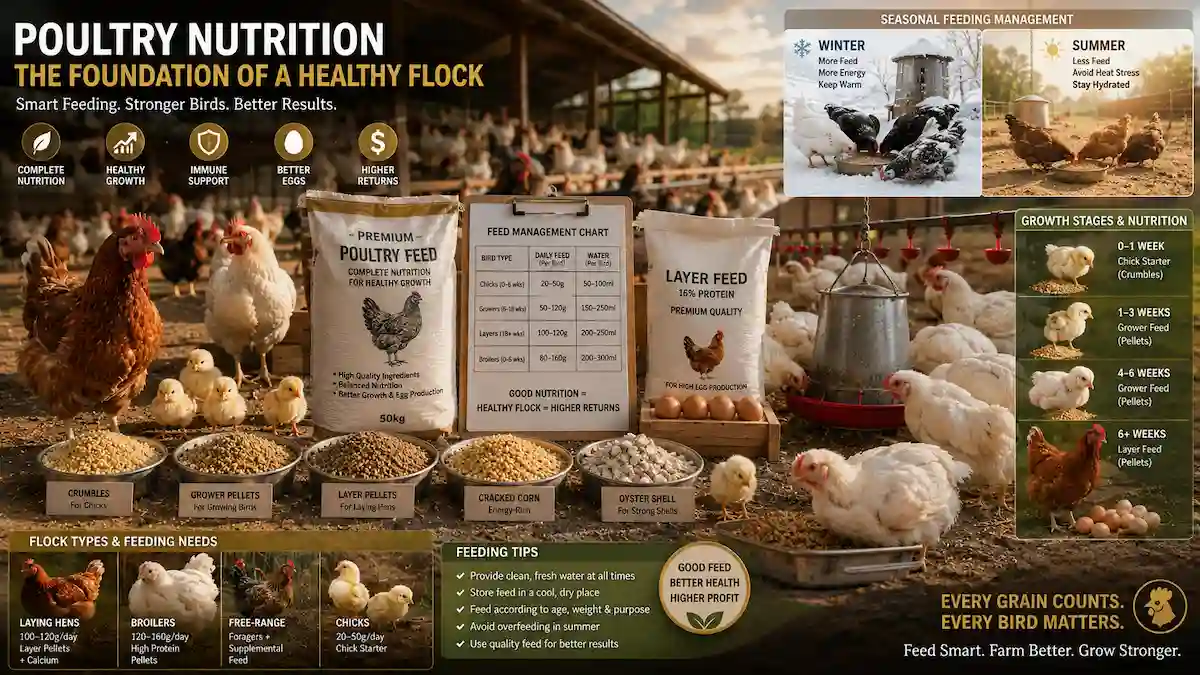
Feed is your biggest variable cost in poultry keeping — and figuring out how much a chicken actually eats per day is more nuanced than most guides let on. Get it wrong on the low side and production drops. Get it wrong on the high side and you’re basically buying expensive coop bedding.

Most chickens eat between 100 and 150 grams per day — but that average is almost useless on its own. Breed, age, season, and management system all pull the number up or down, sometimes significantly.
This guide covers all of it — a chicken feed intake chart by breed, an age-based table, a week-by-week broiler chart, flock size formulas, and a cost breakdown. For the math on your specific setup, our poultry feed calculator handles it fast.

Quick Answer
Most chickens eat 100–150 grams of feed per day depending on breed, age, production stage, and season. Laying hens average 120–130 g/day. Broilers peak at 165–185 g by week seven. Layer feed consumption per day shifts noticeably with temperature — up in winter, down in summer heat.
Key Takeaways
- Average daily feed: 100–150 g for a standard adult chicken
- Laying hens: 120–130 g/day of layer pellets (16% protein, high calcium)
- Broilers: 13 g/day at hatch → 185 g/day by week 7
- Bantams: 50–70 g/day — roughly half a standard hen
- Winter: Expect 10–20% more consumption in cold weather
- Free range: Birds may self-forage 10–30% of daily energy needs
- 100-bird flock: ~12.5 kg of feed per day
How Much Feed Does a Chicken Eat Per Day?
A standard adult chicken eats around 100–150 grams (3.5–5.3 oz) of feed per day. Most laying hens consume 120–130 grams daily, while broilers and heavy breeds may eat significantly more depending on growth stage and climate conditions. Bantams sit well below average at 50–70 g.
These poultry feed requirements assume complete commercial feed — pellets or mash — as the primary diet with no significant foraging to supplement.
| Chicken Type | Daily Feed (grams) | Daily Feed (oz) | Notes |
|---|---|---|---|
| Standard laying hen | 120–130 g | 4.2–4.6 oz | Layer pellets, 16% protein |
| Broiler (week 5–7) | 140–180 g | 4.9–6.3 oz | Peaks near slaughter age |
| Dual-purpose breed | 110–140 g | 3.9–4.9 oz | Rhode Island Red, Sussex, etc. |
| Bantam | 50–70 g | 1.8–2.5 oz | Roughly half a standard hen |
| Meat-type pullet (growing) | 80–120 g | 2.8–4.2 oz | Climbs week by week |
Several things push these numbers up or down — cold snaps, poor feeder design, heavy foraging, or a flock mid-molt. All of those are covered below.
For a full deep-dive into chicken feeding schedules for layers and broilers, AgriFarming’s feeding guide covers both types in detail.

Chicken Feed Quantity Chart by Breed — Daily Intake Comparison
Breed has a bigger impact on daily consumption than most keepers realise. This chicken feed quantity chart shows how twelve common breeds compare — because knowing the average isn’t enough when a Brahma eats nearly twice what a Leghorn does.
One is a slow, heavy bird that eats to match its size. The other is lean, productive, and surprisingly efficient. Their feed needs look nothing alike.
| Breed | Type | Daily Feed (g) | Daily Feed (oz) | Est. Daily Cost (at $0.50/kg) |
|---|---|---|---|---|
| Leghorn | Layer | 110–120 g | 3.9–4.2 oz | ~$0.06 |
| ISA Brown | Layer (commercial) | 120–125 g | 4.2–4.4 oz | ~$0.06 |
| Rhode Island Red | Dual-purpose | 120–130 g | 4.2–4.6 oz | ~$0.06 |
| Plymouth Rock | Dual-purpose | 125–135 g | 4.4–4.8 oz | ~$0.065 |
| Australorp | Layer / dual | 120–130 g | 4.2–4.6 oz | ~$0.06 |
| Sussex | Dual-purpose | 125–140 g | 4.4–4.9 oz | ~$0.065 |
| Orpington | Dual-purpose / heavy | 130–150 g | 4.6–5.3 oz | ~$0.07 |
| Brahma | Meat / heavy | 150–175 g | 5.3–6.2 oz | ~$0.08 |
| Jersey Giant | Meat / heavy | 160–185 g | 5.6–6.5 oz | ~$0.09 |
| Cornish Cross | Broiler | 120–180 g | 4.2–6.3 oz | ~$0.075 avg |
| Silkie | Ornamental / bantam-adjacent | 70–90 g | 2.5–3.2 oz | ~$0.04 |
| Ancona | Layer / light | 100–115 g | 3.5–4.1 oz | ~$0.055 |
Key takeaway: Run 100 Brahmas versus 100 Leghorns and you’re feeding 5–6 kg more per day with the heavy breed. At any scale, breed choice is as much a financial decision as a practical one.
For a deeper look at how broiler and layer nutritional needs differ, see our guide on broiler vs layer chicken differences and management.
A Note on Bantam Feed Requirements
A typical bantam — Sebright, Dutch, Japanese — eats around 50–70 grams per day, roughly 40–50% of a full-size hen.
If you’re running a mixed flock, keep bantams out of your overall intake calculations. Lumping them in with standard birds inflates your estimates and leaves you overordering feed.

Chicken Feed Intake Chart by Age — From Chick to Laying Hen
A day-old chick and a mature laying hen are the same species at opposite ends of the growth curve. This chicken feed intake chart maps how poultry feed requirements climb week by week — and which feed type belongs at each stage.
| Age / Stage | Daily Feed per Bird (g) | Daily Feed per Bird (oz) | Feed Type |
|---|---|---|---|
| Week 1 | 10–15 g | 0.4–0.5 oz | Chick starter (20–22% protein) |
| Week 2 | 18–22 g | 0.6–0.8 oz | Chick starter |
| Week 3–4 | 28–38 g | 1.0–1.3 oz | Chick starter |
| Week 5–6 | 40–55 g | 1.4–1.9 oz | Transition to grower |
| Week 7–10 | 55–75 g | 1.9–2.6 oz | Grower feed (16–18% protein) |
| Week 11–16 | 75–100 g | 2.6–3.5 oz | Grower / developer |
| Week 17–20 (pre-lay) | 100–115 g | 3.5–4.1 oz | Pre-layer or grower |
| Week 20+ (laying) | 120–130 g | 4.2–4.6 oz | Layer pellets (16% protein, high calcium) |
The grower-to-layer transition at 18–20 weeks is the one feed change that trips people up most. Layer pellets carry 3.5–4.5% calcium — the eggshell mineral that grower feed doesn’t supply adequately.
Stay on grower feed too long and you’ll see thin, soft shells. Flip too early and excess calcium can stress young kidneys. The window is narrow but easy to hit if you’re watching your calendar.
For a full breakdown of poultry feed types and formulation, our guide to poultry feed types and feed formulation is a solid reference.
Broiler Feed Consumption: Week-by-Week Chart
Broiler nutrition is its own corner of poultry management. A Cornish Cross hatches at roughly 40 grams and can reach 2.5 kg in seven weeks — a pace that demands progressively more feed each week without exception.
How well you manage that consumption curve determines whether your batch is profitable or barely breaking even.
| Week | Daily Feed per Bird (g) | Cumulative Feed per Bird (kg) | Target Body Weight (g) | FCR (approx.) |
|---|---|---|---|---|
| Week 1 | 13–18 g | ~0.10 kg | 160–180 g | 0.9–1.1 |
| Week 2 | 35–45 g | ~0.36 kg | 400–450 g | 1.3–1.5 |
| Week 3 | 65–80 g | ~0.85 kg | 800–900 g | 1.5–1.7 |
| Week 4 | 100–120 g | ~1.60 kg | 1,300–1,500 g | 1.7–1.9 |
| Week 5 | 135–155 g | ~2.60 kg | 1,800–2,100 g | 1.8–2.0 |
| Week 6 | 155–175 g | ~3.70 kg | 2,300–2,600 g | 1.9–2.1 |
| Week 7 | 165–185 g | ~4.85 kg | 2,700–3,000 g | 2.0–2.2 |

Understanding FCR — and Why It’s Worth Tracking Weekly
FCR stands for Feed Conversion Ratio: total feed consumed divided by body weight gained. An FCR of 2.0 means the bird ate 2 kg to gain 1 kg. The lower the FCR, the more efficient your operation.
Well-managed broiler batches target 1.8–2.0. When FCR creeps above 2.2, something is usually wrong — feed quality issues, disease pressure, poor ventilation, or overcrowding are the usual suspects.
Tracking FCR weekly rather than just at slaughter gives you time to correct course before the problem costs you an entire batch. The University of Kentucky Extension publishes solid benchmarks for broiler production efficiency if you want external reference points.
Layer Feed Consumption Per Day — What Laying Hens Actually Need
Laying hens need 120–130 grams of layer pellets or mash per day. That ration delivers 16–18% protein, 3.5–4.5% calcium, and the energy required for sustained daily egg production.
Expect layer feed consumption per day to slip 10–15% in hot weather and tick upward in cold. Consistent access matters more than most people realise — even a single day of restricted feeding shows up in egg output within 24–48 hours.
How Often Should You Feed Chickens?
Twice a day is the reliable standard for backyard flocks — fill in the morning, top up late afternoon. Commercial layer operations run ad-lib feeders full at all times, which works well since hens self-regulate intake reasonably.
The real danger for layers isn’t overfeeding — it’s underfeeding during peak production. That’s when nutrient demands are highest and birds have the least margin to absorb shortfalls. Broilers do best with 24-hour feed access in early weeks; restricting access at night in later weeks can tighten FCR, but that’s a refinement rather than standard practice.
What Affects How Much a Chicken Eats Each Day
The charts above are reliable starting points, but real consumption shifts season to season. Here are the four factors that move the needle most.

Season and Temperature
Cold drives intake up — sometimes sharply. Below 10°C (50°F), chickens burn extra calories just staying warm, and feed consumption typically rises 10–20% through winter. That’s normal physiology, not a problem — unless the feed supply doesn’t keep pace.
When birds slip into caloric deficit, laying suppresses and immune response weakens — often before you see anything visible. Above 30°C (86°F), appetite drops; feed quality matters more than quantity.
Do Chickens Eat Less in Summer?
Yes — heat stress reduces appetite noticeably. Above 30°C (86°F), a hen may eat 10–15% less than her winter intake, making feed nutrient density critical. Every gram eaten needs to deliver more. High-energy, high-protein layer feed and constant access to cool, fresh water are the two levers that matter most.
How Much Feed Do Free-Range Chickens Need?
Free-range birds typically need 10–30% less supplied feed than confined birds, depending on pasture quality and season. On good ground, foraging covers a meaningful share of daily energy needs.
The catch: this benefit disappears in winter or on worn, overgrazed ground. Don’t assume free-range automatically means lower feed bills year-round — when conditions are poor, free-range birds become nearly as dependent on supplied feed as confined ones.
Molting
Once a year, triggered by shortening autumn days, hens stop laying and regrow their feathers. Feathers are largely protein, and that regrowth draws heavily on nutritional reserves.
During molt, switch temporarily to 18–20% protein feed. Intake dips slightly while laying stops, but protein needs go up — counterintuitive until you factor in what’s happening biologically.
Water Access
Chickens drink roughly twice their feed weight in water daily — about 250–300 ml per bird under normal conditions. Restrict water and feed intake drops fast. If consumption suddenly falls without explanation, check the drinkers first. A blocked nipple drinker, frozen line, or warm stagnant trough will tank your feed numbers before you see any other problem sign. Penn State Extension has practical guidance on water management and flock performance worth bookmarking.
Can Chickens Overeat?
Laying hens generally self-regulate well — overfeeding is rarely the problem. Hens eat to meet their energy needs, then stop. The real risk is obesity in heavy or ornamental breeds kept as pets, where activity is low and feed is unlimited.
Broilers are the exception. Bred for rapid growth, they eat almost continuously. Portion control isn’t needed, but keep scratch and treats under 10% of daily intake — more than that dilutes the nutritional balance of a complete ration.
What Happens If Chickens Don’t Get Enough Protein?
Protein deficiency shows up fast and in multiple ways:
- Egg production drops. Protein is the raw material for eggs — low intake shows up in output within days.
- Feather quality deteriorates. Feathers are roughly 85% protein. Poor plumage is often the first visible sign.
- Growth slows in chicks and broilers. Young birds need 20–22% protein during the starter phase; shortfall stunts early growth permanently.
- Feather-pecking increases. Birds may begin pecking each other — a behavioural signal of protein hunger that quickly turns into a flock-wide problem.
- Immune function weakens. Antibodies are proteins. A deficient bird is a vulnerable bird — disease pressure rises across the whole flock.
Standard layer feed at 16–18% protein prevents most deficiency issues. If you’re supplementing heavily with low-protein treats or scratch grain, you’re diluting the ration and risk seeing these signs over time. For detailed guidance on building a balanced diet, see our guide on what to feed backyard chickens.

How Much Feed Do 50 or 100 Chickens Eat Per Day?
Scaling up to flock totals is simple. The working formula for standard adult layers:
Daily flock feed (kg) = Number of birds × 0.125 kg
Adjust up for heavy breeds or cold weather, down for bantams or free-range setups where foraging is significant.
| Flock Size | Daily Feed (kg) | Daily Feed (lbs) | Weekly Feed (kg) | Monthly Feed (kg) |
|---|---|---|---|---|
| 10 birds | 1.25 kg | 2.8 lbs | 8.75 kg | ~37.5 kg |
| 25 birds | 3.1 kg | 6.8 lbs | 21.9 kg | ~93.8 kg |
| 50 birds | 6.25 kg | 13.8 lbs | 43.75 kg | ~187.5 kg |
| 100 birds | 12.5 kg | 27.6 lbs | 87.5 kg | ~375 kg |
| 250 birds | 31.25 kg | 68.9 lbs | 218.75 kg | ~937.5 kg |
| 500 birds | 62.5 kg | 137.8 lbs | 437.5 kg | ~1,875 kg |
| 1,000 birds | 125 kg | 275.6 lbs | 875 kg | ~3,750 kg |
For a calculation that factors in breed mix, age range, and local feed price, use our chicken feed calculator — it handles the variables a simple formula can’t.
How Much Does It Cost to Feed a Chicken Per Day?
Daily chicken feed costs are lower than most first-time keepers expect — but they compound quickly at scale. At $0.40–$0.60 per kilogram, a standard laying hen runs about $0.05–$0.08 per day. That’s $1.50–$2.40 per bird per month. Manageable for a small flock, significant at a hundred birds or more.
| Feed Price per kg | Daily Cost (per bird) | Monthly Cost (per bird) | Annual Cost (per bird) |
|---|---|---|---|
| $0.30/kg (budget) | ~$0.038 | ~$1.14 | ~$13.70 |
| $0.50/kg (mid-range) | ~$0.063 | ~$1.88 | ~$22.56 |
| $0.70/kg (premium) | ~$0.088 | ~$2.63 | ~$31.57 |
| $1.00/kg (organic) | ~$0.125 | ~$3.75 | ~$45.00 |
All figures assume 125 g/day. Feed prices vary considerably by region — commercial mash in South Asia and Sub-Saharan Africa costs far less per kilogram than organic pellets in Western markets. Use local pricing for anything beyond rough planning. AgriFarming’s guide on managing chicken feed costs covers economic strategies for keeping rations nutritious at lower cost.
Four Ways to Cut Feed Costs Without Cutting Corners
- Fix your feeders first. Poorly designed troughs cause 20–30% wastage from birds flicking and scratching. A tube feeder or trough with an anti-waste lip pays for itself in weeks — and at 100 birds, even a 10% reduction in waste saves several kilograms of feed per day.
- Buy in bulk if you can store it safely. Feed price per kilogram drops meaningfully at 500 kg or tonne quantities. Dry, rodent-proof storage is the only real requirement. At 50+ birds, the upfront cost of good storage infrastructure almost always pays back within a season.
- Supplement with kitchen scraps where regulations allow. Vegetable offcuts, cooked grains, and fruit peelings reduce how much commercial feed you go through. Rules vary by country — check before making it routine.
- Tighten FCR on broiler batches. Better ventilation, appropriate stocking density, and quality starter feed in the first two weeks have an outsized effect on total feed consumed per kilogram of meat. Small FCR improvements compound across an entire batch.
How Much Feed Waste Is Normal?
Feed waste is often invisible on small farms — it disappears into litter and bedding before anyone notices it adds up. Here’s what normal looks like across different setups:
- Backyard flocks (open trough feeders): 15–30% feed waste is typical. Birds scratch, flick, and bill-sweep constantly. At the high end, nearly a third of feed bought never actually gets eaten.
- Commercial operations (tube or nipple-drinker feeders): Well-managed commercial farms target under 3–5% wastage. The difference is almost entirely feeder design and feeder height.
- Rule of thumb: Feeder lip should sit at the height of the bird’s back. Too low and birds scoop feed out. Too high and smaller birds can’t reach.
Waste formula: Divide actual consumption by expected consumption (birds × daily ration). A ratio above 1.2 means roughly 20%+ is being wasted or stolen by rodents. Fixing feeder height and switching to a tube feeder is the single highest-ROI change most backyard keepers can make — it typically covers the feeder cost within 4–6 weeks.
Chicken Feed Storage Mistakes That Cost You Money
Buying good feed and then storing it badly is one of the most common — and expensive — errors in small-scale poultry management. The main problems and how to avoid them:
- Moisture and mold. Feed stored in humid conditions or on concrete floors absorbs moisture fast. Moldy feed contains mycotoxins — particularly aflatoxins from Aspergillus mold — that are seriously harmful to poultry and can cause liver damage, immune suppression, and death at high exposure levels. Always store in a raised, sealed container. Never feed anything that smells musty.
- Rodents. Rats and mice contaminate far more feed than they actually eat — through droppings, urine, and the bacteria they introduce. A single rat in a feed shed can render 10–15 kg of feed unsafe within a week. Metal bins with locking lids are the only reliable solution; plastic bins get chewed through.
- Heat and sunlight. Fat-soluble vitamins (A, D, E, K) degrade quickly in warm, bright conditions. Feed stored near a hot wall or in direct sunlight loses nutritional value within weeks. Keep storage cool, dark, and ventilated.
- Buying too far ahead. Complete feed typically holds its vitamin potency for 8–12 weeks from manufacture. Buying a 3-month supply can work; 6 months usually doesn’t. Check the manufacture or best-before date before bulk-buying.
Storage rule of thumb: Only buy what you’ll use within 6–8 weeks. Store in a sealed metal container, off the ground, away from heat and moisture. If it smells off — don’t feed it.
Frequently Asked Questions About Chicken Feed
1. How much feed does a chicken eat per day in grams?
A standard adult chicken eats 100–150 grams of feed per day. Laying hens average 120–130 g, broilers 130–180 g depending on growth stage, and bantams around 50–70 g. All figures assume complete commercial feed as the main dietary source.
2. How much does it cost to feed a chicken per day?
At $0.50/kg feed price, one laying hen eating 125 g/day costs around $0.063 per day — roughly $1.88 per month. Costs drop with budget feed or free-range foraging, and rise with premium or organic rations. Regional feed prices vary significantly.
3. How much feed do laying hens need daily?
Laying hens need 120–130 grams of layer feed per day, with 16–18% protein and 3.5–4.5% calcium. Consistent daily access is critical — even one day of restricted feeding shows up as reduced or soft-shelled egg output within 24–48 hours.
4. How much feed does a broiler chicken consume per day?
Broiler feed intake starts at 13–18 g/day in week one and reaches 165–185 g/day by week seven. Total feed from hatch to slaughter runs around 4.5–5 kg per bird. A well-managed batch holds an FCR of 1.8–2.0.
5. How often should you feed chickens?
Twice daily is reliable for backyard flocks — morning and late afternoon. Commercial layer farms run ad-lib feeders full around the clock since hens self-regulate well. Broilers need 24-hour access in early weeks. Whatever rhythm you settle on, keep it consistent.
6. Does feed consumption change in winter?
Yes — plan for a 10–20% increase. Chickens eat more in cold weather to maintain body temperature. Make sure water stays unfrozen, since dehydration cuts feed intake quickly. Build that seasonal buffer into your monthly feed order before winter arrives.
7. How much feed do 100 chickens eat per day?
100 standard laying hens eat approximately 12–13 kg (27–29 lbs) of feed per day. Weekly, that’s around 87–90 kg. At this flock size, bulk purchasing makes clear financial sense — the per-kg savings compound steadily across a full season.
8. Why is my chicken eating more than usual?
Most common causes: cold weather, peak egg production, post-illness recovery, molting, or internal parasites. If intake spikes without an obvious trigger, check for worm burden — pale combs, loose droppings, and weight loss despite eating are the usual signs. A deworming protocol is usually the next step.
Getting Feed Right Is Where the Margins Live
Most feed problems trace back to two things: underfeeding during high-demand periods — peak lay, cold weather, post-molt — or wastage through poor feeder design. Neither is complicated to fix once you know what to look for.
Start with 120–130 g per laying hen per day as your baseline. Adjust upward for heavier breeds and cold-weather months. Use the chicken feed intake chart for growing birds and the broiler table for meat batches. Our chicken feed calculator handles precise flock calculations so you don’t have to do it by hand.
Feed management won’t win any awards for glamour. But for anyone keeping chickens with production in mind, it’s where the difference between running a tight operation and quietly losing money tends to show up first.
[ad_2]
Source link

