
[ad_1]
Understanding contract clauses is one of the most important skills for a law student. Whether it is for exams, internships, or future law firm work, contract clauses form the foundation of practical legal knowledge.

However, many students find contract clauses difficult to understand. The language is often complex, sentences are long, and the meaning is not always clear at first reading. This is where tools like ChatGPT can make a big difference.
ChatGPT can act as a smart learning assistant that helps you understand, practice, and apply contract clauses in a much easier way. If used properly, it can save time and improve your understanding significantly.
Why Students Struggle with Contract Clauses
Before understanding how ChatGPT helps, it is important to know why contract clauses feel difficult.
- Legal language is often technical and not easy to read. Words like “indemnify”, “hereinafter”, or “notwithstanding” can confuse beginners.
- Clauses are not just definitions. They have legal consequences, which makes understanding their purpose important.
- Many textbooks explain concepts but do not give enough practical exposure to real clauses.
Because of these reasons, students often end up memorising clauses without actually understanding them. This creates problems during exams, internships, and drafting work.
How ChatGPT Helps You Learn Contract Clauses
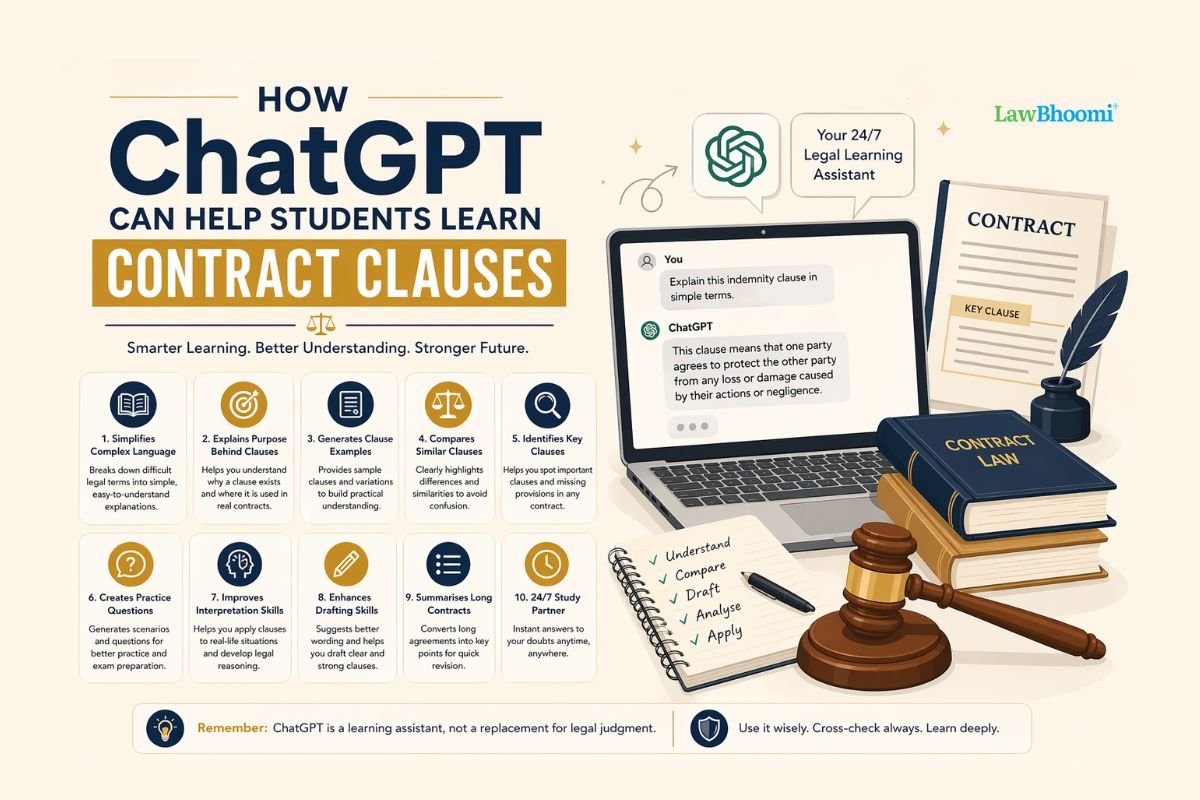
Simplifies Complex Legal Language
One of the biggest advantages of ChatGPT is that it can convert difficult legal language into simple English.
When you copy a clause and ask ChatGPT to explain it, it can:
- Break the clause into smaller parts
- Explain each part in simple words
- Give an overall meaning of the clause
This helps you understand what the clause is actually saying instead of just reading it blindly.
For example, if you paste a confidentiality clause, ChatGPT can explain what information is protected, who is responsible, and what happens if the clause is violated.
Helps You Understand the Purpose of Clauses
Every clause exists for a reason. If you understand the purpose, remembering the clause becomes much easier.
ChatGPT helps you:
- Understand why a clause is used
- Learn where it is used in real contracts
- Connect theory with practical situations
For instance, when you ask about a “limitation of liability clause”, ChatGPT will explain that it is used to limit the amount of loss one party has to pay. This practical understanding is very useful during internships and drafting tasks.
Provides Examples of Contract Clauses
Reading theory alone is not enough. You need to see how clauses look in real contracts.
ChatGPT can generate:
- Sample clauses
- Short and simple versions of clauses
- Variations of the same clause
This helps you understand how clauses are written in practice.
For example, you can ask:
“Draft a simple arbitration clause for a service agreement.”
By seeing such examples, you start recognising patterns in drafting, which improves your confidence.
Helps You Compare Similar Clauses
Many contract clauses look similar but have different meanings and effects.
ChatGPT can help you compare clauses such as:
- Indemnity vs damages
- Termination vs rescission
- Condition vs warranty
Instead of getting confused, you can clearly see the difference.
For example:
- Indemnity focuses on protecting against loss
- Damages focus on compensation after breach
This kind of clarity is very useful in exams and interviews.
Helps You Identify Important Clauses in a Contract
When you read a full contract, it can feel overwhelming. There are many clauses, and you may not know which ones are important.
ChatGPT can help you:
- Identify key clauses like termination, payment, dispute resolution, and confidentiality
- Explain why these clauses are important
- Highlight missing or risky clauses
This improves your ability to read and analyse contracts, which is an important skill for internships.
Creates Practice Questions and Scenarios
Learning becomes stronger when you test yourself.
ChatGPT can create:
- Problem-based questions
- Case scenarios
- Exam-style questions
For example, you can ask:
“Create a problem question on breach of a confidentiality clause.”
This helps you apply your knowledge instead of just reading theory.
It is especially helpful for judiciary exams and law school assessments.
Helps in Clause Interpretation Practice
Understanding how clauses work in real-life situations is very important.
ChatGPT can help you practise interpretation by:
- Giving hypothetical situations
- Asking what will happen in a particular scenario
- Explaining legal consequences
For example:
“What happens if a party violates an arbitration clause and files a case in court?”
This improves your legal reasoning skills, which are essential for moots and internships.
Improves Your Drafting Skills
Drafting is one of the most important practical skills for a law student, but it is also one of the most difficult.
ChatGPT helps you:
- Draft basic clauses
- Improve sentence structure
- Identify unclear or vague wording
You can also ask ChatGPT to:
- Rewrite a clause in better language
- Make it more formal
- Make it simpler
Over time, this improves your drafting style and confidence.
Summarises Long Contracts
Many contracts are long and difficult to read. Students often skip reading them completely.
ChatGPT can:
- Summarise contracts into key points
- Extract important clauses
- Help in quick revision
This is very useful when you are preparing for exams or internships and do not have much time.
Acts as a 24/7 Study Partner
One of the biggest advantages of ChatGPT is that it is always available.
You can:
- Ask doubts anytime
- Get instant explanations
- Learn at your own pace
This makes learning more flexible and less stressful.
Instead of waiting for someone to explain, you can immediately clear your doubts.
How You Should Use ChatGPT Smartly
To get the best results, use ChatGPT actively.
- Do not just read answers. Ask follow-up questions. This helps in deeper understanding.
- Use it daily for small doubts. Regular use improves learning.
- Combine it with your study material. Do not rely only on AI.
For example:
Instead of asking “What is indemnity?”, ask:
“Explain indemnity clause with an example and when it is used in contracts.”
Better questions give better answers.
Conclusion
Learning contract clauses becomes much easier when you understand them properly instead of memorising them. ChatGPT helps you do exactly that.
It simplifies complex language, provides examples, helps in drafting, and allows you to practise real-life scenarios. This makes your learning more practical and effective.
However, it should be used wisely. It is a tool to support your learning, not replace your legal studies.
If used correctly, ChatGPT can help you build a strong foundation in contract law and prepare you better for exams, internships, and your future legal career.
Attention all law students and lawyers!
Are you tired of missing out on internship, job opportunities and law notes?
Well, fear no more! With 2+ lakhs students already on board, you don’t want to be left behind. Be a part of the biggest legal community around!
Join our WhatsApp Groups (Click Here) and Telegram Channel (Click Here) and get instant notifications.

[ad_2]
Source link

