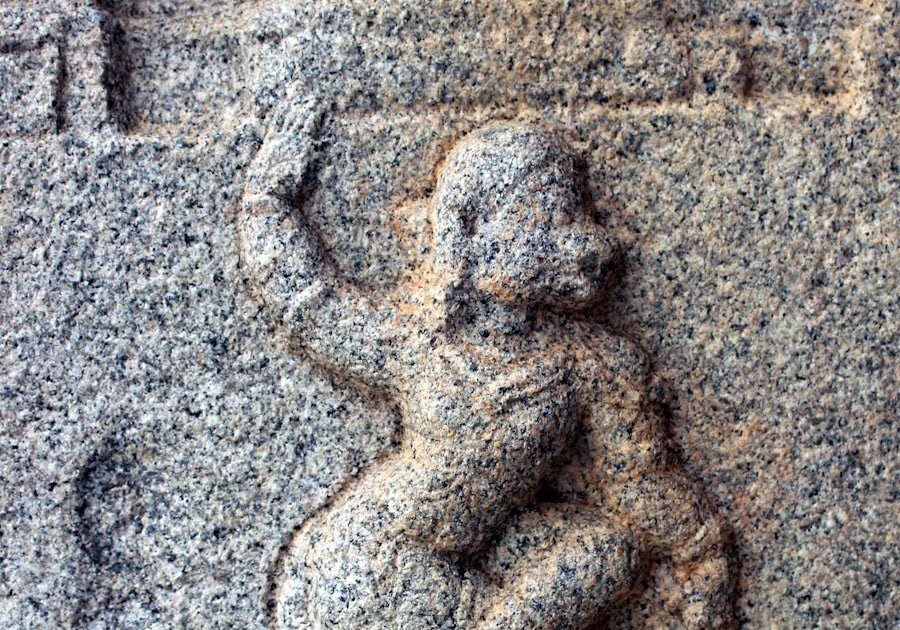

This picture was shot almost nine years ago at Ranga Devastana close to Elephant Stables at Hampi. The relief sculpture was on one face of one of the outer pillars. The sculpture is a depiction of Hanuman sitting on his coiled tail. It’s a story from Ramayana.
After Ravana abducts Sita from Pachavati inside Dandakaranya forest, he brings her to his kingdom Lanka. Ravana keeps Sita at Ashoka Vatika as a prisoner. Meanwhile Rama and Lakshmana searching for Sita arrive at Kishkinda the kingdom of Vanara people. They become acquainted with Sugreeva the brother of Vanara king Vali. They also get acquainted with Sugreeva’s colleague Hanuman. Due to a feud between the brothers, Sugreeva is in exile while Vali reigns. Rama and Sugreeva arrive at an understanding to solve each other’s problems by helping each other. A search team of Vanaras spread out in different directions. Hanuuman follows leads and arrives at Lanka and happens to see sad and lonely lady in Ashoka Vatika. In a subtle way Hanuman approaches the lady and confirms her identity as Sita. Then he tells that Sita about Rama’s rescue campaign and takes permission to return to Kishkinda. However before leaving Lanka Hanuman with an intent to get Ravana’s attention wreaks havoc in the city. The Rakshasa soldiers were no match for Hanuman. Ravana’s son Indrajit enters the scene. Using his special powers Hanuman is captured and presented at Ravana’s court. However, the invisible force restraining Hanuman has expired.

Hanuman identifies himself as an emissary of Rama and asks to be treated with respect but the Rakshasas mock him. That’s when Hanuman elongates and coils his tail into an elevated seat higher than Ravana’s throne. Seated high up he then warns Ravana to return Sita.

So that’s the story of Hanuman’s coiled seat. What follows is more mockery; Hanuman’s tail being set afire. Hanuman gives them a taste of their own medicine by setting fire to Lanka itself and returns to Kishkinda.
With a story behind every image, our ancient temples were like books to impart cultural values.
………

