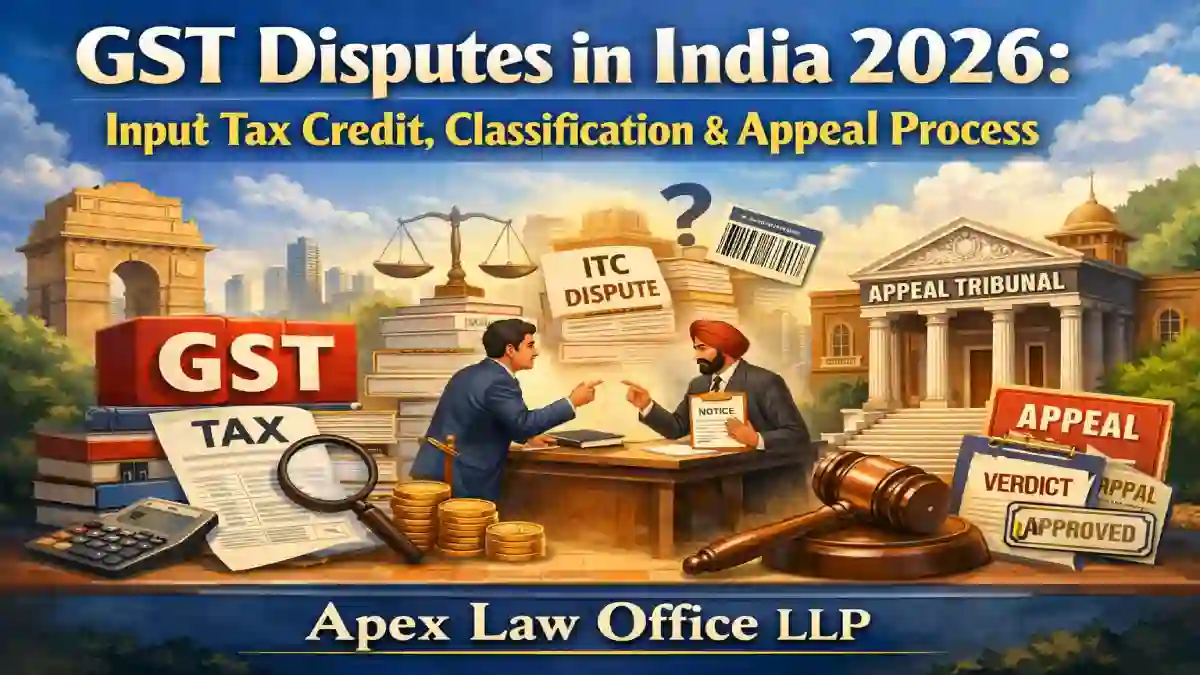

GST Disputes in India 2026 – GST disputes remain a major concern for businesses across India. Tax authorities frequently scrutinize Input Tax Credit claims and tax classifications. Therefore, taxpayers require strong legal guidance and compliance systems. Disputes often arise from mismatched returns, supplier defaults, and classification disagreements. Moreover, evolving compliance requirements increase litigation risks. Businesses, NGOs, startups, and NRIs regularly face GST notices and assessments. Proper legal review reduces exposure to penalties and demand orders. Taxpayers should preserve invoices, contracts, and transaction records carefully.
GST Disputes in India 2026: Input Tax Credit, Classification & Appeal Process – Apex Law Office LLP

Common GST disputes include:

• Input Tax Credit denial
• Product classification disputes
• Wrong tax rate application
• Assessment challenges
| Authority | Function |
|---|---|
| GST Department | Tax administration |
| Appellate Authority | Appeals |
| High Court | Writ jurisdiction |
Why Early Legal Intervention Improves GST Outcomes
GST proceedings involve strict timelines and procedural requirements. Therefore, taxpayers should respond promptly to notices. Legal professionals review records and identify defensible positions. Moreover, early intervention prevents avoidable penalties and recovery actions. Businesses often face disputes regarding tax liability calculations and exemptions. Proper representation strengthens compliance and litigation strategy. Important benefits include:
- Notice response support
- Evidence evaluation
- Appeal preparation
- Litigation management
| GST Issue | Available Remedy |
|---|---|
| ITC denial | Statutory appeal |
| Wrong classification | Legal challenge |
| Tax demand | Adjudication response |
Input Tax Credit Disputes Under GST
Input Tax Credit remains the most litigated GST issue. Businesses depend upon ITC for efficient tax management. Therefore, denial often creates significant financial impact. Authorities examine invoices, supplier compliance, and transaction authenticity. Legal professionals review documentary evidence carefully. Common ITC concerns include:
• Invoice mismatches
• Supplier non-compliance
• Blocked credits
• Documentation defects
• Fake invoice allegations
| ITC Issue | Consequence |
|---|---|
| Missing invoice | Credit denial |
| Supplier default | Departmental scrutiny |
| Record mismatch | Demand notice |
Common Reasons for Input Tax Credit Denial
Authorities may deny ITC for several reasons. Businesses should understand compliance obligations thoroughly. Consequently, risks become easier to manage. Frequent reasons include:
- Incomplete invoices
- Supplier filing failures
- Ineligible expenses
- Documentation gaps
Proper record maintenance improves claim sustainability. Moreover, taxpayers strengthen their position during audits and adjudication proceedings.
Supplier Compliance and Invoice Matching Issues
Supplier compliance significantly affects ITC eligibility. Tax authorities compare return data and invoice disclosures. Therefore, businesses should verify supplier compliance regularly. Important checks include:
• GST registration validity
• Return filing status
• Invoice accuracy
• Transaction records
Proactive verification reduces future disputes. Consequently, businesses protect valuable tax credits effectively.
Documentary Evidence Supporting ITC Claims
Evidence plays a crucial role in GST litigation. Businesses should maintain complete transaction records. Therefore, proper documentation remains essential. Important documents include:
- Tax invoices
- E-way bills
- Purchase orders
- Payment records
Strong evidence supports credit eligibility and strengthens legal defenses during departmental scrutiny.
Classification Disputes and Tax Rate Challenges
Classification disputes affect tax liability significantly. Authorities and taxpayers sometimes interpret products differently. Therefore, legal analysis becomes essential. Classification disagreements commonly involve mixed supplies and evolving business models. Important concerns include:
• Product classification
• Service classification
• Composite supply issues
• Mixed supply disputes
Accurate classification reduces litigation risks and compliance uncertainty.
Product Classification Disputes
Businesses frequently dispute applicable HSN classifications. Tax rates often depend upon classification outcomes. Therefore, legal interpretation remains important. Common disputes involve:
• Manufacturing products
• Technology products
• Medical goods
• Consumer items
Proper classification analysis improves compliance and reduces assessment exposure.
Service Classification and Taxability Questions
Service classification disputes arise across multiple sectors. Taxpayers often seek clarity regarding applicable rates. Therefore, legal review becomes valuable. Important areas include:
- Consulting services
- Digital services
- Software services
- Contractual services
Professional advice helps businesses minimize disputes and maintain compliance.
GST Notices, Assessments, and Adjudication
GST authorities issue notices during audits and investigations. Therefore, taxpayers should respond accurately and promptly. Legal professionals analyze allegations and supporting records. Common proceedings include:
• Show cause notices
• Audit observations
• Demand notices
• Assessment orders
| Proceeding | Purpose |
|---|---|
| SCN | Explain discrepancies |
| Assessment | Determine liability |
| Audit | Verify compliance |
Responding to GST Show Cause Notices
A Show Cause Notice requires a formal response. Businesses should avoid incomplete or delayed submissions. Consequently, legal review becomes important. Effective responses generally include:
• Factual explanations
• Supporting documents
• Legal arguments
• Compliance evidence
Timely replies improve litigation outcomes and reduce adverse findings.
Assessment Orders and Demand Recovery
Assessment orders may create substantial tax liabilities. Taxpayers should evaluate available remedies carefully. Therefore, legal support remains essential. Common consequences include:
• Tax demands
• Interest liability
• Penalty exposure
• Recovery proceedings
Proper representation strengthens challenges against incorrect assessments.
GST Audit and Investigation Support
GST audits require careful preparation and documentation. Authorities often examine transaction accuracy and tax treatment. Therefore, businesses should maintain organized records. Key preparation steps include:
- Document review
- Reconciliation checks
- Compliance verification
- Legal consultation
Prepared taxpayers generally manage audits more effectively.
Appeal Process and Legal Remedies Under GST
GST law provides structured appellate remedies. Therefore, taxpayers may challenge adverse decisions. Appeals require compliance with statutory timelines and procedures. Common forums include:
• Appellate Authority
• GST Appellate Tribunal
• High Courts
• Supreme Court
| Forum | Jurisdiction |
|---|---|
| Appellate Authority | First appeal |
| Tribunal | GST appeals |
| High Court | Writs and appeals |
Appeals Against GST Orders
Taxpayers may contest assessments and penalties through appeals. Therefore, strategic case preparation becomes essential. Lawyers analyze facts, evidence, and legal precedents carefully. Important appeal requirements include:
• Appeal memorandum
• Supporting documents
• Statutory compliance
• Limitation adherence
Well-prepared appeals improve prospects for favorable outcomes.
Role of Evidence Under the BSA
Evidence remains central to GST disputes. Therefore, taxpayers should preserve records carefully. The BSA governs evidentiary standards in legal proceedings. Important records include:
• Invoices
• Contracts
• Financial statements
• Electronic communications
Accurate documentation strengthens taxpayer defenses and appellate arguments.
Criminal Proceedings and Tax Fraud Allegations
Certain GST disputes may involve fraud allegations. Therefore, taxpayers should obtain immediate legal advice. The BNS addresses fraud-related offences. The BNSS governs criminal procedures. Nearby police stations may become involved where criminal complaints arise. Common allegations include:
- Fake invoices
- Fraudulent credits
- Forged documents
- Tax evasion schemes
Prompt legal representation protects procedural rights and legal interests.
Conclusion
GST disputes require careful planning, documentation, and legal strategy. Input Tax Credit and classification issues remain significant litigation areas. Moreover, timely responses improve compliance outcomes and reduce penalties. Businesses should preserve records and seek professional advice promptly. Effective legal representation strengthens defenses, appeals, and dispute resolution efforts.
FAQs
FAQ 1: Why do GST authorities deny Input Tax Credit?
Authorities may deny ITC due to supplier defaults, invoice defects, missing records, or ineligible expenditure claims.
FAQ 2: What causes GST classification disputes?
Classification disputes arise when taxpayers and authorities disagree regarding applicable HSN codes or tax rates.
FAQ 3: Can I challenge a GST assessment order?
Yes. Taxpayers may file statutory appeals before designated appellate authorities and higher forums.
FAQ 4: What documents support GST litigation?
Invoices, contracts, e-way bills, returns, payment records, and electronic communications commonly support GST disputes.
FAQ 5: Can GST disputes involve criminal proceedings?
Yes. Allegations involving fake invoices, fraud, forgery, or tax evasion may trigger criminal action.
FAQ 6: How can a GST lawyer assist taxpayers?
Lawyers handle notices, audits, appeals, investigations, compliance reviews, and litigation before GST authorities and courts.

