
[ad_1]
Written by: Jagdish Reddy
Sources: University Extension Programs, FAO, and Horticulture Research Publications
Last Updated: April 2026

Quick Answer: The fastest way to eliminate fungus gnats in houseplants is to let the top 5 cm (2 inches) of soil dry completely, then drench with Bacillus thuringiensis israelensis (Bti) every 7–10 days for three cycles. This breaks the larval cycle without chemicals. Add yellow sticky traps at soil level to capture egg-laying adults. Most infestations clear within 4–6 weeks.
What Are Fungus Gnats?
Fungus gnats (Bradysia spp., family Sciaridae) are small flies that breed in moist potting soil. Their larvae feed on fungi and root hairs, causing root damage, wilting, and stunted growth. Any overwatered houseplant in any climate can host them.

Why Most Fungus Gnat Guides Fail
Most guides on how to get rid of fungus gnats target adult flies with traps and surface sprays — not the larvae breeding in the soil. Killing adults without treating the growing medium allows new generations to emerge within days. That is why standard advice fails to produce permanent results.
The 4-Step Fungus Gnat Elimination System
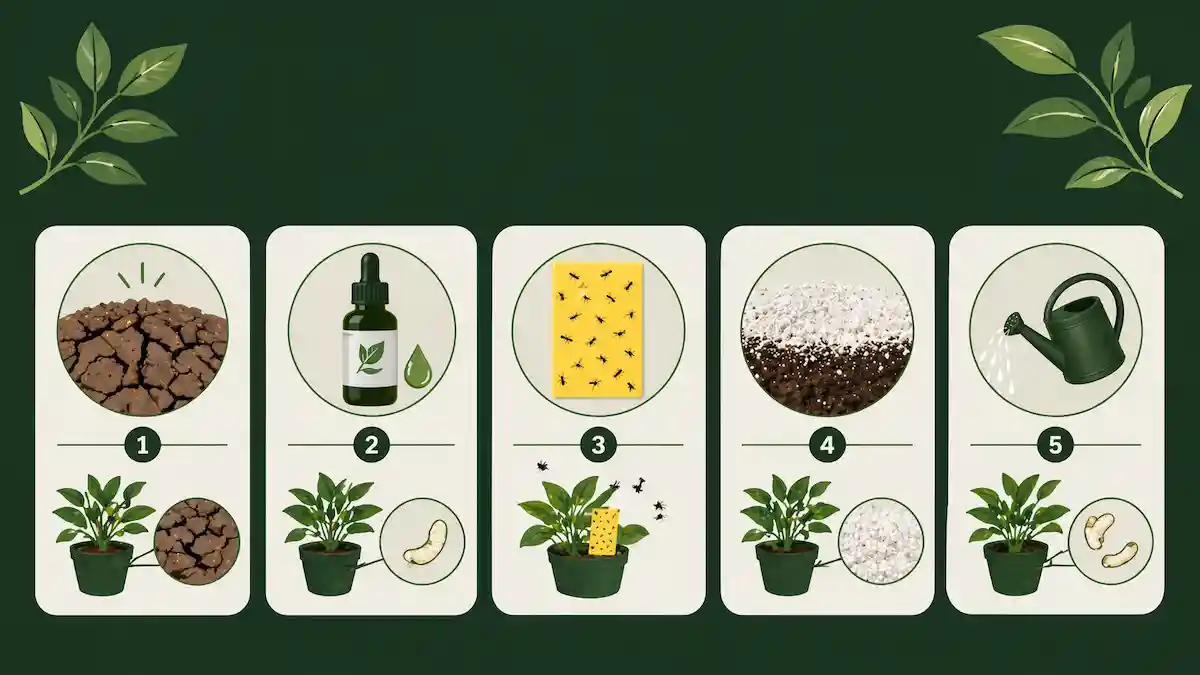
The Dry → Kill → Trap → Block method targets every life cycle stage simultaneously: dry the soil to kill eggs and early larvae, apply Bti to eliminate feeding larvae, trap adults to stop re-infestation, and block with a physical surface barrier. Skipping any step leaves a gap the infestation will exploit.
How to Get Rid of Fungus Gnats Fast
Quick Answer: Dry the soil completely, then apply Bti every 7–10 days for three cycles while using yellow sticky traps to catch adults. This breaks the life cycle at every stage and eliminates most infestations within 4–6 weeks.
Why Do Fungus Gnats Keep Coming Back?
Quick Answer: Fungus gnats return because the soil stays moist, allowing larvae to develop continuously. Killing only adult flies does not stop the cycle. Long-term control requires drying the soil and treating larvae with Bti.
The Science Behind the Infestation
Why Fungus Gnats Keep Coming Back (Root Cause Analysis)
Fungus gnats in soil persist because larvae develop continuously in the growing medium. As long as the growing medium stays wet, new generations replace adults every 3–4 weeks. Breaking this cycle requires targeting the soil — not just the visible flies.

Anaerobic Soil and the Soil Microbiome
Wet soil promotes fungal growth that larvae feed on. Well-draining, oxygenated soil resists infestation. Switching to a mix with 30–40% perlite and watering correctly removes the larval food source at the root.
Peer-reviewed research published by Clemson University’s Land-Grant Press confirms that optimal control of fungus gnats in growing media requires an integrated approach targeting both larval habitat and the short life cycle of Bradysia species.
Are Fungus Gnats Harmful to Humans?
No. Fungus gnats do not bite, sting, or carry disease. The only harm is to plants — larval root feeding causes wilting, yellowing, and stunted growth. In severe cases, Pythium spp. root rot enters through larval damage, which is far harder to treat than the gnats themselves.
Do Fungus Gnats Go Away on Their Own?
Quick Answer: No. As long as moist soil is present, each female lays up to 300 eggs before dying. Without addressing moisture or larvae, the population builds continuously — infestations grow, they do not self-resolve.
When Fungus Gnats Become a Serious Problem
In weeks 1–3, adults are a nuisance but root damage is minimal. By weeks 4–6, larval density causes visible root pruning — plants wilt and yellow despite normal care. Weakened roots become entry points for Pythium root rot.
Watch for: wilting that does not recover after watering, yellowing lower leaves without obvious cause, and seedlings collapsing at soil level. At this stage, begin with a hydrogen peroxide drench for immediate knockdown before starting the full programme.
Fungus Gnats in Houseplants: Soil Drydown Method (Step 1)
Quick Answer: Allow the top 5 cm (2 inches) of growing medium to dry completely between waterings. Eggs and first-instar larvae die within 24–48 hours in dry conditions. This step alone eliminates up to 60% of the larval population before any treatment is applied.
This is the most overlooked, most powerful step. Not because it is complicated, but because most growers return to their normal watering schedule too quickly.
This is where most treatments fail — they ignore the soil completely.
In my experience, most infestations trace directly to overwatering in low-light rooms. The plant does not need the water. The gnats do.

How Long Does Drydown Take?
In temperate climates at 40–55% indoor humidity, the top layer dries in 3–5 days. In tropical and subtropical regions — including India and Southeast Asia — where indoor humidity regularly exceeds 65–70% RH, drying takes 7–10 days depending on pot size.
In India and tropical regions specifically, coco peat-dominant potting mixes present a real challenge. Coco peat retains 8–10 times its weight in water and dries much more slowly than bark or perlite-amended mixes. Switching to a mix with 35–40% coarse perlite significantly speeds up surface drydown.
Can Fungus Gnats Live in Dry Soil?
No. Eggs require moisture to develop. First-instar larvae have no protective cuticle and desiccate rapidly. Consistently dry surface conditions eliminate the breeding environment entirely.
A moisture meter (under $10 USD / ₹800 / £8) removes all guesswork. Do not water until the meter reads dry at the 2.5 cm (1 inch) depth.
If you are unsure how much water your houseplants actually need, use this plant watering calculator to establish a schedule based on your plant type and climate conditions.
This step alone solves most mild infestations without any additional treatment.
How to Kill Fungus Gnats in Soil With Bti (Step 2)
Quick Answer: Soak 1–2 tablespoons of Mosquito Bits in 4 litres (1 US gallon) of water for 30 minutes, then use this water to irrigate infected plants. Repeat every 7–10 days for three cycles. Bti kills larvae within 24 hours of ingestion and is completely safe for plants, beneficial insects, pets, and humans.
Bacillus thuringiensis israelensis (Bti) is a naturally occurring soil bacterium that produces crystal proteins toxic specifically to dipteran larvae — fungus gnats, mosquitoes, and black flies. It does not harm the broader soil microbiome, beneficial nematodes, or earthworms.
Why Bti Works
Bti is a naturally occurring bacterium listed in FAO Integrated Pest Management (IPM) recommendations and approved for organic horticulture globally. Three applications combined with soil drydown eliminate over 90% of larvae within two gnat life cycles.
Koppert Biological Systems, a global leader in biocontrol operating across more than 100 countries, confirms Bti as a core component of integrated pest management programmes for fungus gnats and sciarid flies in both home and commercial growing environments.
One Common Mistake With Bti
I’ve tested Bti across multiple infestations — results only become consistent after the third cycle. A single treatment kills current larvae but leaves freshly deposited eggs free to hatch. Three applications spaced 7–10 days apart are required.
Trapping Adult Fungus Gnats in Houseplants With Yellow Sticky Traps (Step 3)
Quick Answer: Place yellow sticky traps horizontally at soil level, not hanging above the plant. This position captures adult gnats where they spend most of their time — near the soil surface. Replace traps when 50–60% covered.
Traps alone will not solve a fungus gnat problem. But they serve two essential purposes: capturing egg-laying adults before they reinfest the soil, and tracking whether the infestation is declining week over week.
One thing I noticed early on: traps placed above the plant catch almost nothing. Horizontal placement at the pot rim is what actually works.
The Royal Horticultural Society recommends yellow sticky traps as a reliable monitoring and adult reduction tool alongside soil drydown for managing fungus gnats in houseplants.

How to Use Traps Correctly
Place one trap per pot for active infestations. For grouped plant collections, one trap per square metre (10 sq ft) is sufficient for monitoring. As adult catch numbers drop each week, the larval treatment is working.
Traps also confirm identification. Fungus gnats have long legs and a mosquito-like body — they collect on soil-level traps. Fruit flies (Drosophila spp.) have a rounder body and are attracted to food, not soil. Bti drenches do nothing for fruit flies.
Kill Fungus Gnats Naturally With Diatomaceous Earth and Sand Barriers (Step 4)
Quick Answer: Apply a 1–2 cm (0.5–1 inch) layer of food-grade diatomaceous earth (DE) or coarse horticultural sand on the soil surface. DE kills adult gnats and surface larvae through physical abrasion. Sand creates a dry barrier adults cannot penetrate to lay eggs.

Best Soil Mix to Prevent Fungus Gnats
From practical growing experience, the best gnat-resistant mix is: potting compost (50%) + coarse perlite (30%) + bark or sand (20%). In India and tropical regions where coco peat dominates, adding 30% perlite minimum and switching to terracotta pots significantly reduces moisture retention and breeding habitat.
Important: Always Use Food-Grade DE
Pool-grade DE is chemically treated and ineffective. Reapply after every watering — moisture clumps particles and deactivates them. Wear a dust mask during indoor application.
How to Get Rid of Fungus Gnats Fast: Hydrogen Peroxide Soil Drench (Step 5)
Quick Answer: Mix 1 part 3% hydrogen peroxide with 4 parts water. Apply until it drains from the pot bottom. This kills larvae on contact and breaks down into water and oxygen within hours, leaving no residue. Safe for plant roots at this dilution.

Dilution and Safety
Use only 3% pharmacy-grade H₂O₂ at a 1:4 ratio. Do not substitute 10% or 35% concentrations without recalculating — they will burn roots. For succulents and cacti, dilute to 1:6. One drench followed by three Bti cycles clears most infestations within 30 days.
When You Must Repot for Fungus Gnats (Severe Cases)
Most infestations do not require repotting. Repot only when: the medium smells of rot, soil stays soggy 10+ days after watering, or the plant has not responded to two full Bti cycles despite correct drydown.
Remove the plant, discard all old substrate, rinse roots, and trim any brown mushy tissue. Repot into fresh mix (50% compost, 30% perlite, 20% bark) and begin Bti treatment at the first watering.
Organic Amendments That Help
Neem cake mixed into the top growing layer disrupts saprophytic fungi. Neem cake mixed into the top growing layer disrupts saprophytic fungi — the larvae’s food source — starving them without chemical input. Learn more about neem cake uses, application rates, and benefits for houseplants and container growing. — the larvae’s food source — starving them without chemical input. Ground cinnamon on the soil surface reduces surface mould growth similarly. Adding neem cake at repotting (5–10% by volume) reduces future infestation risk significantly.
For broader pest prevention alongside gnat control, neem oil applied as a soil drench or foliar spray also targets fungus gnats at multiple life stages alongside other common houseplant pests.
How to Prevent Fungus Gnats in Houseplants (Air and Drainage)
A small fan across plant shelving reduces surface humidity gnats need to thrive. Ensure all pots have drainage holes — standing water in saucers creates permanent anaerobic root conditions regardless of what is applied above. Eliminating saucer standing water is one of the most underrated prevention steps.
For a complete overview of watering schedules, pot selection, drainage, and pest prevention practices, this indoor gardening guide for beginners covers the foundational habits that prevent fungus gnat conditions from developing in the first place.
Control Methods at a Glance
| Method | Target Stage | Speed | Organic |
|---|---|---|---|
| Soil Drydown | Eggs + Early Larvae | 3–7 days | Yes |
| Bti (B.t. israelensis) | Larvae | 7–21 days | Yes |
| Yellow Sticky Traps | Adults | Immediate | Yes |
| Diatomaceous Earth | Adults + Surface Larvae | 24–48 hrs | Yes |
| H₂O₂ Drench | Larvae | Immediate | Conditional |
| Neem Cake Amendment | Larvae (food disruption) | 7–14 days | Yes |
3 Most Important Points at a Glance
- Dry the soil first — eggs and early larvae die in 24–48 hours without moisture
- Bti kills what drydown misses — apply every 7–10 days for three cycles minimum
- Trap adults at soil level — horizontal traps near the surface, not hanging above the canopy
Climate and Zone Relevance
In tropical and subtropical zones (USDA zones 10–13), gnats are a year-round problem — humidity above 65% RH slows drying, so terracotta pots and Bti programmes must run continuously. In temperate zones (USDA zones 6–9), infestations peak when plants move indoors in autumn. In arid zones (USDA zones 3–6), indoor humidifiers extend soil moisture; use coarse substrate mixes to compensate.
Common Mistakes Growers Make
- Treating adults with surface sprays while larvae develop unchecked in the soil
- Stopping treatment when adults disappear — larvae hatch for 10–14 more days after that
- Using pool-grade DE instead of food-grade — wrong particle structure, ineffective
- Applying Bti only once instead of the required three consecutive cycles
- Skipping quarantine on new plants — the most common cause of recurring infestations
- Resuming wet watering between cycles, allowing surviving eggs to complete development
Key Takeaways
- Soil moisture control is the foundation — dry the top 5 cm (2 inches) between waterings to kill eggs and early larvae
- Bti requires three applications, 7–10 days apart, to break two complete gnat generations
- Yellow sticky traps placed at soil level track population decline and capture egg-laying adults
- DE and sand top-dressings block oviposition and kill surface-crawling adults and larvae
- H₂O₂ drenches (1:4 dilution of 3% solution) provide fast knockdown; follow with Bti cycles
- Quarantine all new plants 14 days — this single habit prevents most recurring infestations
Sources
Based on:
- University extension guides (UK, US, Australia, India) on Bradysia spp. biology and IPM in container horticulture
- FAO Integrated Pest Management manuals for protected and indoor plant production
Frequently Asked Questions about Fungus Gnats in Houseplants
1. How do I know if I have fungus gnats and not fruit flies?
Fungus gnats have long legs and a mosquito-like body; they hover near soil. Fruit flies are rounder and congregate near food, not plants. Place a yellow sticky trap at soil level — gnats appear on it within 24 hours. Fruit flies rarely do. This matters because Bti does nothing for fruit flies, which breed in organic food matter, not potting soil.
2. Can fungus gnats actually kill my houseplants?
Yes, in severe infestations. Larvae prune root hairs and soft root tissue, causing wilting identical to drought stress even when soil is moist. Damaged roots are highly vulnerable to Pythium spp. root rot. Plants in low light or with nutrient deficiencies are most at risk.
3. Why do fungus gnats keep coming back no matter what I do?
Usually one of two causes: new infested plants introduced without quarantine, or inconsistent watering that allows surviving eggs to complete development. A 14-day quarantine for all new plants and consistent soil drydown between waterings solve both.
4. How long does it take to get rid of fungus gnats completely?
Most infestations clear in 4–6 weeks with the Dry → Kill → Trap → Block system. The full life cycle takes 21–28 days at 21–24°C (70–75°F). Do not stop when adults disappear — larvae continue hatching in the soil for 10–14 more days.
5. Is Bti safe for edible herbs and vegetables grown indoors?
Yes. Bti is a USDA-approved organic input certified safe for use on food crops right up to harvest. It has no effect on humans, pets, beneficial soil organisms, or earthworms — only on dipteran larvae including fungus gnats, mosquitoes, and black flies. Widely used in certified organic container vegetable and herb production globally.
6. Do I need to repot my plant to get rid of fungus gnats?
Usually not. Repotting stresses the plant and is rarely necessary unless the medium is waterlogged, compacted, or smelling of rot. Bti drenches, correct drydown, and physical barriers resolve most infestations without disturbing the root zone. If repotting is needed, discard all old substrate and do not reuse it.
7. Can fungus gnats live in dry soil?
No. Eggs require moisture to develop and desiccate within 24–48 hours in dry conditions. First-instar larvae have no protective cuticle and cannot survive surface drydown. Consistency is the key — the soil must stay dry between waterings, not just dry out once and then return to wet conditions immediately.
8. How do I prevent fungus gnats from coming back after treatment?
Three habits: let the top 5 cm (2 inches) of soil dry completely before watering, quarantine new plants 14 days before placing them with existing ones, and ensure every pot has drainage holes with no standing saucer water. In humid environments, terracotta pots and perlite-amended substrate reduce moisture retention significantly.
9. Can fungus gnats spread to other plants?
Yes, easily. Adult fungus gnats fly freely between pots, laying eggs in any moist soil they find. A single infested plant can spread the problem to an entire collection within one to two generations — roughly 3–4 weeks. This is why treating all plants in a space simultaneously is important, not just the visibly affected pot. Yellow sticky traps placed throughout the growing area help monitor spread.
10. Do fungus gnats fly or crawl?
Adults fly — weakly, in short bursts near the soil surface. They rarely fly more than a metre (3 feet) from the host plant. Larvae crawl through the top 5–7 cm (2–3 inches) of growing medium, feeding and pupating there. They do not travel between pots. Only the adult stage is mobile enough to spread the infestation to other plants, which is why trapping adults matters alongside larval treatment.
Conclusion
Fungus gnats in houseplants are a fixable problem. Most infestations persist because growers treat only part of the life cycle — usually the adults, never the larvae.
The Dry → Kill → Trap → Block system targets every stage simultaneously. Start with soil drydown. Add Bti every 7–10 days for three cycles. Trap adults at soil level. Block with DE or sand.
Commit to six weeks. Most growers see full resolution before that.
Note: Fungus gnat control methods described in this guide are most effective when combined with appropriate soil drainage, correct pot sizing, and regular plant inspection. Results vary depending on infestation severity, ambient humidity, growing medium composition, and consistency of treatment. Always use food-grade or horticulturally specified products at recommended dilution rates.
[ad_2]
Source link

