
When Tomáš Bata first arrived in India in 1925, mainly in search of raw materials but also to scope out markets, his thinking was completely aligned to the prevalent Western view of the global North–South divide. His simplistic and openly bigoted attitude can be gleaned from his writings in the company’s newspapers from 1925. Bata wrote:
The world is divided into two parts. The lands that have regular cold rains and the lands that are in the eternal sunshine, where life does not require a lot of material … The northern man produces for the sun-drenched man what he cannot himself, chiefly science, organized government, and industrial goods… When you are in these lands you find that the northern man is pumping the life blood into a new era. It feels like the differences among the various nationalities become meaningless, and those of the north, those white ones, all look like the same race… Luckily there is no danger that this man (the southern man) can win over the European as long as he cannot win over himself and his ignorance. A nation has a right to sovereignty only as long as it can manage its land in such a way to best benefit humanity in general.

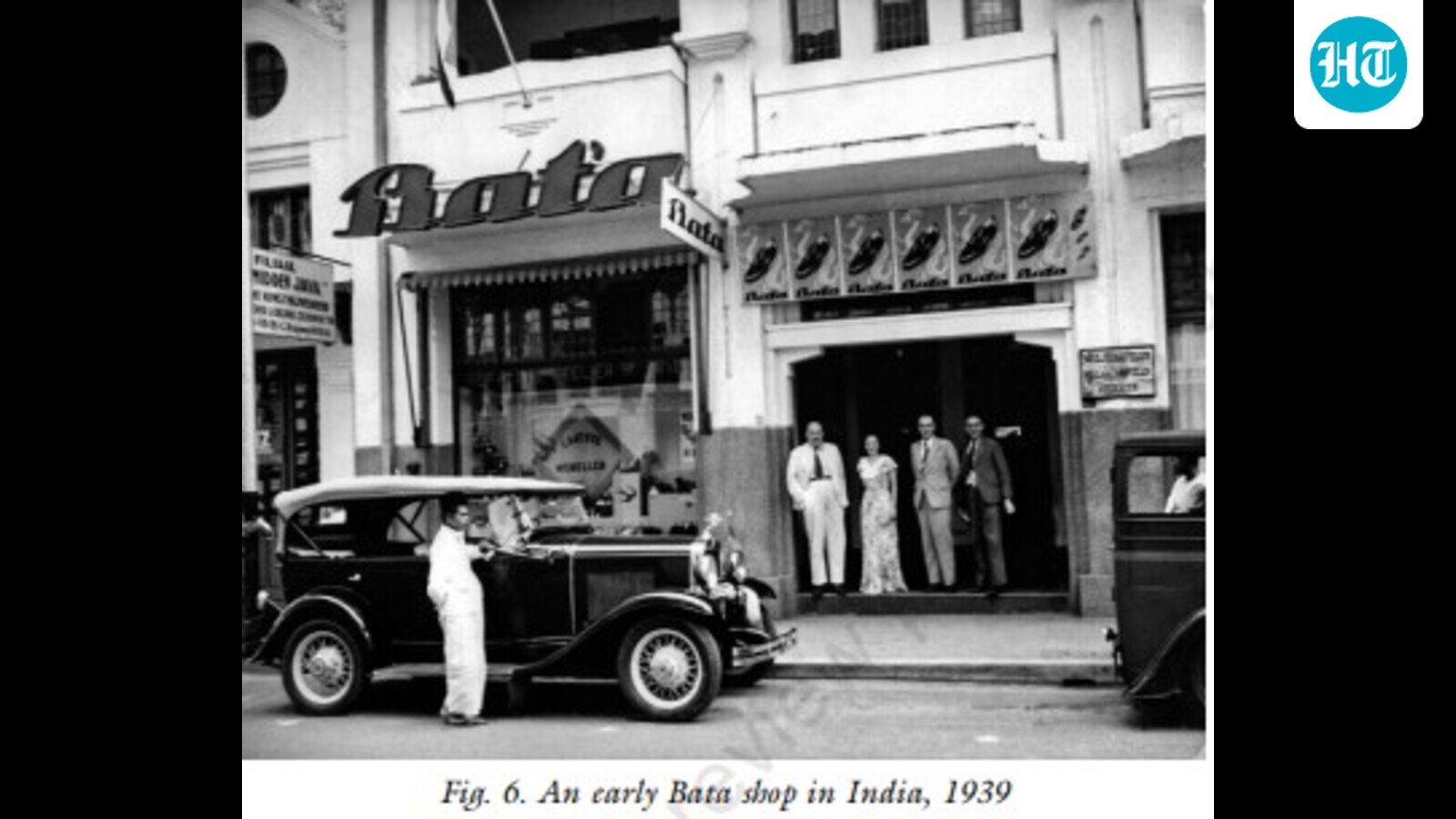
Bata’s thinking may have been influenced by that of American industrialist Henry Ford, whose globalization model he followed, and who treated Black and White employees at his Michigan factories in markedly different ways. White workers, including immigrants from Europe, were afforded similar opportunities and better living conditions while Black employees laboured under the ‘worst possible working conditions’. Just as Ford started expanding operations across Germany, Romania and Egypt, Bata shoes, manufactured in Zlín, started arriving in India. By the beginning of 1926, the first shipment of shoes landed in India, numbering less than 500 pairs. As per stock records from the period, preserved at the Thomas Bata Museum in Batanagar, the total stock of Bata shoes in India had reached 3,460 pairs by the end of 1926. The earliest shops selling Bata shoes in Calcutta included wholesale agencies at 1 and 2 New Market (New Extension) and 2F Bentinck Street. Later, shops were opened across the region including Bombay, Colombo and Rangoon.
However, the company’s exports did not increase as expected in the beginning. Import of European machinery was restricted and Japanese plimsoll shoes inundated the Indian market. Japan’s proximity to India and the existence of better trade routes made Japanese imports 50 times cheaper than shoes from Czechoslovakia. Compared to the millions of pairs of Japanese shoes, Bata imports ran only into the tens of thousands. With the British pound falling by almost 40 per cent at the beginning of the decade, alongside the introduction of preferential quotas and protectionist tariffs, exporting Bata shoes to India was impeded and became unprofitable. Meanwhile, India’s incorporation into the imperial trading bloc after the Ottawa conference, further restricted imports from outside the British empire. Additionally, devaluation of Japanese currency made footwear imports to India much cheaper.
To evaluate this dire situation and possibly course correct, the firm at Zlín decided on a somewhat speculative undertaking, that of sending manpower to India. However, the group that was selected consisted of 14 very young men with limited language proficiency and lack of local know-how. Additionally, they were not provided with adequate financial resources for this venture. In 1931, the group led by L Ploskal, who was assigned the role of manager, set sail for India. Their job description included opening outlets in the Calcutta region to sell shoes they brought with them, and training locals in various aspects of shoemaking. Despite their eagerness, energy and industry, and the fact that they registered the Bata Shoe Company Limited on 23 December 1931, these pioneering employees were encumbered from the start and did not succeed in turning round the fortunes of the company.
With the mission being unsuccessful, Tomáš Bata decided to make a second trip to India himself. His first visit in 1925 had been brief and exploratory; but this second time, in 1932, was intended to rectify the earlier failed attempt and initiate a complete overhaul. Unlike the earlier visit, this one marked a decisive phase in which the Konnagar unit was established, a precursor to the later Batanagar factory. He arrived in Calcutta on 16 January 1932. Interestingly, Bata’s position on differences between peoples had undergone a sea of change by then. His notes of the trip contain the following: ‘Aviation brings home to man the necessity to serve others. It teaches him that his life is continuously in the hands of other people. It cures man of hate towards other nations.’ Whatever one might think of his conversion and the reasons prompting them, it is notable he came to this conclusion in a relatively short time, and once he did, his thinking informed the long-term ethos of the company.
Tomáš immediately went to work, meeting with people at the Chamber of Commerce, conferring with leading industrialists of Bengal and establishing contacts with important government officials. All of it paid off when Rai Bahadur BM Das, superintendent of the Bengal Tanning Institute, and a supporter and sponsor of tanning and leather industries in Bengal, persuaded Bata to open a shoe factory near Calcutta. Bata was suitably convinced and before leaving India, he laid the groundwork renting an old factory in Konnagar, 16 kilometres north of Calcutta and setting up operations there. On his return to Zlín, he was greeted at the airfield by a crowd of people. Recounting his trip and its significance, he remarked,
We are not afraid of the future. Half of the people on earth go barefoot and about five percent of the citizens of the world have quality shoes. We see in fact just how little we have done so far, and just how much work waits for the world’s shoemakers.
It would become his most quoted and iconic speech. It conveyed the global orientation of the company and the confidence that came with it. This global vision – to realize the potential of the peoples labouring under the yoke of European imperialism – was Tomáš’s greatest achievement. Subsequently, he selected 50 graduates from the Bata School of Young Men, among them John Bartos, who was tasked with establishing and managing the Indian operation.
Following his return to Zlín, Bata had planned to fly to Switzerland to meet his son Thomas Jr., who was training at the Bata Shoe factory there. The company’s Junkers Ju-52 plane with Bata and his pilot, Jindřich Brouček, crashed shortly after take-off from Zlín, killing both men instantaneously. Reportedly, the cause was electrical failure.
Despite the shock of his sudden death, work did not stop across the Bata organization, and after the customary period of mourning, Jan Bata, half-brother of the late Tomáš and the newly appointed chief of Bata, called on John Bartos and asked him if he was ready to embark on his mission to India, as recommended by Tomáš. Bartos replied in the affirmative, and at the end of 1932, a group of 20 Czech Batamen boarded the SS Moravia bound for Calcutta. They carried with them equipment and machinery from the factory at Zlín, along with half a million pairs of shoes. The Moravia arrived in India the following year, and on its return journey, transported back to Zlín 18 Indian Batamen who were sent there for technical training.
Bata’s initial strategy in India was to produce rubber plimsoll shoes in Konnagar, with the goal of manufacturing 40,000 pairs of shoes per week. After the installation of machinery, the factory started production, and the first thousand pairs of rubber shoes were made in India on 1 May 1933. From then on, the retail network expanded steadily. Stores sold lower-priced shoes manufactured in Konnagar as well as higher-priced ones from European Bata factories. The margin between production costs in India and retail selling prices helped subsidize the import and distribution of footwear from Zlín. This facilitated sale of shoes from Czechoslovakia at wholesale prices in the Indian market.
One of the early challenges faced by Bata in Konnagar occurred in its dealings with middlemen called Sardars, who under the then-prevalent Sardar system supplied labour to the factory by employing workers on its behalf. The factory would pay the middlemen, who after taking a cut, would pay the workers their salaries. In addition to being outdated, slow and inefficient, the Sardar system repudiated the philosophy of Bata, which already had a highly effective system of hiring and job training in place. The company sought to create a disciplined, loyal and dedicated workforce through social rationalization and the ‘education’ of its labour elite through the Bata School of Work. As unskilled recruits from rural areas failed to meet Bata’s stringent training requirements, the Sardar system of hiring was considered unsuitable. The factory started direct hiring, but this resulted in a contentious situation with the Sardars who threatened local workers and prevented them from joining the factory despite Bata’s offer of higher wages.
Eventually, the company’s bid to offer high salaries along with its training programme enticed workers back to the factory. However, it can safely be surmised that even though Bata paid its Indian workforce well, it was still a fraction of what it paid to its Czechoslovak workers. Jozef Lusk, the Czech consul, advised Bata management to increase the salaries of European workers, which would enable them to be on a similar economic footing with European expatriates in Calcutta. From his perspective, the primary objective was to improve the material position of Czechoslovak workers. He therefore recommended that if an indigenous worker earned Rs12–15 a month, a European worker, specifically a Czech could not be paid ₹35–40 but ₹120–150, which would allow them to maintain their social status and fit into the city’s European community. Whether the consul’s recommendations were incorporated by the company cannot be verified, but ‘it is even stated that Bata enjoyed an improvement of its reputation among the European population of Calcutta, it can be assumed that these recommendations were followed’
The underlying racial and social tensions existing among Europeans in Calcutta is deftly captured by renowned novelist Vikram Seth in his magnum opus, A Suitable Boy. Seth, the son of Prem Nath Seth, an executive of Bata India in the 1950s, and Leila Seth, chief justice of Himachal Pradesh, draws on his parents’ experiences to describe the environment around a thinly veiled Bata Shoe Company that he renames Praha Shoe Company. Reflecting these tensions, Seth writes:
The Czechs resented the fact that the British commercial establishment in Calcutta did not treat them, although they were fellow-Europeans, as anything like their equals. The directors and heads of department and even covenanted assistants of the managing agency of Bentsen & Pryce, for example would not dream of fraternizing with the Czechs of the Praha Shoe Company.
Other hurdles Bata faced had to do with implications it was destroying the Indian cottage industry of shoemaking. Mochis, or indigenous cobblers, were losing their livelihoods, and Bata was thought to be detrimental to national interests. The company navigated this issue skilfully by completely integrating into the Indian milieu at a time when nationalist leaders were exploring the best way to bring about industrial development in post-Independence India. A modern shoemaking factory built with Czechoslovakian capital and a skilled labour force, but relying largely on a domestic workforce and raw materials to manufacture shoes mainly for the Indian market, embodied both of these approaches.
Bata also imported its varied and highly effective system of advertising to India. The Czech firm boasted of an impressive advertising network, which when introduced to the Indian market caught the attention of the masses. Early ads published mostly in newspapers and magazines promoted shoes to prospective Indian customers as an essential durable, a safeguard for feet and a good investment. Later, seasonal ads were introduced, whereby shoes and ladies’ sandals were marketed in the Calcutta region during the high peak sales season of Durga Pujo. Bata’s signature attention to detail came in handy when it was found that lasts brought from Czechoslovakia, which provided the base for shoes, were too wide for Indian feet. Bata employees immediately went to work to remedy it. Salespeople undertook programs to better understand the complexities of customer’s feet. Measurements were collected through surveys conducted across provinces, including in Bata stores, wholesale shops, schools, public places – everywhere. Results of these studies helped experts determine the creation of lasts for India, which would subsequently be used to manufacture footwear.
Within a year, the Bata factory in Konnagar started replacing Japanese imports in the market for plimsoll shoes. A big win for Bata transpired when ‘primary plimsoll importer and wholesaler, Mr Mohkamdin, was impressed upon to stop trading with the Japanese, and purchase shoes from Bata made in India instead. The significance of this deal, interestingly made verbally, cannot be overstated. In time, the quality of plimsolls produced at Konnagar became comparable to those made in Czechoslovakia and other Western countries. Bata’s outstanding plimsoll brand – Jan Marka 556 – became ‘one of the most popular brands in the Indian shoe market until the outbreak of the war, and was in great demand even far beyond borders of India – in British east Africa, in Malaya, in China and other places’. The brand’s success led to the development of Konnagar and its neighbouring villages. Bata thus became an engine for local growth and progress in the region. However, the factory and compound became too small for the scale of operations, and since the lease agreement on Konnagar was set to run out in 1936, Bata subsequently purchased a parcel of land, 19 kilometres south of Calcutta, laying the foundation of what was to become one of its most vaunted townships, Batanagar.

