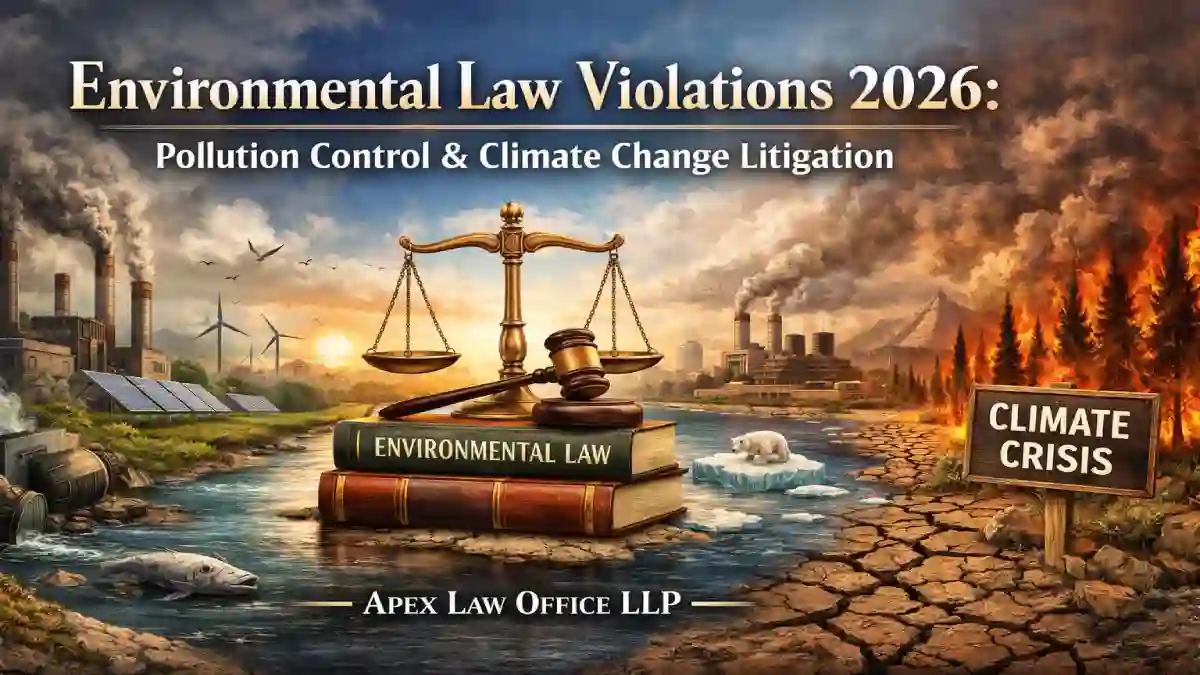

Environmental Law Violations 2026 – Environmental law violations in India involve unlawful activities harming nature, public health, and ecological balance. Apex Law Office LLP assists individuals, companies, industries, and communities with environmental litigation support. Moreover, environmental disputes require knowledge of constitutional rights, statutory regulations, and judicial remedies. Article 21 protects the right to a clean environment through judicial interpretation. Additionally, Article 48A and Article 51A(g) support environmental protection duties. Therefore, pollution control violations may involve air pollution, water contamination, hazardous waste, and climate risks. Further, lawyers analyse violations under the Environment Protection Act, Air Act, Water Act, and National Green Tribunal Act. The legal process includes complaints, notices, evidence collection, tribunal proceedings, and court appeals. Hence, professional legal guidance helps secure environmental compliance and compensation remedies.
Environmental Law Violations 2026: Pollution Control & Climate Change Litigation – Apex Law Office LLP

Types of Environmental Legal Issues Handled by Lawyers
Environmental disputes arise from multiple sources affecting citizens, businesses, and government authorities. Furthermore, legal professionals handle various environmental challenges through courts and specialised forums. Common issues include:

- Industrial pollution complaints and regulatory violations.
- Illegal waste disposal and hazardous substance management.
- Air quality violations affecting communities.
- Water pollution caused by industries and municipalities.
- Deforestation and illegal land-use changes.
- Climate change impact litigation and policy challenges.
Moreover, environmental lawyers represent clients before the National Green Tribunal, High Courts, and Supreme Court. Additionally, they coordinate with regulatory authorities like the Central Pollution Control Board and State Pollution Control Boards. Therefore, effective litigation requires scientific evidence, legal interpretation, and administrative representation. Consequently, timely legal action prevents environmental damage and protects sustainable development objectives.
Environmental Regulatory Authorities and Government Departments
Role of Pollution Control Boards in Environmental Compliance
Pollution control authorities monitor industries and enforce environmental standards across India. Furthermore, the Central Pollution Control Board develops guidelines and coordinates pollution prevention activities. State Pollution Control Boards issue consents, conduct inspections, and initiate enforcement actions. Additionally, industries must obtain Consent to Establish and Consent to Operate approvals. Therefore, violations can result in penalties, closure orders, and prosecution. Environmental lawyers assist clients during inspections, notices, and regulatory proceedings. Moreover, legal support helps companies understand compliance obligations under changing environmental regulations. The important authorities include:
| Authority | Main Responsibility |
|---|---|
| CPCB | National pollution monitoring and guidelines |
| SPCB | State-level environmental regulation |
| MoEFCC | Environmental policies and approvals |
| NGT | Environmental dispute resolution |
Hence, professional representation helps resolve disputes while maintaining environmental responsibility.
Environmental Approvals, Licences and Compliance Requirements
Environmental compliance involves several permissions before starting regulated activities. Moreover, businesses must follow approval procedures under environmental laws and government notifications. Key requirements include:
- Environmental Clearance under applicable rules.
- Pollution control board consent approvals.
- Waste management authorisations.
- Forest and wildlife permissions.
- Environmental audit and reporting compliance.
Additionally, companies facing compliance issues require legal advice regarding notices, penalties, and corrective measures. Furthermore, lawyers review documents, contracts, environmental reports, and regulatory communications. Therefore, legal assistance reduces risks associated with environmental violations. Businesses also receive support during hearings before authorities and tribunals. Consequently, proper compliance planning protects organisations from costly litigation and reputational damage.
Climate Change Litigation and Environmental Court Proceedings
Climate Change Legal Challenges in India 2026
Role of Courts in Climate Change Protection
Environmental Litigation Before Indian Courts and Tribunals
Climate change litigation has expanded due to increasing environmental risks and public awareness. Moreover, Indian courts recognise environmental protection as part of fundamental rights. The Supreme Court, High Courts, and National Green Tribunal address climate-related disputes. Additionally, courts examine government policies, industrial activities, and ecological impacts. Climate litigation may involve:
- Greenhouse gas emission concerns.
- Renewable energy disputes.
- Coastal regulation violations.
- Forest conservation conflicts.
- Climate adaptation failures.
Furthermore, environmental advocates use Public Interest Litigation for protecting common resources. Therefore, courts evaluate environmental principles including sustainable development and precautionary principles. Legal professionals assist petitioners, respondents, and organisations during environmental proceedings. Additionally, evidence under the Bharatiya Sakshya Adhiniyam supports factual claims through scientific records. Hence, proper documentation strengthens environmental litigation strategies before judicial forums.
National Green Tribunal Cases and Environmental Dispute Resolution
The National Green Tribunal provides specialised remedies for environmental disputes. Moreover, the tribunal handles matters involving environmental laws listed under the National Green Tribunal Act. Cases may include pollution damages, ecological restoration, and compensation claims. Therefore, environmental lawyers represent affected parties before the tribunal effectively. The NGT provides remedies such as:
- Environmental compensation orders.
- Restoration directions.
- Pollution prevention measures.
- Compliance monitoring.
- Expert committee investigations.
Additionally, appeals against certain NGT decisions may proceed before the Supreme Court. Furthermore, legal professionals prepare petitions, affidavits, evidence records, and arguments. The tribunal follows principles of natural justice and environmental protection. Consequently, NGT litigation offers faster resolution compared with ordinary civil proceedings. Businesses also seek representation for defending alleged environmental violations and compliance disputes.
Environmental Crimes, Corporate Liability and Legal Remedies
Criminal Proceedings for Environmental Law Violations
Environmental Offences Under Current Indian Legal System
BNS, BNSS and Environmental Crime Enforcement
Environmental offences may involve criminal liability when violations threaten public safety and ecological resources. Moreover, authorities can initiate prosecution against individuals, companies, and responsible officers. The Bharatiya Nyaya Sanhita (BNS) 2023 replaced several provisions of the Indian Penal Code. Additionally, the Bharatiya Nagarik Suraksha Sanhita (BNSS) 2023 governs criminal investigation procedures. Therefore, environmental offences may require coordination between police stations, pollution authorities, and courts. Lawyers assist clients during criminal complaints, investigations, and trial proceedings. Further, evidence collection under the Bharatiya Sakshya Adhiniyam (BSA) strengthens environmental cases. Common criminal issues include:
- Illegal hazardous waste disposal.
- Public nuisance caused by pollution.
- Negligent industrial operations.
- Environmental damage affecting communities.
Moreover, environmental advocates provide representation before Magistrate Courts, Sessions Courts, and High Courts. Hence, legal support ensures proper defence, prosecution assistance, and protection of environmental rights.
Police Complaints and Environmental Violation Investigations
Environmental violations sometimes require immediate police intervention and investigation. Furthermore, affected persons can approach nearby police stations regarding criminal environmental activities. Authorities may register complaints involving illegal dumping, hazardous substances, and public health threats. Additionally, police investigations require cooperation with environmental departments and technical experts. The investigation process generally includes:
- Filing complaints with supporting evidence.
- Recording statements from affected persons.
- Collecting scientific and documentary evidence.
- Conducting inspections with authorised officials.
- Submitting reports before appropriate courts.
Moreover, lawyers guide complainants and accused persons during investigation stages. Therefore, legal representation protects procedural rights under BNSS provisions. Additionally, advocates coordinate with pollution boards and government agencies. Consequently, proper legal action ensures accountability and promotes environmental protection.
Civil Remedies and Environmental Compensation Claims
Civil Litigation for Environmental Damage Recovery
CPC Remedies and Compensation Proceedings
Environmental disputes may also involve civil remedies through courts and tribunals. Moreover, the Code of Civil Procedure, 1908 provides procedural mechanisms for civil litigation. Individuals and organisations may seek injunctions, damages, and protective orders. Additionally, courts consider environmental principles while deciding compensation claims. Civil remedies include:
| Remedy | Purpose |
|---|---|
| Injunction Order | Prevent harmful environmental activities |
| Compensation Claim | Recover pollution-related damages |
| Declaration Suit | Establish legal environmental rights |
| Mandatory Directions | Require corrective actions |
Furthermore, environmental lawyers prepare pleadings, evidence documents, and legal arguments. They also assist clients during mediation and settlement discussions. Therefore, CPC-based proceedings provide structured remedies for environmental disputes. Additionally, courts may direct restoration activities after assessing ecological harm. Hence, professional litigation support improves chances of obtaining effective environmental relief.
Environmental Compensation and Polluter Pays Principle
The polluter pays principle requires responsible parties to compensate environmental damage. Moreover, Indian courts frequently apply this principle in pollution disputes. Industries causing ecological harm may face financial liabilities and restoration obligations. Additionally, compensation calculations consider environmental impact, restoration costs, and public damage. Lawyers assist clients with:
- Environmental compensation challenges.
- Regulatory penalty appeals.
- Damage assessment disputes.
- Restoration negotiations.
Furthermore, regulatory authorities may issue notices requiring corrective measures. Therefore, companies need timely legal advice to avoid prolonged disputes. Environmental lawyers also represent affected communities seeking compensation. Consequently, proper legal proceedings balance development requirements with ecological protection. Hence, environmental compensation remains an important remedy in pollution control litigation.
Corporate Environmental Compliance and Climate Risk Management
Legal Support for Businesses Facing Environmental Issues
Environmental Due Diligence and Corporate Protection
Preventing Environmental Violations Through Legal Compliance
Businesses must adopt environmental compliance strategies to reduce legal risks. Moreover, industries require regular audits, approvals, and monitoring systems. Environmental due diligence identifies potential regulatory violations before authorities initiate action. Additionally, lawyers review operational practices, contracts, and environmental documentation. Compliance support includes:
- Reviewing pollution control approvals.
- Assessing environmental liabilities.
- Preparing regulatory responses.
- Developing compliance policies.
- Managing government inspections.
Furthermore, environmental legal advice helps companies understand obligations under updated regulations. Therefore, businesses can prevent penalties, closure actions, and litigation. Additionally, climate-related risks require stronger sustainability planning. Legal professionals assist organisations with environmental governance frameworks. Consequently, proactive compliance protects corporate reputation and promotes responsible business operations.
Environmental Notices, Appeals and Regulatory Representation
Environmental authorities frequently issue notices regarding suspected violations. Moreover, companies must respond within prescribed timelines to protect legal interests. Lawyers prepare replies, objections, and appeals against environmental enforcement actions. Additionally, representation may involve CPCB, SPCB, MoEFCC, NGT, and High Courts. The legal process includes:
- Reviewing violation allegations.
- Examining inspection reports.
- Preparing factual responses.
- Presenting legal arguments.
- Seeking appropriate relief.
Furthermore, advocates negotiate compliance solutions with regulatory authorities. Therefore, professional representation reduces unnecessary penalties and operational disruptions. Additionally, appeals require strong legal grounds and supporting evidence. Hence, environmental lawyers play an important role in regulatory dispute resolution. Businesses receive guidance for achieving compliance while protecting commercial interests.
Climate Change Litigation Strategies and Future Environmental Protection
Legal Forums and Environmental Dispute Resolution Mechanisms
Apex Law Office LLP: Representation Before Environmental Forums
Strategic Legal Assistance for Climate Change Cases
Climate change litigation requires specialised legal strategies involving environmental science and constitutional principles. Moreover, lawyers analyse climate policies, government actions, and industrial responsibilities. Apex Law Office LLP provides representation for environmental disputes before relevant forums. Additionally, climate cases may involve public interest issues affecting communities and natural resources. Legal strategies include:
- Reviewing climate-related laws and policies.
- Preparing petitions and written submissions.
- Presenting scientific and documentary evidence.
- Challenging unlawful environmental decisions.
- Seeking restoration and compensation remedies.
Furthermore, climate litigation requires understanding international commitments and Indian environmental regulations. Lawyers examine renewable energy disputes, emission concerns, and sustainability obligations. Therefore, effective legal representation supports balanced environmental governance. Additionally, courts increasingly consider climate protection while interpreting fundamental rights. Consequently, strategic litigation helps protect ecological interests and future generations.
Environmental Appeals Before Courts and Government Authorities
Environmental decisions may require review through appeals and legal challenges. Moreover, affected parties can approach appropriate forums against unlawful administrative actions. The available forums include:
| Forum | Environmental Matters |
|---|---|
| National Green Tribunal | Environmental disputes and compensation |
| High Courts | Writ petitions and constitutional remedies |
| Supreme Court | Appeals and significant environmental issues |
| Civil Courts | Damages and injunction claims |
Additionally, lawyers assist clients with petitions, appeals, and regulatory hearings. Furthermore, environmental disputes may involve government departments, industries, residents, and NGOs. Therefore, legal support ensures proper representation throughout proceedings. The legal process requires accurate evidence, timely filing, and compliance with procedural rules. Hence, professional assistance improves dispute management and protects environmental rights.
Government Departments and Environmental Law Resources
Important Indian Government Bodies for Environmental Matters
Environmental Authorities Supporting Legal Compliance
Environmental governance involves multiple government departments responsible for regulation and enforcement. Moreover, these authorities develop policies, monitor compliance, and protect natural resources. Important departments include:
- Ministry of Environment, Forest and Climate Change.
- Central Pollution Control Board.
- State Pollution Control Boards.
- National Green Tribunal.
- State environmental departments.
Additionally, businesses and individuals can access official information regarding environmental requirements. Therefore, understanding government procedures helps prevent legal violations. Furthermore, environmental lawyers assist clients while communicating with regulatory authorities. The relevant government resources include:
| Department | Official Purpose |
|---|---|
| MoEFCC | Environmental policies and approvals |
| CPCB | Pollution standards and monitoring |
| SPCB | State compliance enforcement |
| NGT | Environmental dispute resolution |
Consequently, proper coordination with authorities supports effective environmental compliance. Legal professionals provide assistance during notices, hearings, and appeals.
Environmental Legal Remedies Available in India
Environmental law provides multiple remedies for affected individuals, organisations, and communities. Moreover, courts and tribunals grant relief based on environmental damage and legal violations. Available remedies include:
- Filing complaints before pollution control authorities.
- Approaching NGT for environmental disputes.
- Filing writ petitions before High Courts.
- Seeking compensation for ecological damage.
- Requesting injunction against harmful activities.
- Challenging unlawful environmental approvals.
Furthermore, criminal proceedings may apply for serious environmental offences. Lawyers evaluate facts and recommend suitable legal actions. Therefore, selecting the correct remedy improves the possibility of successful resolution. Additionally, evidence collection remains essential for environmental claims. Hence, professional environmental litigation support ensures effective protection of legal rights.
Environmental Law Compliance Support by Apex Law Office LLP
Comprehensive Legal Services for Environmental Disputes
Environmental Lawyers for Individuals, Companies and NGOs
Protecting Environmental Rights Through Legal Advocacy
Apex Law Office LLP provides legal assistance for diverse environmental law matters. Moreover, the firm supports individuals, companies, NGOs, and institutions facing environmental challenges. Legal services include pollution disputes, compliance reviews, tribunal representation, and litigation support. Additionally, lawyers assist with environmental notices, appeals, and compensation claims. The firm helps clients with:
- Pollution control disputes.
- Climate change litigation.
- Environmental compliance advisory.
- Regulatory representation.
- Environmental damage claims.
Furthermore, legal professionals analyse applicable laws, evidence, and government actions. Therefore, clients receive practical solutions for environmental disputes. Additionally, updated knowledge of CPC, BNS, BNSS, and BSA strengthens legal strategies. Consequently, effective environmental advocacy promotes sustainable development and legal compliance.
Why Choose Apex Law Office LLP for Environmental Litigation
Environmental disputes require experienced legal guidance and detailed regulatory understanding. Moreover, Apex Law Office LLP combines litigation experience with environmental law knowledge. The firm focuses on protecting client interests while supporting ecological responsibility. Additionally, legal strategies consider current environmental regulations and judicial developments. Key advantages include:
| Service Area | Legal Assistance |
|---|---|
| Pollution Cases | Litigation and compliance support |
| Climate Disputes | Court and tribunal representation |
| Corporate Compliance | Regulatory guidance |
| Compensation Claims | Damage recovery assistance |
Furthermore, environmental litigation requires timely action and accurate documentation. Therefore, professional legal support helps clients manage complex environmental issues. Additionally, strategic advice reduces future risks and strengthens legal protection. Hence, Apex Law Office LLP assists clients with reliable environmental law solutions.
1. What are environmental law violations in India?
Environmental law violations include pollution, illegal waste disposal, ecological destruction, and regulatory breaches. Lawyers help individuals and companies address these issues through courts and authorities.
2. Which court handles environmental disputes in India?
The National Green Tribunal handles many environmental disputes. However, High Courts and the Supreme Court also hear important environmental matters through legal proceedings.
3. Can companies face penalties for pollution violations?
Yes, companies may face penalties, compensation claims, closure orders, and prosecution. Legal advice helps businesses respond to notices and maintain compliance.
4. How can citizens report environmental violations?
Citizens can approach pollution control boards, government departments, or police stations. Lawyers assist with complaints, evidence preparation, and further legal remedies.
5. What laws regulate environmental protection in India?
Important laws include the Environment Protection Act, Air Act, Water Act, NGT Act, CPC, BNS, BNSS, and BSA provisions.
6. Can climate change issues be challenged legally?
Yes, climate-related decisions may be challenged through environmental litigation. Courts consider constitutional rights, sustainability principles, and environmental protection obligations.

