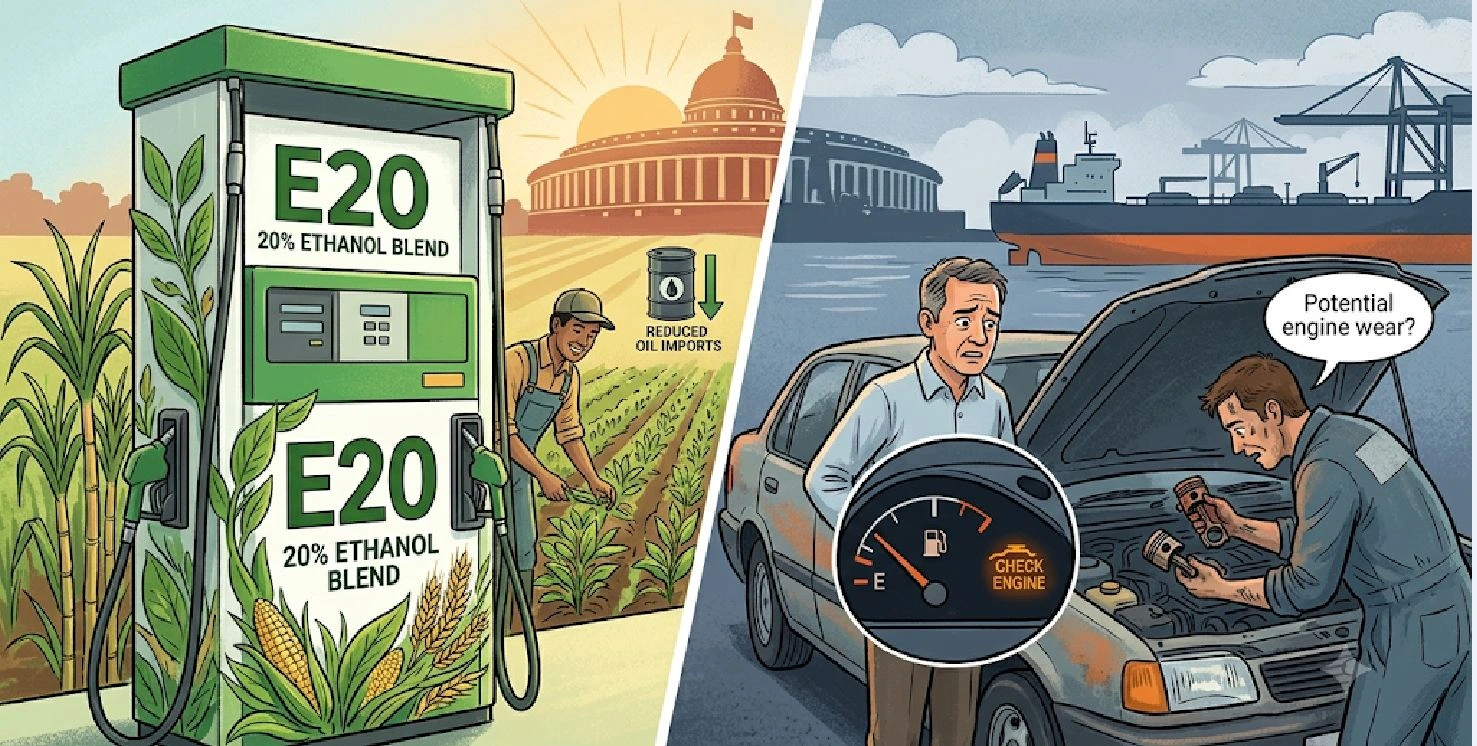

One word, one letter of the alphabet and one numerical have played havoc in recent weeks: Ethanol and E20 respectively. What is all this about? Those who are crying foul today were, perhaps, unaware about either the origin or existence of the substance called Ethanol. But today the word is top of the mind with various formulations and definitions: some call it poison in fuel, some say it is adulterated petrol while logical minds explain that ethanol is a fuel which is derived from crop and crop residue. It is then fermented, goes through a proper distillation and a purification process. Simply put, it is an organic fuel made out of crops. It is blended with petrol and used in vehicles, including two-wheelers and cars.
This is where the common man comes in with his angst and reams of information and misinformation. The devil: E20 or ethanol blend in petrol.

Under the National Policy on Biofuels, the government has fast-forwarded its target of achieving 20 percent ethanol blending. Originally, slated for 2030, the government has advanced it to 2025. This made it mandatory for all petrol stations to use E20 since then.
The hue and cry began when the government told the Supreme Court in June this year that the policy was experimental. Of course, the government backtracked on this admission in Court, but the damage had been done. Consumers were up in arms on the government haste in pushing E20 fuel policy without taking into account the concerns of the consumers, and more importantly, without wider and transparent consultation.
It was in 2003 that India’s Ethanol Blended Petrol programme began. The progress was slow, and by 2014, the blending was lower than two percent: barely 1.5 percent to be exact. By 2022, the blending increased to ten percent. Within the next two years, that is between 2023-2024, the blending averaged a little less than 15 percent. This went up to around 18 percent in 2024. Last year, it was 20 percent: or the E20 monster, so to speak.
The target was to blend 20 percent by 2030. In 2021, the Modi government advanced the deadline and reset the target: from 2030 it became 2025.
And this is where the gap is. While the government is showcasing the “progress” and targets being achieved far ahead of the schedule, the common man alleges “being hit from all sides”.
Be it car owners or two-wheeler drivers, they allege facing issues of low mileage, poor engine performance and non-compatibility of old vehicles with the E20 blend. Hence the slugfest.
Vehicle owners have flagged low mileage and wearing out of parts while using the E20 blend. Technically, petrol has a higher calorific value than ethanol which means that a E20 blend has around seven percent less energy than pure petrol adversely affecting performance, power and mileage.
This is something that the government and its industry minions have also admitted. Of course they choose to underplay the mileage deficit as a “modest decline”. As for rubber parts wearing out, the pro E20 lobby dismisses this as “normal wear and tear” in old vehicles.
The government, on its part, has allayed fears and said the criticism is a result of misinformation and a concerted effort by the vested interests to derail a “positive,
forward-looking and constructive policy” which has been rolled out.
There could be some truth in this, given that the E20 maths means saving roughly Rs 1.4 lakh crore in foreign exchange. Ethanol blending is estimated to have displaced around 245 lakh metric tons of crude oil, while E20 is projected to reduce import cost between 6 to 10 billion dollars annually.
Add to this, the claims about environmental and financial gains which translate into reducing carbon emissions and payment to farmers and investment in more than 200 distilleries.
The government, sources say, roped in several industry voices to say what the government wants to hear and the people to believe. This pro-government lobby has come out in large numbers to defend the E20 roll out, however exaggerated the claims may be.
Major manufacturers like Maruti Suzuki and Toyota have come out in support appearing more as government spokespersons than independent entities.
Of course, there is a business interest as well. Replacement incentives and increasing demand for repairs mean more business and hence the support and bid to brush negatives under the carpet.
At another level there is a kind of “gag order” to stem the ill effects. Many automobile associations, while privately admitting the lapses of this blend, do not want to go public and slam the policy. The key word: fear of the government zeroing in on them.
Having said that one cannot deny the big picture advantages of E20. Pitch these against the issues the vehicle owners are facing and it is a “you gain some and we gain some” kind of a story.
The real issue is the trust deficit between the government and the people. Therefore, whatever the government may say or do, the common man sees it as suspect. On this score, the BJP government is on a weak wicket because there is a public perception that the current dispensation claims more than it does and delivers less.
So also with ethanol blending wherein the common view is that the government claims are less facts and more fiction.
While it is true that there is nothing new and vehicles have been using the E20 blend since last year and a little less in past years, the hullabaloo is because the common man is looking at what it means to him and his vehicle rather than the benefits on a larger scale or the national advantage, if any.
Decidedly, there is a gap that the government should have filled up which is addressing common concerns rather than rushing in to usher a policy well ahead of its prescribed deadline: 2030.
For starters, it should have brought in the high blend in a phased manner rather than an immediate replacement leaving the consumer with many questions and few answers.
In this context, awareness campaigns were and are a must for the common man to understand and comprehend and weigh the advantages and disadvantages and then take a call.
More importantly, the government should have given a choice to the vehicle owners to choose their fuel rather than making E20 mandatory. This effectively means that the E10 should have been allowed to co-exist with E20 till such time all the new vehicles that are manufactured would be E20 compliant. This would have also given time to the older vehicles that are problematic to be phased out once their running life was over or nearing their end.
Therefore, as things have panned out, the problem is less with the policy and more with the way it has been pushed down the throat of vehicle owners and that too without a viable alternative or choice of which fuel they want to use.
—The writer is an author, journalist and political commentator
The post E20: A Good Policy, A Bad Rollout? appeared first on India Legal.

