
[ad_1]
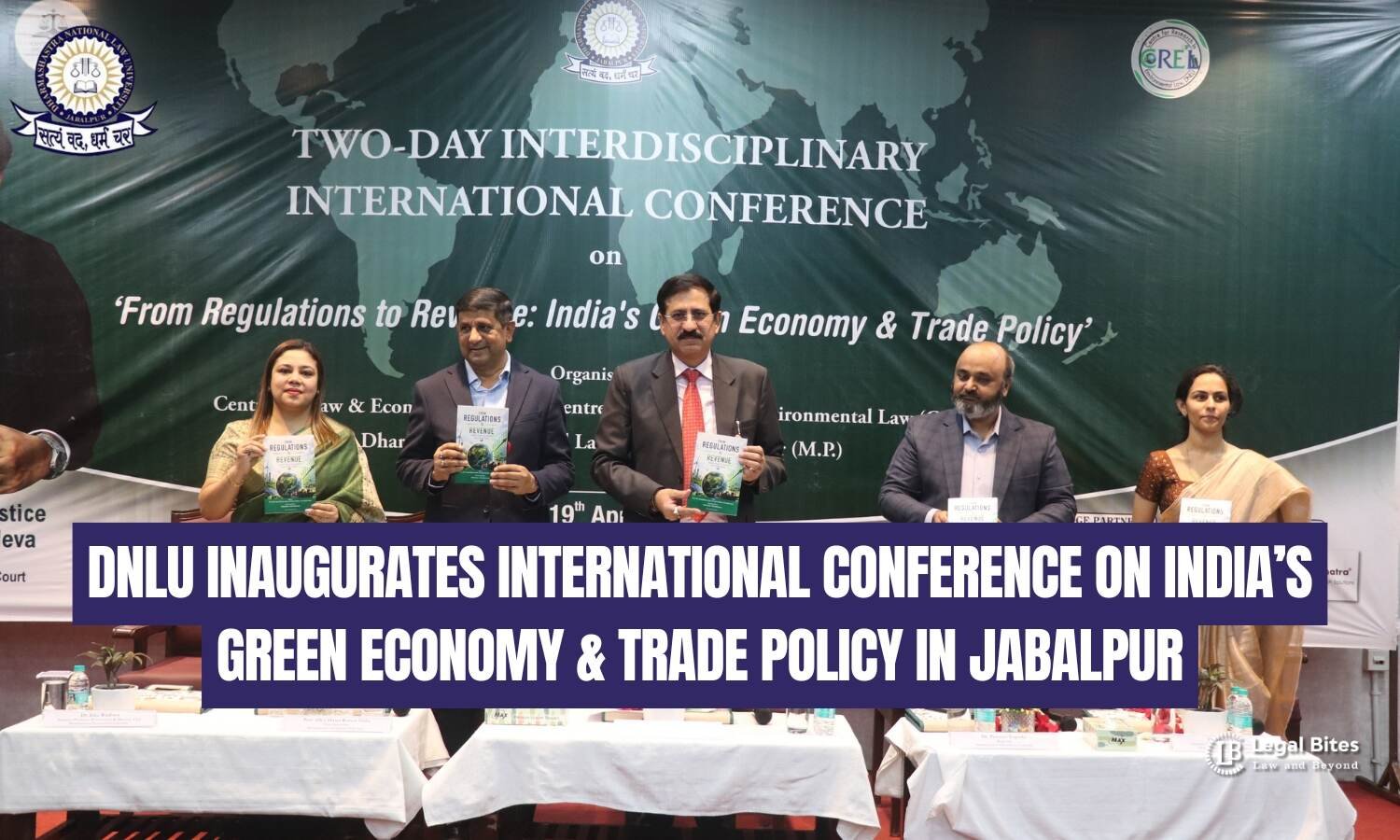
Jabalpur, April 18, 2026: Dharmashastra National Law University (DNLU) inaugurated a two-day interdisciplinary international conference titled “From Regulations to Revenue: India’s Green Economy & Trade Policy”, bringing together leading jurists, policymakers, academicians, and industry experts to deliberate on India’s sustainability-driven economic transition.

High-Profile Inauguration Marks Strong Institutional Push
The conference commenced with a distinguished inaugural ceremony attended by prominent members of the judiciary and academia. Hon’ble Shri Justice Sanjeev Sachdeva, Chief Justice of the Madhya Pradesh High Court, led the gathering alongside Hon’ble Mr. Justice Pramod Kumar, Hon’ble Mr. Justice Vishal Dhagat, and Hon’ble Mr. Justice Himanshu Joshi, all serving as Judges of the M.P. High Court. They were joined by Mr. Dharminder Singh, Registrar General, and Mr. Harsh Singh Bahrawat, Registrar Administration of the High Court. Representing the university leadership were Prof. (Dr.) Manoj Kumar Sinha, Vice Chancellor of DNLU, Dr. Praveen Tripathi, Registrar of DNLU, along with Dr. Isha Wadhwa, Director of the Centre for Law and Economics (CLE), and Dr. Srishti Yadav, Director of the Centre for Research in Environmental Law (CREL).
The conference has been jointly organised by CLE and CREL at DNLU, Jabalpur, with a clear focus on examining the evolving relationship between environmental regulation, economic growth, and international trade in India.
Chief Justice Flags Ground Realities of Green Transition
Delivering a thought-provoking keynote, Justice Sanjeev Sachdeva underscored that despite policy momentum, solar energy continues to remain a luxury for many in India. Reflecting on his journey in the legal profession, he drew attention to the country’s transition from traditional mobility such as cycles to electric vehicles, framing it as part of a broader shift toward sustainable and revenue-generating models.
He also pointed to pressing concerns of water scarcity and energy scarcity, citing examples such as Bandhavgarh, where local communities rely on collecting mahua seeds for their livelihood. Justice Sachdeva emphasised the rapid expansion of green technologies and highlighted the crucial role of MSMEs, startups, and governance frameworks in driving this transformation. Stressing the importance of global compliance standards, he concluded by linking sustainability with everyday life, warning about the implications of global warming and pointing to emerging opportunities for legal practice in green policy.
Academia Pushes for Interdisciplinary Policy Solutions
In his welcome address, Prof. (Dr.) Manoj Kumar Sinha highlighted the importance of interdisciplinary engagement in addressing complex contemporary challenges. He noted that academic platforms such as this conference play a vital role in fostering dialogue and generating innovative ideas that can influence policy development in the green economy and trade sectors.
Dr. Isha Wadhwa, Director of CLE and Assistant Professor of Economics at DNLU, further emphasised the relevance of such initiatives within the broader sustainability discourse. She stressed that institutions must actively contribute to designing frameworks that effectively integrate environmental sustainability with economic objectives, thereby ensuring long-term and inclusive growth.
Focus on Green Finance, Carbon Markets and Trade
As the conference progressed, discussions centred around key themes such as environmental governance, green finance, carbon markets, and sustainable trade practices. The sessions aim to unpack how regulatory frameworks can be leveraged not only to ensure ecological balance but also to generate economic value.
The broader objective of the conference is to provide a comprehensive platform to analyse how law and economics can intersect to support sustainable development. In a global context increasingly shaped by climate change concerns, the deliberations seek to contribute to policy frameworks that promote environmental protection alongside economic advancement across sectors including trade, industry, energy, and agriculture.
Diverse Expert Participation Strengthens Discourse
The conference features an extensive lineup of experts from academia, industry, and legal practice, reflecting the interdisciplinary nature of the subject. Among the notable speakers are Dr. Srinivas Yanamandra, Fintech Consultant and Senior Non-Resident Fellow at Dhirubhai Ambani University School of Law; Dr. Vinay N. Paranjape, Group General Counsel at Petronet LNG Ltd.; and Dr. A. Venkatesan, Group General Manager at GAIL India Ltd.
The discussions are further enriched by contributions from Ms. Stellina Jolly of South Asian University, Dr. Malabika Pal of Miranda House, Mr. Ridhish Rajwanshi of CTIL, and Adv. Kushal Kumar, Founding Partner at Erudite Legal, New Delhi. Other prominent participants include Ms. Sudha Reddy of Alpha Legal Consultants and Founder of the Energy Law Association, Mr. Yashaswi Kant of Trilegal, Dr. Chitra Saruparia of NLU Jodhpur, Dr. Hitesh K. Thakkar of Gujarat National Law University, and Dr. Seema Srivastava of National Law Institute University, Bhopal.
The list also includes Mr. Jaibatruka Mohanta of O.P. Jindal Global University, Prof. (Dr.) Yogendra Srivastava of HNLU, Ms. Saubhagya Bhadkariya of NLIU Bhopal, Dr. Tilottama Raychadhuri of WBNUJS, Dr. Aman Deep Singh of RMLNLU, and Dr. Monalisa Saha of the University of Burdwan. Faculty members from DNLU such as Prof. (Dr.) Shailesh N. Hadli, Dr. Ruchira Chaturvedi, Dr. Gautam Gupta, Dr. Sankalp Singh, Dr. Deeplaxmi Chile, and Dr. Vimal Vishwakarma are also actively contributing to the sessions.
Strong Student and Faculty Backing
The conference is being directed by Dr. Isha Wadhwa and Dr. Srishti Yadav, supported by a dedicated team of CLE and CREL students including Mahak Jain, Aryan Shekar Shrivas, Shriya Singh, Deshna Jain, Shivam Singh, Priyanshi Jain, Isha Mehrotra, Jaya Bhuria, Suhani Badani, Shreyash Jain, Aparna Dwivedi, Nitya Chandel, Aanchal Somkuwar, Ritu Meena, Drishti Singh, Sneha Batav, Surbhi Ahirwar, Poorvi Jain, Aditya Chauhan, Vaibhav Jain, Aneeka Mehra, Vanshika Singh, Sara Mishra, Sapna Meena, Anahita Tripathi, Anjali Bhadoriya, Priyam Mangal, Uma Rani, Shrasti Sharma, Anamika Manjhi, Saksham Gaur, and Drishti Tiwari.
The event is being conducted under the guidance of Prof. (Dr.) Manoj K. Sinha and Dr. Praveen Tripathi, with institutional support from faculty members including Dr. Gargi Chakrabarti, Ms. Shruti Tiwari, Dr. Amit K. Mishra, and Mr. Arpit Tiwari, among others.
Packed Agenda and Interactive Engagement
The two-day conference features a robust academic agenda comprising two keynote addresses, four expert sessions, four panel discussions, and three technical sessions. In her closing remarks, Dr. Srishti Yadav expressed gratitude to all participants and highlighted the successful execution and intellectual depth of the deliberations.
Adding an interactive dimension, the dignitaries also engaged directly with students of DNLU through a dedicated interactive talk session, fostering meaningful exchange between the judiciary and young scholars.
Driving India’s Green Growth Narrative
At a time when climate change is redefining global economic priorities, DNLU’s conference underscores the growing importance of aligning legal, economic, and environmental frameworks. The initiative stands out as a significant step toward shaping India’s policy discourse on building a sustainable and revenue-generating green economy.
[ad_2]
Source link

