

Last verified: July 2026
At 12:10 a.m. on 1 July 2024, a constable on the late-night beat in Gwalior, Madhya Pradesh, lifted his pen and registered an FIR for a motorcycle theft under Section 303(2) of the Bharatiya Nyaya Sanhita, 2023. Ten minutes earlier, the same offence would have travelled through the system as IPC Section 379. By morning, news desks across India were running a parallel headline from Delhi: a 23-year-old street vendor from Patna selling water, bidi and cigarettes from a cart under a foot overbridge near New Delhi railway station had been booked under Section 285 BNS for obstructing a public way. For one half of the day, the country woke up to BNS; for the other half, it was still living with the IPC. The collision between BNS vs IPC was no longer academic. It was a paper trail.

Step back from the scene. On 30 June 2024, every police station in India was running on the Indian Penal Code, 1860, a 163-year-old colonial code drafted by the First Law Commission. On 1 July, the same stations were running on three new statutes (BNS for substance, BNSS for procedure, BSA for evidence), each drafted, debated and passed during a Winter Session in which 146 opposition MPs were under suspension. Within 24 hours, the Union Home Minister personally clarified that the Gwalior motorcycle theft, not the Delhi street vendor, was the country’s first BNS FIR. The Delhi case was quietly dismissed after a perfunctory enquiry. The episode crystallised what this comparison post is about: a complete penal-law overhaul, executed in a single midnight switch, with two parallel systems running simultaneously for years to come.
Speak directly now to whoever you are. If you’re a practising advocate, this post maps every IPC section that matters to its BNS counterpart, with the punishment changes spelled out. If you’re a law student, it carries the precedent map (the rarest-of-rare doctrine, the bedrock culpable-homicide-versus-murder line developed in colonial-era Bombay High Court jurisprudence and refined by the Supreme Court in 1958) across the renumbering. If you’re a journalist or a policy-curious reader, it explains the difference between IPC and BNS in plain terms: which sections were dropped, which were genuinely new, and which were simply renamed. The BNS vs IPC question matters because at any working trial court in India today, both codes are alive on the docket. A charge sheet drafted on 8 July 2026 may cite IPC sections for the offence and BNSS sections for the procedure. The dual-track is not a transition glitch. It’s the operating model for the rest of the decade.

Before the chapter-by-chapter walk-through, here is the one-paragraph answer most readers come for.
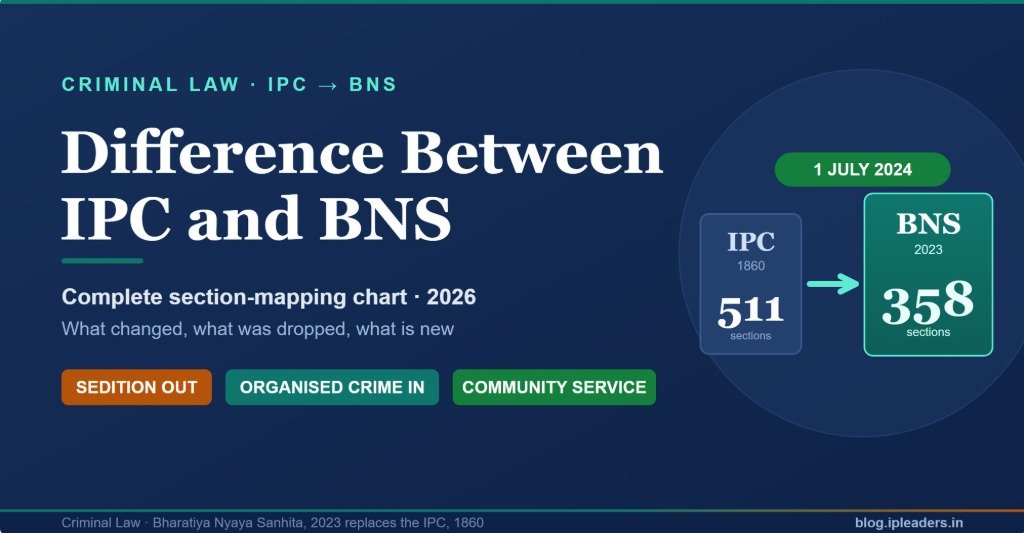
BNS vs IPC: The Bharatiya Nyaya Sanhita, 2023 replaced the Indian Penal Code, 1860 with effect from 1 July 2024. BNS contains 358 sections across 20 chapters, against IPC’s 511 sections. It removes sedition (Section 124A), adultery (Section 497) and the consensual portion of Section 377; adds organised crime, terrorism, mob lynching, snatching and sexual intercourse by deceitful means; raises punishments for offences against women and children; and introduces community service as a sentence.
That’s the headline. What follows is the working detail: the section-mapping chart, the four transition scenarios, the precedent continuity matrix, the post-July-2024 case digest, and the practitioner workflow for FIRs, charge sheets and bail applications drafted after the switch.
BNS vs IPC at a glance: the one-page comparison
If you’ve come here to settle a single argument, the table below does it. The Bharatiya Nyaya Sanhita and the Indian Penal Code are not two flavours of the same statute. They’re two different statutes that share roughly 80% of their substantive content and renumber almost everything.
| Field | Indian Penal Code, 1860 | Bharatiya Nyaya Sanhita, 2023 |
|---|---|---|
| Year enacted | 1860 | 25 December 2023 (President’s assent) |
| In force from | 1 January 1862 | 1 July 2024 |
| Number of sections | 511 | 358 |
| Number of chapters | 23 | 20 |
| Drafted by | First Law Commission of British India | Criminal Law Reform Committee (NLU Delhi, 2020) and MHA |
| Replaces | The pre-1860 patchwork of regulations | Indian Penal Code, 1860 |
The structural shift is genuine. BNS reorganises chapters around themes (offences against women and children get a dedicated chapter), drops some colonial-era debris, and introduces five new offence families that didn’t exist under IPC. But many of the bedrock concepts (mens rea, the murder vs culpable-homicide gradient, the rarest-of-rare doctrine for capital sentencing under Section 103 of the Bharatiya Nyaya Sanhita, 2023) carry over almost word-for-word. That’s what makes the renumbering deceptive. A reader who treats BNS as a rebranded IPC will get most things right and a few things expensively wrong. Worth flagging early: BNS is the substantive code. The Bharatiya Nagarik Suraksha Sanhita, 2023 is the procedural successor to CrPC, and the Bharatiya Sakshya Adhiniyam, 2023 evidence-law overhaul replaces the Indian Evidence Act, 1872. All three came into force on the same day.
In our view, the most useful way to read BNS is to read it section-by-section against IPC, marking three statuses for every provision: renamed (same offence, new number), reformulated (different elements, related offence), or genuinely new (no IPC predecessor). The 14-row mapping chart below does the first cut on the highest-traffic sections. Why does this matter for the reader landing on this page? Because every FIR, every charge sheet, every bail application drafted in 2026 sits at the intersection of these two codes, and the section number you cite determines whether the case proceeds smoothly or gets challenged on a technicality.
The pitfall worth naming up front. Many practitioners treat the BNS as a renumbering exercise and quote IPC precedent under BNS section numbers without the continuity footnote. That’s not always wrong, but it’s not always right either. The next sections walk through where the renumbering hides a substantive shift.
From the colonial code to the present: the historical road to BNS
The IPC was the work of the First Law Commission appointed in 1834. The draft was complete by 1837, criticised, redrafted, and finally enacted in 1860 (the 1857 revolt held up the Bill for two decades). It came into force on 1 January 1862. For the next 162 years it was the substantive criminal code of British India and then independent India. Successive Law Commissions tinkered with it (rape law in 1983, the 2013 Criminal Law Amendment after the constitutional rape-law review committee, the 2018 ten-year mandatory minimum for rape of a child under 12) but no one tried to rewrite the whole thing. Until 2023.
The First Law Commission and the original IPC
Why did the IPC last so long? Two reasons. First, the draft was extraordinarily good for its time: a clean structure, definitions in Chapter II that anchored the whole code, a minimal cluster of general exceptions in Chapter IV, and offence groupings that mostly hold up. Second, India’s reform pattern is conservative. Commissions report, governments shelve. The tradition is amendment, not replacement. So the IPC kept accreting: dowry death in 1983 (Section 304B), criminal misappropriation tweaks, Section 498A on cruelty by husband or relatives, and so on. The colonial illustrations (the chariots, the palanquins, the caste-coded examples in Chapter XXII) stayed in the bare act because nobody bothered to clean them up.
Reform commissions that didn’t land
The pre-2020 reform graveyard is real. The Committee on Reforms of Criminal Justice System (2003) recommended a victim-centric overhaul, faster trials, plea bargaining, and several substantive shifts. Most of it sat. The Committee on Draft National Policy on Criminal Justice (2007) produced a draft policy that nobody implemented. The 2013 rape-law review committee, prompted by the Delhi gang-rape, was the rare exception: its report led directly to the Criminal Law (Amendment) Act, 2013 (which rewrote Section 375, expanded Section 354 into 354A through 354D, and introduced acid-attack provisions in 326A and 326B). Frankly, this gets overlooked: the 2013 committee also recommended deletion of the marital-rape exception in Section 375, and that recommendation was ignored both in 2013 and in 2023.
The 2020 reform committee and the BNS bills
The current Bharatiya statutes trace to a different exercise. In 2020, the MHA constituted a Criminal Law Reform Committee at NLU Delhi. The Committee submitted recommendations. Some, not all, fed into the Bills. The original BNS, BNSS and BSA Bills were introduced on 11 August 2023. They were sent to the Standing Committee on Home Affairs, which produced a critical report flagging definitional gaps, retained colonial illustrations, and drafting inconsistencies. The Bills were withdrawn and reintroduced in December 2023 as “Second Sanhita” Bills. The Lok Sabha passed them on 20 December 2023 and the Rajya Sabha on 21 December 2023, by voice vote. Of the 543 Lok Sabha members, 146 opposition MPs were under suspension at the time of passage, the largest mass suspension in parliamentary history. The President signed the Bills on 25 December 2023, and the MHA notified 1 July 2024 as the appointed day. The pattern Indian practitioners often miss is that public consultation was minimal. Twenty years of recommendation work was followed by ten months of formal scrutiny and a single midnight switch.
Structural and chapter changes: what reorganised
The headline number, 511 sections down to 358, undersells the work. Some sections were deleted (sedition, adultery, the consensual portion of Section 377). Some were merged (nine counterfeiting sections of IPC collapsed into Section 178 of the Bharatiya Nyaya Sanhita, 2023). Some were split (the offences-against-women cluster was reorganised into a dedicated chapter with its own internal numbering logic). And some were added (organised crime, terrorism, snatching, mob lynching, sexual intercourse by deceitful means). The net mathematics is misleading. The substantive change is bigger than the number suggests in some places, smaller in others.
From 511 to 358: what the section-count change really means
Quick context before going further: the 358 number is the count of sections in the BNS bare act. It does not include sub-clauses or schedules. About 175 BNS sections are direct equivalents of IPC provisions with the same elements and similar punishments. About 75 are reformulated (the offence-element changed, even if the substantive concept survives). About 25 are wholly new (no IPC predecessor). The remainder are merged or repackaged.
That gives a working triage rule. If you’re advising a client on whether the law has changed for a given offence, start by classifying the BNS provision into one of those four buckets. The bedrock culpable-homicide-vs-murder distinction in Reg. v. Govinda, (1877) ILR 1 Bom 342 carries unchanged into BNS Sections 100 and 101 because the elements (intention vs knowledge of likelihood) survive the renumbering intact. But Section 69 BNS (sexual intercourse by deceitful means) is wholly new. There’s no IPC predecessor to import precedent from. The fault lines run through the bare act.
23 IPC chapters mapped to 20 BNS chapters
The chapter count drop is real but mostly cosmetic. Some IPC chapters were subsumed (the chapter on weights and measures, Chapter XIII of IPC, is gone because those offences moved to the Legal Metrology Act, 2009). Some were reorganised. The BNS chapter-wise crosswalk below shows the net change. Note: row counts in the BNS column are approximate; the BNS Schedule itself is the authoritative source.
| IPC chapter | IPC title | BNS chapter | BNS title | Net change |
|---|---|---|---|---|
| I | Introduction | I | Preliminary | Renamed; substantively similar |
| II | General Explanations | II | Of Punishments | Restructured (definitions split into Ch I) |
| III | Of Punishments | II | Of Punishments | Community service (s.4(f)) added |
| IV | General Exceptions | III | General Exceptions and Right of Private Defence | Merged with old Ch IV |
| V | Abetment | IV | Abetment, Criminal Conspiracy and Attempt | Merged with old Ch V-A and Ch XXIII |
| V-A | Criminal Conspiracy | IV | (merged) | Merged into Ch IV |
| VI | Offences Against the State | VII | Offences Against the State | Renamed; sedition removed |
| VII | Offences Relating to the Army, Navy and Air Force | VIII | Offences Relating to the Armed Forces | Renamed |
| VIII | Offences Against the Public Tranquillity | XI | Offences Against Public Tranquillity | Renamed |
| IX | Offences by or Relating to Public Servants | XII | Offences by or Relating to Public Servants | Largely retained |
| X | Contempts of the Lawful Authority of Public Servants | XIII | Contempts of the Lawful Authority of Public Servants | Largely retained |
| XI | False Evidence and Offences Against Public Justice | XIV | False Evidence and Offences Against Public Justice | Largely retained |
| XII | Offences Relating to Coin and Government Stamps | IX (s.178 onwards) | (merged) | Nine sections merged into BNS s.178 |
| XIII | Offences Relating to Weights and Measures | (deleted) | n/a | Moved to Legal Metrology Act, 2009 |
| XIV | Offences Affecting the Public Health, Safety, Convenience, Decency and Morals | XV | Offences Affecting the Public Health, Safety, Convenience, Decency and Morals | Largely retained |
| XV | Offences Relating to Religion | XVI | Offences Relating to Religion | Renumbered; s.295A becomes s.299 |
| XVI | Offences Affecting the Human Body | VI | Of Offences Affecting the Human Body | Reorganised; new offences added |
| XVI-A | Offences Against Women and Children | V | Of Offences Against Woman and Child | Promoted to dedicated chapter |
| XVII | Offences Against Property | XVII | Of Offences Against Property | Snatching added (s.304) |
| XVIII | Offences Relating to Documents and to Property Marks | XVIII | Of Offences Relating to Documents and to Property Marks | Largely retained |
| XIX | Of the Criminal Breach of Contracts of Service | (deleted) | n/a | Substantially gone |
| XX | Of Offences Relating to Marriage | X (s.80 onwards) | (merged) | Folded into the new women-and-child chapter |
| XX-A | Of Cruelty by Husband or Relatives | X | Of Offences Against Woman and Child | s.498A becomes s.85; s.304B becomes s.80 |
| XXI | Defamation | XIX | Of Defamation | s.499/500 become s.356 |
| XXII | Criminal Intimidation, Insult and Annoyance | XX | Of Criminal Intimidation, Insult, Annoyance, Defamation, etc. | s.506 becomes s.351 |
| XXIII | Of Attempts to Commit Offences | IV | (merged) | Merged into Abetment chapter |
The pitfall is procedural rather than substantive. A practitioner citing “Chapter XX of the BNS” without checking the actual heading will get into trouble fast: the BNS Chapter XX is not the same as the IPC Chapter XX. The chapters renumbered, but the renumbering doesn’t always preserve thematic continuity. We’d recommend always quoting the BNS chapter heading alongside the number on first reference.
Chapters that moved
The most significant reorganisation is the elevation of offences against women and children to a dedicated chapter (Chapter V of BNS). Under IPC, these provisions were scattered: rape sat in Chapter XVI, cruelty by husband sat in the late-added Chapter XX-A, and dowry death sat under Chapter XVI-A. Under BNS, they sit together in Sections 63 through 99, with internal sub-groupings for rape, dowry, cruelty, and trafficking. The chapter elevation is a signalling move (the legislators wanted a dedicated chapter heading), not a substantive amendment. The elements of the offences are largely preserved, with minor expansions (the gang-rape victim age threshold raised from 16 to 18, for example). What changed in this chapter is mostly the numbering, and that change is enough to confuse pleadings if a drafter relies on muscle memory.
A common community question that surfaces on practitioner forums is whether the age of criminal responsibility changed. The answer is no. It remains seven years under Section 20 BNS (the BNS analogue of IPC Section 82), with the doli incapax extension to 12 years (with maturity assessment) preserved under Section 21. The bigger gap is elsewhere: the inconsistent definitions of “child” across BNS, the POCSO Act, 2012, and the Juvenile Justice (Care and Protection of Children) Act, 2015 still produce drafting confusion in the field.
IPC to BNS section mapping chart: the marquee 14 sections
If you remember 14 section conversions, you’ll get through most of your daily docket. The chart below covers the highest-traffic sections in trial-court practice. Each one carries a punishment-change column and a status flag (renamed, reformulated, merged, or new).
| IPC section | IPC offence | BNS section | BNS offence | Punishment change | Status |
|---|---|---|---|---|---|
| 302 | Murder | Section 103 of the BNS, 2023 | Murder | Same: death or life imprisonment | Renamed |
| 304 | Culpable homicide not amounting to murder | s.105 | Culpable homicide not amounting to murder | Same | Renamed |
| 304A | Death by negligence | s.106 | Death by rash or negligent act | Punishment expanded; s.106(2) hit-and-run new | Reformulated |
| 304B | Dowry death | s.80 | Dowry death | Same | Renumbered into Chapter V |
| 307 | Attempt to murder | s.109 | Attempt to murder | Same | Renamed |
| 354 | Outraging modesty | s.74/75/76/77/78 | Sub-divided cluster | s.74 outraging modesty; s.75 sexual harassment | Reformulated and split |
| 376 | Rape | s.64 | Rape | Punishment for rape of woman under 16/12 increased; gang-rape victim age raised to 18 | Reformulated |
| 420 | Cheating and dishonestly inducing delivery of property | s.318 | Cheating | Punishment same; offence retained | Renamed |
| 498A | Cruelty by husband or relatives | s.85/86 | Cruelty by husband or relatives | Same | Renamed |
| 499/500 | Defamation | s.356 | Defamation | Same | Merged |
| 506 | Criminal intimidation | s.351 | Criminal intimidation | Same | Renamed |
| 509 | Word/gesture insulting modesty of woman | s.79 | Word/gesture insulting modesty | Same | Renamed |
| 124A | Sedition | (no direct equivalent); compare s.152 | (different offence: acts endangering sovereignty) | Removed; new offence introduced | Removed/Replaced (different elements) |
| 295A | Insulting religion | s.299 | Insulting religion | Same | Renamed |
That’s the marquee chart. The H3s below walk through the seven sections lawyers search for most.
Murder: IPC Section 302 to BNS Section 103
Murder is now Section 103 BNS. The offence-element (causing death with intention or with knowledge that death is the likely consequence, with no general exception applying) is retained. The punishment, death or imprisonment for life with fine, is identical. What’s new is Section 103(2): murder by a group of five or more persons on the ground of race, caste, community, sex, place of birth, language, personal belief or any other similar ground (the BNS codification of mob lynching). It carries the same maximum (death) and a minimum of life imprisonment with a minimum fine.
The headline doctrinal point: the rarest-of-rare framework from Bachan Singh v. State of Punjab, (1980) 2 SCC 684 and the five-criteria sentencing test from Machhi Singh v. State of Punjab, (1983) 3 SCC 470 survive intact under BNS Section 103. There is no statutory shift in the death-penalty doctrine; the same Constitution Bench framework applies. This is one of the easiest continuity calls in BNS interpretation. The reader who wants the extended sentencing context can read how courts have read Section 302 IPC over the decades, including the standalone “rarest of rare” jurisprudence, the influence of Macchi Singh‘s five tests, and the role of mitigating circumstances; that doctrinal corpus migrates almost entirely onto Section 103 BNS.
What practitioners often miss is that the procedural side has changed even though the substantive side has not. A trial court framing charges for a 2025 murder must use Section 103 BNS as the substantive citation and Section 251 BNSS as the charge-framing procedural citation. Mixing them up (or citing IPC Section 302 in a charge sheet for a post-July 2024 offence) is a regular pleading error in the field.
Cheating: IPC Section 420 to BNS Section 318
Cheating becomes Section 318 BNS. The substantive offence-element (deception inducing the delivery of property or causing wrongful loss) is retained. The punishment for cheating dishonestly inducing delivery of property remains imprisonment up to seven years and fine. What practitioners need to track is the interplay with Section 338 BNS (forgery of valuable security) and Section 340 BNS (using forged documents), which the Bombay High Court read together in Nagani Akram Mohammad Shafi v. Union of India, 2025:BHC-AS:27479. The contour of “dishonest intent” in cheating cases is the same one developed under IPC Section 420 over decades. The pitfall here is procedural: investigating officers sometimes still cite “IPC 420” out of habit on FIRs registered for post-July 2024 offences. The right citation is Section 318 BNS read with Section 173 BNSS.
Rape: IPC Section 376 to BNS Section 64
Rape sits in Section 64 BNS, with the definition retained from the post-2013 IPC Section 375. Punishment is rigorous imprisonment for not less than 10 years, extendable to life. Two changes worth flagging. First, the gang-rape victim age threshold under Section 70(2) BNS is now 18 (raised from 16 under the IPC scheme). Second, rape of a woman under 16 attracts mandatory minimum 20 years and may extend to remainder-of-life or death; rape of a woman under 12 retains the death-penalty option introduced by the 2018 IPC amendment. The marital-rape exception under Section 63 BNS has been retained, despite the 2013 rape-law review committee’s recommendation to delete it. That gap is the subject of pending Supreme Court litigation.
Cruelty by husband or relatives: IPC Section 498A to BNS Section 85
Section 85 BNS retains the offence of cruelty by husband or relatives, with the same punishment (imprisonment up to three years and fine) and the same definitional structure (Explanation under Section 86 BNS). The dowry-death provision under Section 304B IPC moves to Section 80 BNS, with the same elements (death within seven years of marriage, in connection with dowry demand) and same punishment (minimum seven years, extendable to life). For practitioners drafting matrimonial-criminal complaints in 2026, the practical mechanics are unchanged. The working framework of Section 498A IPC (the elements of “cruelty,” the question of who counts as a “relative of the husband,” the case law on quashing for misuse, and the procedural safeguards built up over years) carries directly onto Section 85 BNS. The pitfall is that misuse-allegation jurisprudence (the 2014 Supreme Court arrest-safeguard line on Section 41A CrPC, the 2017 family-welfare-committee phase that the Court itself withdrew, and the 2022 ruling clarifying that vague allegations against in-laws cannot sustain a Section 498A charge) all needs to be re-cited as carrying continuity to Section 85.
Sedition recast: IPC Section 124A to BNS Section 152
The sedition offence in IPC Section 124A was formally removed. There is no provision in BNS that uses the word “sedition.” But Section 152 BNS introduces a new offence titled “Acts endangering sovereignty, unity and integrity of India” with elements that overlap, and in some readings exceed, the deleted Section 124A. The maximum punishment is life imprisonment or seven years and fine, against the IPC ceiling of life or three years. So whether sedition has been deleted depends on what one thinks “sedition” means in substance. Parliament’s view, as recorded in the Standing Committee proceedings, is that the new section is structurally distinct because it requires intentional acts (spoken or written words, signs, electronic communication) that excite secession, armed rebellion or subversive activities. The early High Court reading from Tejender Pal Singh @ Timma v. State of Rajasthan, 2024:RJ-JD:34845 (Rajasthan, 16 December 2024) has held that Section 152 must be a shield for national security, not a sword against political dissent.
Outraging modesty: IPC Section 354 to BNS Section 74 onwards
IPC Section 354 has been split. Section 74 BNS retains the core offence (assault or use of criminal force with intent to outrage modesty), with imprisonment of one to five years and fine. Sexual harassment moves to Section 75 BNS, the disrobing offence to Section 76, voyeurism to Section 77, and stalking to Section 78. The 2013-amendment provisions of Section 354A through 354D IPC therefore migrate cleanly onto these BNS counterparts. The practitioner consequence is straightforward: Section 354 IPC becomes a five-section cluster, and pleadings need to choose the right one.
Defamation, criminal intimidation, religious feelings, death by negligence
Defamation moves from Sections 499 and 500 IPC to a single section, Section 356 BNS. Criminal intimidation moves from IPC Section 506 to BNS Section 351. Insulting religious feelings moves from IPC Section 295A to BNS Section 299. Death by negligence moves from IPC Section 304A to BNS Section 106, with a new sub-section 106(2) targeting hit-and-run with up to ten years’ imprisonment if the driver flees the scene without reporting. The community service punishment under Section 4(f) BNS is available as a sentencing option for some of these (notably defamation and certain Section 106(1) cases under specific conditions). The mapping continues for some 175 substantive sections, which the BNS Schedule and the official MHA conversion table cover comprehensively.
BNS to IPC reverse mapping: looking up an old precedent under the new section
The forward map is what most readers come for. The reverse map is what working practitioners actually need. If you have a BNS section number on a charge sheet drafted in 2026 and you’re trying to find the corresponding IPC precedent corpus, the question is: which IPC section does this BNS section descend from?
Why reverse mapping matters for citing precedent in 2026 pleadings
Picture this: an advocate filing a discharge application in mid-2026 wants to argue that the specific evidence on record does not establish “intention” within the murder definition. The charge sheet cites BNS Section 103. The advocate wants to rely on the Virsa Singh v. State of Punjab, AIR 1958 SC 465 “ordinary course of nature” test. The argument requires the advocate to bridge the BNS section number back to its IPC origin (Section 300, third clause) so that the precedent (developed under IPC) can be cited as continuing under BNS. Without that bridge, the bench may pause on whether the precedent applies at all. With the bridge in a one-line continuity footnote, the argument runs cleanly. This is what we mean by the reverse-mapping skill: it’s not academic. It’s a daily drafting move.
Top 12 BNS sections and their IPC genealogy
A rapid lookup table for the highest-frequency BNS sections, showing where they came from. This is the same data as Table 1, presented in BNS-first order.
| BNS section | BNS offence | IPC origin | Continuity status |
|---|---|---|---|
| s.64 | Rape | s.376 | Substantive continuity; aggravation thresholds shifted |
| s.69 | Sexual intercourse by deceitful means | None (genuinely new) | No IPC predecessor |
| s.74 | Outraging modesty | s.354 (substantive part) | Continuity; cluster split |
| s.80 | Dowry death | s.304B | Direct continuity |
| s.85 | Cruelty by husband or relatives | s.498A | Direct continuity |
| s.103 | Murder | s.302 | Direct continuity; s.103(2) lynching new |
| s.105 | Culpable homicide not amounting to murder | s.304 | Direct continuity |
| s.106 | Death by rash or negligent act | s.304A | Continuity; s.106(2) hit-and-run new |
| s.111 | Organised crime | None (genuinely new); MCOCA-style | No IPC predecessor |
| s.113 | Terrorist act | None in IPC; UAPA precedent | UAPA overlap |
| s.152 | Acts endangering sovereignty | s.124A (sedition) repealed; partial overlap | Partial; new elements |
| s.318 | Cheating | s.420 | Direct continuity |
Sections with one-to-many or many-to-one mapping
Two patterns produce most of the practitioner confusion. The one-to-many split: IPC Section 354 becomes BNS Sections 74, 75, 76, 77 and 78. The many-to-one merge: nine counterfeiting provisions of IPC (Sections 230 through 263A clustered around coin and stamps) merge into Section 178 of the Bharatiya Nyaya Sanhita, 2023. The pleading rule we’d recommend is conservative. When citing precedent in a BNS pleading, name both numbers in the first reference: “Section 318 BNS (the substantive successor of Section 420 IPC), as interpreted in [the relevant case].” After the first reference, drop the IPC number and stay with BNS. That gives the bench the bridge without cluttering the pleading.
The pitfall to flag for newer practitioners: the wrong-section-in-pleading error is the single most common BNS drafting mistake. It usually arises from copy-paste from older templates. Quashing applications, anticipatory bail applications, and discharge applications drafted in 2026 sometimes still cite IPC sections in the cause title and BNS sections in the prayer. The standardisation of templates is still in progress at most legal-aid clearinghouses and bar association libraries.
New offences added by BNS: what was not in the IPC
Five offence families are genuinely new. They have no direct IPC predecessor. The bench reading them in 2025 and 2026 has been making law from scratch.
| BNS section | New offence | Closest IPC predecessor | Punishment | Source |
|---|---|---|---|---|
| s.111 | Organised crime | None (MCOCA-style) | Imprisonment 5 years to life; fine min Rs. 5 lakh; death if death caused | BNS bare act |
| s.112 | Petty organised crime | None | Imprisonment 1 to 7 years; fine | BNS bare act |
| s.113 | Terrorist act | UAPA s.15 (overlap) | Death or life imprisonment; fine min Rs. 10 lakh | BNS bare act + UAPA cross-ref |
| s.103(2) | Mob lynching murder | s.302 (general murder) | Death or life imprisonment | PIB Press Release 2080661 |
| s.304 | Snatching | s.379/s.392 (theft/robbery overlap) | Imprisonment up to 3 years; fine | PIB |
| s.69 | Sexual intercourse by deceitful means / false promise of marriage | None | Imprisonment up to 10 years; fine | Allahabad HC commentary |
| s.152 | Acts endangering sovereignty, unity and integrity | s.124A (repealed; partial overlap) | Life imprisonment or 7 years; fine | BNS bare act |
| Schedule (s.4(f)) | Community service | None | Up to 24 hours of unpaid community service for six listed offences | PRS Legislative Research |
Organised crime: Section 111 BNS
Section 111 of the Bharatiya Nyaya Sanhita, 2023 codifies organised crime as a federal offence for the first time at the all-India level. Until BNS, organised crime had been a state-level concept (the Maharashtra Control of Organised Crime Act, 1999, the Karnataka Control of Organised Crime Act, 2000) with separate special-court machinery and separate penalty structures. Section 111 BNS now makes it a substantive offence in the general criminal code, applicable across India. The definition covers continuing unlawful activity by an organised crime syndicate, including kidnapping, robbery, extortion, contract killing, cybercrime, trafficking, and economic offences committed for material or pecuniary gain. The minimum sentence is five years and the maximum is life imprisonment, with death where the act causes death.
The practitioner consequence is significant. A criminal lawyer in Maharashtra used to reach for MCOCA when the facts had a syndicate angle. In 2026, the same lawyer must choose between MCOCA (which still exists) and Section 111 BNS, and the choice is not always easy. MCOCA has special procedural advantages (presumption against bail, longer remand, special courts) but a higher evidentiary threshold (two predicate cases with charge sheet in the past ten years). Section 111 BNS has lower predicate requirements but no automatic special-court routing. The interplay between the two is the subject of early jurisprudence.
Petty organised crime: Section 112 BNS
Section 112 BNS is the more modest sibling. It targets gangs that operate in patterns (theft, snatching, cheating, unauthorised betting, gambling, selling tickets, public exam paper leaks) without the high-organisation threshold of Section 111. The punishment is one to seven years and fine. Whether Section 112 was needed (or whether existing IPC theft and cheating provisions were enough) was a key Standing Committee critique. The early reading is that prosecutors are using Section 112 selectively, mostly for organised picketing of public exams and ticket-tout operations.
Terrorism: Section 113 BNS and the UAPA overlap
Section 113 BNS is the first time terrorism has been a substantive offence in the general criminal code. Until BNS, terrorism was the territory of special legislation: TADA (1985-1995), POTA (2002-2004), and now the Unlawful Activities (Prevention) Act, 1967 (UAPA). The UAPA continues to exist. Section 113 BNS adds an alternative. The element-set is similar: acts intended to threaten the unity, integrity, sovereignty or security of India, or to strike terror in the people, with use of explosives, firearms, biological or chemical agents, or any other means.
What the public hasn’t fully absorbed yet is that the BNS s.113 versus UAPA s.15 question is a live charging-discretion problem. Both are available. Both carry death or life as the maximum. UAPA has special procedural restraints (longer judicial custody, higher bail threshold under Section 43D(5)). Section 113 BNS does not have those. The choice may matter for the accused. In our view, the early jurisprudence will need to develop a clear principle on which statute applies when, drawing from Kartar Singh v. State of Punjab, (1994) 3 SCC 569 on constitutional safeguards for terrorism statutes.
Mob lynching: Section 103(2) BNS
Until BNS, mob lynching had no codified offence. The 2018 Supreme Court judgment on lynching directed Parliament to legislate. Section 103(2) BNS does that. It treats murder by a group of five or more persons on grounds of identity (race, caste, community, sex, place of birth, language, personal belief or any other ground) as a separate murder species, punishable with death or life imprisonment with mandatory minimum life. The PIB PIB press release on the new criminal laws highlights this as one of the most significant additions.
The drafting question raised by the Standing Committee was whether “any other ground” in the closing clause is unconstitutionally vague. That question is unsettled. The early High Court readings have construed it narrowly, requiring the prosecution to identify an ascertainable identity-based motive.
Snatching: Section 304 BNS
Snatching, the act of grabbing a chain or phone or wallet from a moving target with sudden force, sat in a grey zone under IPC. It looked like robbery (Section 392 IPC), but the force-element was often not strong enough to qualify. It looked like theft (Section 379 IPC), but the use-of-force element bumped it past simple theft. Section 304 BNS codifies it as a separate offence with imprisonment up to three years and fine. The PIB press release frames this as a response to the chain-snatching epidemic in metro cities. The practitioner observation is that Section 304 BNS is being used heavily in Mumbai, Delhi and Bengaluru, with Punjab and Haryana High Court rulings starting to draw the contour line between snatching and robbery in 2025.
Sexual intercourse by deceitful means: Section 69 BNS
Section 69 BNS is the most controversial new offence in BNS. It criminalises sexual intercourse obtained by deceitful means, including a false promise of marriage, with imprisonment up to ten years and fine. There is no IPC predecessor; the false-promise-of-marriage scenario was previously prosecuted (with mixed outcomes) under Section 375 IPC’s “consent” jurisprudence and as cheating under Section 420 IPC. Section 69 makes it a standalone offence.
The early reading is that it has been over-used at the FIR stage and curtailed at the appellate stage. The Supreme Court ruling in Rajnish Singh @ Soni v. State of Uttar Pradesh, 2025 INSC 308 (3 March 2025) held that mere non-performance of a marriage promise without dishonest intent ab initio is not sustainable. A 16-year consensual relationship, the court held, cannot be retroactively framed as a “false promise” merely because the marriage did not eventually take place. The contour is being drawn at “dishonest intention from the start.”
Acts endangering sovereignty: Section 152 BNS
Discussed in detail in the marquee section above. Worth repeating here that Section 152 is the most-litigated BNS provision in the first two years. The Rajasthan High Court ruling in Tejender Pal Singh @ Timma v. State of Rajasthan, 2024:RJ-JD:34845 (16 December 2024) and the pending Supreme Court constitutional challenge to Section 152 shape the early jurisprudence. Bar and Bench’s report on the Tejender Pal Singh observation captures the bench’s framing: Section 152 is a shield for national security, not a sword against political dissent.
Community service joins fine, simple imprisonment, rigorous imprisonment, life imprisonment and the death penalty as the sixth punishment under Section 4 BNS. It’s available for six specific offences listed in the schedule, including non-appearance in response to a proclamation, defamation, attempt to commit suicide for the purpose of restraint, and certain minor public-order offences. The form (up to 24 hours of unpaid community work, supervised by a designated officer) and the eligibility criteria (low-severity, non-recidivist offenders) are still being refined through subordinate rules being notified state by state.
That’s the new-offence cluster. Five families. Three contested at the Supreme Court. One (organised crime) reshaping the relationship between BNS and state-level special legislation. One (community service) likely to be the most-used new sentencing option once states finish notifying their rules.
Sections BNS removed: what is no longer a crime in India
The deletion column matters as much as the addition column. Some IPC offences are simply gone. Some were already gone under Supreme Court rulings before BNS (and BNS chose not to revive them). Some were moved to other statutes.
| IPC section | Offence | Why removed | Constitutional/policy authority |
|---|---|---|---|
| s.124A | Sedition | Removed; partial overlap in BNS s.152 | Standing Committee + pending SC challenge |
| s.497 | Adultery | Already struck down; not revived | Joseph Shine v. Union of India, (2019) 3 SCC 39 |
| s.377 (consensual portion) | Unnatural offences (consensual same-sex) | Read down; not revived for consenting adults | Navtej Singh Johar v. Union of India, (2018) 10 SCC 1 |
| Chapter XIII (weights and measures) | Multiple sections | Moved to a separate statute | Legal Metrology Act, 2009 |
| Selected colonial offences | Chariot, palanquin references | Drafting cleanup; though some references retained by error | Standing Committee report |
| s.309 | Attempt to commit suicide | Decriminalised earlier; s.309 IPC gone | Mental Healthcare Act, 2017 (s.115) |
Sedition formally removed; Section 152 is structurally different
The most-discussed deletion is Section 124A. Sedition has been formally removed from the Indian criminal code. The official position, reflected in the Standing Committee proceedings and the Home Minister’s statements during the Bill debates, is that Section 152 BNS is a different offence. The element-set differs: Section 152 requires intentional acts (words spoken or written, signs, visible representation, electronic communication) that excite secession, armed rebellion or subversive activities, or encourage feelings of separatist activities. The maximum punishment is life imprisonment or seven years.
In practice, though, the question is contested. Critics argue Section 152 covers more ground than Section 124A did, with the addition of “subversive activities” (an undefined term) and “separatist activities” being read by courts in some early decisions to cover legitimate dissent. A pending Supreme Court writ petition asks the Court to test Section 152 against Article 14 (vagueness) and Article 19(1)(a) (free speech). The ruling in Tejender Pal Singh anticipates that test by reading the section narrowly. Whether the Supreme Court will adopt that narrowing or strike Section 152 down entirely is the single biggest unsettled question in BNS jurisprudence as of mid-2026.
Adultery: already gone under the 2018 Supreme Court ruling; BNS does not revive it
The Joseph Shine ruling (2018) struck down IPC Section 497 as unconstitutional, holding it violated Articles 14, 15 and 21. The judgment de-criminalised adultery; matrimonial remedies (divorce on the ground of adultery) survive in personal law. BNS does not revive Section 497 in any form. There is no adultery offence in the new code. That’s the practical answer for the public-FAQ question on whether adultery is still a crime in India: no, since 2018. The Standing Committee specifically asked whether the omission was an oversight; the MHA confirmed it was deliberate.
Section 377: consensual portion gone; non-consensual gap
The Navtej Singh Johar ruling (2018) read down IPC Section 377 to decriminalise consensual same-sex relations between adults. BNS does not retain a Section 377 equivalent. The consensual portion is therefore gone. But the non-consensual portion of Section 377 (which covered non-consensual carnal intercourse against the order of nature, including male-on-male rape and bestiality) has not been re-codified. This is a flagged drafting gap. Rape under Section 64 BNS is defined as a male-on-female offence. Male-on-male rape is therefore not a substantive offence in BNS, except as it might fit elsewhere (Section 74 outraging modesty does not cover penetrative acts). Bestiality has no provision. The Standing Committee called this out; no amendment has yet followed. Critics treat this as the second-largest drafting gap in BNS after the marital-rape exception.
Weights and measures: moved to the Legal Metrology Act, 2009
The IPC Chapter XIII offences (false weights, fraudulent measurement) have been removed from the criminal code. They sit in the Legal Metrology Act, 2009 now, which covers verification, certification and penalty for fraudulent practice in commercial weighing and measuring instruments. The shift is clean (the prosecutor for a 2026 false-weights case files under the Legal Metrology Act, not BNS), but some old-school FIR forms still list the IPC chapter. Worth checking against the local police-station SOP.
Other minor and colonial-era cleanups
The IPC contained a number of provisions that hadn’t been used in living memory: offences related to chariots, palanquins, and certain caste-coded illustrations in Chapter XXII. The BNS drafting cleaned up some of these. But, embarrassingly, not all. The Standing Committee noted that several BNS illustrations retain anachronistic references (palanquin riding, certain offence examples in the public-order chapter) that should have been modernised. The cleanup is incomplete, and the cleanup of the cleanup is a Section 13 candidate for a future amendment.
Suicide attempt under Section 309 IPC
This one was already gone under Section 115 of the Mental Healthcare Act, 2017, which decriminalised suicide attempts (with a presumption of severe stress). BNS confirms the deletion. The new code’s Section 226 covers attempt to commit suicide for the purpose of restraint or compulsion of a public servant (the political-protest variant), not the general attempt-to-commit-suicide that was Section 309 IPC. The pre-BNS Constitution Bench jurisprudence on Section 309 (the 1996 ruling that upheld it constitutionally before the 2017 statutory decriminalisation) is no longer applicable to the general suicide-attempt scenario; only to the Section 226 narrow case.
Differences in punishment, sentencing, and procedural quirks under BNS
Are IPC and BNS punishments the same for the same crime? The honest answer: yes for roughly 80% of offences, no for offences against women and children, and complicated for the new offence-families.
Are IPC and BNS punishments the same for the same crime?
For most renumbered offences, the punishment is identical. Murder still carries death or life imprisonment (Section 103 BNS). Cheating still carries up to seven years (Section 318). Defamation still carries up to two years (Section 356). Cruelty by husband still carries up to three years (Section 85). The renumbering is cosmetic on the punishment front for the bulk of offences. Where the punishment changes, the change usually goes upward. For offences against women and children, BNS raises minimums, expands maxima, or adds new aggravation categories. For mob lynching (Section 103(2)), the minimum is life imprisonment, harder than the general murder default which technically allows shorter sentences in some configurations.
Death penalty under BNS Section 103 and the Bachan Singh continuity
The death penalty has been retained. Section 103 of the Bharatiya Nyaya Sanhita, 2023 preserves death as an option for murder. The constitutional framework from Bachan Singh v. State of Punjab, (1980) 2 SCC 684 is unaltered: death is constitutional only in the rarest of rare cases, with sentencing requiring a balanced consideration of aggravating and mitigating circumstances, and life imprisonment being the rule. The five-criteria test from Machhi Singh v. State of Punjab, (1983) 3 SCC 470 (manner of commission, motive, anti-social nature, magnitude, victim personality) is applied as before. Reading the BNS as a whole, death remains an available punishment for several offences: murder (s.103), aggravated rape (s.65), terrorism causing death (s.113), and several others. The constitutional constraints from Bachan Singh and Macchi Singh continue to govern the sentencing exercise.
Community service is the headline sentencing innovation in BNS. Under Section 4(f) BNS, a court can sentence the offender to community service for six listed offences. The form is up to 24 hours of unpaid community work, supervised by a designated officer. The eligibility test is non-recidivism plus low offence severity. State governments are still notifying subordinate rules on what specific community work qualifies (cleaning a public hospital, working at a government school, supporting a local administration office). The early uptake has been slow because most state rules were notified only in late 2025 or early 2026. The expectation is community service will become the default for first-time defamation, certain Section 226 cases, and minor public-order offences.
Mandatory minimum sentences expanded
Several BNS sections introduce or raise mandatory minimums. Rape of a woman under 16 attracts a mandatory minimum 20 years under Section 65. Gang rape attracts a mandatory minimum 20 years under Section 70. Mob lynching under Section 103(2) attracts mandatory minimum life. Trafficking-of-persons offences carry mandatory minimums of 7 to 10 years. These mandatory floors limit judicial discretion in sentencing and reduce the space for plea bargaining. In practice, the mandatory-minimum trend tilts BNS toward more severe sentencing for offences against women and children compared to the pre-2018 IPC regime.
A common sentencing question on practitioner forums is whether the dowry-death minimum changed. The answer is no: Section 80 BNS retains the seven-year minimum from Section 304B IPC. The maximum stays at life. What changed is the chapter location and the section number, not the punishment.
Transition rules: which law applies when
This is the practitioner’s hardest question. Which law applies to an offence committed on 25 June 2024 but reported on 8 July 2026? Which law governs the procedure for trial of that offence in 2026? What about an appeal pending on 1 July 2024? The four-scenario decision matrix below is the answer.
| Scenario | Offence date | FIR date | Stage on 1 Jul 2024 | Substantive law | Procedural law |
|---|---|---|---|---|---|
| A | Pre-1 Jul 2024 | Pre-1 Jul 2024 | Investigation/trial pending | IPC | CrPC (continues per BNSS s.531 proviso) |
| B | Pre-1 Jul 2024 | Post-1 Jul 2024 | New FIR | IPC (Article 20(1)) | BNSS (the Deepu hybrid) |
| C | Post-1 Jul 2024 | Post-1 Jul 2024 | New FIR | BNS | BNSS |
| D | Pre-1 Jul 2024 | Pre-1 Jul 2024 | Appeal/revision pending | IPC | CrPC continues per BNSS s.531 proviso |
The constitutional floor: Article 20(1)
The bedrock rule is constitutional. Article 20(1) of the Constitution of India prohibits ex post facto criminal liability: no person shall be convicted of an offence except for violation of a law in force at the time of the act, nor subjected to a penalty greater than the one prescribed at that time. In plain terms: nobody can be punished under BNS for an act committed before 1 July 2024. The substantive law that applies is the law in force when the act was committed. For pre-July offences, that’s IPC. For post-July offences, BNS. This is not a policy choice. It’s a constitutional command.
Scenario A: offence pre-July, FIR pre-July
If both the offence and the FIR pre-date 1 July 2024, the substantive law is IPC and the procedural law is CrPC (continuing under the BNSS Section 531 proviso, which preserves the procedural framework for cases initiated before the appointed day). The rule is straightforward, and the bulk of pending criminal litigation in 2026 sits in this scenario. The trial is conducted under CrPC, the chargesheet is filed under CrPC, the bail applications are filed under CrPC.
Scenario B: offence pre-July, FIR post-July (the Deepu hybrid)
This is the hardest case. The offence was committed before 1 July 2024 (so substantively IPC governs by Article 20(1)), but the FIR is registered after 1 July 2024 (so procedurally BNSS applies). The Allahabad High Court’s foundational ruling in Deepu and 4 Others v. State of U.P., 2024:AHC:126843-DB (6 August 2024) held that FIRs registered after 1 July 2024 for pre-July offences should be registered under IPC sections (substantive) but investigated under BNSS procedure. The Rajasthan High Court ruling in Vijay Sharma & Anr. v. State of Rajasthan, 2024:RJ-JD:35171 reinforces this hybrid framework. LiveLaw’s analysis of CrPC applicability after 1 July 2024 walks through the hybrid framework and the savings clause. The pleading consequence is that the FIR title in Scenario B reads something like: “FIR No. X/2025 under IPC Section 302 read with BNSS Section 173 (offence dated 25 June 2024).”
Scenario C: offence post-July
Both substantive and procedural law are the new codes. The FIR is registered under BNS, the investigation is under BNSS, the evidence rules are under BSA. This is the cleanest scenario. The practitioner workflow is straightforward.
Scenario D: appeal/revision pending on 1 July 2024
Section 531 of the Bharatiya Nagarik Suraksha Sanhita, 2023 explicitly preserves the procedural framework for proceedings pending on the appointed day. An appeal pending in the High Court on 1 July 2024 continues to be governed by CrPC procedure. The substantive law (IPC, since the underlying offence pre-dates the switch) applies to the merits. The combination is IPC plus CrPC for the duration of the appellate process. This continues until the case is finally disposed of.
The community-question dimension that surfaces on Quora and on practitioner WhatsApp groups is whether a pending IPC case will be re-filed under BNS. The answer is no. Re-filing would offend Article 20(1). Pending cases continue under IPC. New cases for new offences run under BNS. The transition is parallel, not retroactive.
The pitfall is the missing-savings-clause pleading error. A bail application or quashing petition that doesn’t expressly plead the transitional savings (BNSS Section 531 plus Article 20(1)) leaves the bench to find the right framework on its own. We’d recommend a one-paragraph transitional-savings clause as standard for any 2026 pleading involving a pre-July offence. This is the single most consequential drafting move in dual-track practice.
Does old IPC precedent still apply under BNS?
Citing Bachan Singh v. State of Punjab, (1980) 2 SCC 684 in a BNS Section 103 trial is correct. Citing Joseph Shine v. Union of India, (2019) 3 SCC 39 in a BNS argument about adultery is correct (because there’s no equivalent in BNS, and Joseph Shine continues to govern). Citing Kartar Singh v. State of Punjab, (1994) 3 SCC 569 in a BNS Section 113 challenge is persuasive (because the constitutional safeguards survive). But citing IPC precedent in a Section 69 case is misleading (because Section 69 is genuinely new). The question is when precedent migrates and when it doesn’t.
| Landmark case | IPC section interpreted | One-line holding | BNS counterpart | Good-law status under BNS |
|---|---|---|---|---|
| Bachan Singh (1980) | s.302 | Death penalty constitutional only in rarest of rare cases | s.103 | Good law; framework unchanged |
| Machhi Singh (1983) | s.302 | Five-criteria test for rarest of rare | s.103 | Good law |
| Virsa Singh (1958) | s.300 (3rd clause) | Ordinary course of nature test for murder intent | s.101 | Good law; clause preserved |
| Reg v. Govinda (1876) | s.299 vs s.300 | Bedrock culpable homicide vs murder distinction | s.100 vs s.101 | Good law |
| Joseph Shine (2018) | s.497 | Adultery struck down | (deleted) | Good law (governs the absence) |
| Navtej Singh Johar (2018) | s.377 (consensual) | Read-down to decriminalise consenting adults | (deleted) | Good law (governs the absence) |
| Kartar Singh (1994) | TADA | Constitutional safeguards for terrorism statutes | s.113 | Persuasive |
| Tejender Pal Singh (2024) | (BNS s.152) | Section 152 not a sword against legitimate dissent | s.152 | Direct precedent under BNS |
| Deepu (2024) | (BNSS s.531) | IPC substantive plus BNSS procedural for pre-July offences | s.531 | Foundational transitional ruling |
| Vijay Sharma (2024) | (BNSS s.531) | Reinforces hybrid framework | s.531 | Direct precedent |
The continuity rule: when offence-element is preserved, precedent applies
The working principle is straightforward. If the BNS section preserves the IPC offence-element (the actus reus and mens rea structure) without modification, then IPC precedent on that element migrates intact. This is true for the bulk of BNS sections, including murder, culpable homicide, cheating, cruelty, and defamation. The continuity is doctrinal: the law has not changed, only the section number has. Pleadings citing IPC precedent under BNS section numbers are correct, provided they include a one-line continuity footnote (“the offence-element under Section 103 BNS is identical to the element under Section 302 IPC, and the Bachan Singh framework therefore continues to apply”).
Sentencing doctrines: Bachan Singh and Macchi Singh under Section 103
Bachan Singh (1980) is a Constitution Bench ruling. Its holding is binding on all courts. The death penalty doctrine (rarest of rare, balance of aggravating and mitigating circumstances, life imprisonment as the rule) is not a function of which section number governs murder. It’s a function of constitutional law and the death-penalty jurisprudence built up over four decades. Section 103 BNS does not change the constitutional framework. Bachan Singh remains good law. The same applies to Machhi Singh (1983), the operational five-criteria test. Both are routinely cited in BNS Section 103 sentencing exercises in 2025 and 2026, with the continuity footnote.
Murder vs culpable homicide: Virsa Singh and Reg v. Govinda
The bedrock distinction between murder and culpable homicide rests on the gradient of intention and knowledge. Virsa Singh (1958) gave us the “ordinary course of nature” test for the third clause of Section 300 IPC: if the injury was sufficient in the ordinary course of nature to cause death, and was inflicted intentionally, the offence is murder. Reg v. Govinda (1876) gave us the framework for distinguishing the two offences in the first place. Both decisions interpret elements that BNS preserves intact. Section 100 BNS (culpable homicide) and Section 101 BNS (murder) carry the same definitions as IPC Sections 299 and 300. The case law is good law. The continuity is straightforward.
When precedent is displaced: Section 69 and the no-IPC-predecessor problem
The hard case is the wholly-new offence. Section 69 of the Bharatiya Nyaya Sanhita, 2023 (sexual intercourse by deceitful means, including false promise of marriage) has no IPC predecessor. There’s no IPC precedent corpus to import. The early jurisprudence is being built from the consent-and-deceit lens of the Rajnish Singh @ Soni (2025) ruling, and from the few post-2024 High Court decisions beginning to test the section directly. Citing IPC precedent on cheating (Section 420) in a Section 69 case is wrong: the offences are different, the elements are different, and the IPC consent jurisprudence under Section 375 doesn’t translate cleanly to the false-promise scenario.
The pitfall is conceptual sloppiness. Practitioners citing pre-2024 case law in a BNS Section 69 case need to be careful about which IPC line they’re drawing from. The cleanest move, in our view, is to cite Section 69 BNS as the substantive provision and rely on the post-2024 BNS jurisprudence (Allahabad HC, Bombay HC, and the few Supreme Court rulings beginning to address the section) for the contour. IPC precedent here is at best persuasive and at worst misleading.
Practitioner workflow: how to draft an FIR, charge sheet, and bail application after 1 July 2024
This is the section the working criminal lawyer comes for. The transition rules are the constitutional skeleton. The drafting workflow is the muscle.
Titling an FIR for an offence dated 25 June 2024 registered on 8 July 2026
The FIR title is the first place where the dual-track shows up. Picture the situation: an offence committed on 25 June 2024 (pre-July), reported on 8 July 2026 (post-July). The substantive law is IPC. The procedural law is BNSS. The FIR registration form is the BNSS form. The sample FIR title language reads: “FIR No. 124/2026, P.S. Hauz Khas, dated 8 July 2026. Offence: Section 302 IPC (date of offence: 25 June 2024) read with Section 173 BNSS.” That citation structure makes the dual-track explicit. Investigating officers in 2026 are still varying in how they handle this. Some still title under “BNS Section 103” out of muscle memory, which is wrong. Some title under “IPC Section 302” but use the CrPC procedural framework, which is also wrong.
Which sections to cite in the charge sheet
The charge sheet is filed under Section 193 of the Bharatiya Nagarik Suraksha Sanhita, 2023 (the BNSS analogue of Section 173 CrPC). The substantive sections cited depend on the date of offence. For a pre-July offence, the charge sheet cites IPC sections (302, 307, 376, 420, etc.) for the substantive offence and BNSS sections for the procedural framework. For a post-July offence, the charge sheet cites BNS sections (103, 109, 64, 318) and BNSS sections. The cause-title format that has emerged in trial-court practice across Delhi, Mumbai and Bengaluru reads: “State v. [Accused], FIR No. 124/2026, [Section] IPC/BNS read with [Section] BNSS.” The procedure for charge framing under BNSS Section 251 walks through the trial-court mechanics, including the timeline (within 60 days of commitment in sessions cases), the bench’s discretion in altering charges, and the implications for accused-rights that practitioners need to plead.
Drafting a bail application under BNSS Section 482
Anticipatory bail moves from CrPC Section 438 to Section 482 BNSS. The substantive standard (the 2010 Supreme Court framework on anticipatory bail factors and the 2020 Constitution Bench ruling that life-of-FIR conditions are impermissible) carries over: the court considers the nature and gravity of the accusation, the antecedents of the applicant, the possibility of the applicant fleeing, and the likelihood of tampering with evidence. The bail-jurisdiction architecture (sessions court, then High Court) is preserved. The procedural mechanics (notice, hearing, conditions) are largely the same. How to draft an anticipatory bail application under BNSS Section 482 covers the structure, the prayer, the grounds, and the recent High Court rulings shaping the early jurisprudence in 2025 and 2026.
What changed is the procedural section number. The pleading must cite BNSS Section 482 (not CrPC Section 438) for any bail application filed after 1 July 2024 (regardless of when the offence was committed, because procedural law applies as of the filing date). The substantive grounds remain. The case law continues to apply. But the cause title and the section numbers must be updated.
The standard pattern that is emerging in 2026 pleadings is a one-line continuity footnote at the first mention of any IPC precedent. The form is: “The doctrine in [Case Name] interprets the offence-element under Section X IPC, which is preserved without modification in Section Y BNS; the doctrine therefore continues to apply.” This footnote does two things. It informs the bench that the drafter has thought about the migration. And it forecloses the easy challenge from opposing counsel that the precedent is no longer good law because the section number has changed. Worth flagging: not every bench cares. But enough do that the footnote is now standard.
Common errors
The errors fall into five buckets. First, wrong section heading on the FIR (citing IPC for a post-July offence or BNS for a pre-July offence). Second, missing sanction order where required (for offences against public servants, for terrorism cases under Section 113, for organised crime under Section 111, and for several others, prior sanction may be required and is often overlooked). Third, the missing transitional-savings clause (failing to plead BNSS Section 531 plus Article 20(1) in pre-July-offence pleadings). Fourth, the wrong procedural section in bail applications (citing CrPC Section 438 instead of BNSS Section 482). Fifth, the wrong-court error (filing in a court that no longer has jurisdiction under the BNSS reorganisation). The error rate is highest in district-court practice and lowest in High Court practice.
Post-July 2024 case digest: two years of BNS jurisprudence
By mid-2026, the body of BNS-specific High Court jurisprudence is small but consequential. The ten or so headline rulings define the operational shape of the new code.
The first published HC reading of BNS Section 152: Tejender Pal Singh
Tejender Pal Singh @ Timma v. State of Rajasthan, 2024:RJ-JD:34845 (Rajasthan High Court, 16 December 2024) is the first published High Court ruling on BNS Section 152. The case arose from an FIR against a Sikh preacher whose social-media post on a pro-Khalistan figure was treated by the police as an offence under Section 152. The Rajasthan High Court at Jodhpur quashed the FIR. The bench’s framing has become the touchstone for early Section 152 jurisprudence: the section is a shield for national security, not a sword against political dissent. Only deliberate acts with malicious intent attract liability. Mere expression of views, however unpalatable to the government of the day, does not. The ruling has been cited in subsequent quashing applications across Punjab and Haryana, Delhi, and the Bombay High Court.
The transition rulings: Deepu and Vijay Sharma
Deepu and 4 Others v. State of U.P., 2024:AHC:126843-DB (Allahabad High Court, 6 August 2024) and Vijay Sharma & Anr. v. State of Rajasthan, 2024:RJ-JD:35171 (Rajasthan High Court, 2024) are the two foundational transitional rulings. Both reach the same conclusion: for offences committed before 1 July 2024 but reported after, the FIR is registered under IPC sections (substantive) and investigated under BNSS procedure. The hybrid framework has been treated as settled in subsequent rulings, including a Bombay HC line and a Punjab and Haryana HC line. The constitutional anchor is Article 20(1). The statutory anchor is BNSS Section 531. Together, these two cases supply the working framework that every dual-track practitioner uses in 2026.
Section 69 contour: Rajnish Singh Soni
Rajnish Singh @ Soni v. State of Uttar Pradesh, 2025 INSC 308 (Supreme Court, 3 March 2025) draws the contour of the false-promise-of-marriage line. The bench, on appeal from the Allahabad High Court, held that mere non-performance of a marriage promise without dishonest intent ab initio is not sustainable. A 16-year consensual relationship that did not result in marriage is not, on those facts alone, a “false promise” prosecutable. The bench required evidence of dishonest intention from the start. The reasoning translates directly into the Section 69 BNS jurisprudence emerging post-July 2024, with subsequent rulings from Bombay and Madras following a similar high-evidentiary-threshold approach to the dishonest-intent element.
Economic offences: Nagani Akram and Section 318
Nagani Akram Mohammad Shafi v. Union of India, 2025:BHC-AS:27479 (Bombay High Court, 8 July 2025) interprets the cheating-and-forgery cluster under BNS Sections 318(4), 338 and 340(2). The case was an early test of the inter-section reading: prosecution under cheating coupled with forgery of valuable security and use of forged documents. The bench treated the IPC line (under Sections 420, 467 and 471) as continuing to govern the substantive interpretation, with the BNS numbering as a procedural updating. The ruling is cited in 2026 economic-offence pleadings as the working framework for Section 318 charges, particularly in cases involving banking fraud and document forgery in commercial transactions.
The Supreme Court on speech offences: Imran Pratapgadhi
The most consequential free-speech reading under the new code so far came from the Supreme Court in Imran Pratapgadhi v. State of Gujarat, 2025 INSC 410 (28 March 2025). The Court quashed an FIR registered over a recited poem and held that where an alleged offence turns on spoken or written words, the police must weigh the free-speech guarantee under Article 19(1)(a) and hold the preliminary enquiry that Section 173(3) BNSS contemplates before registering an FIR. The charge there rested on other BNS speech provisions rather than Section 152, but the ruling reinforces the Tejender Pal Singh line: speech offences under the new code must be read narrowly, against the constitutional free-speech floor. It is also the first significant Supreme Court gloss on the Section 173(3) BNSS preliminary-enquiry filter, which matters for every speech-based FIR drafted in 2026.
A few more rulings worth flagging for the BNS 2024-2026 corpus. The Allahabad HC has produced multiple Section 69 rulings beyond Rajnish Singh Soni, narrowing the offence further. The Bombay HC has touched Section 304 (snatching) in cases distinguishing it from Sections 379 and 392 IPC. The Punjab and Haryana HC has begun to draw the line between Section 113 BNS and UAPA Section 15 in terrorism cases. LiveLaw’s running digest of BNS, BNSS and BSA judgments tracks the corpus as it grows month by month.
The case-law engine is just warming up. The Supreme Court has not yet delivered a Constitution Bench ruling squarely construing a BNS offence. The first Supreme Court ruling on Section 152 (in the pending constitutional writ petition) is expected within the next 12 to 18 months. That ruling is likely to set the constitutional anchor for the rest of the BNS interpretation.
Drafting errors, pending Supreme Court challenges, and what is yet to settle
A code passed in haste produces drafting errors. The Standing Committee on Home Affairs flagged several. Some were corrected in the December 2023 Second Sanhita Bill. Others were not.
Chariot and palanquin obsolete illustrations
The IPC’s Chapter XXII contained several offence illustrations using mid-19th-century objects: chariots, palanquins, certain modes of transport that haven’t existed in mainstream Indian life for over a century. The drafting cleanup intended for BNS removed many of these but missed others. Several BNS sections still carry illustrations that reference objects no longer in everyday use. The Standing Committee called for a comprehensive illustration revision; the drafting team did the cleanup partially. The remainder is a Section 13 candidate for a future amendment cycle.
Inconsistent definitions of child age across statutes
Section 2 of the Bharatiya Nyaya Sanhita, 2023 defines “child” for BNS purposes. The Protection of Children from Sexual Offences Act, 2012 uses a slightly different definition for protection-of-children purposes. The Juvenile Justice (Care and Protection of Children) Act, 2015 uses yet another for juvenile-justice purposes. The three definitions overlap but don’t align in every edge case. A drafter prosecuting a sexual offence against a 17-year-old on 8 July 2026 must navigate three concurrent definitions to determine the appropriate charging matrix. The Standing Committee asked for harmonisation; the BNS drafting team chose not to amend POCSO or the JJ Act. So the inconsistency stays.
Section 152 and the pending Supreme Court constitutional challenge
Discussed above. A constitutional writ petition challenges Section 152 under Article 14 (vagueness) and Article 19(1)(a) (free speech). The Supreme Court has issued notice. Hearings are scheduled. The Wire’s coverage of the Supreme Court notice walks through the constitutional challenge in detail. The expectation among practitioners is that the Court will read Section 152 narrowly (in line with Tejender Pal Singh) rather than strike it down. That’s a cautious prediction. The Court might do more.
Section 106(2) hit-and-run: deferred enforcement
The hit-and-run sub-section under Section 106(2) BNS was the only BNS provision to face a serious operational pushback at notification. The All India Motor Transport Congress called a strike in early July 2024 over the ten-year maximum imprisonment for fleeing the scene of a fatal accident without reporting. The MHA temporarily deferred enforcement of Section 106(2) pending consultation. As of mid-2026, partial enforcement has resumed (with subordinate rules clarifying when the maximum applies). The early signals suggest the section will be applied with prosecutorial restraint, particularly in cases where the driver fled out of fear of mob violence rather than to evade liability. This is one of the few BNS provisions where pre-notification enforcement and post-notification practice diverge.
Marital rape exception under Section 63
Section 63 BNS retains the marital-rape exception from IPC Section 375 Exception 2: sexual intercourse between a man and his own wife (the wife not being under 18) is not rape. The 2013 rape-law review committee recommended deletion of this exception. The BNS drafting team did not delete it. The Delhi High Court’s 2022 split verdict in the marital-rape constitutional challenge has been pending Supreme Court review. The BNS retention has revived the constitutional challenge. The expectation is the Supreme Court will rule on this within the next 24 months, and the ruling will likely require the legislature to revisit Section 63.
The pitfall for the practitioner advising a client on a domestic-violence case in 2026 is that the substantive criminal law (Section 63 BNS) does not cover non-consensual intercourse within marriage, while the civil law (the Protection of Women from Domestic Violence Act, 2005) does, and the Supreme Court might tilt the criminal law in the next two years. Drafting safe-harbour advice in this corner is genuinely hard.
BNS for judiciary, CLAT PG, and law-school exams: what to study and how
The exam question is practical. If you’re preparing for the 2026 Delhi Judicial Services prelims, the Bihar Civil Judge prelims, or the CLAT PG 2027 entrance, what do you actually study?
Has IPC been replaced in the judicial services and CLAT PG syllabus?
Mostly yes for 2026 onwards. Most state public service commissions have updated their syllabuses to reflect BNS, BNSS and BSA as the primary criminal-law statutes. CLAT PG 2025 and 2026 papers have included BNS-specific questions. Some states (Bihar, UP, Madhya Pradesh) still ask supplementary questions on IPC for the older syllabus, but the main paper has switched. The transition pattern in judicial services is roughly: a one-year overlap year, then a clean BNS shift. By 2027, the IPC syllabus references should be largely gone except for legacy-precedent questions.
Should you memorise IPC numbers, BNS numbers, or both?
The honest answer: BNS first, IPC numbers for cases pre-1 July 2024. The reasoning is that all new offences in 2026 and beyond are BNS offences. The bulk of trial-court work for the next eight to ten years is BNS work. But IPC numbers continue to feature in pre-July-offence litigation, in old precedent, and in cases that are still pending. So the memorisation hierarchy is: know the BNS section number for any offence you discuss; know the IPC equivalent if and only if you’re citing a pre-July precedent or analysing a pre-July offence. The cross-walk table from the marquee section above (IPC 302 to BNS 103, IPC 420 to BNS 318, IPC 376 to BNS 64, IPC 498A to BNS 85) covers the highest-frequency conversions. Memorise those 14. Look up the rest.
A 25-section must-know memorisation list for BNS
For a 2026 judicial services candidate, the must-know list runs roughly: Section 4 (punishments), Section 20 (age of criminal responsibility), Section 64 (rape), Section 65 (aggravated rape), Section 69 (sexual intercourse by deceitful means), Section 70 (gang rape), Section 74 (outraging modesty), Section 80 (dowry death), Section 85 (cruelty by husband or relatives), Section 100 (culpable homicide), Section 101 (murder definition), Section 103 (murder punishment), Section 105 (culpable homicide not amounting to murder), Section 106 (death by negligence; hit-and-run), Section 109 (attempt to murder), Section 111 (organised crime), Section 112 (petty organised crime), Section 113 (terrorism), Section 152 (acts endangering sovereignty), Section 178 (counterfeiting cluster), Section 226 (attempt to commit suicide for compulsion), Section 299 (insulting religion), Section 304 (snatching), Section 318 (cheating), Section 351 (criminal intimidation). That’s 25. The rest can be looked up.
How BNS questions are framed in lower judicial services prelims
The pattern emerging from 2025-2026 prelims is direct-recall plus application. Direct recall: “What is the punishment for cheating under BNS Section 318?” Application: “An accused commits theft of a motorcycle on 28 June 2024. The FIR is registered on 8 July 2026. Which substantive law applies?” The application questions are the differentiator. They reward candidates who understand the four-scenario transition matrix. Memorising the matrix is the highest-yield prep move.
A common student question on judicial-services forums is whether to read the BNS bare act or commentary. Both. The bare act is essential for direct recall. The commentary (PRS, AZB, the standard Devgan annotations) is essential for application. Reading only commentary leaves you weak on direct-recall section numbers. Reading only the bare act leaves you weak on the doctrinal map. Allocate roughly 60% of prep time to the bare act and 40% to commentary, assuming you’ve already done IPC.
What changes for the criminal lawyer over the next five years
Where does this go from here? The 2026 to 2031 horizon is mostly operational. The substantive law won’t change much. The procedural and case-law layers will.
Police and judicial training
The single biggest 2026 to 2028 story is training. The BNSS mandates forensic visits for offences punishable with seven years or more. Most rural and semi-urban districts have severe forensic capacity gaps. The most-cited national audit (a 26-laboratory survey by Project 39A and IndiaSpend) found roughly 40% of sanctioned posts vacant overall, with scientific roles accounting for the bulk of those vacancies. Closing those gaps is a multi-year exercise. Police-station SOPs are being rewritten state by state. Judicial training programmes are running through the National Judicial Academy and state judicial academies. The early signals suggest training quality varies sharply by state, with Maharashtra, Karnataka and Delhi running well ahead of the central-belt states.
Anticipated Supreme Court clarifications
The Court is expected to rule on Section 152 (the pending writ petition) within 12 to 18 months. A ruling on Section 69 contour (in a case from Allahabad or Bombay) is likely within a similar window. Section 113 (terrorism) versus UAPA Section 15 will probably get a clarifying ruling. Section 106(2) (hit-and-run) will see its first major Supreme Court reading once the deferred-enforcement issue settles. The marital-rape exception under Section 63 may produce a constitutional ruling within 24 months. Each of these will reshape a section of BNS jurisprudence.
Forensic capacity and the seven-year rule
The seven-year mandatory-forensic rule is operational in form but uneven in practice. Districts with adequate forensic facilities are complying. Districts without are deferring or skipping the forensic step, which creates appellate vulnerabilities. The High Courts are starting to flag non-compliance in bail and remand orders. By 2028, this issue will likely produce its own jurisprudential corpus on what counts as substantial compliance with the BNSS forensic mandate.
Why IPC will not disappear from courtrooms before 2034
The average pending criminal case in India runs six to ten years from FIR to disposal. Offences committed before 1 July 2024 will remain on the IPC docket for that horizon. Practitioners working on pre-July cases will continue citing IPC sections, drawing on the IPC case-law corpus, and arguing under the CrPC procedural framework, well into the 2030s. Dual-track practice is not a transition glitch. It’s the operating model for the rest of the decade and beyond.
Three second-order effects
Three downstream consequences are worth flagging. First, dual-track legal practice as a discrete competency: criminal lawyers must be fluent in IPC, CrPC, IEA and BNS, BNSS, BSA simultaneously for the next 8 to 10 years. The 2026 bar exam is starting to test both regimes; law school criminal-law courses are running both syllabuses. Second, precedent mapping as a new legal skill: citing Bachan Singh in a BNS Section 103 trial requires the continuity-footnote pattern that did not exist before 1 July 2024. Expect commercial databases (SCC OnLine, Manupatra, Indian Kanoon) to develop “good-law-status” annotations that flag which IPC precedents migrate cleanly. Third, drafting-error litigation: the chariot illustrations, the inconsistent age definitions, the undefined “subversive activities” in Section 152 will surface as Article 14 and Article 21 vagueness challenges. The next two to three years will produce a course-correcting jurisprudence on these gaps.
Where to find an official IPC-to-BNS conversion table and reliable resources
If you’ve come this far and want to verify any of the section conversions discussed above, the official sources are below.
MHA’s official BNS bare act and gazette notification
The Ministry of Home Affairs hosts the official Bharatiya Nyaya Sanhita, 2023 PDF on its website. The text is the authoritative version. The gazette notification dated 25 December 2023 (President’s assent) and the appointed-day notification dated 24 February 2024 (1 July 2024 as the appointed day) are also published on the MHA portal. A reader cross-checking a specific section number should rely on the MHA PDF as the primary source.
PRS India’s bill track and committee report
PRS Legislative Research maintains the bill-track page for the Bharatiya Nyaya (Second) Sanhita Bill, 2023, with the original Bill text, the Standing Committee report, and the post-amendment final text. PRS India’s bill track for the Bharatiya Nyaya (Second) Sanhita, 2023 is the cleanest summary of the legislative history, the Committee critiques, and the parliamentary debate.
Indian Kanoon: section text and linked judgments
Indian Kanoon hosts the BNS bare act and links each section to the post-July-2024 judgments interpreting it. For practitioners researching a specific section’s case law, Indian Kanoon is the highest-yield free resource. The search interface (indiankanoon.org/search/?formInput=...) supports section-and-statute queries.
Caveats on third-party converter tools
Several third-party websites offer “IPC to BNS converter” tools. Use them with care. Some are accurate; some are not. The conversion logic varies. Tools that simply map IPC numbers to nearest-renumbered-BNS numbers without flagging reformulation, merger or deletion can mislead. For practitioner work, cross-check against the MHA PDF. For exam prep, treat converter tools as starting points, not authoritative sources.
Frequently asked questions about BNS vs IPC
What is the difference between BNS and IPC?
The Bharatiya Nyaya Sanhita, 2023 replaced the Indian Penal Code, 1860 on 1 July 2024 as India’s substantive criminal code. BNS has 358 sections in 20 chapters; IPC had 511 sections in 23 chapters. BNS removes sedition, adultery and the consensual portion of Section 377; adds organised crime, terrorism, mob lynching, snatching and sexual intercourse by deceitful means. Punishment for offences against women and children was raised. Most other offences continue with renumbered sections.
When did BNS replace IPC?
BNS was passed by Parliament on 20 and 21 December 2023, received Presidential assent on 25 December 2023, and was notified into force on 1 July 2024. From 12 a.m. on 1 July, every police station in India switched to registering FIRs under the new code. Pre-1 July offences continue to be governed substantively by IPC under Article 20(1).
What is the BNS equivalent of Section 302 IPC?
Murder is now Section 103 of the BNS. The offence-element (causing death with intention or with knowledge) and the punishment (death or imprisonment for life with fine) are unchanged from IPC Section 302. Section 103(2) BNS adds mob-lynching murder (group of five or more on identity grounds) as a separately codified species, also punishable with death or life imprisonment.
What is the BNS equivalent of Section 420 IPC?
Cheating and dishonestly inducing delivery of property has moved from IPC Section 420 to BNS Section 318. The offence-element (deception inducing delivery) is preserved. The punishment is up to seven years and fine, identical to the IPC. Section 318 is read together with Sections 338 and 340 BNS for forgery and forged-document offences in economic-offence cases.
What is the BNS equivalent of Section 376 IPC?
Rape moves from IPC Section 376 to BNS Section 64. The definition retained from the post-2013 IPC is preserved. Punishment for rape of a woman under 16 is now a mandatory minimum of 20 years (under Section 65 BNS). The gang-rape victim age threshold has been raised from 16 to 18 under Section 70(2). The marital-rape exception under Section 63 has been retained.
What is the BNS equivalent of Section 498A IPC?
Cruelty by husband or relatives moves from IPC Section 498A to BNS Section 85. The definitional clause is in Section 86 BNS. The punishment (imprisonment up to three years and fine) is unchanged. The associated dowry-death offence under IPC Section 304B becomes BNS Section 80 with the same minimum (seven years) and maximum (life) imprisonment.
Is sedition still an offence in India?
Sedition under IPC Section 124A has been formally removed. BNS does not contain a section titled “sedition.” However, Section 152 BNS (acts endangering sovereignty, unity and integrity of India) introduces a partially overlapping offence with elements that critics argue cover similar ground. The Rajasthan High Court has read Section 152 narrowly. The Supreme Court is examining its constitutionality in a pending constitutional writ petition.
What happens to FIRs registered before 1 July 2024?
FIRs registered before 1 July 2024 continue under the IPC and CrPC framework. The substantive law is IPC; the procedural law is CrPC, which continues by operation of the BNSS Section 531 saving clause. Trial, appeal, and revision proceedings initiated before 1 July 2024 stay under the old framework until final disposal.
Can a person be tried under BNS for an offence committed before 1 July 2024?
No. Article 20(1) of the Constitution prohibits ex post facto criminal liability. An act committed before 1 July 2024 is governed substantively by IPC. The Allahabad High Court’s ruling in Deepu v. State of UP confirms that FIRs registered after 1 July 2024 for pre-July offences are registered under IPC sections (substantive) but investigated under BNSS procedure.
How many sections does BNS have compared to IPC?
BNS has 358 sections; IPC had 511. The reduction comes from merging some IPC sections (nine counterfeiting provisions collapsed into BNS Section 178), deleting others (sedition, adultery, Section 377 consensual portion), and moving the weights-and-measures cluster to the Legal Metrology Act, 2009. About 175 BNS sections directly correspond to IPC provisions; about 75 are reformulated; about 25 are wholly new.
What new offences has BNS added?
BNS adds organised crime (Section 111), petty organised crime (Section 112), terrorism (Section 113), mob lynching as a separate species of murder (Section 103(2)), snatching (Section 304), sexual intercourse by deceitful means (Section 69), and acts endangering sovereignty (Section 152, as a partial successor to sedition). The new code also introduces community service as the sixth punishment under Section 4(f) for six listed minor offences.
What is organised crime under BNS?
Section 111 BNS defines organised crime as continuing unlawful activity by a syndicate of two or more persons, including kidnapping, robbery, extortion, contract killing, cybercrime, trafficking and economic offences for material or pecuniary gain. The minimum sentence is five years and the maximum is life imprisonment, with death where the offence causes death. The fine is at least Rs. 5 lakh.
What is the punishment for mob lynching under BNS?
Mob lynching is codified under Section 103(2) BNS as murder by a group of five or more persons on grounds of race, caste, community, sex, place of birth, language or personal belief. The punishment is death or imprisonment for life, with mandatory minimum life imprisonment and a mandatory minimum fine. The codification responds to the 2018 Supreme Court judgment on lynching that directed Parliament to legislate.
What is Section 152 BNS and how is it different from sedition?
Section 152 BNS criminalises acts that excite secession, armed rebellion, subversive activities, or feelings of separatist activities, by spoken or written words, signs, or electronic communication. The maximum punishment is life imprisonment or seven years and fine. Critics argue it covers similar ground to the deleted Section 124A IPC. The Rajasthan High Court has read it narrowly. Its constitutionality is being examined by the Supreme Court.
What is Section 69 BNS, sexual intercourse by deceitful means?
Section 69 BNS criminalises sexual intercourse obtained by deceitful means, including a false promise of marriage, with imprisonment up to ten years and fine. The Supreme Court’s ruling in Rajnish Singh Soni (2025) clarified that mere non-performance of a marriage promise without dishonest intent ab initio is not a Section 69 offence. The contour requires evidence of dishonest intention from the start of the relationship.
Has the death penalty been retained under BNS?
Yes. Section 103 BNS retains the death penalty as an option for murder. The constitutional framework from Bachan Singh (1980) and the operational test from Macchi Singh (1983) continue to govern: death is constitutional only in the rarest of rare cases, with sentencing requiring balanced consideration of aggravating and mitigating circumstances. Several other BNS sections also carry death as an option (aggravated rape, terrorism causing death).
Are Bachan Singh and Macchi Singh still good law under BNS?
Yes. Both Constitution Bench rulings interpret the death-penalty doctrine, which is a constitutional framework rather than a section-specific reading. The rarest-of-rare doctrine and the five-criteria sentencing test apply unchanged to Section 103 BNS death-penalty cases. Continuity is straightforward: the offence-element of murder is preserved, the constitutional framework is preserved, and the Supreme Court Constitution Bench rulings remain binding on all courts.
Section 4(f) BNS introduces community service as the sixth punishment, alongside fine, simple imprisonment, rigorous imprisonment, life imprisonment and the death penalty. It is available for six listed offences, including non-appearance after proclamation, defamation under Section 356, and certain minor public-order offences. The form is up to 24 hours of unpaid community work supervised by a designated officer. State governments are notifying subordinate rules on eligible work.
References
Case Law
- Bachan Singh v. State of Punjab, (1980) 2 SCC 684. AIR 1980 SC 898; 5-judge Constitution Bench.
- Deepu and 4 Others v. State of U.P. and 3 Others, 2024:AHC:126843-DB. Allahabad HC, Division Bench, 6 August 2024.
- Imran Pratapgadhi v. State of Gujarat, 2025 INSC 410. Supreme Court, 28 March 2025 (free speech; preliminary enquiry under Section 173(3) BNSS).
- Joseph Shine v. Union of India, (2019) 3 SCC 39. AIR 2018 SC 4898; 5-judge Constitution Bench.
- Kartar Singh v. State of Punjab, (1994) 3 SCC 569. 5-judge Constitution Bench.
- Machhi Singh and Others v. State of Punjab, (1983) 3 SCC 470. AIR 1983 SC 957.
- Nagani Akram Mohammad Shafi v. Union of India, 2025:BHC-AS:27479. Bombay HC, 8 July 2025.
- Navtej Singh Johar v. Union of India, (2018) 10 SCC 1. AIR 2018 SC 4321; 5-judge Constitution Bench.
- Rajnish Singh @ Soni v. State of Uttar Pradesh and Another, 2025 INSC 308. [2025] 3 S.C.R. 303; Supreme Court, 3 March 2025.
- Reg. v. Govinda, (1877) ILR 1 Bom 342. Bombay HC (Melvill J.), 18 July 1876.
- Tejender Pal Singh @ Timma v. State of Rajasthan, 2024:RJ-JD:34845. Rajasthan HC at Jodhpur (Justice Arun Monga), 16 December 2024.
- Vijay Sharma & Anr. v. State of Rajasthan & Anr., 2024:RJ-JD:35171. Rajasthan HC at Jodhpur (LiveLaw PDF; Indian Kanoon entry pending).
- Virsa Singh v. State of Punjab, AIR 1958 SC 465. 1958 SCR 1495.
Statutes
- Constitution of India. Articles cited: 14, 19(1)(a), 20(1), 21.
- Indian Penal Code, 1860. Sections cited: 124A, 295A, 299, 300, 302, 304, 304A, 304B, 354, 375, 376, 377, 379, 392, 420, 467, 471, 497, 498A, 499, 500, 506, 509.
- Unlawful Activities (Prevention) Act, 1967. Sections cited: 15, 43D.
- Legal Metrology Act, 2009. Replaces IPC Chapter XIII (weights and measures).
- Protection of Children from Sexual Offences Act, 2012. Definition of “child” cross-referenced.
- Bharatiya Nyaya Sanhita, 2023. Sections cited: 2, 4, 20, 63, 64, 65, 69, 70, 74, 75, 76, 77, 78, 79, 80, 85, 86, 100, 101, 103, 105, 106, 109, 111, 112, 113, 152, 178, 226, 285, 299, 303, 304, 318, 338, 340, 351, 356.
- Bharatiya Nagarik Suraksha Sanhita, 2023. Sections cited: 173, 193, 251, 482, 528, 531.
- Bharatiya Sakshya Adhiniyam, 2023. Replaces Indian Evidence Act, 1872.
Government and secondary sources
- Press Information Bureau, Mob lynching and snatching related provisions in new criminal laws (PRID 2080661)
- PRS Legislative Research, Bharatiya Nyaya (Second) Sanhita, 2023 bill track
- LiveLaw, Running digest of BNS, BNSS and BSA judgments
- Bar and Bench, Coverage of Tejender Pal Singh and Section 152 jurisprudence
- The Wire, Coverage of Supreme Court notice on the pending Section 152 BNS constitutional challenge
This article is for informational purposes only and does not constitute legal advice. For specific legal guidance, consult a qualified legal professional practising in India.

