

(Part 2 of 4)
THE KING’S MISTRESS, DIANE DE POITIERS. WAS SHE ALSO HIS FATHER’S MISTRESS?

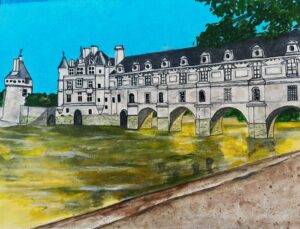
Diane de Poitiers once owned this picturesque little castle on the River Cher. Its walls are of pale local limestone, its roof and turrets are gray stone tiles. The curious thing is that most of the possessors of the Château de Chenonceau through the ages were women—wives or mistresses—and they are ones responsible for its exquisite design and startling beauty.
The chateau was built on the foundations of an old water mill, and so sits a little into the waters of the Cher, with a drawbridge to access the building. But, as much as it looks like a fortified castle, it was a place to retreat, to rest, to be alone and not to be bothered by the outside world.
Even its situation on the Cher, which is a tributary of the mightier Loire River, and with the forests behind on the far bank, is one of peace and isolation.
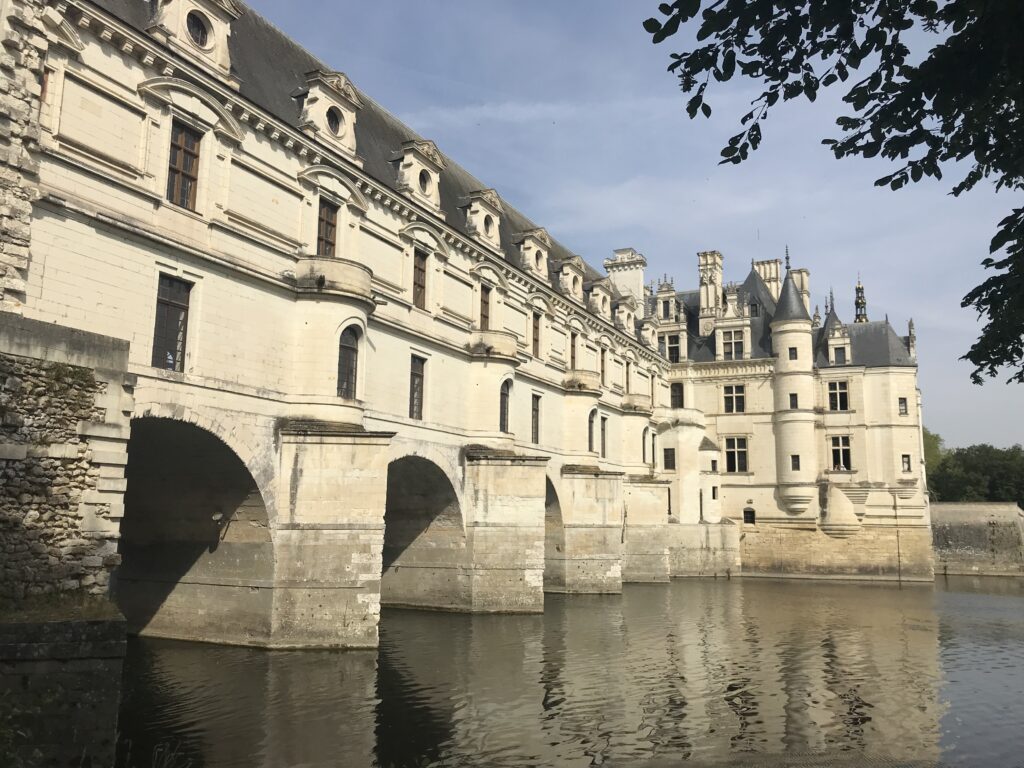
The exquisite Château de Chenonceau spanning the River Cher, casting its elegant reflection upon the waters. On the farther end is the chateau as it was first built, on the river, on the foundations of an old water mill. Diane de Poitiers built that graceful arched bridge to the other bank. Her rival, Catherine de Medici, took it one step further and constructed two storeys of apartments on the arched bridge. Image Source: Indu Sundaresan
In its history, the Château de Chenonceau was owned by two women, bitter rivals—one the mistress of King Henry II of France, and the second, his wife, Catherine de Medici, each of whom cherished the little palace, built and refined it to her own taste, and grudged its ownership to the other.
While Henry II lived, his mistress, Diane de Poitiers had possession of Chenonceau. When he died, the wife snatched it from her. Catherine had the power—she was the mother of the future kings of France, regent during their minority. . .in other words, she was now king.
And, she threw her wrath upon the woman who had for so long entranced and enchanted her husband, to the extent that it wasn’t just the disputed possession of the mansion on the Cher, but court politics and religious decisions that had bowed to Diane de Poitiers during her husband’s tenure as king.
The lure of the enchantress:
And, what exactly was Diane’s hold on Henry II? She was attractive, that much we can take for granted. Catherine de Medici had birth and family connections which she brought into the marriage with Henry. But, Diane had the beauty, naturally, since marriages were made for power, wealth and influence, and love came from elsewhere.
All very well.
But Diane was also some twenty years older than Henry. Consider that, in those times marriages happened very early, with the girl being as young as twelve sometimes, and the boy two or three years older.
Then, they had children early also—so, with Diane de Poitiers being twenty years older than Henry II, there was essentially a generation’s gap between them. And, she kept her hold on him until he died, no matter how much (faster) she aged.
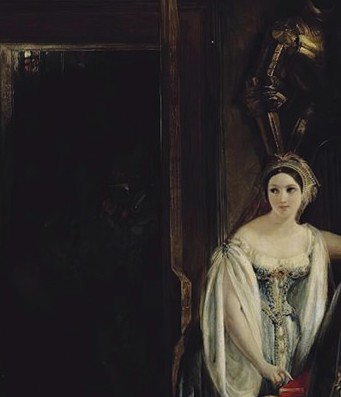
If this is a true representation of Diane de Poitiers, then, I guess we must admit her charms? Image Source
(The generation’s gap might surprise us a little—but the French loved well and loved freely in those times, no matter who they were married to. Take the case of Louise of Savoy, who was the mother of King Francois I—and Francois was Henry II’s father, so Louise was his grandmother.
During Francois’s reign, there was a huge dustup about a Constable Bourbon (short version, he rebelled) who was supposedly sought romantically by this queen mother, Louise. At least, there is a theory that Louise’s pursuit of him led to his eventual rebellion, because he wouldn’t bow to her advances. We’ll hear more of this anon in this post, because Louise of Savoy knew Diane de Poitiers well.)
So, who exactly was Henry II’s wondrous mistress, Diane de Poitiers?
We first visit that little castle on the Rhône River, deep in the country:
A substantial span of the Loire Valley with its riches of vineyards, cornfields, and forests of game and bird lay within the Duchy of Normandy in the 12th Century. And, it all belonged to that man, William, Duke of Normandy, who went over and conquered England—see my blog post on The Bayeux Tapestry which tells the story of William’s conquest.
With no William in Normandy now—he was king of all England—France began battling and taking over Norman lands and absorbing them.
Then, the French kings began building their lovely chateaus along the broad banks of the River Loire, as a place to escape from their exhaustive duties in Paris. More and more duchies and counties came under French rule, including the County of Burgundy in southeastern France, which includes the Provence.
What the kings did with their chateaus in the Loire Valley, the nobles followed in building their own mansions and mini-fortresses both in the Loire and in Burgundy.
One such chateau was in the tiny village of Saint Vallier on the banks of the River Rhône in that original county of Burgundy. Geographically, Saint Vallier is south of Lyons and just north of a city called Valence. (Remember Valence; we’ll hear of it again in relation to Diane).
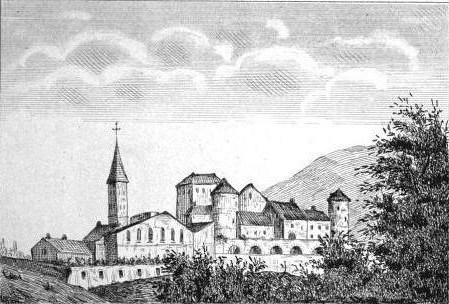
The Château de Saint Vallier, Diane de Poitiers’ birthplace. The River Galaure joins the Rhône here in the middle of town, and the chateau is on the Galaure, but close enough to the point where the Galaure empties into the larger river. Image Source
Diane de Poitiers was born in Saint Vallier in either 1499, or, in some tellings, in 1500 CE.
Her father, Jean de Poitiers had three children, and Diane was his youngest. Jean de Poitiers was ‘seigneur’ of Saint Vallier—the lord of the manor, the owner of all lands around, the local squire, if you will.
He had tenants and farmers on his land who paid him rent, and lived in a castle-like, fortified house called the Château de Saint Vallier—with high stone walls and four grand turreted towers on each corner. Today, the towers are flush with the top of the walls, no higher, but at one point they loomed over the countryside to point out the residence of the highest authority in that land.
Why did the Château de Saint Vallier lose its towers? It was because Diane’s father had to pay a penalty for disloyalty to his king, we’ll see that as we go along.
The Valence connection with Diane de Poitiers:
I bring up the city of Valence, just south of Saint Vallier on the Rhône River, because King Henry II gave Diane de Poitiers the title of Duchess of Valentinois—and, there was a reason why. It had been part of her extended family’s estate at one time.
Both Valence and the demonym Valentinois are used interchangeably to not just denote the city and the county, but also the people (the Valentinois) who inhabited the county.
It’s confusing, so I’ll use the former for the city and the latter for the people. As in, the Count de Valentinois in the 13th Century who first made the connection between the town of Saint Vallier and his domain of Valence.
In 1257 CE, one Aymar de Poitiers, the Count of Valentinois, married the daughter of the house of Saint Vallier and so the two estates were merged, or rather, the smaller Saint Vallier became part of the greater Valence property.
Jean de Poitiers, Diane’s father, was obviously then some sort of a Valentinois himself, probably the younger son of a younger son who had been given this smaller Saint Vallier as an inheritance.
Younger sons of younger sons do not rise very much in the nobility typically—Jean de Poitiers was merely a seigneur.
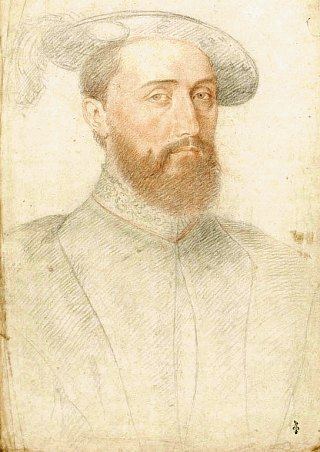
This is Diane’s father, Jean de Poitiers. The portrait is said to have been painted about 1538, which was a year before his death. That seems unlikely because he would have been about sixty years old. And he had suffered one major shock before this. Jean de Poitiers had been incarcerated and had barely saved his neck (hint, Diane helped in his release) but the experience does not seem to have marked his face in this portrait. Image Source
The Valentinois title of counts, however, went extinct and was absorbed as one of the titles of the French monarch—something like that.
Just before Diane de Poitiers was born, and while her father was still plain old ‘seigneur,’ the king of France bestowed the Valentinois title upon an Italian man. That king, Louis XII, was none other than Henry II’s. . .um, in the position of his grandfather, so to speak—Louis XII occupied the French throne before Henry’s father. See Part 1 for that.
And who was this Italian? Cesare Borgia—yup, from that poisonous and poisoning family who occupied the pontiff’s throne in the Vatican. And, Cesare now bore the title of Duke of Valentinois—a big step up from the Counts of Valentinois. And when Cesare died, the title died with him.
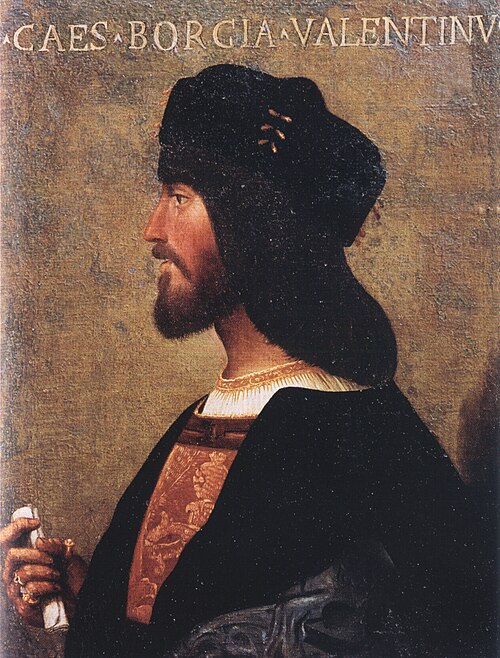
We might as well take a gander at Cesare Borgia, who came all the way to the French court to acquire his title of Duke of Valentinois from the estates surrounding Valence in southeast France. He was one of the harmless Borgias, but brother to the lethal Lucrezia. Image Source
Why am I spending so much time on the head of the house of the Valentinois?
Because, fifty years later, when our Diane de Poitiers was. . .well, that old, and still very much holding King Henry II in thralldom as his mistress, he revived the Valentinois dukedom and made her Duchess of Valentinois.
The lands of Valence came to her, the income came to her, and, by this time she had also inherited her little birthplace of a castle at Saint Vallier because her brother was dead.
Whoever might have had the right to inherit upon her brother’s death didn’t have the advantage of being the king’s mistress. And the de facto ruler of all France.
The Poitiers and their somewhat connection to the French royal court:
Diane de Poitiers’s grandfather, also an Aymar de Poitiers, had a nice ‘if only’ moment in his life. He was first married, in 1467, to Marie, the illegitimate daughter of Charles VII, king of France. The marriage actually happened under the auspices of the next king, Louis XI, who took a great interest in the welfare of his illegitimate sisters.
Louis XI gave Marie an official coat of arms to display on her coach and carriages, her house, upon the drapery, and the finials of her gateposts. She was also called Marie of France—that ‘France’ surname, if you will, was typically the exclusive province of the princes and princesses of blood.
Marie of France was a fine catch for Aymar de Poitiers, who was also only a seigneur of Saint Vallier, but had risen to sénéchal at the royal court—it means an official in charge of domestic arrangements for the king, so quite proximate to royalty.
Since Marie was, at least biologically, a ‘princess of blood,’ there was always the chance that if she had a son and maybe. . .if all lines of inheritance were extinguished, that son, or his son, could sit on the French throne. But alas, Marie died, and so also did her infant daughter.
Marie’s mother, Agnes Sorel, was possibly the first mistress of a French king to be accorded a status of respect and position, not just in the king’s heart but as a counselor, advisor and overseer of matters of state. It was a position that Diane de Poitiers would occupy with King Henry II.
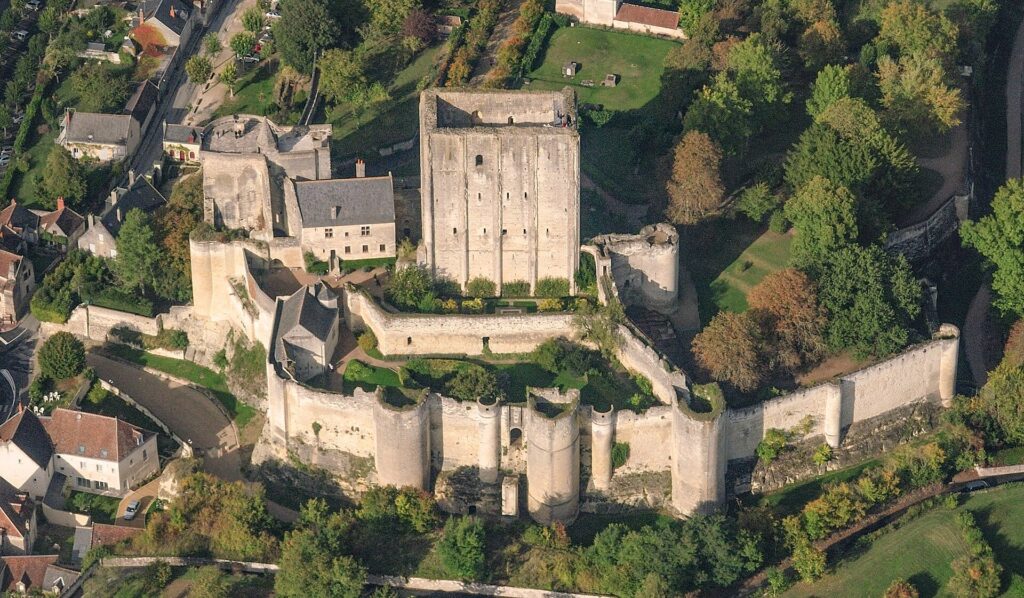
Her lover, Charles VII, gave Agnes this chateau in the Loire Valley, the Château de Loches. In a series of weird coincidences, Diane de Poitiers’s father would come to be imprisoned at this castle. Read on. Image Source
There seems to be no end to the amount of coincidences or connections between the people surrounding the French court, who moved, loved and married within a very small group. Here’s one to scramble your brain.
Marie of France’s sister married a Jacques de Brézé, their son was none other than Louis de Brézé. If you’ve read Part 1 of this blog post his name will be familiar, if not, I’ll tell you why: Diane de Poitiers married Louis de Brézé, a man naturally much older than her (because he was of her father’s generation) when she was fifteen years old.
So, and here’s the brain scramble: Diane married her grandfather’s first wife’s sister’s son.
Back to Diane’s grandfather now; Aymar marries again:
Aymar de Poitiers, Diane’s grandfather, took his second wife from the house of Auvergne, and through them, struck some royal gold again, maybe more substantial this time. One of his sisters-in-law married into the Scottish royal family, and his brother-in-law’s granddaughter was. . .Catherine de Medici.
So, Diane de Poitiers was actually related by blood to her rival, Catherine de Medici.
Hence Diane’s granduncle (her grandmother’s brother) was Catherine’s grandfather. The thing is, everyone seemed to have been related to everyone else and my research into this blog post (and trying to explain it with some coherence) has been fairly rigorous.
Diane’s father, Jean de Poitiers, grew up with his maternal cousins, who were the counts of Auvergne, and who were, in turn, in the service of the dukes of Bourbon. Here, will come another royal connection, and a fair bit of trouble for Diane’s father later in life.
The Bourbon Conspiracy comes into being:
I’ll speak of the latter first—that Bourbon trouble, I mean, and its connection to Henry II’s grandmother, Louise of Savoy. (I refer to this briefly in Part 1 of this blog post when Henry’s father, Francois I, is on the throne).
Through his maternal cousins, Jean de Poitiers spent his childhood in close contact with two Bourbon brothers, Charles and Francois. (The two brothers were heirs to the county of Montpensier, being the younger branch of the Bourbons, and under elder branch, the head of the house was the Duke of Bourbon).
These two men were his friends, and his early loyalties, forged through the rough and tumble of childhood, made him think of Charles as, almost, his brother.
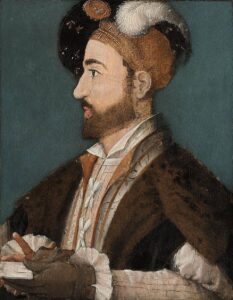
Charles, who (eventually) became the Duke of Bourbon and held the office of Constable at the French court, was the eponymous player in the Constable Conspiracy. You could say that one of the other players (who provoked the conspiracy, maybe) was Louise of Savoy, Francois I’s mother, and Henry II’s grandmother.
This Bourbon connection between Diane’s father and Charles, brought some problems into a young Diane de Poitiers’ life. Image Source
When it came time for the young men to get married, Charles married his cousin Suzanne, the daughter of the Duke of Bourbon. Suzanne’s mother, Anne Beaujeu, had been a royal princess, daughter of Louis XI (so, niece to the illegitimate Marie of France who had married Aymar de Poitiers (Diane’s grandfather) in his first marriage. You see how confusing it all is? Everyone’s related to everyone else; they seemed to marry in a tight circle!).
Anyhow, this Charles then became Duke of Bourbon, there being no other heir to that title other than his wife, Suzanne.
The trouble, however? Charles revolted against the French king, Francois I. And guess who joined him then in his rebellion? And, nearly lost his life? Jean de Poitiers.
But, we’re getting a little ahead of ourselves, so. . .
Back now to Diane’s idyllic (?) childhood upon the River Rhône:
Royal children, or, should I say direct children of royalty, had a fairly involved education.
The immediate children of the king were called the ‘Children of France,’ and signed themselves with their first name and the word ‘France.’
Boys—dauphin is the French word for the heir, the crown prince—were much more prized than girls, obviously, because the succession went through the male line.
Even so, royal princes and princesses had access to the best tutors. These were not merely teachers, in the sense of learning the art merely to impart it to others. But the court’s learned men, the clergy, philosophers, sculptors, Italian painters, and architects were all corralled to teach them.
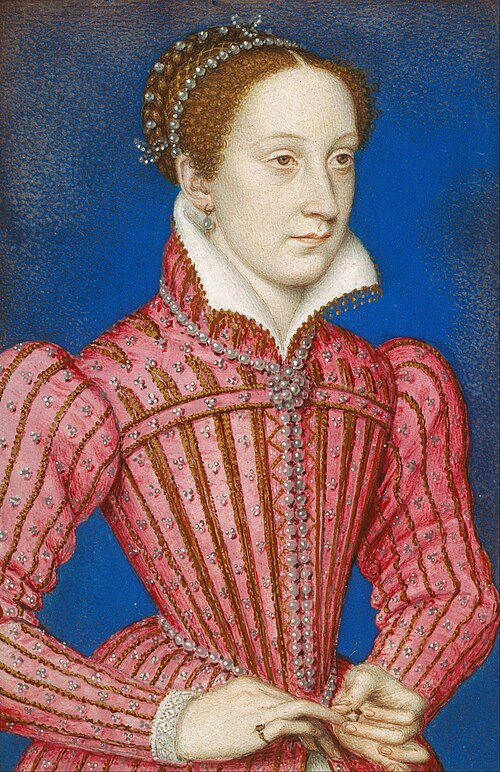
A brief jump-ahead into history: It wasn’t just the immediate royal children who were brought up at the court (any European court), their future spouses were there also. Marriage alliances were made extremely early in childhood, and typically the foreign royal princess who was to marry the crown prince would also be reared into adulthood in the court.
This is Mary, Queen of Scots (yup, she who had a claim to the Scottish and English thrones and whom Elizabeth I of England kept in perpetual imprisonment). Mary came to the French court as Francois II’s fiancée—he was Henry II’s son. Just to make sure the Scottish alliance went through, Henry II had her brought to his court when she was six years old—so, she grew up with her future husband, learned French, and became French.
The ‘mortal enemies’ battle with Elizabeth I of England would come later. For now, and briefly, Mary, Queen of Scots became the queen of France when Henry II died and the throne went to her husband and his son. Image Source
They learned Spanish, Italian, Greek, Latin and Hebrew, along with philosophy and divinity. The princesses played with dolls in their free time. The princes jousted, went hunting stag and deer, hawked in the forests, played a form of Italian tennis, shot with bows and arrows and built toy castles and fortifications and learned how to defend them.
That last, was obviously practical training for the kingly role the heir (or, his brothers if he died) would have to assume when he grew up.
As for Diane, the daughter of the seigneur of Saint Vallier?
Nothing much is known of her early life or her education. It’s most likely to have been somewhat scant.
In later life, Diane de Poitiers was lauded for her admirable figure, for her ability to exercise, hunt and ride—it was said that she maintained her weight and her complexion with an early ride every single morning, when the mists still rose from the grass and the dew dwelt upon the leaves.
That’s all very well—and some historians have extrapolated this adult behavior to her childhood, as in the riding and the hunting began there. You know, they filled in what they didn’t know of her youth from her later days.
(When I was researching another woman who rose to dizzying heights of fame in 16th Century Mughal India—Mehrunnisa, Empress Nur Jahan in the first two novels of my Taj Mahal Trilogy, The Twentieth Wife and The Feast of Roses—I stumbled across a similar narrative.
As in, no one had known who she was until she reached the grand age of thirty-four years and married Emperor Jahangir. . .and effectively took charge of the Mughal Empire. Then, everyone began scrambling to fill in her past. So, I had to do a lot of reading and parsing through the narratives to decide which was possibly the right one, at which time in her life.)
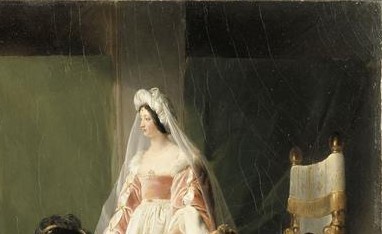
Diane de Poitiers, later in life. Image Source
Jean de Poitiers, while Diane was growing up, held various military posts—chevalier, a lieutenant of the province of Dauphine, and finally, Grand Sénéchal of Provence.
This last title was the one his father had held at the royal court of Louis XI, and being there, hobnobbing with the elite, so to speak, Jean de Poitiers had an idea.
He decided to ask the previous king’s sister, Anne Beaujeu, who was the Duchess of Bourbon, if she would sponsor his daughter, Diane de Poitiers.
A young Diane de Poitiers attends on Anne Beaujeu—the Duchess of Bourbon:
Diane de Poitiers married when she was fifteen years old. Before that, she was sent to the household of the Duchess of Bourbon to complete her education, or because there was no scope for refinement and manners in bucolic Saint Vallier, or just because her father thought it would be a good idea to bring her closer to royalty.
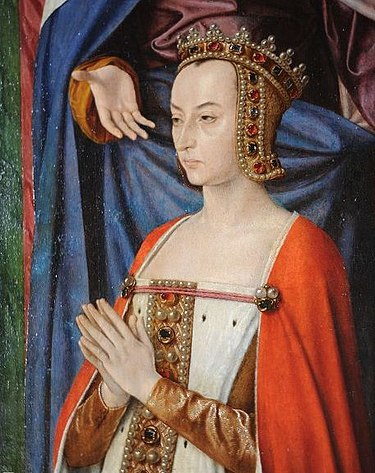
About the only remaining portrait of Anne Beaujeu is from the triptych in Moulins Cathedral in France. The Château de Moulins was the family seat of the dukes of Bourbon—Anne was the Duchess of Bourbon.
The château/castle is in ruins today, but directly opposite the ruins is the cathedral, and the triptych within it. It was commissioned by Anne’s husband. The central panel shows the Madonna and Child. On the right panel is this portrait of Anne, kneeling in prayer. On the left panel is Pierre II, the Duke of Bourbon, Anne’s husband. Image Source
Anne Beaujeu, who was the daughter of King Louis XI, had married a younger son in the house of Bourbon, and eventually, her husband acquired the title of Duke of Bourbon. Another of the Bourbon properties was the province of Beaujolais, which Anne governed with her husband initially (hence, she’s Anne of Beaujeu).
Anne was also regent for many years until her brother, Charles VIII, gained his majority, and she was ruler in all but name through those years. So, Jean de Poitiers could not have done better than to attach his daughter Diane to Anne’s train.
Another young lady who had learned under the same instructress as Diane, was none other than Louise of Savoy. Who would later become mother of Francois I, and grandmother to. . .Henry II.
Louise was almost twenty-five years older than Diane de Poitiers, so their paths would not have crossed under Anne Beaujeu’s roof—unless Louise had come to visit—but later in life, Louise would certainly have known who Diane was.
Way back, a few generations before Diane de Poitiers, there was yet another Beaujolais connection, but, I’m not going to get into that—suffice it to say, the de Poitiers had several links to the royal court of France.
As for the education itself. . .
Again, in later life, Diane de Poitiers demonstrated an ability to diplomacy, to statesmanship, to a knowledge of architecture (we’ll visit the Château de Chenonceau in this blog post and drop in on Diane’s home, the Château d’Anet), of painting, of art and music. . .well, there seems to have been almost nothing—culture, refinement, society—at which she was not an adept.
Where did all this come from? Most historians will point to Anne Beaujeu’s influence, and to this time when Diane was maybe ten or eleven years old.
Now, she learned Greek, Latin and other languages, how a lady should sit, stand, speak, and wipe her mouth with her handkerchief and not the sleeves of her gown (!)
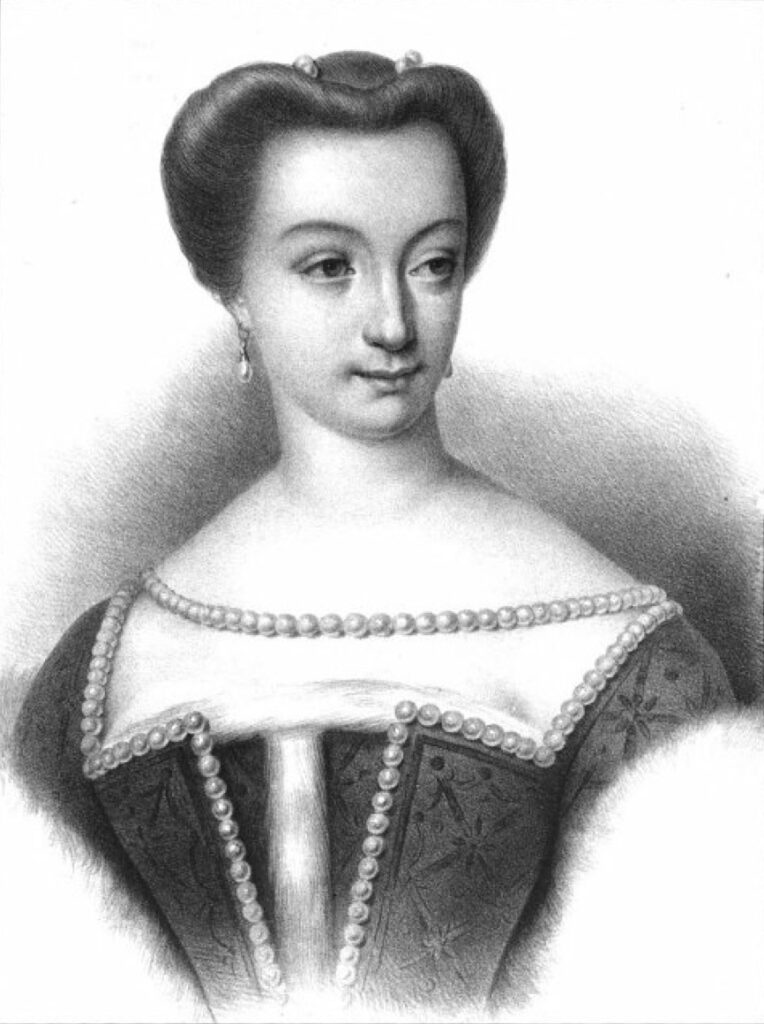
There are so many ‘portraits’ of Diane de Poitiers—there’s a resemblance, for sure, between all of them. But, it’s hard to decide whether they are authentic—with her sitting for them. If this is Diane, then it’s most likely when she was very young, while she was under Anne Beaujeu’s patronage. Just before she was married. Image Source
It’s possible. But, it’s more likely that Diane had an innate intelligence and ambition, and did not stop learning that which would most serve her.
In any case, she had little opportunity to exercise her wiles when she was as yet this young, because Louis de Brézé came a-knocking.
My bridegroom has my grandfather’s years:
Louis de Brézé was the Grand Sénéchal of Normandy, and far more prominent at court than Jean de Poitiers. He was well-respected, had been around for a very long while, was Master of the Hunt, and had had the ear of several French sovereigns.
Louis was also descended, on the wrong side of the blanket, from a French king—his mother had been the natural daughter of Charles VII, and so he was, well, sort of a ‘prince’ of the blood. (I just mentioned that Marie of France connection with Diane de Poitiers).
That relationship to the French throne had kept him by the side of the kings; favors were thrust upon him, riches heaped, and in turn, he served his royal cousins faithfully and wielded some enormous power.
Perhaps it was this that turned Jean de Poitiers’ head. For what man would consider giving his fifteen-year-old daughter to a man who was fifteen years older than him? How does that conversation even happen?
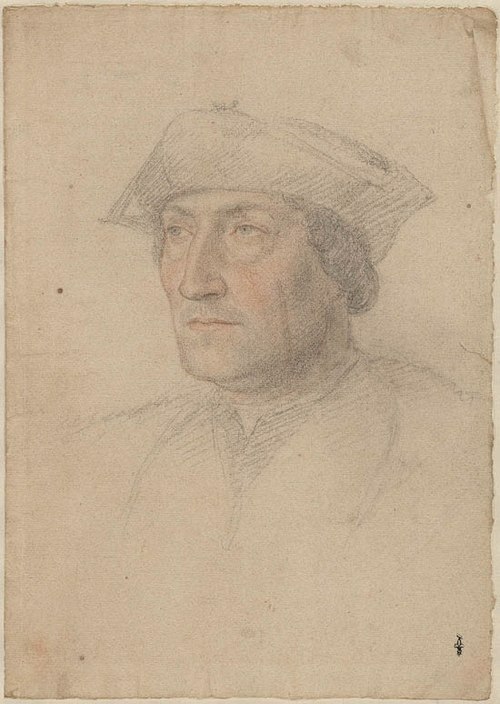
This sketch may or may not be that of Louis de Brézé —perhaps as he looked when he married Diane de Poitiers. De Brézé was in his fifties, a solemn man with much gravitas. Image Source
There’s one theory, that it was Louis de Brézé who himself asked for the match, having seen the young Diane at some event, maybe the coronation of Francois I (our Henry’s father) while she was yet under Anne Beaujeu’s care. And, he had picked out her pale, serene face among all the other young girls who thronged around and decided that he wanted her as his wife.
He did take her. In March of 1515, when Diane was fifteen years old, and Louis fifty-five, they were married in grand style at the Hôtel de Bourbon on the banks of the River Seine in Paris.
The mansion (it wasn’t a hotel as the name suggests) belonged to Jean de Poitiers’s childhood friend, Charles Bourbon—that Duke of Bourbon who would be involved in the Constable Conspiracy against his king, Francois I (Henry’s father) and who would yank Jean de Poitiers into it.
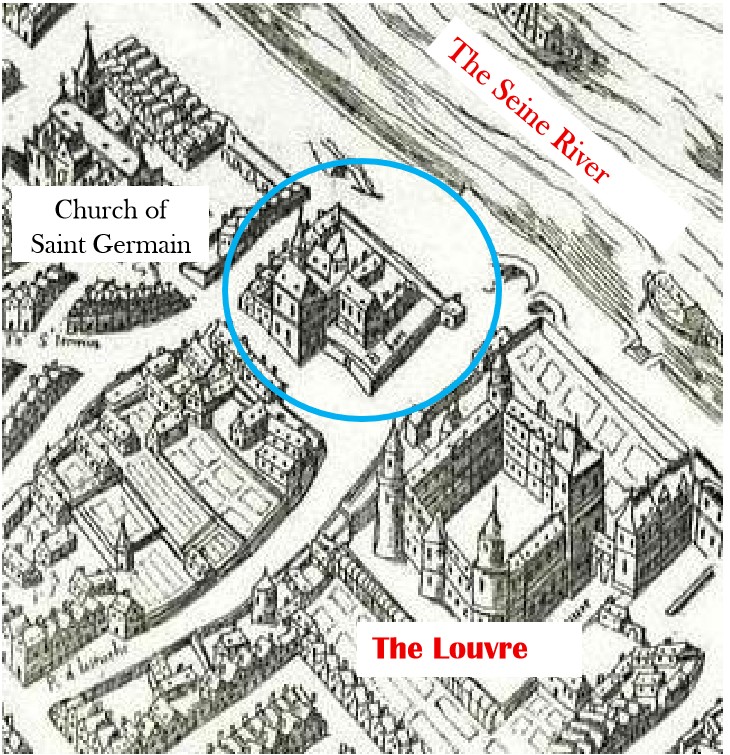
The Hôtel de Bourbon where Diane de Poitiers married Louis de Brézé in 1515 CE is marked with the blue circle on the banks of the Seine. (Map is from 1609). To the east is the Church of Saint Germain l’Auxerrois (still exists) and the Louvre palace is on its west.
The Hôtel de Bourbon was demolished, in parts, in Diane de Poitiers’s lifetime—you see, that little conspiracy its owner, Charles Bourbon, indulged in against his king made him lose the mansion. When Charles Bourbon fled France, King Francois I destroyed a part of his palace, and then it was eventually completely wrecked to give way to the courtyard of the Louvre—see the image below. Image Source
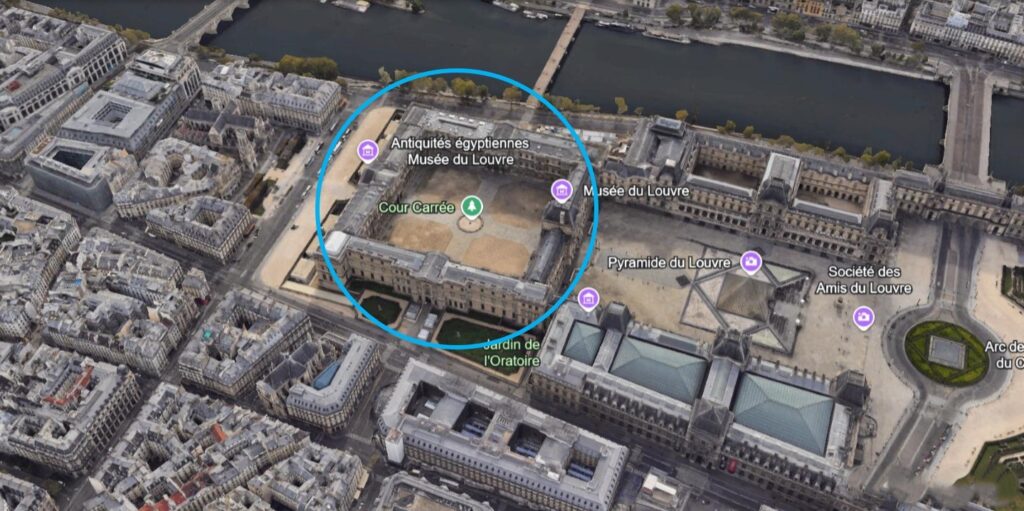
I tilted Google Earth so that you could see the Louvre and the church from the same angle as the map above, which is from 1609. Again, the blue circle more or less encompasses the site of the Hôtel de Bourbon—it became the colonnaded courtyard of the Louvre palace/now the Louvre Museum. Image Source: Google Earth
With this marriage I’m nursing a serpent in my bosom?
The curious thing is that Jean de Poitiers, in giving his child to Louis de Brézé, hadn’t foreseen that it would be Louis who would uncover the Bourbon plot/the Constable Conspiracy and inform the king.
Louis, of course, at that time, did not know that his father-in-law was also involved. Would he have stayed his telling if he had realized that? Who knows?
But anyhow, at the time of the wedding, everyone was presumably happy—there’s no record of what Diane de Poitiers thought of her ancient husband, forty years older than her.
Her father was certainly content with the match—his son-in-law was a powerful courtier; the newly crowned King Francois I and his queen, Claude, were in that great hall. His friend, Charles Bourbon had a splendid establishment, here, right in the heart of Paris in the 1st Arrondissement.
The entire court, nobles, princes of the blood, and aristocrats had turned up in their best finery. The stables were vast enough to accommodate the crowd, and the Hôtel de Bourbon was a well-run establishment, with its own doctors, librarians, chaplains and chapel, pages, valets, maids and cooks all of whom lived on the premises.
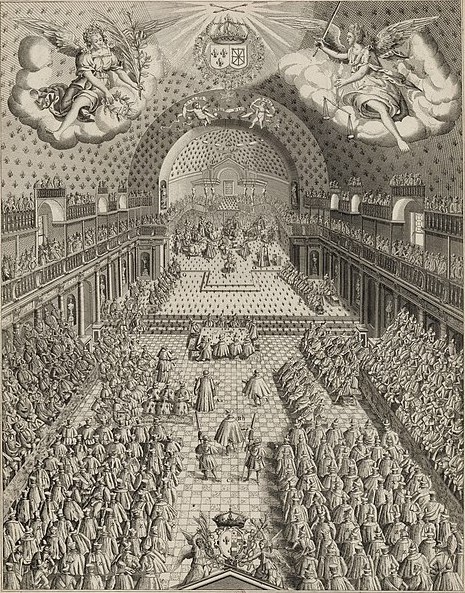
This is the Grand Salle or the Great Hall at the Hôtel de Bourbon. To give you an idea of its vastness and splendor, pictured here is a legislative assembly of some kind in 1614 (the king was still very much in power; this was a nominal nod toward. . .maybe giving the people some semblance of civil rights.)
It was a giant space, obviously seating so many people comfortably, with enough room for them to breathe and move about. Image Source
The great, central hall was filled with a riot of people and a riot of color, the candles shedding golden light on silks, satins, and jeweled necks and bosoms.
With this marriage, Diane de Poitiers became very rich, because her husband owned several estates, including the Chateau d’Anet which Henry II (later) rebuilt for her completely.
If you’re wondering where Henry II was when his future mistress, Diane de Poitiers, got married? He was yet that proverbial twinkle in his mother’s eye—he wasn’t born until four years later.
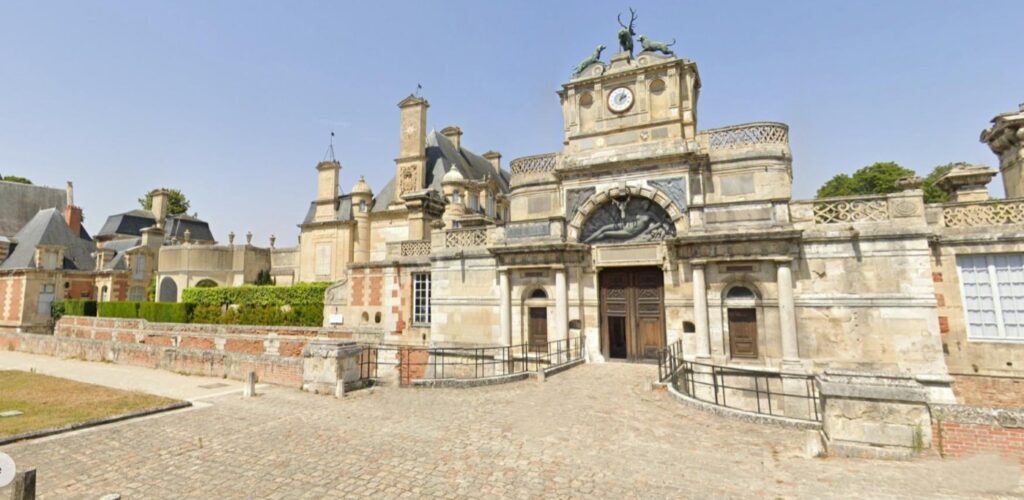
When Catherine de Medici kicked Diane out of the Château de Chenonceau, she came back here, to the estate she inherited from her husband, Louis de Brézé. Henry II had already provided her with the funds, and architects and landscapers, to turn this Château d’Anet into picturesque perfection. The Château de Chenonceau is certainly more lovely, but Anet’s not bad either. Image Source: Google Earth
Louis de Brézé brought his very young bride to live at his Chateau d’Anet. He had two other splendid estates that went to her when he died—Breval was a village, merely acreage and lands, but Montchauvet actually had a castle or a mansion house in the village. Yet, the de Brézés chose to live at Anet.
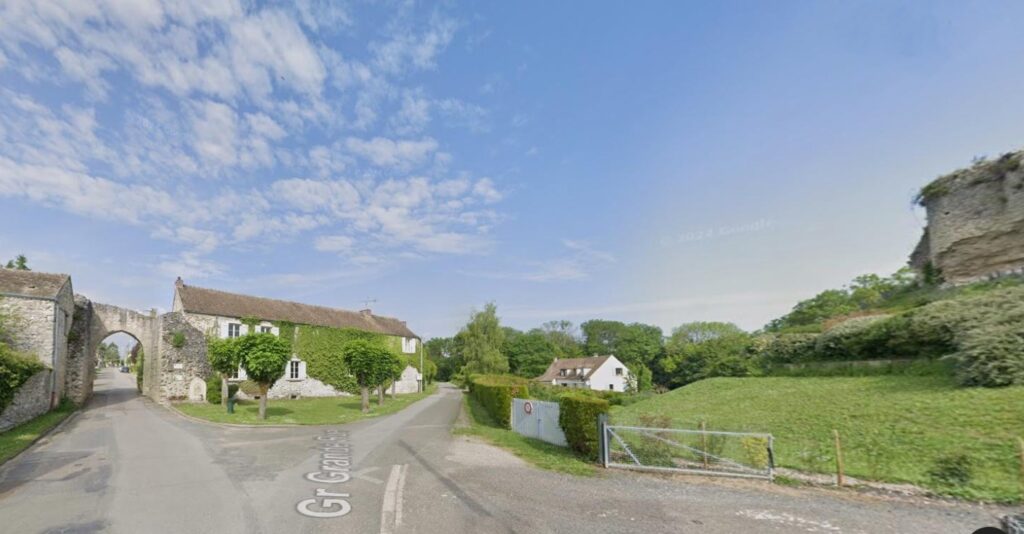
This (on the right) is all that remains of the keep of the Château de Montchauvet, so there’s no telling what it looked like when Diane de Poitiers inherited it, or if it was already a ruin by that time. If the latter is true, it’s no wonder that Diane de Poitiers went back to live at the Château d’Anet instead with its rich comforts, after Catherine de Medici took Château de Chenonceau away from her. Image Source: Google Maps
A very happy married life?
Louis de Brézé had been married before, of course—he could not have arrived at the grand age of fifty-five years without having been wed at least once. And, you’d have imagined that his children would all be much, much older than their new stepmother, and perhaps, they would have had children who were as old as their new step-grandmother.
But Louis de Brézé had no children at all with his first wife; perhaps that was why he had wanted to marry again, and to marry Diane de Poitiers.
After all, that much-wanted son and heir did not come to Louis de Brézé through his Diane—they had two daughters instead, three and six years after that magnificent wedding. And, they were married for seventeen years until his death.
With that ostentatious wedding, the grand husband, that proximity to the court, the fifteen-year-old Diane de Poitiers became one of Queen Claude’s ladies-in-waiting.
The De Brézés hosted King Francois I and his wife at their Chateau d’Anet—so the king and queen knew her well, this woman who was to eventually dominate not only over their son and heir, Henry, but the entire country.
In later years, Diane de Poitiers maintained a discreet silence on her married life—to all outward appearance, she had been a docile, obedient inmate of Louis de Brézé’s home, entertaining her husband’s sovereign and friends, taking her place in the Queen’s court, making very few enemies. In other words, she kept in the background.
Until, at one point, she didn’t. And, that bring us to. . .
The Constable Bourbon Conspiracy and Diane’s father’s part in it:
Remember Charles Bourbon’s magnificent Hôtel de Bourbon where Diane and Louis de Brézé were married? At that time, Charles, Duke of Bourbon (through his marriage with Suzanne, daughter of the duke) was an immensely rich man, and also, a prince of the blood.
In other words, Charles Bourbon was not only of royal heritage, in 1515, when Francois I had just been crowned king—and had no heirs yet to his throne—it was Charles Bourbon who stood next in line. At Francois I’s coronation, Charles Bourbon sat in state himself, with the assembly kowtowing to him as much as to their new king.
Because, who knew, if Francois died tomorrow in a jousting tournament, or was flung off his horse while hunting, and the queen was incubating no heir. . .then the crown would rest upon Charles Bourbon’s head. Better to be safe, the nobles must have thought, and hedge our bets.
Charles Bourbon’s estates were massive in central France—he was the wealthiest prince of the blood. And, the Bourbon seat was at Moulins.
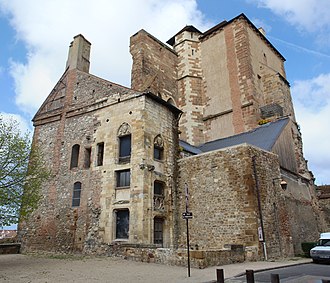
Little remains of the fortress at Moulins where, for centuries, the dukes of Bourbon had their seat and held a mini-court themselves as the most powerful men other than the sovereign. This is part of the palace. There’s a better view in the model below. Image Source
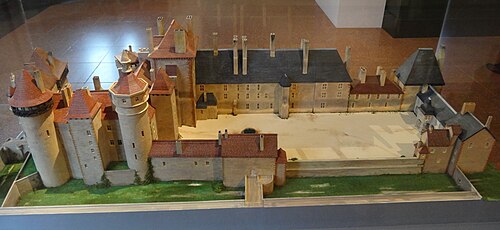
This is the model of what the Château de Moulins must have looked like. In his ‘city’ house—the Hôtel de Bourbon in Paris next to the Louvre—Charles Bourbon easily had a large complement of employees—clergymen, librarians, pages, valets, kitchen wenches and cooks.
Here, with the space to spread out, the dukes of Bourbon had built themselves a fortress, complete with a keep and high walls. Image Source
A reminder, while Suzanne’s father was still duke, her royal mother, Anne Beaujeu, had mentored a series of young girls.
One of those was Diane de Poitiers, so it was here, at Moulins castle, that Diane spent some of her teenage years. Many years before Diane, one of the other girls had been Louise of Savoy—who was right now the Queen Mother. It was her son, Francois I, who was the king who attended Diane’s wedding.
The Constable de Bourbon:
Five of the highest offices attending upon the French king (think of them as the cabinet in a non-democratic nation) were the Constable, the Chamberlain, the Sénéchal (Diane de Poitiers’s father and husband were both sénéchals), the Butler, and the Chancellor.
Of these, the Constable, who was the commander of the imperial forces, was the most important.
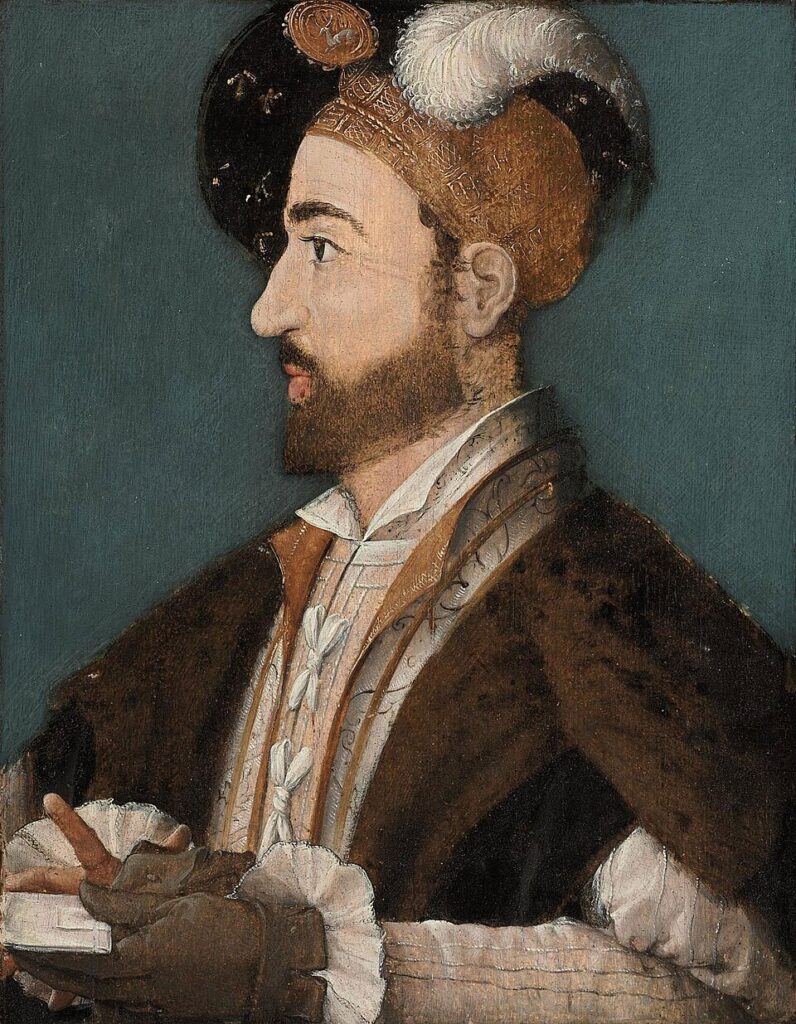
Charles, Duke of Bourbon, the Constable at the imperial court under Francois I. Image Source
At the time of the whole Bourbon conspiracy, Charles Bourbon was the Constable of France under Francois I—that close to the throne, that much relied upon, and so it was that much of a betrayal and a shock to the king.
(And Francois I was, again, Henry II’s father. Diane de Poitiers was married by this time (it was her husband who revealed the conspiracy). Henry II, just a child, was in Spain under imprisonment by the Holy Roman Emperor—see Part 1 for that history).
Because, Charles Bourbon had much—too much almost of everything, apart from his royal salary and his required royal loyalty.
Even his titles were numerous. He was duke of three places, earl of five, dauphin of one, and seigneur of six. Each of those properties and estates gave him thousands of livres in payment, and the king’s mother, Louise of Savoy, offered him other estates and their incomes.
And so, we come to, perhaps, the biggest reason for that conspiracy in the first place.
Another aging Royal Mistress?
History is a bit jumbled—and historians have varied opinions—on why exactly Charles Bourbon, so lauded, so exalted at the French court would. . .er, savagely bite the hand that had fed him so generously.
There’s a theory that the king’s mother, Louise of Savoy, was the moving force behind all this favor shown to Charles Bourbon. Why? Perhaps since Charles was the next heir to the crown, and Louise was simply acting on the maxim of keeping friends close and enemies closer.
Or, perhaps because she was in love with him.
I guess serious historians scoff at the idea of love between a woman fifteen years older than a man (A-hem, Diane de Poitiers and Henry II? And Henry was this queen’s grandson). Others speak of it as not love, but jealousy, spite, malice, all directed toward Charles Bourbon’s massive income and his estates which rivalled those of the king.
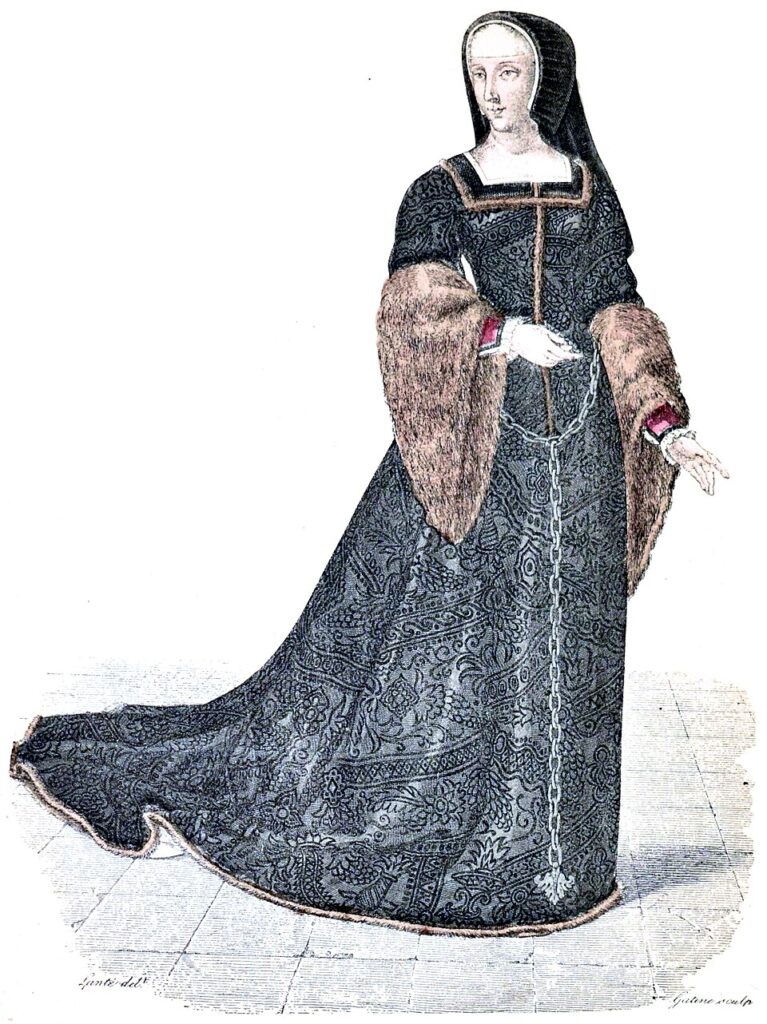
At the time of the Constable Conspiracy, Louise of Savoy was close to fifty years old. Charles, the Constable Bourbon would have been about thirty-five. And, he was married. But things went astray when his wife, Suzanne, died.
Louise of Savoy was a widow—had been for many years, and what she’s wearing here, the black gown with the fitted bodice, the wide sleeves and the French hood covering her hair, was very typical early 16th Century fashion.
I point out the fashion because Anne Boleyn, who had stayed on in France as lady-in-waiting to Queen Claude, Francois I’s wife and Henry II’s mother, was about to leave for England.
She’s also always pictured in these French fashions—it must have been part of her charm for her king of England husband, Henry VIII. Image Source
In 1521—six years after Diane de Poitiers married her old husband—Charles Bourbon’s wife, Suzanne, died.
Did Louise of Savoy’s heart thump a little bit faster now that Charles was a free man? He would have to marry again—he had no heirs. (In fact, he ended up having no heirs). So either he had to cast around for a wife from the lower branches of royal families in Europe, or someone else would do that for him, or Louise of Savor was determined to have a say in it.
She could herself, of course, not marry him, not being of child-bearing age any longer.
Sources do say that she was in love with him, and for that reason put objections in the way of every proposed alliance.
Then again, there’s a theory her involvement was completely disinterested from a romantic point of view. She was just making sure that Charles Bourbon did not ally himself with a powerful Italian or Spanish royal house. . .and so threaten her son, Francois I’s, throne.
Sure. But, there’s also the fact that she herself gave him several estates to add to his gigantic income, which was completely unnecessary—all this well before his wife died.
Either way, Charles Bourbon could not be at odds with Louise of Savoy and still maintain a good relationship with his king, Francois I—because she was, in some senses, the power behind the throne, and had been hugely influential in her son’s life when he was a child.
If it’s not love, then it’s money? The wedding contract:
As I’d mentioned, Charles Bourbon was a prince of the blood, so, royal, directly descended from King Louis XI. Suzanne’s mother, Anne Beaujeu, had been that king’s daughter.
Over the years that the French kings had ruled, and disposed of their royal domains in some way or the other to their younger sons and daughters, a clause had come to be added to each, successive, wedding contract.
And, it was very clear. If this marriage resulted in no heirs—male or female—the property would revert to the crown, even if the property had been so disposed a few generations ago. It would go back to be absorbed into the royal domains again.
When Anne Beaujeu, daughter of Louis XI, married the (eventual) Duke of Bourbon, her wedding contract was also specific on this point as regarded the dowry she brought into the marriage.
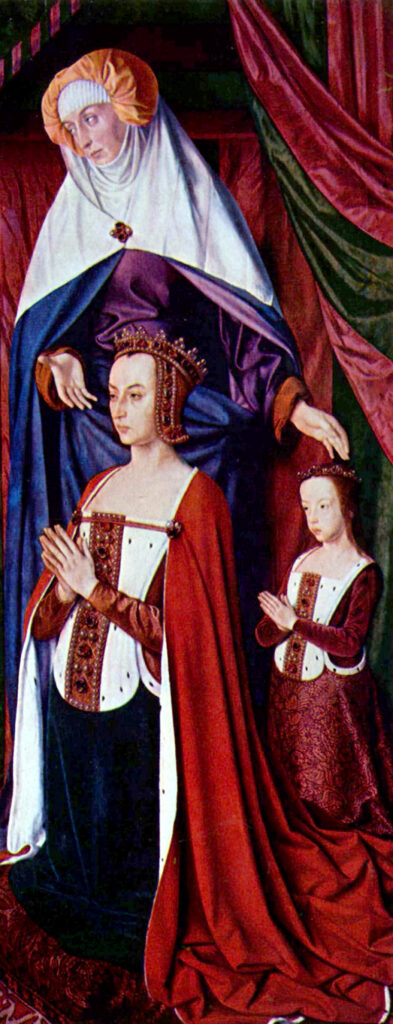
Anne Beaujeu knew well what she was doing with that wedding contract of her daughter’s. She had been the daughter of one king, and the sister of another (Charles VIII), and during her brother’s long minority, she and her husband had been regents of France. She had practically ruled over the country—there was very little she did not know about politics, the court, society, and how to manipulate any of them.
This is the right panel of the triptych painted by Jean Hey, commissioned by Anne and her husband, which is in Moulins Cathedral today. Anne kneels, and behind her is Suzanne—her only child and heir. Image Source
When Charles Bourbon married Suzanne, Anne’s daughter, they were both very young, in their early teens, and obviously had nothing to do with the contract.
In this Charles Bourbon/Suzanne wedding contract, Anne went against the previous law.
She made sure that the property that came with her, and the property that belonged to her husband, the Duke of Bourbon, would be in the Bourbon family forever, even if there were no direct heirs.
Hell hath no fury like a woman scorned? Louise of Savoy, the queen mother, retaliates:
When Suzanne died in 1521, court gossip would have it that Louise of Savoy, the Queen Mother, wanted to marry Charles Bourbon. And, he refused. Over and over again.
So, she turned her attention to his estates. The Attorney-General of France declared that marriage contract to be null and void, and the clause that left Suzanne’s property to her husband to be invalid.
By 1523, parliament had declared it to be so also, and the matter was then to be sent up to the King’s Council.
The Bourbon Conspiracy then:
With all this tension at court—with his king and with the Queen Mother—Charles Bourbon made a pact with Charles V, the Holy Roman Emperor.
I won’t go into much detail here, but the essence of it was that Rome would invade and conquer France with Charles Bourbon’s inside information and help, and then Charles would be suitably rewarded in the division of the spoils.
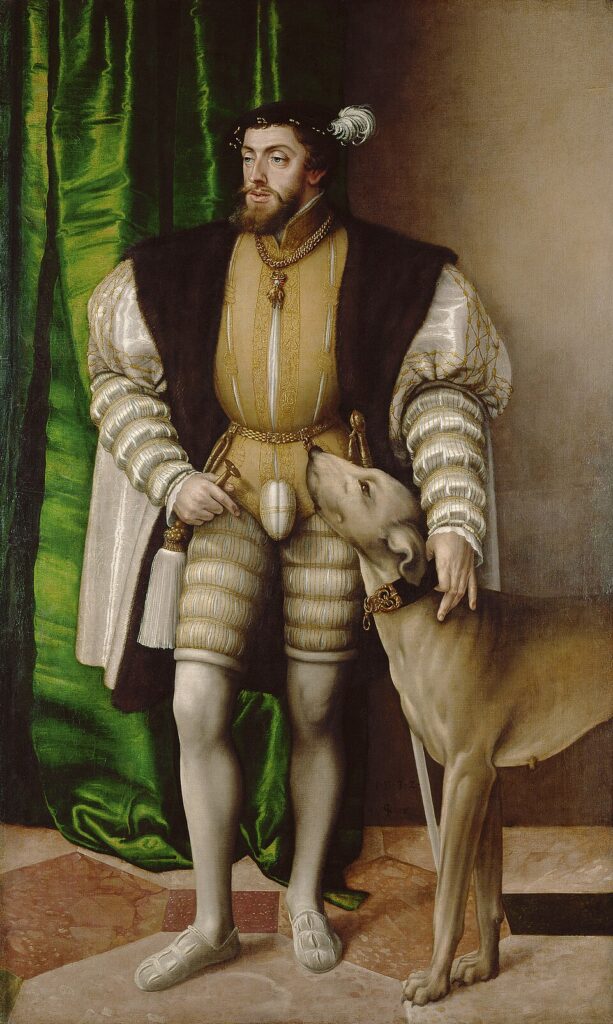
Charles V, the Holy Roman Emperor was the scourge of the kings of France. He was at this moment involved in a war with Francois I, the current king and Henry II’s father. So, conspiring against France with Constable Bourbon was just another. . .arrow to his bow.
He would capture Francois I, and keep Henry II in captivity for years, see Part 1 of this blog post. Image Source
The king, Francois I, was on his way to take over Milan when the conspiracy leaked in a Norman church, with two of the conspirators confessing to their priest. The priest took the information to his Sénéchal of Normandy.
And, who was that sénéchal?
None other than Louis de Brézé, Diane de Poitiers’ husband.
The Bourbon lands were seized, including the magnificent Château de Moulins, other conspirators were arrested and thrown into jail. Charles Bourbon fled in the night to that other Charles, the Holy Roman Emperor, for refuge.
The sins of my father:
Louis de Brézé had been swift in taking the news of the conspiracy to Louise of Savoy, Queen Mother and regent during her son’s absence on the campaign on Milan. And it was she who sent word to Francois I, and took action in confiscating all the Bourbon lands she had so coveted by dismissing that wedding contract.
Foremost among Charles Bourbon’s supporters was Diane’s father, Jean de Poitiers. So Louis de Brézé had actually betrayed his own father-in-law. He had supposedly been unaware that Jean de Poitiers was party to the plot to overthrow France.
But. . .think about it for a moment.
Louis de Brézé must have known of the close and long friendship between his father-in-law and Charles Bourbon.
It was in Bourbon’s Hôtel de Bourbon that he had himself married Diane—with all the expense of that grand entertainment paid by Charles Bourbon. He had been married now to Diane for eight years—and he understood nothing of his father-in-law’s loyalty to the Bourbon house?
The formidable Château de Loches in the Loire Valley, where Diane’s father, Jean de Poitiers was imprisoned for the Constable Conspiracy. Image Source
Whatever might have been the true state of affairs, Jean de Poitiers was sent to prison at the Château de Loches along with others—there, to await a trial for treason.
For which, the only possible verdict was death.
Once a royal residence, the Château de Loches was now a formidable state prison, with steep walls, an intimidating keep and turrets, impregnable and easily defended.
(Again, I’d mentioned earlier in this blog post that the Château de Loches had belonged to Diane’s husband’s grandmother–also a royal mistress. And this royal mistress, Agnes Sorel, had also been the mother of Diane’s grandfather’s first wife–how’s that for several coincidences?)
Diane’s father pleads for his life:
From prison, Jean de Poitiers managed to smuggle out three letters—one to the Bishop of Lisieux (one of the men who had revealed the conspiracy to Francois I and Louise de Savoy), to his son-in-law, Louis de Brézé, and of course, to his daughter.
Incarcerated in the cold, dark keep of the Château de Loches where daylight entered only through a few narrow lancet windows in the walls, Jean de Poitiers finally realized the extent of his folly.
But, he steadfastly desisted in confessing it—thinking it better policy to claim to have not been involved in the plot to overthrow France at all.
In his letter to his daughter, Jean de Poitiers begged for a visit.
You could not give me greater pleasure than by coming to see me. . .I implore you, have so much pity for your poor father as to come to see him. . .My heart is breaking, I cannot write anymore.
Jean de Poitiers to Diane de Poitiers, 1523
Diane did not come.
There’s no record of what she actually thought at that time, how grieved she was, or what she had attempted to do. Her father was accused of grand treason—so, no matter how much she might have petitioned Francois I, or Louise of Savoy, very little mercy could have been shown to Jean de Poitiers. And given that the Château de Loches was the most intimidating and secure of the state prisons, she would not have gained permission to see her father.
The trial and the verdict:
At the Château de Loches, trained inquisitors hounded the prisoners for details of the conspiracy—bringing them from their prison cells to interrogation rooms over and over again, making them repeat every piece of evidence, checking to see if they diverted in the slightest from their narratives.
Jean de Poitiers held fast to his innocence. He knew nothing, if he had visited Charles Bourbon it was through friendship or because he had a favor to ask of him, he’d seen nothing, he’d done nothing, he held his king and the crown in the highest reverence.
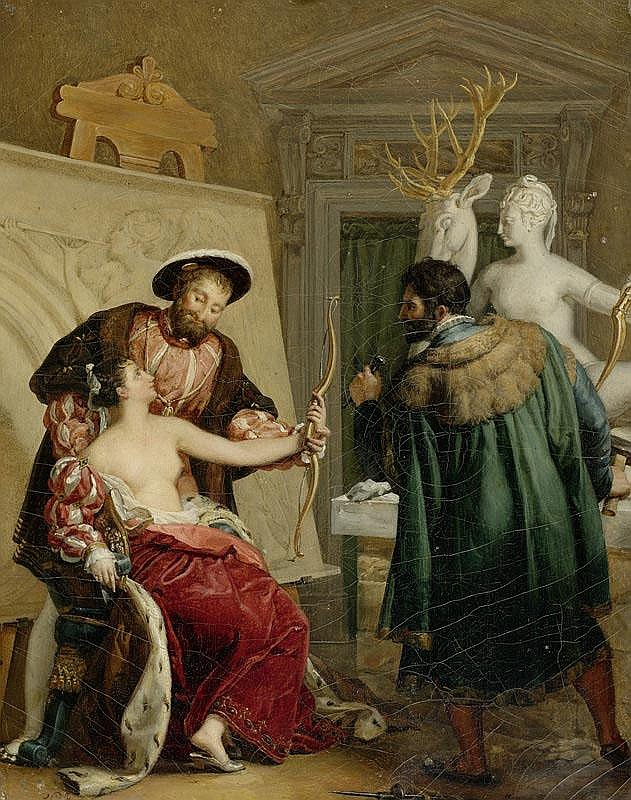
Although Diane de Poitiers could not visit her father during his incarceration, legend has it that she was not idle in his cause. She was importuning the king, Francois I—I suppose in the only way in which a beautiful woman can.
This painting is supposed to reveal that relationship between Diane and Francois I—well before she became his son’s mistress (Henry II was only about four years old right now). There are several such paintings about their er. . .affinity to each other.
This one is rather unchronological. It shows Diane posing for the Fountain of Diana marble statue (the statue is on the right). This statue was made for her Chateau d’Anet some twenty-five years after the Constable Conspiracy.
So, Francois I could not have overseen the posing and the sculpture. Still, the painting’s meant to represent their closeness. Image Source
This went on for four interrogations. Before the fifth, Diane’s father called his questioners into his cell, told them to throw all their previous notes into the fire—what he was going to reveal now was the truth as it had happened.
Jean de Poitiers had known of the plot with the Holy Roman Emperor, Charles V—and, Henry VIII of England (that Henry of many wives; see my blog posts on Salisbury Cathedral; Winchester Cathedral and Bath Abbey where I mention him.
Given the ever-fluctuating affinities in Europe, just three years ago Henry VIII and Francois I had met in great, everlasting friendship. Or something. Then, Henry VIII had supposedly been inimical toward Charles V. Now? Well, now he was back in camaraderie with the Holy Roman Emperor.
Anne Boleyn—Henry VIII’s future wife and the cause of the Reformation—had just gone back to England from the French court (see Part 1 of this blog post). Maybe he’d met her already? In any case, he was now friendly with Charles V.
You see, Charles V was Henry VIII’s first wife’s (Catherine of Aragon’s) nephew, and as the Holy Roman Emperor had the. . .shall we say guardianship of the Catholic religion?
(Although, just a few years later, Charles V would sack Rome and imprison the pope—that caused a fair amount of awkwardness for him. The pope who was imprisoned was Clement VII and he was the one who denied Henry VIII the annulment of his marriage to Catherine of Aragon. All this, later though. Right now, they were all bosom friends).
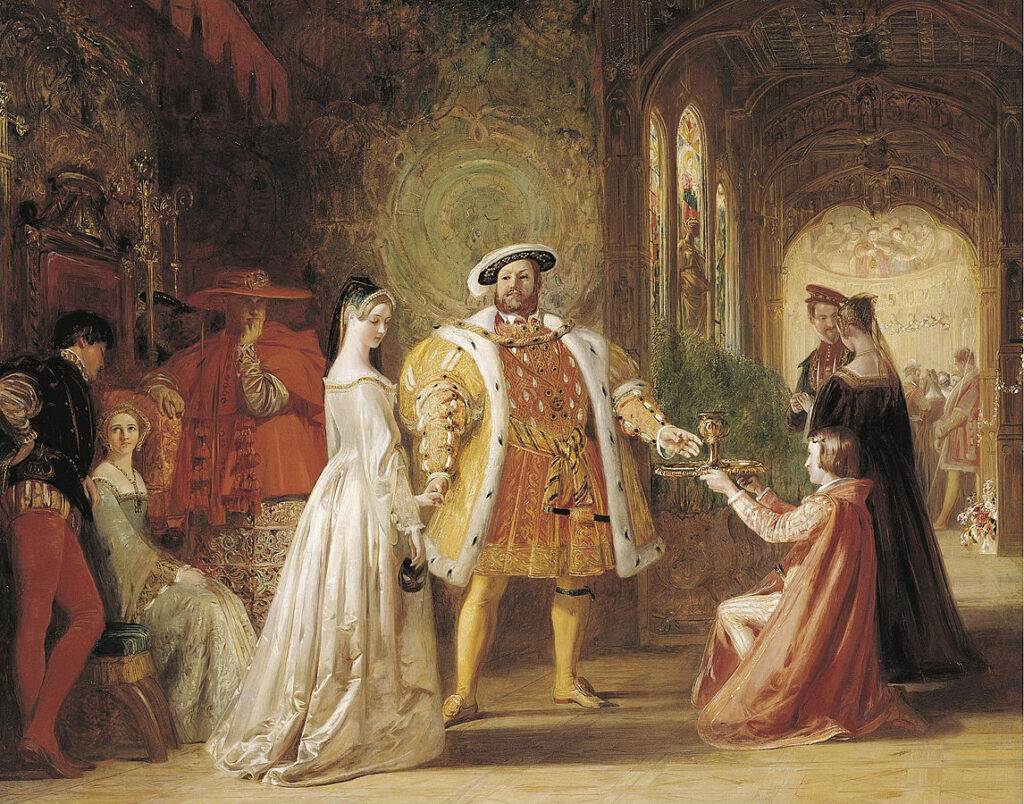
This painting is titled ‘Henry VIII’s first interview with Anne Boleyn.’ The first time he met her, and she was bashful, alluring, perhaps so very foreign and charmingly French from all the time she had been in France.
The painting was made later, of course, but the time of the painting is just about right now in the narrative of this blog post—during the whole mess of the Constable Conspiracy. Image Source
Like I said, they were all linked to each other in Europe at that time, and their coalitions shifted so quickly that your head spins—who’s friends with whom at any given year? And a bitter enemy the next?
So, anyhow, at this point Henry VIII of England thought it would be jolly good if he could get back parts of France which had been under Norman rule—because it was a Norman duke who had conquered England in the 12th Century, see my post on The Bayeux Tapestry.
And the English continued—from then—to consider parts of Normandy theirs, even if it lay across the Channel.
Coming back to Jean de Poitiers now:
On the night that Jean was told of the plot, the Holy Roman Emperor’s representative came by with the treaty all drawn up—basically, if France was conquered and Francois I overthrown, so much would go to Charles V, parts of Normandy to Henry VIII, and so much land to Charles Bourbon, along with the promise of a royal bride.
Three copies of the treaty were written out and Charles Bourbon signed his name to it.
What did Jean de Poitiers do? He also signed, although there was no direct benefit to him. He signed as a witness.
If that piece of paper came to light, there could be no doubt that Jean de Poitiers had known of the plot against the king of France and was in some, very strong way, involved in it.
This much, Jean de Poitiers (with assurances of his horror at having signed the document) said to the prison officials.
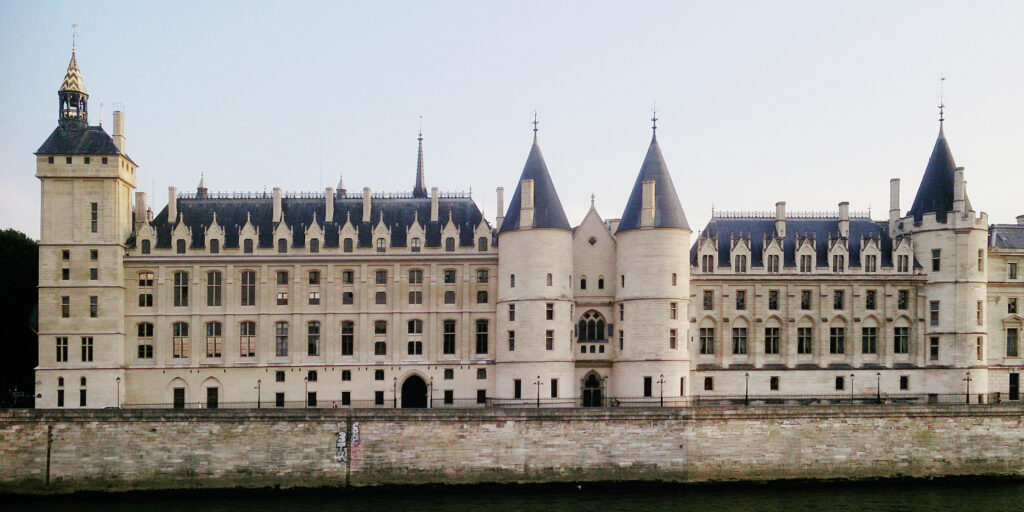
The Conciergerie in Paris—a prison and a courthouse—where Jean de Poitiers was kept during his trial. The other prisoners were brought from the Château de Loches along with Jean de Poitiers, but were housed in the more intimidating confines of the Bastille.
Why the special treatment? Maybe, Diane de Poitiers had had some influence with the king. Image Source
The trial came to pass, the verdict went against him, and Jean de Poitiers was stripped of his titles, his lands, his rank and. . .he was to be beheaded that same day.
They offered him a last meal. But he could not eat it. Then, they took him to the place of execution where an executioner waited with his axe upon a platform. Jean de Poitiers was prepared for it, his head bared, his hands tied behind his back, and made to kneel and put his neck upon the block.
The crowd waited as the executioner asked for Jean de Poitiers to exonerate him for what he was about to do, and that pardon was given but. . .
. . .the axe did not fall.
Something was wrong, and no one knew what.
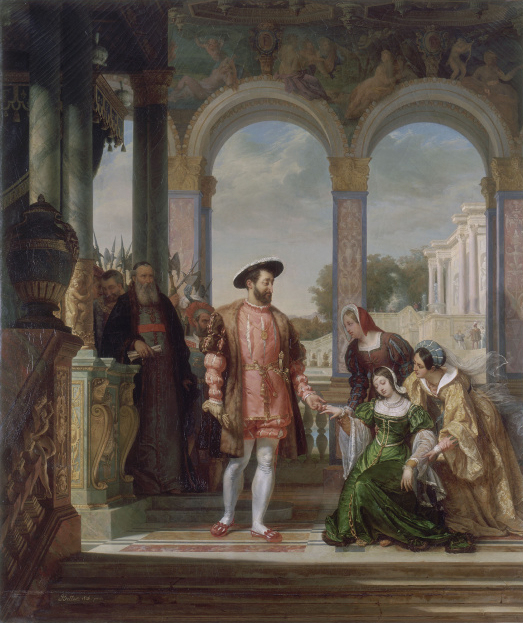
No one quite knows what part Diane played in her father’s pardon, but there are many speculations. And that is what yet another painting shows.
A graceful Diane de Poitiers, kneeling, almost fainting with grief at her father’s hard fate. And Francois I, impeccably royal, extending his hand to lift her up. . .into his arms? Image Source
An hour later, as they all still stood on the platform, a messenger rode up waving the king’s pardon above his head. Francois I, king of France, had, upon the entreaty of the Grand Sénéchal of Normandy, decided to spare Jean de Poitiers’ life.
But, he was to never set foot into daylight again. He would be in prison until the day he died.
Diane de Poitiers’ first foray into becoming a royal mistress? More evidence?
Why was Jean de Poitiers spared at literally the last moment?
Or, actually, past the last moment, because the executioner never lifted his axe, even after having asked his required pardon of the victim.
Diane de Poitiers was twenty-four years old at this time, and if her portraits from later years (when she was Francois I’s son’s mistress) are to be credited, she must have been exquisitely beautiful.
The king, Francois I, it was said, did not pardon her father because of her husband’s intercession, but because of hers. And what else could a young woman—who had very little power—grant to the king, other than herself?
If this is true, then Louis de Brézé well knew what his wife was about to do, and did, to secure the pardon of her father.
It’s possible.
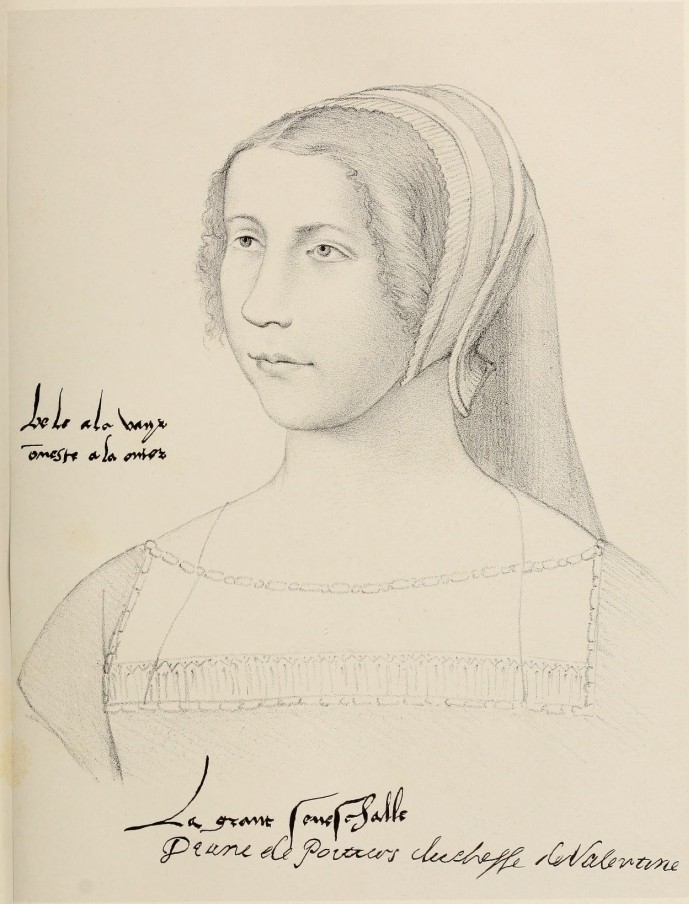
This is a crayon sketch of Diane de Poitiers, possibly done in 1515—the year she was married. It comes from an album of sketches titled Francois I chez Madame de Boisy.
Madame de Boisy’s husband was an accomplished artist, she herself drew portraits of people around the king’s court, but, by no means was considered accomplished herself. Indeed, this crayon sketch has Diane’s likeness, but not the sharpness of her features.
But, the most curious thing about this sketch are those words on the left, written, maybe a few years later (say, 1519 CE) by none other than King Francois I himself—supposedly, when he was rifling through the album.
The words are (translated) “Beautiful to look at, and agreeable to visit.” This is Francois I saying this about Diane de Poitiers—he knew her well, of course—about three or four years before her father’s arrest. Image Source
And, with that curious couplet on Diane’s crayon sketch, Francois I probably made his feelings for her known—in retrospect, the gossip and rumors about Diane and Francois I seem more possible.
Jean de Poitiers went back to the prison house of Château de Loches to live out the rest of his natural life.
King Francois I returned from imprisonment in Madrid (see this story in Part 1 of this blog post) having given up his two sons, including Diane de Poitiers’s future. . .er, master, Henry II, who would have been seven years old now.
And then, surprisingly, in 1526, he pardoned all the offenders in the Constable Conspiracy.
Diane de Poitiers at work again on the king?
Perhaps Francois I had been mellowed by his own confinement at Madrid? His quarters would have been much more splendid than the keep at the Château de Loches, but he had lost his personal liberty, and he had been ill—had that made him more forgiving?
Or had Diane de Poitiers something to do with that blanket pardon of the Constable conspirators?
Over time, Jean de Poitiers regained all his estates, his titles and his rank in society. When he died in 1539, he was a well-respected member of the French courts again.
Perhaps that was natural—because by the time Jean de Poitiers died, he knew what his daughter’s power and authority was; she had already met the young dauphin, the crown prince, Henry, who was to become the next king.
But first, Diane’s aged husband has to die, and we’ll see that, and her rise, in the next blog post.
If you’ve enjoyed reading this post, please share it, so others may read also. Thank you!
Primary Citations and Sources: The Library, Fourth Series, Volume VII; Helen W. Henderson, The Enchantress, Being the life of Diane de Poytiers Mistress of King Henry the Second of France; The People’s Magazine, An Illustrated Miscellany; E. Maxtone Graham, Children of France; Reginald Blomfield, A History of French Architecture, From the reign of Charles VIII till the death of Mazarin; Marcel Monarché, ed., The Chateaux of the Loire; H. Noel Williams, King Henri II: His Court and Times; Charles Terrasse, Le Château de Chenonceau by Charles Terrasse.
On the next blog post—Henry II, heir to the French throne, marries Catherine de Medici—and Diane transfers her favors from the king to the heir—Mortal Enemies: The Queen and the Mistress who coveted the Château de Chenonceau—Part 3
Search Engine Keyword Phrases: Chateau de Chenonceau from Paris; Chateau de Chenonceau opening hours; why was Chateau de Chenonceau built; Chateau de Chenonceau Instagram; Paris to Chateau de Chenonceau by train; Chateau de Chenonceau price; Diane de Poitiers; Ladies Castle; Katherine de Medici; Renaissance architecture France; castle with arched bridge; Chateau des Dames; fairytale castle Loire Valley; influential French women; Katherine de Medici’s garden; Chateau de Chenonceau flowers; Chenonceau history; Who lived at Chateau Chenonceau; What is Chateau de Chenonceau famous for; where is chateau de chenonceau located; Chateau de Chenonceau fun facts.

