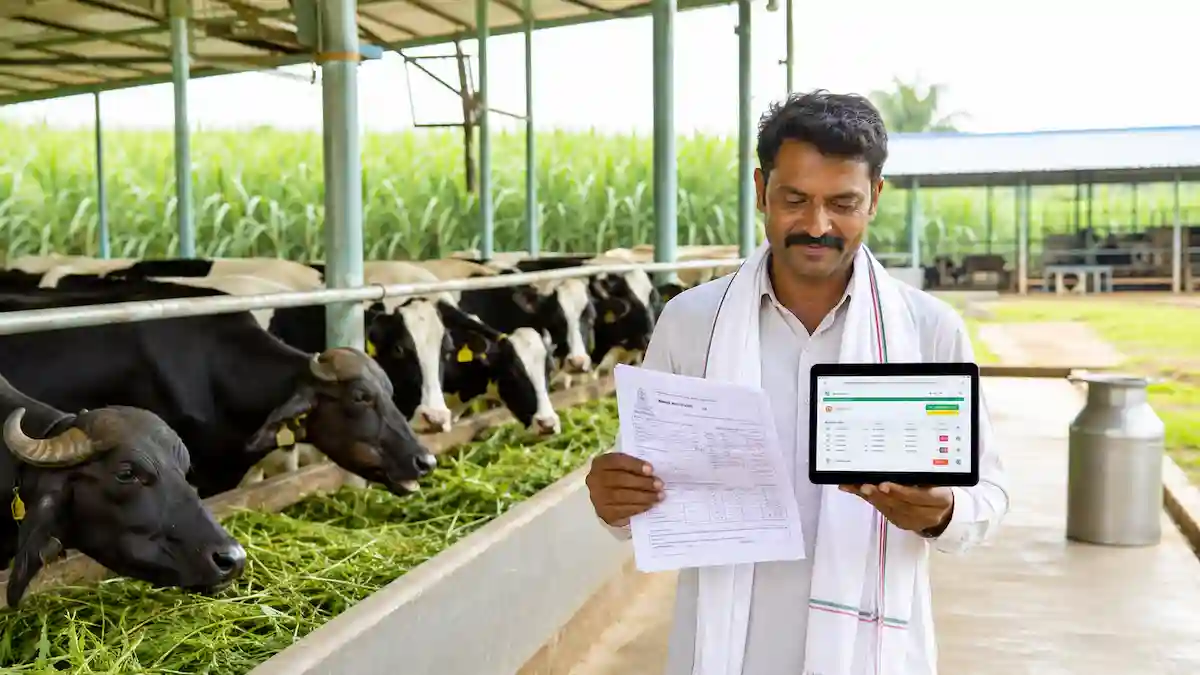

A dairy farm subsidy in India can reduce your project cost by 24% to 39%, depending on your state and eligibility. That estimate is based on our compiled subsidy database covering Central and State government schemes.
This guide shows you the exact government subsidy for dairy farming in India, how much you can actually get, and a free calculator that runs the numbers for your state in seconds.

Quick answer: A dairy farming subsidy is a partial refund of your project cost, paid through central and state livestock schemes routed via NABARD and state Animal Husbandry departments. Rates typically run 24% to 29% for general category and 32% to 39% for SC/ST, capped between roughly ₹4.8 lakh and ₹5.84 lakh depending on the state.
Last updated: July 2026. Subsidy percentages and caps are revised periodically by each state, so treat the figures below as a working estimate and confirm the final number with your local department before you apply.
Reviewed against the latest Department of Animal Husbandry & Dairying notifications and state livestock subsidy guidelines.
| Item | Typical Value |
|---|---|
| Subsidy Range | 24% to 39% |
| Governing Scheme | Central/state livestock schemes |
| Bank Loan Required | Usually yes |
| Online Application | Yes, via state portal |
| Calculator | Free, updated per state |
What Is the Dairy Farm Subsidy in India and How Does It Work?
What Is a Government Dairy Farming Subsidy?
A dairy farm government subsidy is a partial refund of your project cost, paid by the Central or State government once your dairy unit is set up and verified.

Most schemes work as “back-ended” subsidies. You take a bank loan first, build the shed, buy the animals, and the subsidy is credited against your loan after inspection.
Why Does the Government Provide Dairy Farm Subsidies?
India runs on small dairy holdings, most farmers own fewer than 5 animals. Subsidies lower the entry cost so more rural households can start or expand a dairy unit without taking on crushing debt.
It also pushes farmers toward better breeds, proper sheds, and hygiene standards, since most schemes require these before releasing funds.
Who Can Apply for a Dairy Farm Subsidy?
Individual farmers, Self-Help Groups (SHGs), Farmer Producer Organizations (FPOs), and dairy cooperatives can all apply, though eligibility rules shift slightly by scheme and state.

- Individual farmers with land or a leased shed
- Small and marginal farmers
- Women entrepreneurs (often at a higher subsidy rate)
- SHGs, FPOs, and registered dairy cooperatives
You do not need prior dairy experience for most schemes, but you do need land or a leased shed in your own name or a documented lease. A rented shed without a written lease is a common reason applications stall at the verification stage.
Use Our Dairy Farm Subsidy Calculator to Estimate Your Eligible Subsidy
Skip the manual math. Enter your state, category, and herd size below to get your exact numbers.

Tip: If you are comparing multiple states, run the calculator separately for each one. Subsidy percentages, project costs, and maximum limits vary significantly from state to state.
Estimate your subsidy for setting up or expanding a dairy unit under the National Livestock Mission and state dairy development schemes.
Scheme
Eligible Subsidy
Subsidy Percentage
Maximum Subsidy
Farmer Contribution
Central Govt. Share
State Govt. Share
Last Updated
Frequently Asked Questions
Dairy unit subsidies are commonly funded under the National Livestock Mission (NLM) and Rashtriya Gokul Mission, along with matching state dairy development schemes.
Yes, most schemes require the dairy shed and animal housing to meet minimum space, ventilation, and hygiene standards specified in scheme guidelines before disbursing the subsidy.
Yes, a mixed herd is generally eligible; the subsidy is calculated per animal at the applicable standard unit cost for your state.
Disclaimer: Figures shown are indicative estimates based on published scheme guidelines and may change without notice. Always verify current subsidy rates, caps, and eligibility with the concerned government department before making financial decisions.
How the Dairy Farm Subsidy Calculator Works
The calculator multiplies your number of milch animals by your state’s standard cost per animal, giving your base project cost.
Your category’s subsidy percentage for that state is applied next, capped at the state’s maximum subsidy limit, and the result is split into Central and State government shares.
What Information Do You Need Before Using the Dairy Farm Subsidy Calculator?
Keep these six details ready. The tool will not run without them.
| Field | What to Enter | Required |
|---|---|---|
| State / UT | Your state or union territory | Yes |
| Farmer Category | Small/Marginal or General | Yes |
| Social Category | General, OBC, or SC/ST | Yes |
| Gender | Male, Female, or Other | Optional |
| Animal Type | Cow, Buffalo, or Mixed Herd | Yes |
| Number of Milch Animals | Total animals you plan to keep | Yes |
Social category matters more than farmer category here. In most states, SC/ST applicants qualify for higher subsidy rates than the general category, although the exact benefit depends on the applicable government scheme.
How to Interpret Your Estimated Subsidy Amount
The calculator returns eight results. Here is what each one means.
| Result | What It Tells You |
|---|---|
| Scheme | The government scheme funding your subsidy |
| Eligible Subsidy | Your amount, already capped at your state limit |
| Subsidy Percentage | The rate applied to your project cost |
| Maximum Subsidy | Your state’s upper limit, regardless of herd size |
| Farmer Contribution | What you pay from savings or loan |
| Central/State Share | How the subsidy splits between governments |
Many farmers assume the subsidy is simply project cost multiplied by the percentage. In reality, every state also sets a maximum subsidy limit, which can reduce your final payout once your herd grows large enough. Big herds hit that cap faster than small ones.
How Much Dairy Farm Subsidy Can You Get in India?
Your dairy subsidy amount comes down to two numbers: the dairy farm subsidy percentage for your category, and your state’s maximum cap.
Subsidy Percentage for Different Categories of Farmers
Rates vary by state, but the pattern holds everywhere. Telangana’s numbers are typical:
| Category | Subsidy Rate |
|---|---|
| General | 25% |
| OBC | 25% |
| SC/ST | 33% |
| Small/Marginal | 25% |
In our dataset, SC/ST status consistently corresponds to a higher rate, typically 8 to 10 percentage points above general category, though the exact gap depends on your state’s scheme.
Maximum Subsidy Amount Available
Every state caps the total payout, no matter how large your herd is. Five examples:
| State | Rate/Animal | Max Subsidy (General) |
|---|---|---|
| Telangana | ₹60,000 | ₹5,00,000 |
| Andhra Pradesh | ₹57,600 | ₹4,80,000 |
| Karnataka | ₹62,400 | ₹5,20,000 |
| Maharashtra | ₹68,220 | ₹5,68,500 |
| Tamil Nadu | ₹66,000 | ₹5,50,000 |
Once your subsidy hits this ceiling, adding more animals only raises your own contribution, not the government’s share.
What Determines Your Dairy Farm Subsidy Amount?
- State: sets both the per-animal cost and the percentage table
- Social category: SC/ST status generally qualifies for the top rate
- Herd size: raises your cost in a straight line, until the cap kicks in
- State maximum limit: the hard ceiling that overrides the percentage once reached
Government Dairy Farm Subsidy Schemes You Can Apply for in India
Government subsidy for dairy farming in India is not one single scheme. It runs through several central programs and state top-ups, each aimed at a different scale of dairy project.
Animal Husbandry Infrastructure Development Fund (AHIDF)
AHIDF is not a per-cow subsidy. This fund backs larger dairy processing infrastructure, cold chains, and value-addition units, mainly for FPOs, private companies, and cooperatives.
Eligible borrowers get a 3% interest subvention on bank loans, financing up to 90% of the project, with an 8-year repayment window that includes a 2-year moratorium. This suits farmers scaling into processing, not first-time small herds.
National Livestock Mission (NLM) and Related Central Schemes
Subsidy for individual animal purchase and shed setup, the case our calculator models, usually falls under the National Livestock Mission’s dairy entrepreneurship component or an equivalent central livestock scheme, depending on your state and project type.
In our compiled dataset, general-category rates in this component run 22% to 29% across the states and union territories covered, with a 60:40 Central-State split in each case recorded. Actual figures are set by government notification and can be revised, so treat these as reference points rather than fixed law.
Rashtriya Gokul Mission (RGM)
RGM focuses on indigenous cattle breed conservation and genetic improvement, not direct cash subsidies to individual farmers buying animals.
Gokul Grams, breeding centres, and artificial insemination networks receive most of this funding. Farmers benefit indirectly through access to better bulls and semen at subsidized rates.
Dairy Development Schemes by State Governments
Every state layers its own scheme on top of the Central framework, which is why the same herd size produces a different subsidy in Telangana versus Maharashtra.
Check your state’s Animal Husbandry Department page before applying, since state top-up schemes change more often than Central ones.
NABARD-Supported Dairy Financing Options
NABARD historically ran the Dairy Entrepreneurship Development Scheme (DEDS), offering 25% capital subsidy (33.33% for SC/ST and women), but this specific scheme was discontinued after FY 2020-21.
Today, NABARD primarily refinances eligible lending institutions and supports implementation of dairy financing programs, rather than providing a direct subsidy to individual farmers itself.
How to Choose the Best Dairy Farm Subsidy Scheme
The right scheme depends on the size and structure of your project, not just which one offers the highest percentage on paper.
Small Dairy Farms
A first-time unit of 5 to 15 animals fits the NLM dairy entrepreneurship route through your state Animal Husbandry Department. The subsidy, bank loan, and documentation are all sized for an individual applicant.
Commercial Dairy Farms
Larger operations moving into processing, chilling, or packaging should look at AHIDF instead. It funds infrastructure at a different scale and is built for private companies and bigger project costs, not a handful of animals.
FPOs and Cooperatives
Groups applying together can often combine a state top-up scheme with shared infrastructure funding, spreading the fixed cost of a shed or a milking parlour across members. Check with your state department on which components can be jointly financed before splitting the application.
Which Dairy Animals and Costs Does the Subsidy Cover?
Which Dairy Animals Are Eligible?
Most state schemes for dairy farm financial assistance cover these animal categories:
- Indigenous cows (Gir, Sahiwal, Tharparkar, and similar breeds)
- Crossbred cows (HF, Jersey crosses)
- Buffaloes (Murrah and graded buffalo)
- Mixed herds combining cows and buffaloes

This livestock subsidy is calculated per animal at your state’s standard unit cost, so a mixed herd simply adds each animal’s cost before the percentage is applied. Cattle farming subsidy rates do not usually change based on breed choice within these categories, only the per-animal cost varies.
Eligible Project Components
A government subsidy for dairy farm setup usually covers more than the animals themselves. Depending on the scheme, eligible components can include:
- Cattle shed construction
- Milking machines and milk cans
- Chaff cutters and feed storage units
- Bulk milk coolers, for larger or cooperative-linked units
Not every state funds every component under the same scheme. Confirm which items your state’s dairy farm subsidy scheme actually covers before you finalize your project report and budget.
Central Government vs State Government Dairy Farm Subsidies
Key Differences Between Central and State Subsidies
| Aspect | Central Subsidy | State Subsidy |
|---|---|---|
| Source | NLM, AHIDF, RGM | State Animal Husbandry Dept. |
| Rate | Fixed nationally, category-based | Varies, often a top-up |
| Processing | Central portal or bank | State department office |
In practice, your final subsidy is usually a Central scheme rate with a state-specific cap layered on top, which is exactly what the state tables above show.
Can You Combine Different Subsidy Schemes?
Sometimes, but not on the same cost head. You generally cannot claim two subsidies for the same shed or the same batch of animals.
Layering a Central scheme with a separate state incentive, like a milk price bonus, is usually fine. Always confirm with your local department before assuming both apply.
Dairy Farm Subsidy Eligibility Criteria Explained
Dairy farm subsidy eligibility criteria differ slightly by scheme, but most states apply the same baseline requirements below.
Age, Residency, and Applicant Requirements
Most schemes require the applicant to be an adult Indian resident, typically 18 years or older, with a valid Aadhaar-linked bank account in the state where the farm is located.
Eligibility for Individual Farmers, SHGs, FPOs, and Cooperatives
Individuals, SHGs, FPOs, Joint Liability Groups, and registered cooperatives can all apply. Group applicants usually need registration proof and a resolution naming the authorized signatory.
Land Ownership and Dairy Farm Requirements
You need suitable land or a leased shed for housing the animals, meeting minimum space and ventilation standards set by your state’s scheme guidelines.
Animals must come from a recognized breeder or registered cattle market with a valid health certificate, not an unverified local seller.
Eligibility checklist:
- Indian citizen, generally 18 years or older
- Valid Aadhaar-linked bank account
- Land or a documented leased shed for the animals
- A dairy project report matching your requested herd size
Dairy Subsidy for Women, Young Farmers, FPOs, and Entrepreneurs
Some Central and State dairy subsidy schemes provide additional benefits or a higher subsidy rate for women applicants, sometimes matching the SC/ST rate even within the general social category. This benefit varies by scheme and state, so confirm it with your local department rather than assuming it applies automatically.
Young farmers and first-generation entrepreneurs face no separate age-based bonus in most schemes, but they do qualify for the standard rates on the same terms as any individual applicant. Dairy entrepreneur subsidy support through FPOs and cooperatives often allows shared infrastructure, like a common milking parlour, which lowers the per-member project cost.
Documents Required to Apply for a Dairy Farm Subsidy
Dairy farm subsidy documents fall into four groups. Missing any one of these is the fastest way to stall your dairy farm subsidy application.
| Category | Documents |
|---|---|
| Identity/Address | Aadhaar Card, address proof |
| Land | Ownership or lease document for the shed |
| Project | Dairy farm project report |
| Financial | Bank passbook with IFSC, loan sanction letter |
Add a caste certificate if you are applying under the SC/ST or OBC category, and a veterinary health certificate for the animals once purchased.
Documents checklist:
- Aadhaar Card and address proof
- Land ownership or lease document
- Bank passbook with IFSC code
- Dairy farm project report
- Caste certificate (SC/ST or OBC applicants)
- Veterinary health certificate for the animals
How to Apply for a Government Dairy Farm Subsidy
Applying for a government subsidy for dairy farm setup follows one of two routes, online or offline, depending on your state.

Online Application Process
- Register on your state Animal Husbandry Department portal or the NLM Udyamimitra portal
- Fill in applicant, land, and herd details, matching your project report
- Upload Aadhaar, land/lease document, bank passbook, and project report
- Submit and note your application ID for tracking
- Respond quickly if the department requests a site visit or a document correction
Offline Application Process
Visit your district Animal Husbandry office or a nationalized bank branch that finances dairy projects, and submit physical copies of the same document set.
Ask for a receipt with a reference number. Without it, following up on a stalled application becomes difficult since offline files move between departments manually.
Tips to Improve Your Chances of Approval
- Get your project report reviewed by a bank or a local Animal Husbandry officer before submission
- Match your requested herd size to your actual land and fodder capacity
- Keep every document current, an expired caste or health certificate is a common rejection reason
When Is the Dairy Farm Subsidy Released?
Subsidy release follows a fixed sequence, not a single lump-sum payout on approval:
- Application submitted with complete documents
- Bank loan sanctioned
- Shed built and animals purchased
- Site inspection by the department
- Subsidy credited against your loan account
Most farmers wait 2 to 4 months between loan sanction and subsidy credit, though this stretches longer if the inspection queue is backed up in your district.
Reasons Dairy Farm Subsidy Gets Delayed
- Bank account details not matching Aadhaar records
- Incomplete or expired documents flagged during verification
- Site inspection delayed due to officer availability
- Animal health certification pending or disputed
Dairy Farm Loan vs Government Subsidy: Key Differences Explained
A dairy farm subsidy is not a loan and not a straight grant either. It sits in between: a partial, conditional write-off tied to a bank loan in most states.

How Subsidies Reduce Your Loan Burden
A loan is money you repay in full with interest. A dairy farm subsidy loan structure is different: the subsidy is a partial write-off, credited against your loan once your project passes inspection, so you end up repaying less. It works more like a delayed dairy farm grant than an upfront cash handout.
Banks That Finance Dairy Farming Projects
State Bank of India, Canara Bank, and IDBI all run dedicated dairy loan products, alongside regional rural banks and district cooperative banks, usually with NABARD refinancing behind the loan.
Your local branch experience matters more than the bank’s brand. A branch that has processed dairy subsidy claims before moves faster than one handling its first application.
Interest Rates and Repayment Terms
Rates follow standard agricultural lending norms and shift with RBI policy, so confirm the current rate with your bank rather than relying on an old figure.
Repayment is usually structured around milk income, with a short moratorium during the first few months while the herd builds up to full lactation. Ask your bank to align the EMI schedule with your expected cash flow, not a flat monthly figure.
Dairy Farm Project Cost and Subsidy Examples
Real numbers from the calculator, using Telangana’s rates: ₹60,000 per animal, 25% for general category.

Subsidy Example for a 10-Cow Dairy Farm
| Item | Amount |
|---|---|
| Project Cost | ₹6,00,000 |
| Eligible Subsidy | ₹1,50,000 |
| Farmer Contribution | ₹4,50,000 |
Subsidy Example for a 20-Cow Dairy Farm
| Item | Amount |
|---|---|
| Project Cost | ₹12,00,000 |
| Eligible Subsidy | ₹3,00,000 |
| Farmer Contribution | ₹9,00,000 |
Example of a Small Dairy Farm Project Cost
A 5-cow unit in Telangana costs roughly ₹3,00,000, earning a ₹75,000 subsidy at 25%. Small herds stay well under every state’s subsidy cap, so the full percentage always applies.
Practical logic here: below the cap, adding animals scales your subsidy in a straight line. Above the cap, it does not. Check your state’s maximum before deciding whether a 15-cow or 30-cow unit is actually worth the extra investment on the subsidy side.
State-Wise Dairy Farm Subsidy Rates in India
Andhra Pradesh Dairy Farm Subsidy
24% general, 32% SC/ST, capped at ₹4,80,000. Rate per animal is ₹57,600. Applications go through the Andhra Pradesh Animal Husbandry Department.
This is the lowest per-animal rate among the five states here, so a 10-cow AP unit costs less upfront than the same unit in Maharashtra or Tamil Nadu.
Telangana Dairy Farm Subsidy
25% general, 33% SC/ST, capped at ₹5,00,000. Rate per animal is ₹60,000. Handled by the Telangana Animal Husbandry Department.
At this rate, a general-category farmer needs roughly 34 animals before hitting the state’s subsidy cap.
Karnataka Dairy Farm Subsidy
26% general, 34% SC/ST, capped at ₹5,20,000. Rate per animal is ₹62,400. Applications route through the Karnataka Department of Animal Husbandry & Veterinary Services.
That puts Karnataka a notch above Telangana and Andhra Pradesh on both rate and cap, though still short of Maharashtra and Tamil Nadu.
Maharashtra Dairy Farm Subsidy
28% general, 38% SC/ST, capped at ₹5,68,500, the highest limit among these five states. Rate per animal is ₹68,220.
Maharashtra also carries the highest per-animal cost here, so the higher cap largely offsets the larger project cost rather than creating an outsized advantage.
Tamil Nadu Dairy Farm Subsidy
28% general, 36% SC/ST, capped at ₹5,50,000. Rate per animal is ₹66,000. Managed by the Tamil Nadu Animal Husbandry Department.
Tamil Nadu matches Maharashtra’s general rate but trails it slightly on both the cap and the SC/ST rate.
Dairy Farm Subsidy in Kerala
25% general, 33% SC/ST, capped at ₹5,01,000. Rate per animal is ₹60,120, in line with the southern state average, closer to Telangana’s numbers than to Tamil Nadu’s.
Dairy Farm Subsidy in West and Central India
General rates here run from 23% in Goa to 29% in Madhya Pradesh. Madhya Pradesh also carries the highest cap in this group at ₹5,81,000, while Goa’s cap sits lowest at ₹4,51,000.
Gujarat (26%, cap ₹5,18,500) and Chhattisgarh (25%, cap ₹5,04,500) fall in between, both close to the national average for general category.
Dairy Farm Subsidy in North India
This region has the widest spread: Haryana sits at 22% general, while Rajasthan and Jammu and Kashmir both reach 29%, the highest general rate on record.
Punjab (24%), Uttar Pradesh (25%), Himachal Pradesh (23%), Delhi (26%), Chandigarh (26%), Uttarakhand (28%), and Ladakh (28%) fill out the middle of the range, each with its own cap between ₹4.45 lakh and ₹5.84 lakh.
Dairy Farm Subsidy in East India
Odisha leads this region at 29% general with the highest cap of any state on record, ₹5,89,000. Bihar follows closely at 29% general, capped at ₹5,73,000.
Jharkhand sits at 27% (cap ₹5,49,500) and West Bengal at 23% (cap ₹4,64,500), the lowest general rate in eastern India.
Dairy Farm Subsidy in Northeast India
Rates here run 22% to 28% general. Assam and Mizoram sit at the lower end (22%), while Arunachal Pradesh and Sikkim reach 28%, each capped near ₹5.5 lakh.
Manipur (25%), Meghalaya (26%), Nagaland (26%), and Tripura (25%) fall in the middle, all within a few percentage points of the national general-category average.
Dairy Farm Subsidy in Union Territories
Dadra and Nagar Haveli and Daman and Diu offers the highest UT rate at 29% general, capped at ₹5,76,500. Andaman and Nicobar Islands follows at 26% (cap ₹5,26,000).
Lakshadweep and Puducherry both sit at 22% general, the lowest rate among all states and union territories on record, each capped just above ₹4.3 lakh.
All States and Union Territories at a Glance
Every state and UT dairy farm subsidy scheme in this dataset, sorted alphabetically:
| State / UT | General Rate | SC/ST Rate | Max Subsidy |
|---|---|---|---|
| Andaman & Nicobar Islands | 26% | 35% | ₹5,26,000 |
| Andhra Pradesh | 24% | 32% | ₹4,80,000 |
| Arunachal Pradesh | 28% | 37% | ₹5,58,000 |
| Assam | 22% | 28% | ₹4,30,000 |
| Bihar | 29% | 38% | ₹5,73,000 |
| Chandigarh | 26% | 34% | ₹5,22,000 |
| Chhattisgarh | 25% | 33% | ₹5,04,500 |
| Dadra & Nagar Haveli, Daman & Diu | 29% | 38% | ₹5,76,500 |
| Delhi | 26% | 34% | ₹5,13,000 |
| Goa | 23% | 30% | ₹4,51,000 |
| Gujarat | 26% | 34% | ₹5,18,500 |
| Haryana | 22% | 29% | ₹4,45,500 |
| Himachal Pradesh | 23% | 31% | ₹4,68,000 |
| Jammu & Kashmir | 29% | 38% | ₹5,82,500 |
| Jharkhand | 27% | 36% | ₹5,49,500 |
| Karnataka | 26% | 34% | ₹5,20,000 |
| Kerala | 25% | 33% | ₹5,01,000 |
| Ladakh | 28% | 37% | ₹5,61,500 |
| Lakshadweep | 22% | 29% | ₹4,34,000 |
| Madhya Pradesh | 29% | 38% | ₹5,81,000 |
| Maharashtra | 28% | 38% | ₹5,68,500 |
| Manipur | 25% | 33% | ₹5,06,000 |
| Meghalaya | 26% | 34% | ₹5,21,500 |
| Mizoram | 22% | 29% | ₹4,46,000 |
| Nagaland | 26% | 35% | ₹5,25,500 |
| Odisha | 29% | 39% | ₹5,89,000 |
| Puducherry | 22% | 29% | ₹4,35,000 |
| Punjab | 24% | 32% | ₹4,79,500 |
| Rajasthan | 29% | 39% | ₹5,84,000 |
| Sikkim | 28% | 36% | ₹5,53,000 |
| Tamil Nadu | 28% | 36% | ₹5,50,000 |
| Telangana | 25% | 33% | ₹5,00,000 |
| Tripura | 25% | 33% | ₹5,01,000 |
| Uttar Pradesh | 25% | 33% | ₹4,94,500 |
| Uttarakhand | 28% | 37% | ₹5,56,500 |
| West Bengal | 23% | 31% | ₹4,64,500 |
Odisha and Rajasthan currently offer the highest general-category rates nationwide. Assam, Mizoram, Lakshadweep, and Puducherry sit at the lowest, 22%. Run your own state through the calculator above for the exact figure, since caps and per-animal costs shift alongside the percentage.
Dairy Farm Subsidy Calculator vs Manual Calculation
Why Use an Online Subsidy Calculator?
Manual calculation means digging through state notification PDFs for rates and caps that change yearly. The calculator uses the latest subsidy data available in our database and applies the cap for you automatically.
Benefits of Instant Subsidy Estimates
You see your farmer contribution and central/state split before applying, so there are no surprises when the bank explains your loan terms.
How to Improve Your Chances of Getting a Dairy Farm Subsidy Approved
Prepare a Strong Dairy Farm Project Report
Your dairy farm subsidy project report should include realistic milk yield estimates, feed costs, and a repayment schedule tied to actual lactation cycles, not optimistic best-case numbers.
Choose the Right Government Scheme
Match the scheme to your project size. Small individual herds fit NLM. Processing units and cold chains fit AHIDF. Picking the wrong government subsidy for dairy farm expansion is one of the most common reasons applications get stuck in review.
Work With an Eligible Financing Bank
Not every branch handles dairy subsidy disbursal smoothly. Ask which local bank has processed dairy loans before, and start there.
Keep Your Documents Complete and Accurate
Cross-check spellings, IFSC codes, and land records against your Aadhaar before submission. Small mismatches cause the most delays.
Common Mistakes That Lead to Dairy Farm Subsidy Rejection
Incomplete Documentation
Missing a caste certificate or an expired health certificate is the single most common rejection reason.
Incorrect Project Cost Estimates
Inflating or underestimating your project cost against the state’s standard per-animal rate raises red flags during verification.
Applying Under the Wrong Scheme
Applying to AHIDF for a 10-cow individual unit, when NLM is the correct fit, wastes months in processing.
Missing Loan or Bank Requirements
Since most subsidies are back-ended against a bank loan, a rejected loan application stops the subsidy before it starts. Get informal bank approval before you finalize your project report, not after.
Frequently Asked Questions About Dairy Farming Subsidy in India
How much government subsidy is available for dairy farming?
Government subsidy for dairy farming in India typically ranges from 24% to 29% for general category farmers and 32% to 39% for SC/ST farmers, depending on the state, capped at a fixed maximum amount per unit.
Who is eligible for a dairy farm subsidy?
Individual farmers, SHGs, FPOs, and registered dairy cooperatives with suitable land or a leased shed and a valid bank account can apply, subject to state-specific eligibility rules.
Is a bank loan mandatory to receive a subsidy?
Most schemes disburse subsidy as a back-ended credit against a bank loan, so a sanctioned loan is usually required, though a few state top-ups work as direct grants.
Can I receive both Central and State Government subsidies?
You generally cannot claim two subsidies against the same cost head, like the same shed or the same animals, but separate incentives such as a milk price bonus can usually apply alongside.
Does the subsidy amount vary by state?
Yes. Both the per-animal cost and the subsidy percentage differ by state, which is why the same 10-cow farm produces a different subsidy figure in Telangana versus Maharashtra.
Conclusion
Government subsidy for dairy farming in India ultimately depends on three numbers: your state’s per-animal rate, your category’s percentage, and your state’s maximum cap.

Run your own details through the calculator above, then take the output straight to your district Animal Husbandry office or bank to start your application.
Related Reading
References
Disclaimer: Information on this site is for educational purposes only. Scheme details, subsidy percentages, and eligibility criteria change periodically and vary by state. Always verify the current guidelines with the Department of Animal Husbandry and Dairying, NABARD, or your State Animal Husbandry Department before applying or making major financial decisions.

