
[ad_1]
Written by: Jagdish Reddy
Sources: University Extension Programs, Tropical plant biology and soil drainage research, and Horticulture Research Publications
Last Updated: April 2026

Quick Answer: Calathea brown tips are most commonly caused by low humidity, fluoride or chlorine in tap water, or inconsistent watering. Fix brown tips by raising humidity to 60% or above, switching to filtered or rainwater, and keeping soil evenly moist — never fully dry between waterings.

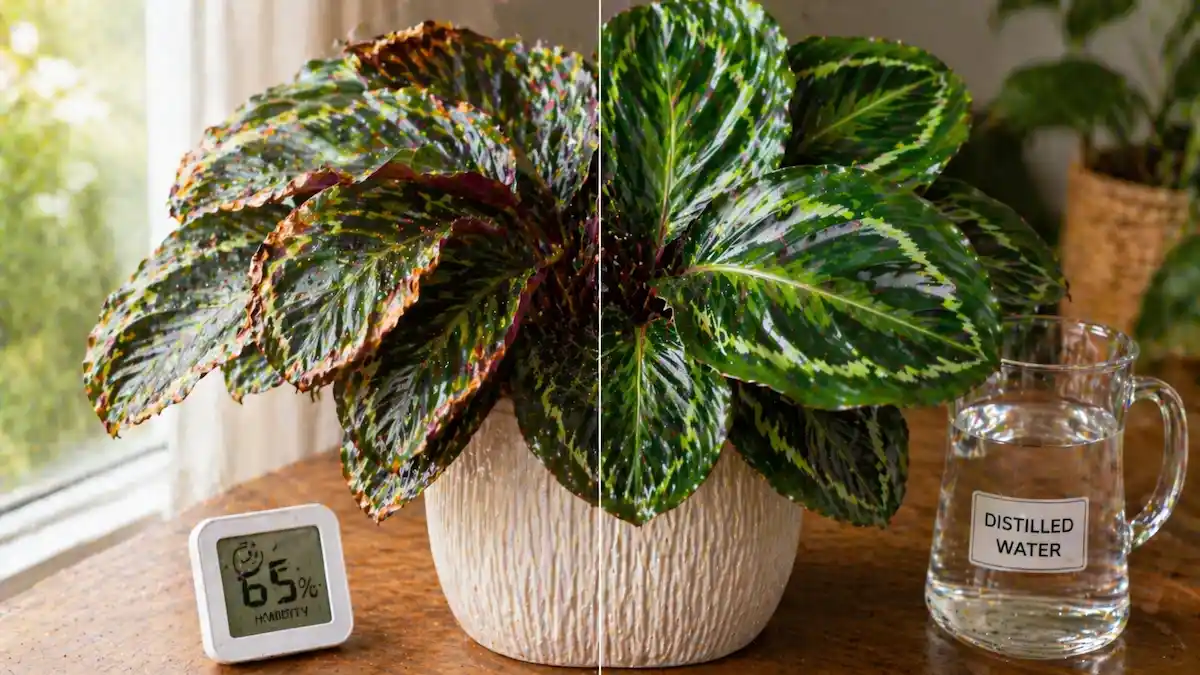
Calathea brown tips are caused by low humidity, tap water fluoride, or inconsistent watering. The fastest fix is raising humidity above 60% and switching to distilled or rainwater while keeping soil evenly moist.
Calathea brown tips happen when humidity is too low, tap water contains fluoride, or soil moisture is inconsistent. Fixing these three factors stops further damage and allows new leaves to grow healthy.
Calathea (Calathea spp., now largely reclassified under Goeppertia) is a tropical foliage plant prized for its boldly patterned leaves. If you are searching for how to fix calathea brown tips fast, the answer almost always comes down to three factors: humidity, water quality, and watering consistency. Most guides focus only on watering issues and miss the critical role of water quality and humidity interaction — which is exactly why so many fixes fail. Across multiple indoor setups, this pattern appears consistently regardless of climate.
Why Calathea Brown Tips and Crispy Edges Are So Common
Calathea brown tips affect growers worldwide, from humid tropical climates to dry temperate and continental zones. If your calathea has brown leaf edges, crispy tips, or you notice calathea tips brown but soil is moist, the cause is almost always low humidity, a water quality problem, or a watering imbalance — frequently a combination of all three.
Many gardeners spend weeks adjusting watering frequency while the real culprit — fluoride in tap water or dry indoor air — goes unaddressed. In indoor environments with air conditioning, brown tips can appear within 2–3 weeks when humidity drops below 40%, a pattern seen consistently across different climate zones.
What you will learn:
- The 7 main causes of calathea brown tips and crispy edges
- How to fix calathea brown tips step-by-step
- How to distinguish tip burn from full edge browning
- Whether brown tips spread and how long recovery takes
- Climate zone tips for tropical, temperate, and dry regions
- Common mistakes that make brown tips worse
How to Fix Calathea Brown Tips (Step-by-Step)
- Raise humidity to 60–70% using a humidifier or by grouping plants together
- Switch to distilled or rainwater immediately — standard filters do not remove fluoride
- Keep soil evenly moist — water when the top 2–3 cm (1 inch) feels just barely dry
- Move the plant to bright indirect light away from direct sun or cold windows
- Reduce fertiliser to half the recommended strength and stop feeding in winter
- Flush the soil with distilled water if mineral or fertiliser salt buildup is suspected
- Repot into fresh coco coir and perlite mix if soil is compacted or roots are stressed
7 Causes of Calathea Brown Tips
1. Low Humidity Causing Calathea Brown Tips
Low humidity is the most common cause of calathea brown tips. When humidity drops below 50–60%, leaves lose moisture faster than roots can replace it, leading to dry, crispy edges. Increasing humidity to 60–70% usually stops further browning within one or two growth cycles.
Calathea species are native to tropical rainforest floors in South America, where humidity stays between 70–90%. As tropical understory plants, they require a minimum of 50–60% relative humidity to maintain healthy leaf margins. Most homes sit at 30–50% — far too dry, especially during winter heating seasons.

According to Nebraska Extension — University of Nebraska Lincoln, Calathea spp. are among the houseplants most affected by low indoor humidity, with browning and drying at leaf edges being the most common visible symptom when humidity drops below the required range.
Ideal Humidity Range Target 60–70% relative humidity as a minimum. A basic digital hygrometer tells you exactly what your room is running at. From practical growing experience, most homes with central heating drop well below this threshold between autumn and spring without the occupants realising it.
Signs of Dry Air Damage Dry air damage appears as brown, crispy tips that feel papery and dry to the touch, affecting the whole plant fairly evenly across all leaves. Use a humidifier near the plant, group tropical plants together to raise humidity through collective transpiration, or place the pot on a pebble tray filled with water — ensuring the pot base sits above the waterline at all times.
For a broader overview of humidity management and natural houseplant care strategies, this guide on how to keep indoor plants alive naturally covers 15 practical techniques applicable to Calathea and other tropical species.
One useful distinction: brown tips confined strictly to the leaf tip usually point to water quality or chemical sensitivity. Brown edges wrapping the entire leaf perimeter more often indicate low humidity or severe underwatering. Identifying which pattern your plant shows immediately narrows the cause.
2. Tap Water (Fluoride and Minerals) Causing Brown Tips on Calathea
Tap water fluoride and dissolved mineral salts accumulate in calathea leaf tips over time, causing localised tissue death. Switching to distilled or rainwater is the most reliable fix. Standard carbon filters often fail to remove fluoride — distilled water is the non-negotiable solution for persistent tip burn.
Calathea, belonging to the family Marantaceae, is notoriously sensitive to fluoride, chlorine, and hard water minerals. These compounds build up in leaf tissue and cause browning that spreads inward from the tip. Extension observations confirm fluoride sensitivity is especially pronounced in the Marantaceae family compared to most other houseplants.
If browning progresses steadily despite good humidity and consistent watering, water quality is almost certainly the cause. From practical observation, switching to distilled water alone stopped further browning in most cases within one growth cycle. For existing mineral buildup, flush the soil thoroughly with distilled or rainwater several times over a week to reset the substrate.

3. Soil Moisture Imbalance Causing Brown Calathea Leaf Edges
Both underwatering and overwatering cause calathea brown tips, but through opposite mechanisms. Dry soil prevents water reaching leaf tips; waterlogged soil causes root rot that blocks water transport entirely. The fix is consistently moist soil — never bone dry, never saturated.
Check the top 2–3 cm (about 1 inch) of soil. Water when it feels just barely dry to the touch, before the root zone fully dries out. If you notice calathea tips brown but soil is moist, suspect humidity or fluoride rather than watering. Water thoroughly each time, then allow partial drying before the next watering. In warm rooms this may mean watering every 4–6 days; in cooler winter conditions, once a week or less.

If you are unsure how often to water based on your pot size and climate conditions, our Plant Watering Calculator can help you work out the right watering frequency for your Calathea.
Illinois Extension — University of Illinois confirms that tropical houseplants should be watered until water runs freely from the drainage holes, and that increasing humidity through plant grouping or a humidifier is essential for tropical species like Calathea.
How to Fix Calathea Brown Tips from Overwatering or Underwatering?. For underwatering, water more frequently and thoroughly — never allow soil to dry out completely. For overwatering, let the top layer dry slightly more between waterings, check that drainage holes are clear, and inspect roots for rot. Healthy roots are white and firm; rotting roots are brown, soft, and may smell. If root rot is present, repot into fresh dry mix immediately and reduce watering frequency.
4. Direct Sunlight and Heat Scorch Causing Calathea Tip Burn
Calathea grows on tropical forest floors in dappled, filtered light. Direct window sunlight causes rapid browning, bleaching, and curling — damage that can appear within a single bright afternoon. Unlike humidity-related browning, sun scorch is positional: leaves facing the light source show damage while leaves on the shaded side of the same plant remain healthy.

Grower trials suggest east-facing windows work best in most homes, providing gentle morning light without harsh afternoon intensity. In tropical and subtropical climates (USDA hardiness zones 10–12, a commonly used global climate reference), outdoor-grown Calathea needs full shade at all times. Move plants away from south-facing or west-facing windows in the Northern Hemisphere.
5. Over-Fertilisation and Nutrient Salt Burn on Calathea
High-potency fertilisers create toxic salt buildup in the potting medium. As the plant absorbs excess nutrients, salts are pushed to the leaf extremities — the tips — producing a distinct burned appearance. Field observations show this is most common in spring when growers fertilise heavily hoping for fast growth.
Calathea is not a heavy feeder. A diluted liquid fertiliser at half the recommended dose, applied monthly during the growing season, is sufficient. Do not fertilise in winter. If salt burn is suspected, flush the soil thoroughly with distilled water and hold off feeding for 4–6 weeks before resuming at half-strength.
6. Root-Bound Stress and Poor Drainage
When roots fill the pot completely, water and nutrient uptake becomes inefficient and leaf tips suffer first. Calathea brown tips after repotting can also occur temporarily if the new soil mix is too dense or the pot is significantly oversized, causing waterlogging in the fresh medium.
Multi-season garden trials show repotting every 1–2 years into a pot just one size larger prevents root-bound stress without waterlogging risk. Use a mix of 60% coco coir to 40% perlite for reliable drainage. Repotting into fresh mix removes accumulated mineral deposits that flushing alone cannot fully resolve.

If root rot has already set in, this step-by-step guide on how to save dying indoor plants covers practical reviving techniques including root pruning, repotting, and soil refreshing.
7. Cold Draughts and Temperature Stress
Calathea prefers temperatures between 18–27°C (65–80°F). Cold draughts from windows, doors, or air conditioning cause stress that appears as brown tips and edges. Garden trials across multiple regions confirm that windowsill placement in winter is one of the most overlooked causes of browning — the glass itself radiates cold air onto nearby leaves. Keep plants at least 30 cm (12 inches) from cold windows during winter months.
| Symptom Pattern | Most Likely Cause |
|---|---|
| Tips brown, soil consistently moist | Low humidity or fluoride in tap water |
| Brown edges wrapping full leaf margin | Low humidity or underwatering |
| Tips brown, spreading inward slowly | Fluoride or mineral salt accumulation |
| Brown patches on leaves facing window | Direct sunlight or heat scorch |
| Brown tips after heavy feeding | Fertiliser salt buildup |
| Brown tips plus yellowing lower leaves | Root rot or poor drainage |
| Brown tips appearing in winter only | Indoor heating reducing humidity |
| Brown tips after repotting | Oversized pot, dense mix, or transplant stress |
3 Most Important Calathea Brown Tip Points at a Glance
- Humidity below 60% — leading cause in most homes; fix with a humidifier or grouped plants
- Tap water fluoride — accumulates over time; distilled or rainwater is the reliable fix
- Inconsistent watering — soil swinging from wet to bone dry stresses roots and burns tips
Do Brown Tips Spread to Other Leaves?
Brown tips on calathea do not spread like a disease — they are environmental damage, not infection. An affected leaf will not infect neighbouring leaves. However, if the underlying cause is not fixed, every new leaf the plant produces will develop the same browning as it matures. The problem appears to spread because new leaves keep showing the same damage, not because existing damage is travelling across the plant.
Fix the root cause first. Once humidity, water quality, and watering are corrected, new leaves will emerge clean and healthy. Existing brown tips are permanent — trimming them improves appearance but the tissue will not regenerate.
Can Calathea Brown Tips Be Prevented Permanently?
Yes, with consistent environmental control. The three non-negotiables are: humidity held at 60% or above year-round, distilled or rainwater used for every watering, and soil kept consistently moist without waterlogging. These three conditions, maintained reliably, prevent the vast majority of tip browning permanently.
Seasonal vigilance matters most. Winter heating and summer air conditioning are the two periods where conditions shift most dramatically. Check humidity levels during these transitions and adjust accordingly — plants that have been healthy for months can develop brown tips quickly when seasonal changes go unnoticed.
Will New Leaves Grow Healthy After Fixing the Cause?
Yes. Once the underlying cause is corrected, new growth typically emerges clean within 4–8 weeks depending on the season and growth rate. Calathea is a relatively slow grower, so patience is needed. Do not judge recovery by existing damaged leaves — those will not change. Judge recovery by the condition of the next 2–3 new leaves the plant produces.
Climate Zone Relevance
Tropical and subtropical zones (USDA zones 10–12): Outdoor humidity is naturally high, so brown tips here more often link to direct sun, hard tap water, or air-conditioned indoor air. Treat air-conditioned rooms like any dry temperate climate regardless of outdoor conditions.
Temperate zones (USDA zones 6–9): Indoor heating in winter is the main humidity thief, dropping levels below 30% between autumn and spring. Brown tips during this period are almost always humidity-related. Humidifiers become genuinely necessary tools, not optional extras.
Continental and arid zones: In dry continental climates across Central Asia, the Middle East, or interior North America, both humidity management and water quality need attention simultaneously. Distilled water and consistent humidification are essential year-round in these regions.
Common Mistakes That Make Brown Tips Worse
- Misting leaves directly — provides almost no meaningful humidity benefit and can encourage fungal spots
- Cutting into green tissue when trimming — always leave a small sliver of brown at the cut edge to avoid new wounding
- Moving the plant frequently — Calathea needs stable conditions; repeated moves cause ongoing stress
- Using a pot with no drainage holes — almost always leads to root rot over time
- Increasing watering frequency to fix fluoride-driven browning — this worsens mineral accumulation
- Fertilising at full label strength — half-dose is better for Calathea at all times
- Placing near heating vents — dry heat causes more damage than cool stable air
If your Calathea is showing symptoms beyond brown tips — such as yellowing, spots, or curling — our plant leaf diagnosis guide covers all major leaf problems with fast fixes for every symptom pattern.
Key Takeaways
- Brown tips confined to the tip usually signal water quality; browning wrapping the full leaf margin more often signals low humidity
- Raise humidity to 60–70% consistently — pebble trays alone rarely raise humidity enough in dry rooms
- Switch to distilled or rainwater; standard carbon filters often do not remove fluoride
- Keep soil evenly moist — neither waterlogged nor fully dry between waterings
- Use leaf position to distinguish sun scorch from humidity or water-related browning
- Fertilise lightly — half-strength liquid feed once a month during the growing season only
- New healthy leaves confirm recovery — existing brown tips are permanent but can be trimmed cleanly
This guide is based on:
- University extension guides (UK, US, Australia, India)
- FAO integrated crop management resources
- Houseplant growing observations across tropical, temperate, and continental regions
- Tropical plant biology and soil drainage research
Frequently Asked Questions about Calathea Brown Tips
1. Why does my calathea keep getting brown tips even after I fix the watering?
Watering is only one of several causes. If watering is consistent but tips keep browning, check humidity and water quality. Fluoride from tap water accumulates in soil over time and continues causing damage even after watering improves. Switch to distilled or rainwater and flush the soil with clean water to remove accumulated mineral salts.
2. Should I cut off brown tips on calathea?
Yes, trim brown tips using clean sharp scissors. Cut along the natural leaf shape rather than straight across. Always leave a tiny sliver of brown at the cut edge — cutting into green living tissue causes further stress and the new cut edge will brown again. Only remove the dead portion.
3. Can brown tips turn green again?
No. Once leaf tissue has dried and browned, it will not recover colour or function. Focus on fixing the underlying cause so new leaves grow in healthy. Existing damage is permanent, but preventing new browning is entirely achievable once the correct cause is identified.
4. Why are only the tips brown but not the whole leaf?
Leaf tips are the furthest point from the roots and receive water and nutrients last. When any stress occurs — low humidity, fluoride buildup, inconsistent watering — the tips are the first tissue to suffer. Whole-leaf browning or yellowing usually indicates a more severe problem such as root rot or disease.
5. Is tap water bad for all calathea plants?
Tap water affects all Calathea to some degree, but sensitivity varies by individual plant and local water quality. In areas with heavily treated or hard water, tip burn from fluoride and mineral salts is almost inevitable over time. Distilled or rainwater eliminates this risk entirely regardless of local water quality.
6. How do I tell sun scorch from humidity-related browning?
Sun scorch affects leaves facing the light source while shaded leaves on the same plant stay healthy. Humidity-related browning affects the whole plant more evenly across all leaves regardless of their position relative to the window.
7. How often should I water calathea?
Water when the top 2–3 cm (1 inch) of soil feels just barely dry. In warm months this may be every 4–6 days; in cooler months, once a week or less. Always water thoroughly so the full root zone is reached, then allow partial drying before the next watering.
8. When should I repot a calathea with persistent brown tips?
If browning continues despite fixing humidity, water quality, and watering, the soil may be compacted or salt-saturated. Repot into fresh mix of 60% coco coir and 40% perlite, choosing a pot just one size larger. This refreshes the root zone and removes deposits that flushing alone cannot fully clear.
Conclusion
Calathea brown tips are almost always fixable once you identify the real cause. The most effective starting point is addressing the two most common factors simultaneously — raise humidity above 60% and switch to distilled or rainwater. These two changes alone resolve brown tips for the majority of growers, with visible improvement in new growth within 4–8 weeks.
Review watering consistency, light position, and fertiliser use if browning continues after those changes. Calathea rewards stable, consistent conditions above all else. Once humidity, water quality, and moisture balance are right, new leaves grow clean and the plant recovers reliably.
For further guidance on Calathea light, humidity, and watering requirements, the Royal Horticultural Society provides a reliable reference for home gardeners across all growing conditions.
Note: Brown tip prevention works best when combined with appropriate potting mix, adequate drainage, and stable room conditions. Results vary depending on local water quality, climate zone, indoor humidity levels, and seasonal temperature changes. Fixing one factor while ignoring others may give incomplete results.
[ad_2]
Source link

