
[ad_1]


DNA profiling is often presented as
“conclusive science”, but in court it is only as trustworthy as the collection, sealing, storage, transport,
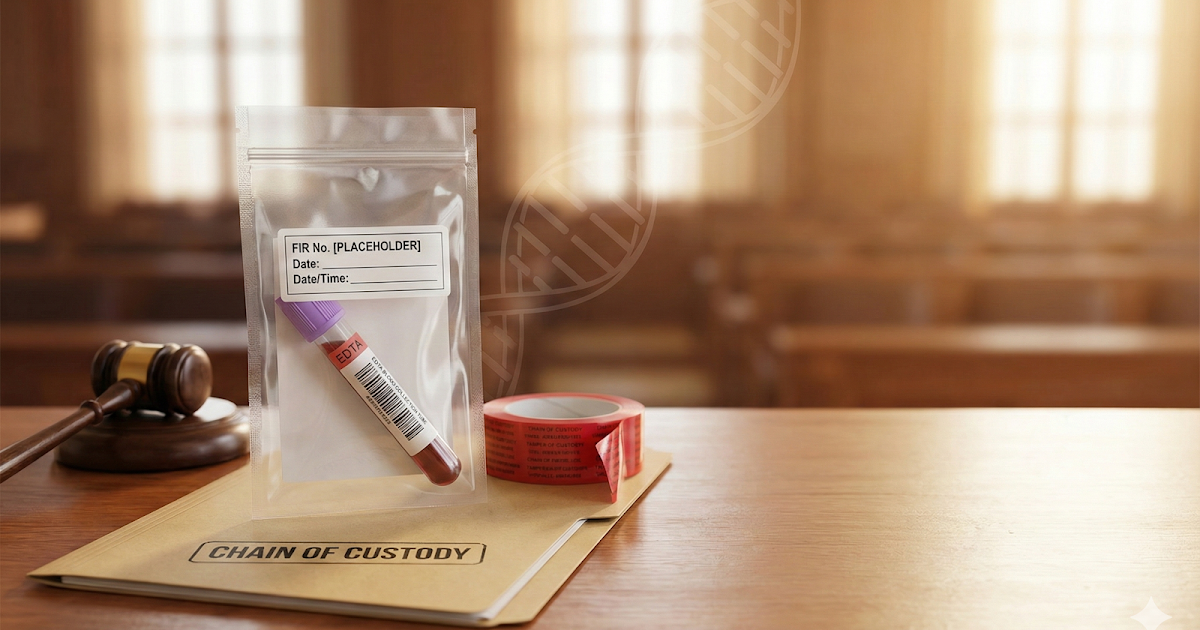
and documentation that connects the blood tube to the final report. Courts
have repeatedly stressed that procedure
is the bridge between science and proof: where the chain of custody is
broken or the handling is sloppy, DNA conclusions can collapse.
This note sets out: (i) the BNSS statutory authority to collect
biological samples, (ii) the Supreme
Court’s uniform safeguards for DNA evidence management, (iii) a practical SOP for blood collection for
DNA, and (iv) a Sessions Court
reliability checklist for appreciating DNA reports as expert opinion
evidence.
1) Legal foundation: BNSS (2023) +
expert opinion under evidence law
Under BNSS, the criminal process
expressly contemplates medical examination and collection of biological
material (including blood) when necessary for investigation, through provisions
governing examination of accused and victims. The statutory scheme places DNA
sampling within “modern scientific techniques”, but the legality of sampling is
only the first step—admissibility and weight depend on whether safeguards were
followed.
In evidence law terms, DNA profiling
is treated as expert opinion evidence,
not a substitute for proof of foundational facts like identity of sample,
integrity of seals, and continuity of custody. Therefore, every DNA report must
be read together with its “supporting documents”: requisition letter, MLC
notes, sealing memo, malkhana entries, forwarding letter, and FSL receipt.
2) The Supreme Court’s “uniform DNA
handling” rule (Devakar, 2025)
In Kattavellai @ Devakar v. State of Tamil Nadu (Neutral Citation: 2025 INSC 845), the Supreme Court
acquitted a death‑row convict after finding serious investigative lapses and
issued nationwide directions for DNA
evidence handling. These directions are court‑focused and practical: they
require that DNA evidence be supported by proper documentation and a
demonstrable chain of custody.
Core requirements (as repeatedly
reported/quoted in summaries of the judgment and directions) are:
·
Collection documentation must record FIR details,
sections/statute, IO/police station details, serial numbering, and must bear
signatures/designations of the medical professional, IO, and (where possible)
independent witnesses.
·
Transport timeline: sealed samples should reach the FSL
within 48 hours, and any unavoidable
delay should be documented with reasons and preservation details.
·
Storage integrity: packages should not be
opened/altered/resealed without trial‑court authorization.
·
Chain of custody register: a custody register must track every
transfer and should form part of the trial court record.
These directions reflect a simple
judicial philosophy: even “high science” is unreliable if the sample’s sanctity cannot be proved.
3) Why EDTA tubes (lavender top)
matter: science that becomes “legal reliability”
A frequent (and avoidable) failure in
practice is collecting reference blood in the wrong tube.
·
EDTA is preferred because it inhibits
nuclease activity by chelating divalent ions and is compatible with DNA
extraction and PCR workflows.
·
Heparin is widely recognized as problematic
for PCR because it can inhibit DNA polymerase and lead to amplification
failures or artefacts.
For trial courts, this is not
academic biochemistry: if a sample is collected in a heparin tube and the lab’s
methodology involves PCR/STR profiling, the defence can legitimately question
whether the process itself was scientifically suitable.
4) Practical SOP: Blood collection
for DNA profiling (court‑proof version)
This SOP is written so that a judge
can audit the file and a
prosecutor/defence counsel can cross‑examine
the steps.
1. Authority
+ requisition (BNSS)
o IO records reasons for seeking
medical examination / sampling and issues a written requisition citing the
relevant BNSS provision.
o The requisition should specify
purpose: “DNA profiling / STR analysis”, and the exhibit should be numbered.
2. Identity
confirmation
o Doctor verifies identity
(name/age/sex identifiers) and notes who produced the person (IO/constable).
o Any dispute about identity must be
recorded at the time of draw, not later in court.
3. Aseptic
venepuncture + correct tube
o Collect venous blood using aseptic
technique into sterile EDTA
vacutainer (lavender top).
o Avoid heparin tubes for PCR/STR DNA
profiling; if heparin is used for exceptional reasons, that reason and its
implications must be stated.
4. Mixing
+ prevention of clotting
o Gently invert the EDTA tube to mix
anticoagulant and blood (do not shake vigorously).
5. Immediate
labelling (at bedside)
o Label tube and outer container with:
name/ID, date/time of collection, FIR number, police station, sections, exhibit
number, doctor’s seal/signature.
6. Sealing
+ witness protocol
o Place tube in secondary packaging;
apply tamper‑evident seal/wax seal.
o Obtain signatures of the doctor and
IO; if an independent witness is available, take their signature as well; if
not, record efforts made.
7. Short‑term
storage until dispatch
o Store upright at 2–8°C if dispatch is
not immediate; avoid repeated temperature fluctuations.
o Record where stored and who had
access (a mini‑custody record begins here).
8. Dispatch
to FSL within 48 hours (Devakar rule)
o Transport in a sealed condition with
cold‑chain where feasible.
o If the 48‑hour timeline cannot be
met, document reasons and the preservation conditions.
9. Receipt
+ custody register
o Receiving authority (malkhana/FSL)
checks seals; records date/time; issues acknowledgment.
o Chain‑of‑custody entries must show
every hand‑over and hand‑back.
5) Storage windows: how courts should
view delay arguments
Delay is not automatically fatal; unexplained delay + unclear storage +
missing custody links is fatal.
Scientific literature and
manufacturer guidance generally support that EDTA whole blood is best processed
quickly, tolerates short room‑temperature windows, and performs better under
refrigeration for a few days. Longer storage at deep‑freeze temperatures is for
archiving/retesting but introduces its own handling risks (freeze–thaw cycles,
documentation).
For courtroom purposes, a judge
should ask:
·
Was
the 48‑hour FSL delivery complied
with? If not, is there a written reason and proof of refrigeration?
·
Did
the FSL note “seal intact”, sample condition, and whether the sample was “fit
for analysis”?
·
Did
the report disclose or imply inhibition/degradation issues?
6) FSL quality control (QC): what
should appear in a reliable report
A well‑supported DNA opinion should
show or imply:
·
Quantification
adequacy (often qPCR/fluorometric quant).
·
Purity/inhibition
checks (at least that inhibitors were addressed).
·
Method
used (STR kit/platform) and interpretation standard.
·
Ability
to withstand cross‑examination: who analyzed, what controls, what contamination
precautions.
Where QC is missing entirely and the
defence raises specific doubt (heparin tube, seal mismatch, unexplained delay),
the court should be slow to treat the report as clinching.
7) Sessions Court “admissibility
& weight” checklist (bench‑friendly)
A Sessions Judge can record findings
under these heads:
1. Legal
authority: BNSS
provision invoked; requisition and MLC on record.
2. Identity
& sampling integrity:
EDTA tube, labels, date/time, seal description; doctor’s testimony.
3. Chain
of custody:
custody register/malkhana witness; receipts; seal‑intact endorsements.
4. Timeliness
& preservation:
48‑hour compliance; storage explanation; cold‑chain evidence.
5. Laboratory
reliability:
method + controls + possibility of contamination ruled out.
6. Corroboration: DNA opinion fits with other proved
circumstances; court avoids “DNA as gospel truth” approach where foundational
proof is weak.

References / Further Reading (for
readers to verify statements)
A. Primary legal sources (most
authoritative)
1. Supreme
Court of India – Reportable Judgment (Full text PDF)
Kattavellai @ Devakar v. State of Tamil
Nadu, Criminal Appeal No. 1672 of 2019, Neutral Citation 2025 INSC 845, decision dated 15 July
2025 (Reportable).
What to check: passages discussing DNA evidence weaknesses, chain of custody
concerns, and the Court’s issued directions.
2. BNSS
2023 (official text)
– India Code PDF
The Bharatiya Nagarik Suraksha Sanhita,
2023 (official statutory PDF).
What to check: provisions on medical examination of accused/victims and
statutory recognition of scientific techniques.
3. Drishti IAS (structured summary of
guidelines; useful for teaching/notes)
What to check: 48‑hour rule, chain of custody register, trial‑court record
requirement.
C. Chain‑of‑custody / admissibility
commentary (secondary)
4. Delhi High Court emphasis on rigorous
custody for DNA (as summarized) – Santosh
Kumar Singh v. State (CBI) (2010) discussion
What to check: the proposition that DNA custody must be stricter than ordinary
exhibits due to contamination risk.
D. Scientific / technical sources
(for EDTA vs heparin, stability, storage)
5. Peer‑reviewed
study – EDTA
vs heparin storage and DNA quality
“Quantitative analysis of genomic DNA degradation in whole blood under various
storage conditions…” (2015).
What to check: room‑temperature extraction window (~3 days), EDTA advantages,
heparin performance issues.
6. Peer‑reviewed
open access –
heparin inhibits PCR; EDTA preferred
“Comparative Study of The Influence of EDTA and Sodium Heparin…” (2015).
What to check: explicit statements about heparin inhibiting DNA polymerase
activity in PCR.
7. Manufacturer shipping/storage
instructions (practical guidance; not law, but useful for feasibility and QC)
“Whole Blood Collection, Storage, and Shipping Instructions” (Bionano
Genomics).
What to check: recommended time windows at 4°C and room temperature for EDTA
blood.
8. Biobanking perspective on long‑term
storage temperatures and yield
Thermo Fisher blog summary of Bulla et al. (2016) findings.
What to check: relative yields at −20°C and −80°C over a year; decline at
+4°C/room temperature.
Annexure A — Sessions Court Practice Note (Deskbook)
A1) The “three questions” framework (use at admission/weight stage)
A Sessions Court can evaluate DNA blood evidence using three structured questions:
-
Legality: Was the sample collected under identifiable BNSS authority and proper medical procedure?
-
Integrity: Can the prosecution prove that the very blood drawn is the blood tested (labels, seals, custody continuity)?
-
Reliability: Is the lab method scientifically sound and applied to a suitable specimen (EDTA vs heparin; inhibitor checks; controls)?
A2) Devakar “non‑negotiables” (bench‑level)
In Devakar (2025 INSC 845), the Supreme Court required:
-
Documentation at collection with FIR/date, sections/statute, IO/police station details, serial number and signatures/designations of medical professional, IO and independent witnesses (efforts to join witnesses to be recorded if absent).
-
Chain of custody register maintained from collection to conviction/acquittal; must be appended to Trial Court record; IO responsible to explain lapse.
-
DGPs to create and dispatch sample forms for chain of custody and documentation.
B1) “Documents to call for” (production list)
Call for these as part of foundational proof:
-
Police requisition to doctor (BNSS basis, FIR and purpose: DNA profiling/STR).
-
MLC/medical report: date/time, identity particulars, and recording of material taken for DNA profiling (reporting discipline similar to CrPC 53A practice).
-
Label/seal memo: tube type (EDTA), exhibit number, seal impression description, signatures of doctor + IO + witness/effort note.
-
Storage note: where stored until dispatch, temperature (2–8°C), who had access
-
Forwarding letter + dispatch proof + FSL receipt noting seal intact/condition at intake.
-
Malkhana register extracts (if kept in police custody even briefly)
-
Chain of Custody Register (Devakar) appended to trial record, with each movement countersigned with reasons.
-
FSL report + annexures: method/kit, controls, any inhibitor/degradation remarks.
B2) Bench checklist (record findings under each head)
-
Authority: BNSS basis + requisition + MLC on record.
-
Tube suitability: EDTA used; if heparin used, lab explanation on inhibition mitigation.
-
Label + seal integrity: FIR/date/time, exhibit no., seal details; signatures as per Devakar direction.
-
48‑hour dispatch: compliance or written reasons + preservation details
-
Chain of custody: continuous register; appended to trial record; gaps explained
-
Lab reliability: controls/inhibitors addressed; method recognized.
B3) Cross‑examination modules (ready questions)
(i) IO / Carrier / Malkhana
-
Produce the Chain of Custody Register entry for each handover; who countersigned and why was movement necessary?
-
Where was the sealed exhibit kept before dispatch; who had access; is any storage log produced?
-
Was the sample at FSL within 48 hours; if not, show written reasons and preservation details.
(ii) Medical Officer
-
What tube was used: EDTA or heparin; why?
-
How was the tube labeled (FIR/time/exhibit no.); what seal and whose seal; who signed?
-
Was the sealing contemporaneous at bedside (before leaving custody of the doctor)?
(iii) FSL Expert
-
Was seal intact on receipt; what intake record exists?
-
Were inhibitors checked/controlled; how are anticoagulant‑related issues (heparin) handled in PCR workflows?nij.ojp+1
-
What controls were run; do they exclude contamination?[nij.ojp]
B4) Template paragraph for orders/judgment (copy‑paste)
“The DNA report is expert opinion evidence; its probative value depends upon proof of lawful collection and an unbroken chain of custody. The Supreme Court in Kattavellai @ Devakar v. State of Tamil Nadu (2025 INSC 845) directed that a Chain of Custody Register shall be maintained from collection to conviction/acquittal, countersigned at each transfer with reasons, and shall necessarily be appended to the Trial Court record; failure requires the IO to explain the lapse. The Court also mandated documentation at collection and timely dispatch to the FSL within 48 hours (or recorded reasons for delay). In the present case, the prosecution has/has not proved EDTA collection suitability (given known heparin‑PCR inhibition concerns), contemporaneous labeling and sealing, timely dispatch/preservation, and a complete custody register. Accordingly, the DNA report is accepted/rejected (or relied upon with limited weight) for reasons recorded above.”
[ad_2]
Source link

