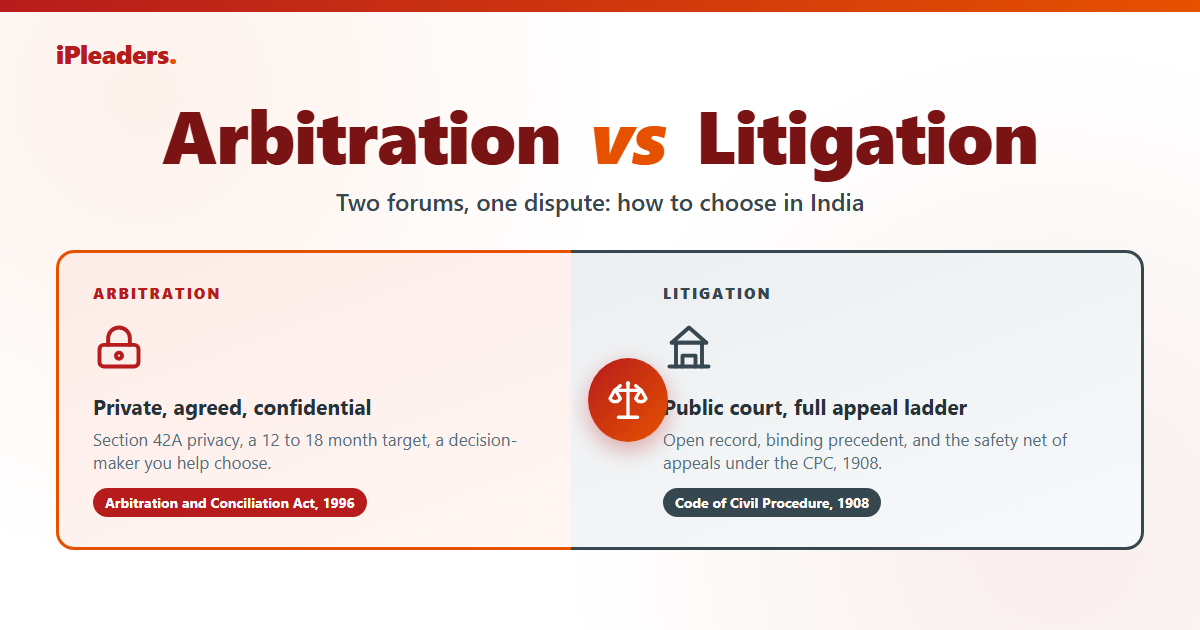


Arbitration vs litigation is, at heart, a choice between two forums for the same fight: arbitration is a private, consent-based process under the Arbitration and Conciliation Act, 1996, usually faster and confidential, but with almost no route to reargue the merits; litigation is the public court process under the Code of Civil Procedure, 1908, slower and open, but with a full ladder of appeals. Which one fits depends on the value of the dispute, how much confidentiality matters, whether you need a binding precedent or an injunction against outsiders, and, before any of that, whether the dispute is even capable of being arbitrated at all. Some disputes cannot go to arbitration no matter what the contract says. So the real decision is usually made years before the dispute, at the moment two parties sign a contract and pick their forum.
This article sets out how arbitration and litigation differ in India, and when each is the right forum.

The two are not ranked good and bad. They are chosen, and the choice is a trade-off rather than a winner. A business that values speed and privacy leans one way; a party that needs a public precedent or an appeal on the law leans the other.
That choice is usually locked in by a single clause. A contract’s dispute-resolution clause fixes the forum before anyone knows what the dispute will be, which is why the comparison matters most at the drafting table, not in the middle of a quarrel. Get the clause wrong and you can be dragged into the forum you were trying to avoid.

What follows is the working detail: how each forum runs, what it costs in money and time, whether you can challenge the outcome, and the gate that overrides personal preference, which is whether the subject matter can be arbitrated in the first place.
Arbitration and litigation at a glance
The core distinction is simple: arbitration is a dispute resolution you agree to, decided by a private tribunal you help choose, while litigation is a dispute resolution the state provides, decided by a judge assigned to you. Everything else, the speed, the cost, the privacy, the appeal, flows from that one difference. If you want the deeper background on the private forum itself, iPleaders has a full explainer on what arbitration is and how the 1996 Act frames it; this post assumes you know the basics and focuses on the comparison.
The table below is the one most readers come for. Read it as a map, not a verdict, because the “better” column changes with the dispute.
| Parameter | Arbitration | Litigation |
|---|---|---|
| Nature of forum | Private, agreed by the parties | Public, provided by the state |
| Governing law | Arbitration and Conciliation Act, 1996 | Code of Civil Procedure, 1908; Commercial Courts Act, 2015 |
| Consent required | Yes, a written arbitration agreement | No, any party can sue |
| Who decides | Arbitrator(s) chosen by or for the parties | A judge assigned by the court |
| Privacy | Confidential (Section 42A) | Open court, public record |
| Typical timeline | 12 to 18 months (Section 29A target) | Often several years, appeals aside |
| Cost profile | Party-funded: arbitrator and institution fees | Lower court fees, cost diluted over time |
| Challenge or appeal | Narrow challenge under Section 34; limited appeal under Section 37 | Full appellate ladder: appeal, second appeal, revision |
| Enforcement | Award enforced as a court decree (Section 36) | Decree executed under Order XXI |
| Precedent value | None; binds only the parties | Binding or persuasive precedent |
| Best-fit disputes | Commercial, cross-border, technical, confidential | Non-arbitrable subjects, third-party rights, low value |
Notice what the table does not say. It does not say arbitration wins. For a two-lakh recovery suit, the arbitrator’s fee alone can swallow the sum in dispute, and the local court is the sensible forum. For a fifty-crore construction claim between an Indian company and a foreign contractor, arbitration is usually the only forum that makes sense. The parameters are constant; the weight you give each one is not.
How each forum actually works in India
Before comparing outcomes, it helps to see the two machines run. They start in completely different places: one starts with a clause, the other starts with a plaint.
Arbitration: the consent-driven track
Arbitration works only because the parties agreed to it. The foundation is the arbitration agreement, which Section 7 of the Arbitration and Conciliation Act, 1996 requires to be in writing, usually as a clause tucked into the main contract. No clause, no arbitration. That’s the first thing that trips people up.
If a dispute arises and one party still runs to court, the other can point to the clause. Under Section 8, a judicial authority must refer the parties to arbitration unless it finds that prima facie no valid arbitration agreement exists (Section 45 does the same job for foreign-seated arbitrations). The bar is deliberately low, because the 2015 and 2019 amendments were built to keep courts out of the arbitral process wherever possible.
Then the tribunal has to be formed. Parties can name their arbitrators in the clause or agree on them later; if they can’t agree, Section 11 lets the court step in and appoint. The tribunal can be a sole arbitrator or a panel of three, and the parties can pick people with genuine domain expertise, a retired judge for a contract dispute, an engineer-arbitrator for a construction claim. This is also where the choice between ad hoc and institutional arbitration bites, and iPleaders covers that split in detail in its guide to ad hoc and institutional arbitration. Once seized, the tribunal can even grant interim relief under Section 17, and the court retains a parallel power under Section 9.
Litigation: the court-driven track
Litigation needs no prior agreement. You file a plaint in the court with the right pecuniary and territorial jurisdiction, the defendant is summoned, pleadings close, issues are framed, evidence is led, and the court delivers a judgment and decree. The process is governed end to end by the Code of Civil Procedure, 1908, and the forum sits somewhere in the hierarchy of courts that hears a civil suit, from the district court up to the High Court and the Supreme Court of India.
For commercial disputes above a specified value, there’s a dedicated track. The Commercial Courts Act, 2015 routes them to commercial courts and commercial divisions of High Courts, with tighter timelines and case-management hearings. It also adds a filter that catches a lot of litigants by surprise: under Section 12A, a party must attempt pre-institution mediation before filing a commercial suit, unless the suit contemplates urgent interim relief. Skip that step where it applies and your plaint can be rejected. Worth flagging, because it’s the one procedural trap that sends commercial suits back to square one.
Cost and time: is arbitration really cheaper and faster?
The short answer? Usually faster, not always cheaper. The popular belief that arbitration is the budget option is only half right, and the half that’s wrong catches small litigants out.
Time
On timelines, arbitration has a genuine structural edge. Section 29A of the Arbitration and Conciliation Act, 1996 requires the tribunal to make its award within twelve months from the completion of pleadings, extendable by six months if the parties consent, and beyond that only by a court. That’s a statutory clock. Litigation has no equivalent. A civil suit runs on the court’s calendar, competes with a crowded docket, and can stretch across years before a first judgment, with appeals adding more on top. Even the fast-tracked commercial courts, built specifically to compress this, rarely match the arbitral timeline once appeals are counted.
There’s a caveat worth naming. The Section 29A clock is firmer for domestic arbitration than for international commercial arbitration, where the twelve-month period is an endeavour rather than a hard bar. And a determined party can still drag an arbitration out through challenges and adjournments. But as a rule, if speed is the priority, arbitration is the safer bet.
Cost
Cost is where the myth breaks. In litigation, the state pays the judge; you pay court fees (often modest, though ad valorem fees on high-value suits are not) plus your lawyers. In arbitration, the parties pay for everything: the arbitrators’ fees, the institution’s administrative charges if it’s institutional, the venue, the transcription. Those costs are front-loaded and split between the parties, and for a sole arbitrator on a mid-sized claim they’re manageable. For a three-member tribunal, they multiply.
Here’s the practical reality. For large, complex, or cross-border disputes, arbitration usually works out cheaper overall once you count the years of court time, appeals, and management distraction that litigation absorbs. For small-value disputes, it’s often the opposite: the arbitrator’s fee can exceed what the same case would cost in a local court. The mistake we see most often is a startup copying a three-arbitrator ICC-style clause into a vendor contract worth a few lakh, then discovering the tribunal costs more than the claim. Match the forum to the value, not to the fashion.
Appeals and finality: can you challenge the outcome?
This is the factor most comparisons skate over, and it’s often the one that decides the question. What happens if you lose and think the decision is wrong?
Arbitration: finality is the point
An arbitral award is not appealed the way a decree is. There is no forum that rehears the dispute on its merits and substitutes a better answer. The only route is a challenge under Section 34 of the Arbitration and Conciliation Act, 1996, and the grounds are deliberately narrow: things like incapacity, an invalid agreement, denial of a fair hearing, the award exceeding the scope of the reference, or conflict with the public policy of India. A court hearing a Section 34 petition does not ask “was the tribunal right?” It asks “was the process fair and lawful?” The limitation is tight too, three months from receipt of the award, extendable by only thirty days. iPleaders has a dedicated piece on the narrow grounds for setting aside an award under Section 34 if you want the full contour.
Beyond that, Section 37 allows a limited appeal, for instance against an order setting aside or refusing to set aside an award, but again on no wider a basis than the Section 34 grounds themselves. A further challenge to the Supreme Court by special leave under Article 136 is possible but rare. So finality is a feature: you get a binding result quickly. It’s also a risk: if the arbitrator gets the law wrong in a way that doesn’t touch the narrow grounds, you may simply be stuck with it.
Litigation: correction built in
Courts are built for second-guessing. A trial court decree can go up on first appeal (on both facts and law), then a second appeal to the High Court on a substantial question of law, with revision and review powers layered on, and finally a special leave petition to the Supreme Court. Every layer is a chance to fix an error. The price of all that correction is time and cost, the very things arbitration trims. That’s the trade in one line: arbitration buys speed by giving up the appeal; litigation keeps the appeal by giving up speed.
Confidentiality, enforcement, and neutrality
Three more factors round out the comparison, and each can be decisive on the right facts.
Confidentiality
Arbitration is private by default. Section 42A, inserted by the 2019 amendment, obliges the arbitrator and the parties to keep the proceedings confidential, except where disclosure is necessary to enforce the award. For a dispute involving trade secrets, a sensitive commercial relationship, or reputations that a public fight would damage, that privacy is worth a great deal. Litigation is the opposite: proceedings are held in open court, judgments are published, and anyone can read the file. Is that always bad? No. Sometimes a public record is exactly what a party wants.
Enforcement
A common worry is whether a private award has real teeth. It does. Under Section 36, once the time to challenge an award has passed (or a challenge has failed), the award is enforced as if it were a decree of the court, executed through the same Order XXI machinery of the Code of Civil Procedure, 1908 that enforces a court judgment. And since the 2019 amendment and the ruling in Hindustan Construction Co. Ltd. v. Union of India, (2020) 17 SCC 324, merely filing a Section 34 challenge no longer automatically stays enforcement; the award-holder can move to enforce while the challenge is pending, subject to the court’s discretion on a stay.
Cross-border, arbitration pulls decisively ahead. A foreign arbitral award from a New York Convention country is enforceable in India under Part II of the 1996 Act, a well-worn and treaty-backed route. The Supreme Court’s Constitution Bench in Bharat Aluminium Co. v. Kaiser Aluminium Technical Services Inc., (2012) 9 SCC 552 settled the territorial framework that separates Indian-seated from foreign-seated arbitration. Enforcing a foreign court judgment, by contrast, is a far patchier affair that depends on reciprocity arrangements. For any deal that crosses a border, this alone often decides the clause.
Neutrality and expertise
In litigation you take the judge you’re assigned, a generalist who may be hearing a complex commodities dispute between two property matters. In arbitration you can choose a decision-maker who actually knows the field, and a neutral one where the parties come from different countries and neither wants the other’s home courts. That’s why international commercial arbitration became the default for cross-border commerce. If you’re weighing that route, Skill Arbitrage has a course covering choosing a commercial-law career path such as M&A or private equity, where clause-drafting and cross-border enforcement are daily work.
Which disputes cannot be arbitrated at all
Here’s where preference stops mattering. You can draft the tightest arbitration clause in the world, and it will still fail if the subject matter is not arbitrable. When a dispute is non-arbitrable, litigation isn’t the better option; it’s the only one.
The Supreme Court drew the modern boundary in Vidya Drolia v. Durga Trading Corporation, (2021) 2 SCC 1, laying down a four-fold test. A dispute is generally not arbitrable when it concerns rights in rem (rights against the world rather than against a specific person), when it affects third-party rights or needs a centralised, one-for-all adjudication, when it touches the state’s inalienable sovereign functions, or when a statute expressly or by necessary implication keeps it out of arbitration. The earlier decision in Booz Allen & Hamilton Inc. v. SBI Home Finance Ltd., (2011) 5 SCC 532 gave the working list that the profession still uses.
So what actually stays out? In broad terms: criminal offences, matrimonial disputes like divorce and custody, guardianship matters, insolvency and winding-up, testamentary matters such as grant of probate, and disputes over trusts. These need a court because they decide status, bind the world, or involve public interest that two private parties cannot bargain away. iPleaders has a deeper treatment of exactly which disputes are arbitrable under the Vidya Drolia test, and it’s worth reading before you rely on an arbitration clause in a borderline area.
The line does move, and it has moved towards arbitration. Vidya Drolia itself pulled landlord-tenant disputes under the Transfer of Property Act, 1882 into the arbitrable column, and the courts have largely brought fraud in too, so a plea of fraud no longer automatically forces a commercial dispute into court. Competition and certain intellectual-property questions remain contested at the edges. The practical takeaway: before you assume a dispute can be arbitrated, check that its subject matter clears the Vidya Drolia gate. Get this wrong and your clause is decoration.
Arbitration or litigation: which forum fits?
Is the subject matter arbitrable? (Does it clear the Vidya Drolia test?)
NoGo to litigation. Criminal, matrimonial, guardianship, insolvency, testamentary and trust disputes must be decided by a court.
YesContinue to Gate 2.
↓
Is there a valid written arbitration agreement between the parties?
NoLitigation, unless the parties now agree to arbitrate. No agreement, no compulsion to arbitrate.
YesContinue to Gate 3.
↓
Do confidentiality, speed, cross-border neutrality or expertise matter, and is the value high enough to justify tribunal costs?
Yes → ArbitrationFix the seat, rules, number of arbitrators and language in the clause.
No → LitigationLow value, a need for public precedent, or relief binding on third parties point to court.
Order of questions: check arbitrability first (Vidya Drolia), then the agreement, then the trade-offs. The forum is chosen in the contract clause, before any dispute arises.
iPleaders · blog.ipleaders.in
How to choose the right forum
Put the pieces together and the decision usually resolves itself. The question isn’t “which is better in the abstract” but “which fits this dispute, this relationship, and this contract.” The matrix below is the short version.
| Choose arbitration when | Choose litigation when |
|---|---|
| Confidentiality genuinely matters | You need a public precedent or a reported ruling |
| The dispute is cross-border or the parties want a neutral forum | The subject matter is non-arbitrable (criminal, matrimonial, insolvency) |
| The subject is technical and you want an expert decision-maker | You need relief binding on third parties, or an injunction against outsiders |
| Speed and a firm timeline are priorities | The value is low and arbitrator fees would outweigh the claim |
| The parties want to preserve an ongoing relationship | There is no arbitration agreement between the parties |
| You can accept a final result with little appeal | You want the safety net of a full appeal on the merits |
Two practical points sit underneath the matrix. First, the choice is made at the drafting stage, not the fighting stage. The arbitration clause versus the jurisdiction clause is decided when the contract is signed, and a good arbitration clause does more than say “disputes shall be arbitrated”: it fixes the seat, the governing rules, the number of arbitrators, and the language, because vague clauses breed satellite litigation about the arbitration itself. If you draft these for a living, LawSikho has a focused walk-through on how to draft an arbitration clause in India that covers the seat-versus-venue and rules choices in depth.
Second, the ground is shifting towards arbitration in India by design. The Draft Arbitration and Conciliation (Amendment) Bill, 2024, under consultation, leans further into institutional arbitration, tighter timelines, and even less court intervention. Where’s the system heading? Towards making arbitration the default for commercial disputes and reserving the courts for what only they can do. That direction should sit in the back of your mind when you pick a forum for a contract meant to run for a decade.
Frequently asked questions
What is the main difference between arbitration and litigation?
Arbitration is a private dispute resolution that the parties agree to in advance, decided by an arbitrator they help choose under the Arbitration and Conciliation Act, 1996. Litigation is the public court process under the Code of Civil Procedure, 1908, decided by a judge the court assigns. The first is consent-based and confidential; the second is open and available to anyone.
Is arbitration cheaper than litigation in India?
Not always. For large or cross-border disputes, arbitration is usually cheaper overall once you count the years and appeals that litigation adds. For small-value disputes, arbitration can cost more, because the parties pay the arbitrator and institution fees directly, and those can exceed what a local court would cost.
Is arbitration faster than going to court?
Generally, yes. Section 29A of the Arbitration and Conciliation Act, 1996 sets a twelve-month target for the award, extendable by six months with consent. Civil litigation runs on the court’s calendar with no equivalent statutory clock, and appeals can extend it by years.
Can an arbitration award be appealed?
Not on its merits. An award can only be challenged under Section 34 on narrow grounds such as an invalid agreement, denial of a fair hearing, or conflict with the public policy of India, within three months. A limited further appeal lies under Section 37, but no court rehears the dispute the way an appellate court reviews a decree.
Which disputes cannot be settled by arbitration in India?
Criminal offences, matrimonial disputes like divorce and custody, guardianship, insolvency and winding-up, testamentary matters like probate, and trust disputes are generally non-arbitrable. Under the Vidya Drolia test, disputes involving rights in rem or the state’s sovereign functions must go to court.
Is an arbitration award as enforceable as a court decree?
Yes. Under Section 36 of the Arbitration and Conciliation Act, 1996, once the challenge period passes or a challenge fails, an award is enforced as if it were a court decree, through the same Order XXI process. Since 2019, filing a Section 34 challenge no longer automatically stays enforcement.
Can a court case be moved to arbitration?
If a valid arbitration agreement exists, yes. Under Section 8, a court must refer the parties to arbitration unless it finds prima facie that no valid arbitration agreement exists. Without an arbitration agreement, though, a party cannot force the dispute out of court.
Is arbitration confidential?
Yes. Section 42A, added in 2019, requires the arbitrator and the parties to keep the proceedings confidential, except where disclosure is needed to enforce or challenge the award. Court litigation, by contrast, is held in open court and the judgments are public.
Which is better for a business, arbitration or litigation?
It depends on the dispute. Arbitration suits confidential, technical, high-value, or cross-border commercial disputes where speed and a neutral, expert forum matter. Litigation suits low-value disputes, non-arbitrable subjects, and situations where a business needs a public precedent or relief against third parties.
What law governs arbitration in India?
The Arbitration and Conciliation Act, 1996 governs domestic arbitration, international commercial arbitration, and the enforcement of foreign awards. It has been amended in 2015, 2019, and 2021, and a further amendment bill was under consultation in 2024.
References
Case Law
- Bharat Aluminium Co. v. Kaiser Aluminium Technical Services Inc., (2012) 9 SCC 552
- Booz Allen & Hamilton Inc. v. SBI Home Finance Ltd., (2011) 5 SCC 532
- Hindustan Construction Co. Ltd. v. Union of India, (2020) 17 SCC 324
- Vidya Drolia v. Durga Trading Corporation, (2021) 2 SCC 1
Statutes
- Arbitration and Conciliation Act, 1996 (sections cited: 7, 8, 9, 11, 17, 29A, 34, 36, 37, 42A, 45)
- Code of Civil Procedure, 1908 (Order XXI on execution of decrees, and the appellate provisions)
- Commercial Courts Act, 2015 (Section 12A on pre-institution mediation)
- Transfer of Property Act, 1882 (landlord-tenant provisions, arbitrability per Vidya Drolia)
This article is for informational and educational purposes only and does not constitute legal advice. For advice on a specific dispute or the drafting of a dispute-resolution clause, consult a qualified advocate.

