
[ad_1]

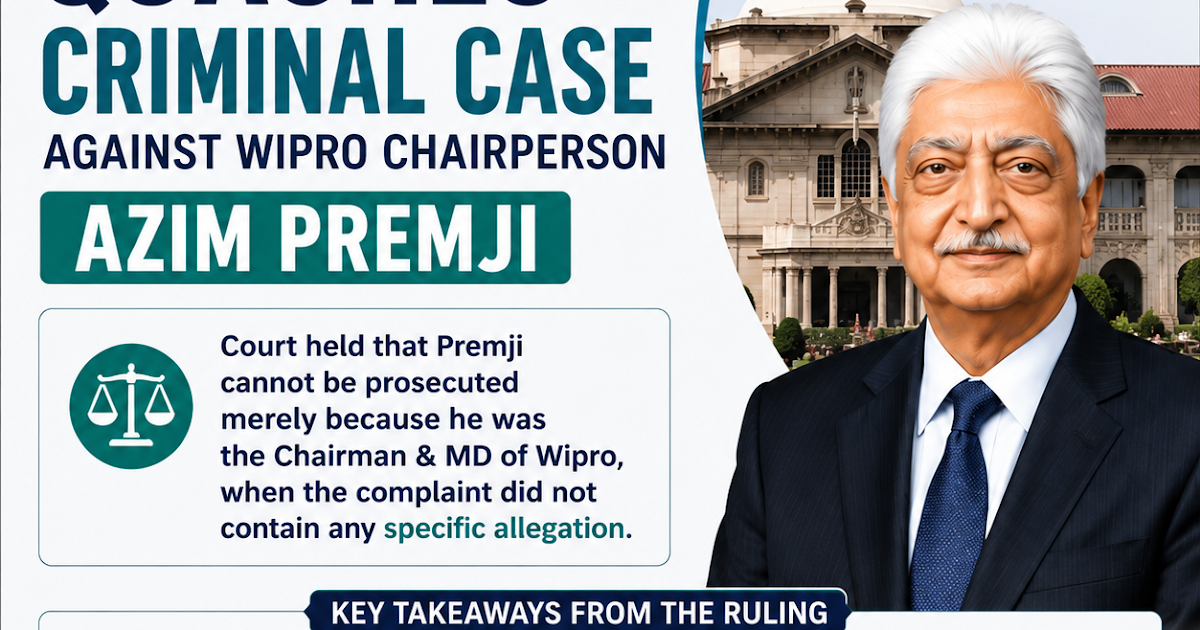
In a significant judgment impacting corporate governance, labour law enforcement, and director liability, the Allahabad High Court recently quashed criminal proceedings initiated against Wipro Chairperson Azim Premji in a labour law complaint.

The Court held that:
a Chairman or Managing Director cannot be prosecuted merely because of designation unless the complaint contains specific allegations showing direct involvement in the alleged offence.
The ruling is an important reaffirmation of settled principles relating to:
-
vicarious criminal liability,
-
prosecution of company directors,
-
labour law compliance enforcement,
-
and judicial scrutiny in criminal complaints.
The judgment is expected to have major implications for:
The case originated from a labour law complaint filed against Wipro Limited and several of its senior officials concerning alleged violations of labour legislation.
The complaint reportedly related to issues under labour welfare laws, including allegations connected with compliance obligations under the Equal Remuneration framework.
Based on the complaint, the magistrate court issued:
The proceedings were challenged before the Allahabad High Court.
The primary question before the Court was:
Can a company Chairman or Managing Director be criminally prosecuted solely because of their corporate designation?
The High Court answered this question in the negative.
The Court held that:
-
criminal liability cannot arise merely from holding a senior position,
-
and prosecution requires specific allegations establishing direct role and responsibility.
1. Designation Alone Is Not Sufficient
The Court observed that:
does not automatically make a person criminally liable for every alleged violation committed by the company.
The complaint must specifically explain:
Without such allegations, prosecution becomes legally unsustainable.
This principle is central to Indian corporate criminal jurisprudence.
The High Court found that the complaint failed to:
-
describe Azim Premji’s direct involvement,
-
identify any specific act or omission,
-
or explain how he was responsible for day-to-day operations concerning the alleged violation.
The prosecution proceeded largely on the assumption that:
because Premji was Chairman and Managing Director, he must automatically be liable.
The Court rejected this approach.
This observation is particularly important because many labour law complaints routinely include:
The Court also emphasised that magistrates cannot mechanically issue summons in criminal complaints involving corporate officials.
Before summoning directors or senior executives, courts must examine:
-
statutory requirements,
-
contents of the complaint,
-
factual allegations,
-
and prima facie material.
The High Court observed that:
judicial application of mind is essential before initiating criminal prosecution against senior corporate officers.
This serves as an important safeguard against arbitrary prosecution.
Indian criminal law generally does not impose automatic vicarious liability unless specifically created by statute.
In corporate offences:
The Court reaffirmed that:
criminal liability cannot be imposed merely through designation-based assumptions.
This principle has been consistently recognised in:
-
company law,
-
cheque dishonour cases,
-
tax prosecutions,
-
environmental laws,
-
and labour law matters.
The judgment is highly relevant in the context of labour law enforcement because regulatory authorities frequently prosecute:
for procedural or technical non-compliance.
The ruling clarifies that:
✅ prosecution must be evidence-based
✅ complaints must contain specific particulars
✅ corporate hierarchy alone cannot justify criminal liability
This may significantly influence future proceedings under:
-
labour welfare statutes,
-
EPF laws,
-
ESI legislation,
-
wage laws,
-
and future Labour Codes.
The judgment strengthens important corporate governance protections.
A. Protection Against Mechanical Prosecution
Senior corporate officials often face criminal complaints despite:
-
lack of operational control,
-
absence of direct involvement,
-
or no role in day-to-day compliance management.
The ruling protects against indiscriminate prosecution.
B. Need for Better Complaint Drafting
Labour authorities and enforcement agencies may now need to:
-
provide detailed role attribution,
-
identify responsible individuals precisely,
-
and avoid generic allegations.
Future complaints lacking specificity may face stricter judicial scrutiny.
C. Importance of Compliance Structures
Corporates may increasingly focus on:
-
documented delegation systems,
-
compliance accountability frameworks,
-
internal governance mechanisms,
-
and role clarity.
This helps determine:
-
who was actually responsible,
-
and whether senior leadership exercised operational control.
The High Court exercised its inherent powers to prevent:
-
abuse of judicial process,
-
unnecessary criminal litigation,
-
and unjustified prosecution.
The judgment reinforces an important principle:
criminal law should not become a tool for routine or mechanical harassment.
The broader principle emerging from the judgment is:
Corporate criminal liability requires factual and legal nexus — not merely designation.
This strengthens:
Importantly, the judgment does not weaken labour law enforcement.
The Court did not hold that:
-
directors can never be prosecuted,
-
companies are immune from liability,
-
or labour law violations are insignificant.
Instead, the Court clarified that:
✅ prosecution must follow due process
✅ allegations must be specific
✅ judicial scrutiny is essential
✅ criminal liability must have factual foundation
This balances:
-
regulatory enforcement,
with -
protection against arbitrary prosecution.
As India moves toward implementation of Labour Codes, this ruling may become increasingly important.
Future compliance enforcement under:
-
Code on Wages,
-
Occupational Safety Code,
-
Industrial Relations Code,
-
and Social Security Code
will likely require:
-
clearer accountability structures,
-
proper identification of responsible officials,
-
and legally sustainable prosecution mechanisms.
The judgment may therefore influence the future approach toward:
-
corporate labour compliance,
-
director liability,
-
and enforcement strategy in India.
The Allahabad High Court’s decision quashing criminal proceedings against Azim Premji represents a significant reaffirmation of principles governing corporate criminal liability.
The Court made it clear that:
senior corporate officials cannot be prosecuted merely because of their designation unless specific allegations establish direct involvement.
The ruling strengthens:
At the same time, it reminds enforcement authorities that:
labour law compliance action must remain legally precise, evidence-based, and procedurally fair.
The judgment is likely to become an important precedent in future disputes involving:
Source References
Tags
#AllahabadHighCourt #AzimPremji #Wipro #CorporateLaw #LabourLaw #Compliance #EmploymentLaw #DirectorLiability #CorporateGovernance #LegalUpdate #IndustrialRelations #HRCompliance #IndiaLaw #ClickNexi
[ad_2]
Source link

