
[ad_1]
REMARKS OF CJI ON WOMEN’S DAY FUNCTION

During the Women’s Day Function arranged by the Gender Sensitisation and Internal Complaints
Committee (GSICC) of the Supreme Court, Chief Justice of India DY Chandrachud highlighted the
issue of inappropriate language and behaviour towards women lawyers. As a young lawyer, he had
observed senior lawyers using inappropriate language towards women lawyers in a group setting, and
no one spoke out against it at the time.
However, he noted that people have now become more aware
and have come to realise that such behaviour is unacceptable. The CJI emphasised the importance of
zero tolerance towards such misbehaviour and the need to address issues of harassment and ill-
treatment of women. He mentioned hearing disturbing stories from his women colleagues and friends
regarding the behaviour of lawyers and judges. The CJI stressed the importance of ensuring zero
tolerance towards inappropriate behaviour, inappropriate jokes, and similar conduct.
The Chief Justice of India, DY Chandrachud, emphasised the need to clearly communicate a message
to those in positions of authority regarding the unacceptability of inappropriate behaviour towards
women, which occurs not only in lower levels but also in higher levels of authority. He also stressed
the importance of making the Supreme Court and the legal field a gender-equal workspace and
environment.
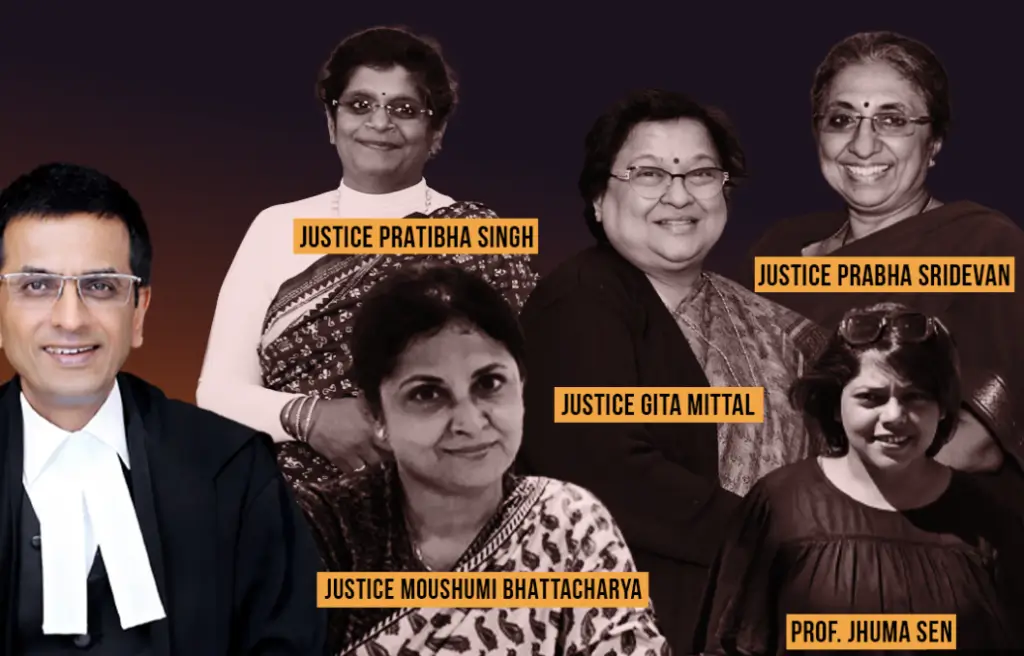
In March of this year, the CJI Sridevan, the development of a glossary by a committee
chaired by Justice Moushumi Bhattacharya, which includes Delhi High Court Judge Justice Prathiba
M. Singh, former Judges Prabha Sridevan and Gita Mittal, and Jhuma Sen, an advocate in the Calcutta
High Court and an adjunct faculty member at the West Bengal National University of Juridical
Sciences in Kolkata (WBNUJS). The CJI’s remarks reflect the need to take proactive steps to address
the pervasive issue of inappropriate behaviour towards women in the legal profession and to promote a
more inclusive and equitable workspace.
INAUGURATION OF TWO-DAY NATIONAL CONFERENCE ON DIGITALISATION
Odisha High Court organised a two-day National Conference on Digitisation, Paperless Courts, and e-
Initiatives, which was inaugurated by the Chief Justice of India, Dr. Justice DY Chandrachud, on
Saturday. The conference was attended by various notable figures, including Justice Rajesh Bindal, a
Judge of the Supreme Court of India, and Dr. Justice S. Muralidhar, the Chief Justice of Orissa High
Court, as well as judges and delegates from all the High Courts in India. The event provided an
opportunity for key stakeholders to discuss and deliberate on critical issues related to digitisation and
e-initiatives in the Indian judiciary.
INITIATIVES AND VISIONS FOR LGBTQ
During the National Conference on Digitisation, Paperless Courts, and e-Initiatives, the Chief Justice
of India discussed the various e-initiatives and plans put forth by the e-committee of the Supreme
Court. The CJI also highlighted the launch of the LGBTQ Handbook, which was released the previous
year. The Handbook was created by a committee led by Justice Moushumi Bhattacharya, a Judge of
the Calcutta High Court, after extensive consultations with domain experts.
NEED FOR A LEGAL GLOSSARY TO ELIMINATE GENDER-INAPPROPRIATE TERMS
The Chief Justice of India emphasised the need for a “Legal Glossary” to address the use of gender-
inappropriate terms by legal professionals and judges during legal proceedings. In addition to the
previously launched LGBTQ Handbook, the CJI stated that the Legal Glossary is in the works and
will provide a comprehensive list of such terms. He cited examples of phrases used in judgments of
conviction under Section 376 of the Indian Penal Code, such as “the victim was ravished by the
appellant” and “she was a concubine,” as well as inappropriate racial references, to illustrate the need
for such a glossary.
The CJI explained that the purpose of the Legal Glossary is not to criticise the
judiciary but to make judges aware of the importance of paying as much attention to language as to
substance in today’s era. The Legal Glossary aims to explain why certain words are inappropriate for
use in court proceedings.
[ad_2]
Source link

