
[ad_1]


By Kenneth Tiven
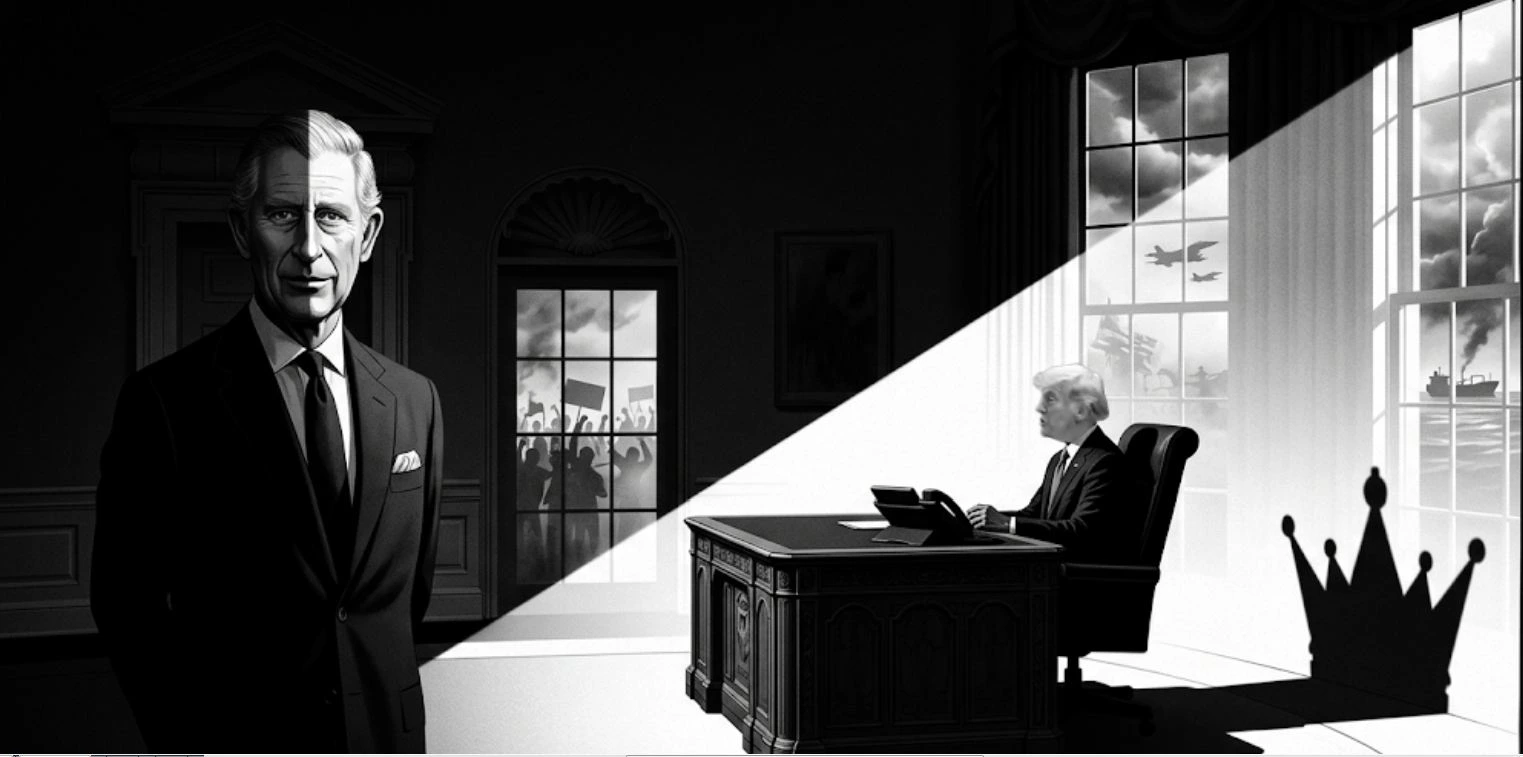
A real king walked through the Oval Office this past week, as King Charles III met with US President Donald Trump—a moment heavy with symbolism in a nation founded in rejection of monarchy. Yet, the irony lingered: critics argue Trump’s governing style increasingly echoes royal prerogative more than democratic restraint.
No week in Trump’s second term passes quietly. The state visit by Charles and Queen Camilla was designed to celebrate 250 years since American independence from King George III, while reaffirming the enduring alliance between the United States and the United Kingdom. Instead, it unfolded against a backdrop of disruption.
Just a day earlier, Trump made his first appearance at the White House Correspondents’ Dinner—an uneasy encounter with journalists he has long disparaged. The evening was abruptly cut short after a security breach involving an armed intruder.
Back at the White House, Trump shifted focus not to press relations, but to reviving plans for a controversial privately-funded ballroom addition—currently stalled by legal challenges.
Beyond ceremony, the visit highlighted deeper geopolitical strain. Britain, balancing its ties between Washington and Brussels, faces a US administration increasingly unpredictable in its alliances. That unpredictability surfaced again when German Chancellor Friedrich Merz criticized US-Israeli military actions against Iran—remarks that triggered an immediate and heated response from Trump.
Calling the conflict a necessary “excursion” to block Iran’s nuclear ambitions, Trump expressed frustration with European and NATO allies unwilling to fully support the campaign. Within days, he escalated tensions further, hinting at a possible reduction of US troops in Germany—home to the largest American military presence in Europe and a strategic hub for operations.
Military planners, already strained by a costly and inconclusive conflict, now face additional uncertainty. Estimates suggest the war effort has exceeded $25 billion, with no clear resolution in sight. Trump’s repeated declarations of victory appear, to critics, driven more by instinct than evidence.
His approach to Iran has been similarly erratic—oscillating between confrontation and negotiation, unsettling global markets dependent on oil flows through the Strait of Hormuz. While Trump insists he holds the upper hand, the reality remains a stalemate defined by mutual distrust. The old Cold War doctrine voiced by Ronald Reagan—“trust but verify”—feels distant in a relationship where neither side trusts nor verifies.
On the ground, public sentiment reflects growing unease. From Minneapolis to international audiences, skepticism about American leadership is rising. Protest movements—echoing the civic activism that followed the murder of George Floyd—continue to gain momentum, fuelled by concerns over immigration enforcement and civil liberties.
Voices from abroad add complexity. An Afghan immigrant who once worked alongside US forces suggested that earlier intervention in Iran might have sparked regime change, citing brutal crackdowns that reportedly killed tens of thousands of protesters. Others, particularly younger observers, express disillusionment more bluntly: admiration for power, they argue, has replaced principled leadership.
Even Trump’s traditional base shows signs of fracture. White evangelical Christians—long aligned with his political agenda—are reassessing their support amid shifting priorities and declining approval ratings ahead of looming mid-term elections.
Returning home, the author encountered a different kind of transformation: a digitized America. Facial recognition at border control replaced traditional passport checks, while dynamic pricing screens at airport eateries reflected inflationary pressures felt worldwide. Yet, the US experience remains distinct, shaped by stagnant federal wages and rising consumer costs.
In this moment of contradiction—ceremonial monarchy meeting assertive populism—the question lingers: what kind of leadership defines America today?
By next week, the answer may shift again.
—The writer has worked in senior positions at The Washington Post,
NBC, ABC and CNN and also consults for several Indian channels
[ad_2]
Source link

