
By ClickNexi Editorial Team
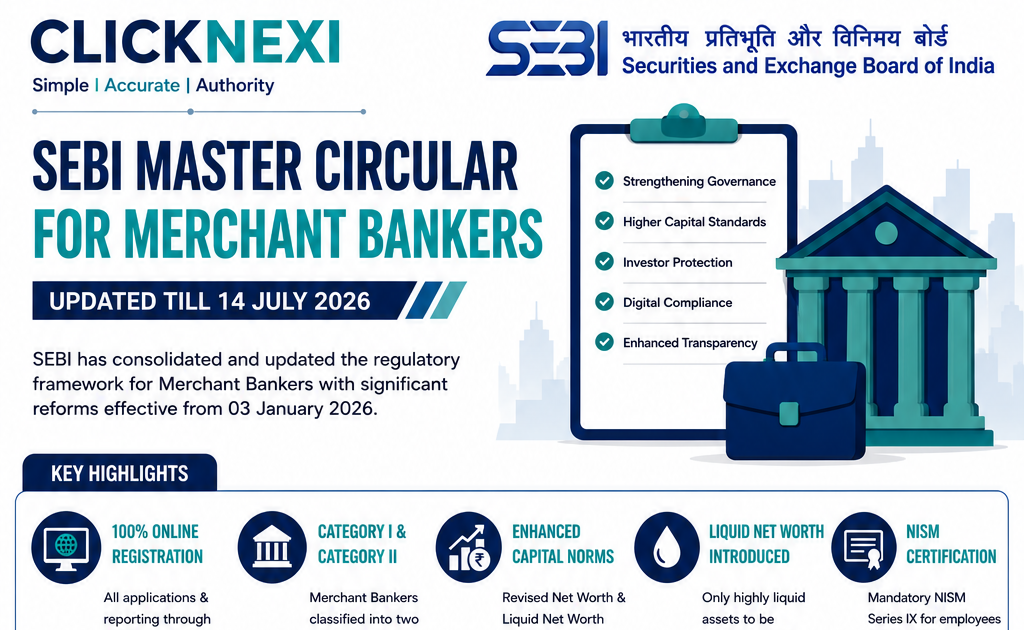
The Securities and Exchange Board of India (SEBI) has released the updated Master Circular for Merchant Bankers Registered with SEBI, consolidating all applicable circulars and amendments issued under the SEBI (Merchant Bankers) Regulations, 1992. Updated as on 14 July 2026, the Master Circular reflects major regulatory reforms introduced through the amendments effective from 3 January 2026 and subsequent circulars issued on 2 January 2026 and 11 June 2026.

The revised framework significantly strengthens governance, financial soundness, investor protection, regulatory reporting, and operational standards for Merchant Bankers operating in India’s securities market.
Merchant Bankers play a pivotal role in India’s capital markets. They manage Initial Public Offerings (IPOs), Further Public Offers (FPOs), Rights Issues, Buybacks, Delisting, Qualified Institutional Placements (QIPs), Open Offers, and various corporate restructuring transactions.
Over the years, SEBI has issued numerous circulars regulating these intermediaries. To simplify compliance and provide a single point of reference, SEBI has consolidated all operative circulars into one Master Circular.
The latest version incorporates:
- Amendments to the Merchant Bankers Regulations notified on 5 December 2025
- Online Registration Mechanism
- Revised Capital Adequacy Norms
- New Liquid Net Worth Requirements
- Governance and Certification Standards
- Compliance Reporting Framework
- Investor Protection Measures
1. Complete Digital Registration Through SI Portal
SEBI has mandated that every Merchant Banker shall use the SEBI Intermediary (SI) Portal for:
- Registration applications
- Surrender requests
- Change in particulars
- Half-yearly reporting
- Approval applications
- Regulatory communication
Although supporting declarations may still be required physically in certain cases, the entire regulatory workflow is now online.
One of the most significant reforms is the categorisation of Merchant Bankers into:
Existing Merchant Bankers must choose the category under which they wish to continue operations.
The categorisation determines:
- Capital adequacy
- Permitted activities
- Compliance obligations
- Financial strength requirements
SEBI has substantially increased minimum financial requirements.
Phase I (On or before 31 March 2027)
Category I
- Net Worth: ₹25 Crore
- Liquid Net Worth: ₹6.25 Crore
Category II
- Net Worth: ₹7.5 Crore
- Liquid Net Worth: ₹1.875 Crore
Phase II (On or before 31 March 2028)
Category I
- Net Worth: ₹50 Crore
- Liquid Net Worth: ₹12.5 Crore
Category II
- Net Worth: ₹10 Crore
- Liquid Net Worth: ₹2.5 Crore
This represents one of the biggest financial reforms in merchant banking regulation in recent years.
For the first time, SEBI has introduced a separate concept of Liquid Net Worth.
Only highly liquid assets qualify.
Eligible assets include:
- Cash
- Bank Fixed Deposits
- Government Securities
- Overnight Mutual Funds
- Liquid Mutual Funds
- Government Securities Mutual Funds
- Listed Nifty 500 Shares
SEBI has also prescribed valuation haircuts:
| Asset | Haircut |
|---|---|
| Cash | 0% |
| Bank FD | 0% |
| Government Securities | 10% |
| Liquid Mutual Funds | 10% |
| Listed Nifty 500 Shares | 30% |
Merchant Bankers must continuously maintain these liquid assets and certify compliance through Chartered Accountant certificates.
Professional competency has been significantly strengthened.
Employees
Minimum two qualified employees must possess:
Compliance Officer
Must possess:
- NISM Series IX
- NISM Series IIIA – Securities Intermediaries Compliance (Non-Fund)
Existing Merchant Bankers have been given transitional timelines, while newly appointed personnel must obtain certifications within prescribed periods.
SEBI now mandates complete independence of the Compliance Officer.
The Compliance Officer:
- Cannot simultaneously act as Principal Officer
- Must function independently
- Must supervise regulatory compliance
- Must certify half-yearly reports submitted to SEBI
The Principal Officer must:
- Possess at least five years’ experience in financial markets.
- Be responsible for merchant banking operations.
- Meet regulatory eligibility requirements before registration.
SEBI has laid down a structured procedure for:
- Acquisitions
- Shareholding changes
- Mergers
- Business transfers
- NCLT-approved restructuring
Applications must be submitted through the SI Portal along with declarations regarding:
- Pending litigation
- Regulatory actions
- Investor complaints
- Shareholding pattern
- Fit and Proper status
- Existing liabilities
Fresh registration may be required after approval depending on the transaction structure.
Where merchant banking business is transferred:
- Fresh registration may be required.
- Transferor may surrender registration.
- Separate procedures apply for regulatory and non-regulatory transfers.
- Same registration number may continue only in specified situations involving change in control.
Merchant Bankers must submit Half-Yearly Reports electronically through the SI Portal.
The Board of Directors must review:
- Compliance deficiencies
- Corrective actions
- Due diligence process
- Track record of public issues
The Compliance Officer certifies the report before submission.
SEBI has strengthened transparency requirements.
Merchant Bankers must disclose:
- Investor Charter
- Complaint statistics
- Resolution status
- Public issue performance
- Three-year track record of IPOs managed
This enables investors to evaluate the historical performance and governance standards of Merchant Bankers.
Merchant Bankers increasingly rely on cloud-based Governance, Risk and Compliance (GRC) platforms.
SEBI has reiterated CERT-In’s advisory emphasizing:
- Data localisation considerations
- Information security
- Cyber resilience
- Protection of confidential financial information
- Risk management for SaaS deployments
The revised framework will have significant operational implications:
Financial Impact
- Increased capital requirements
- Maintenance of liquid assets
- Higher compliance costs
Governance Impact
- Independent Compliance Officer
- Qualified Principal Officer
- Board oversight
- Strengthened internal controls
Operational Impact
- Digital compliance
- Regular reporting
- Continuous certification
- Enhanced documentation
Market Impact
- Improved investor confidence
- Better governance
- Stronger financial discipline
- Higher professional standards
| Requirement | Timeline |
|---|---|
| Revised Regulations Effective | 3 January 2026 |
| Independent Compliance Officer | By 3 April 2026 (existing MBs) |
| Existing Employee Certifications | By 2 January 2027 |
| Category Selection & Phase I Compliance | By 31 March 2027 |
| Phase II Capital Requirements | By 31 March 2028 |
The SEBI Master Circular for Merchant Bankers (Updated till 14 July 2026) marks a major evolution in India’s merchant banking regulatory framework. By introducing higher capital standards, liquid net worth requirements, mandatory professional certifications, enhanced governance mechanisms, digital regulatory processes, and stronger investor protection measures, SEBI aims to create a more resilient, transparent, and professionally managed merchant banking ecosystem.
Merchant Bankers should review the revised provisions carefully, strengthen their governance and compliance frameworks, ensure timely certification of key personnel, and prepare for the phased financial requirements well before the prescribed deadlines. These reforms are expected to enhance market integrity, improve operational resilience, and reinforce investor confidence in India’s capital markets.

