
Introduction
The rapid growth of digital technology has transformed the way people create, store, and share information. Courts now regularly use electronic records such as emails, WhatsApp chats, CCTV footage, call records, and digital documents as electronic evidence. Since people can easily alter, copy, or delete these records, the law lays down specific conditions to ensure their authenticity and admissibility.
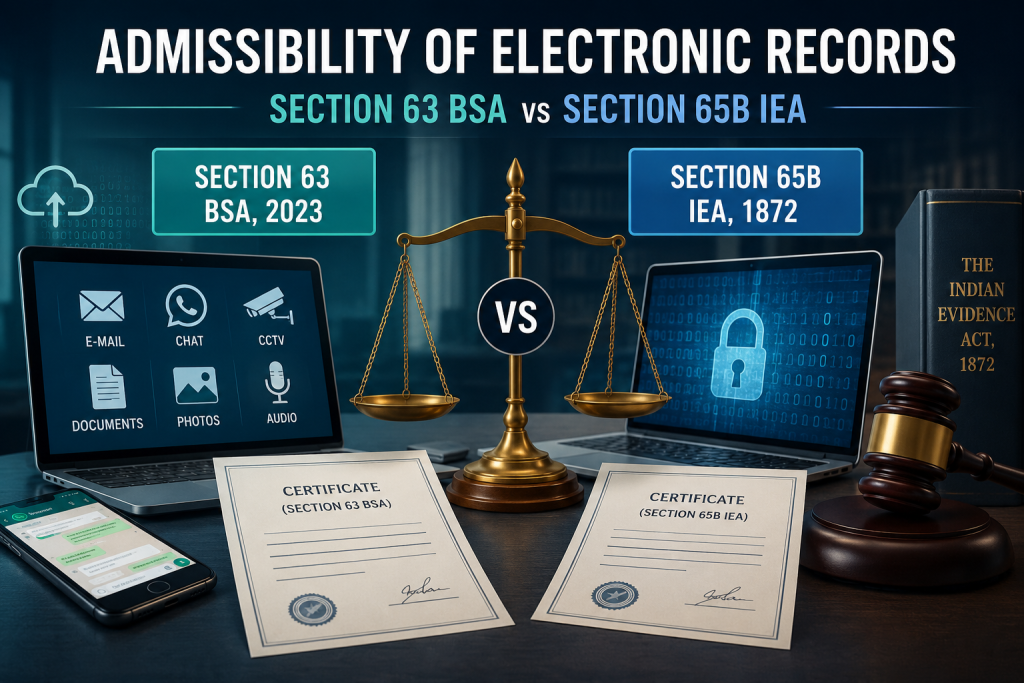
The Indian Evidence Act, 1872 (IEA) governed the admissibility of electronic records through Section 65B. After the Bharatiya Sakshya Adhiniyam, 2023 (BSA) came into force on 1 July 2024, Section 63 replaced Section 65B. Although the new provision retains the basic principles of admissibility, it recognizes modern digital technologies and introduces procedural changes to strengthen the authenticity and reliability of electronic evidence.
Electronic Evidence and Electronic Records: Meaning and Significance
An electronic record consists of any information that a computer or digital device stores, sends, or receives in digital form. This category includes emails, SMS messages, social media chats, digital photographs, audio and video recordings, computer databases, and server logs. Unlike a signed paper contract, an electronic record does not carry a physical signature or a visible mark of authenticity. It exists as a string of data, and anyone can copy, edit, or delete it without leaving an obvious trace.

This fragility explains why courts treat electronic evidence with caution. Someone can morph a photograph, splice a voice recording, or fabricate a chat screenshot. Because of this risk, the law demands a certificate that confirms a properly functioning device produced the electronic record and that no one has tampered with it. This certificate requirement forms the common thread linking Section 65B IEA and Section 63 BSA, and it lies at the core of most disputes on digital evidence law in Indian courts.
Section 65B of the Indian Evidence Act, 1872
Parliament inserted Section 65B[1] into the Evidence Act in 2000, alongside the Information Technology Act,[2] to address the growing use of computers in daily transactions. The provision allowed courts to treat a computer output, such as a printout or a copy on a CD, as a document and to admit it in evidence without requiring the original electronic device.
The provision laid down four technical conditions: the operator must have used the computer regularly, the user must have fed the information into the system in the ordinary course of activities, the computer must have worked properly during the relevant period, and the output must reproduce the information that the user originally fed into it.
Along with these conditions, sub-section (4)[3] required a person to sign a certificate that identifies the electronic record, describes how the device produced it, and gives details of the device involved. Without this certificate, a party could not prove secondary electronic evidence, such as a printout of an email or a CD copy of CCTV footage, in most situations. The certificate requirement under Section 65B of the Indian Evidence Act has become the single most litigated issue in electronic evidence cases in India.
Section 63 of the Bharatiya Sakshya Adhiniyam, 2023
Section 63 of the BSA[4] carries forward the same basic scheme. It defines electronic and digital records broadly enough to cover information in emails, servers, smartphones, cloud storage, and even semiconductor memory It also mandates that parties provide a certificate along with any electronic record submitted as secondary evidence.
However, the new provision makes some useful additions. It expands the list of devices it covers to reflect modern technology such as cloud computing and communication devices, which the language of the older Act did not clearly address. It also clarifies that either the person in charge of the device or an expert examining the device can give the certificate, which reduces confusion about who is competent to issue it. In substance, Section 63 Bharatiya Sakshya Adhiniyam keeps the certificate-based structure intact while giving it a more modern and slightly wider vocabulary.
Comparative Analysis of Section 63 BSA and Section 65B IEA
A comparison of the admissibility of electronic records under Section 63 BSA vs Section 65B IEA shows that the similarities outweigh the differences. Both provisions:
- Require a certificate for secondary electronic evidence.
- Set out similar technical conditions relating to regular use and proper functioning of the device.
- Treat a certified computer output as equivalent to the original document.
The differences are mainly about clarity and scope rather than substance. Section 63 BSA uses updated terms to cover newer technology, spells out more clearly who can sign the certificate, and follows a schedule-based format rather than scattered sub-sections. It does not remove the certificate requirement or create a shortcut around it, despite some early expectations that the new law might relax these rules.
In effect, a lawyer preparing electronic evidence under the BSA follows almost the same checklist that applied under Section 65B, only with clearer wording. This continuity matters because most of the case law that developed around Section 65B Indian Evidence Act remains relevant for interpreting Section 63, since the two provisions share a common structure and purpose.
Important Supreme Court Decisions
Three judgments explain how courts have applied these rules in practice.
Anvar PV v PK Basheer (2014)[5] settled that a certificate under Section 65B(4) is mandatory for any electronic record that a party submits as secondary evidence. The Supreme Court held that oral evidence or expert opinion cannot replace this certificate, and that general provisions on documentary evidence do not apply once a special provision like Section 65B exists.
In State (NCT of Delhi) v Navjot Sandhu[6] , which the Supreme Court decided in 2005, well before Anvar PV, the Court took a more relaxed view. It allowed courts to admit call records even without a certificate, reasoning that other provisions of the Evidence Act could independently support such evidence. This approach created confusion for almost a decade until Anvar PV expressly overruled it on this point.
Arjun Pandit Rao Khotkar v Kailash Kushan Rao Gorantyal (2020)[7] clarified the practical application of Anvar PV. The Court held that the certificate is indeed mandatory, but if a party genuinely cannot obtain it from the person in control of the device, that party can request the court to summon the certificate or the device itself. This ruling balanced strict compliance with fairness, and it recognised that litigants should not lose their case simply because an uncooperative party refuses to issue a certificate.
Together, these three decisions moved the law from an inconsistent position under Navjot Sandhu, through a strict rule in Anvar PV, to a workable middle path in Arjun Panditrao. This judicial journey continues to guide courts applying Section 63 BSA, since the legislature drafted the new provision with full awareness of this case law.
Challenges and Practical Impact
Despite this settled legal position, practical problems remain common in Indian courts.
- Obtaining a certificate is often difficult when the device belongs to a third party, such as a telecom company or a private business, that has no obligation to cooperate quickly.
- Police investigators sometimes seize digital devices without following proper forensic procedure, which weakens the reliability of the evidence they collect.
- Many trial courts and lawyers, particularly outside major cities, still lack full familiarity with the technical requirements of electronic evidence in India, and this gap leads lawyers to raise objections late in trial or leads courts to reject evidence on technical grounds.
- A broader concern also arises about keeping pace with technology. Cloud storage, encrypted messaging apps, and evidence that sits across foreign servers raise questions that neither Section 65B nor Section 63 answers in complete detail.
As electronic records grow more complex, courts will likely need continued guidance from the higher judiciary on issues such as blockchain-based records, AI-generated content, and cross-border data requests.
Conclusion
The shift from Section 65B IEA to Section 63 BSA does not represent a break from the past but a continuation of it, with clearer language and a slightly wider scope. The certificate requirement, which the courts have tested and refined through Anvar PV, Navjot Sandhu, and Arjun Panditrao, remains the backbone of both provisions. For students, lawyers, and judges, understanding the admissibility of electronic records under Section 63 BSA vs Section 65B IEA is no longer optional, since digital evidence now appears in nearly every kind of case, from matrimonial disputes to serious criminal trials. Going forward, consistent judicial interpretation and better forensic practices will matter more than further changes to the statutory text itself.
Reference
[1]Indian Evidence Act 1872, s 65B (as inserted by the Information Technology Act 2000, s 92 and sch II).
[2]Information Technology Act 2000.
[3]Indian Evidence Act 1872, s 65B(4).
[4]Bharatiya Sakshya Adhiniyam 2023, s 63.
[5]Anvar PV v PK Basheer (2014) 10 SCC 473.
[6]State (NCT of Delhi) v Navjot Sandhu (2005) 11 SCC 600.
[7]Arjun Panditrao Khotkar v Kailash Kushan Rao Gorantyal (2020) 7 SCC 1.

