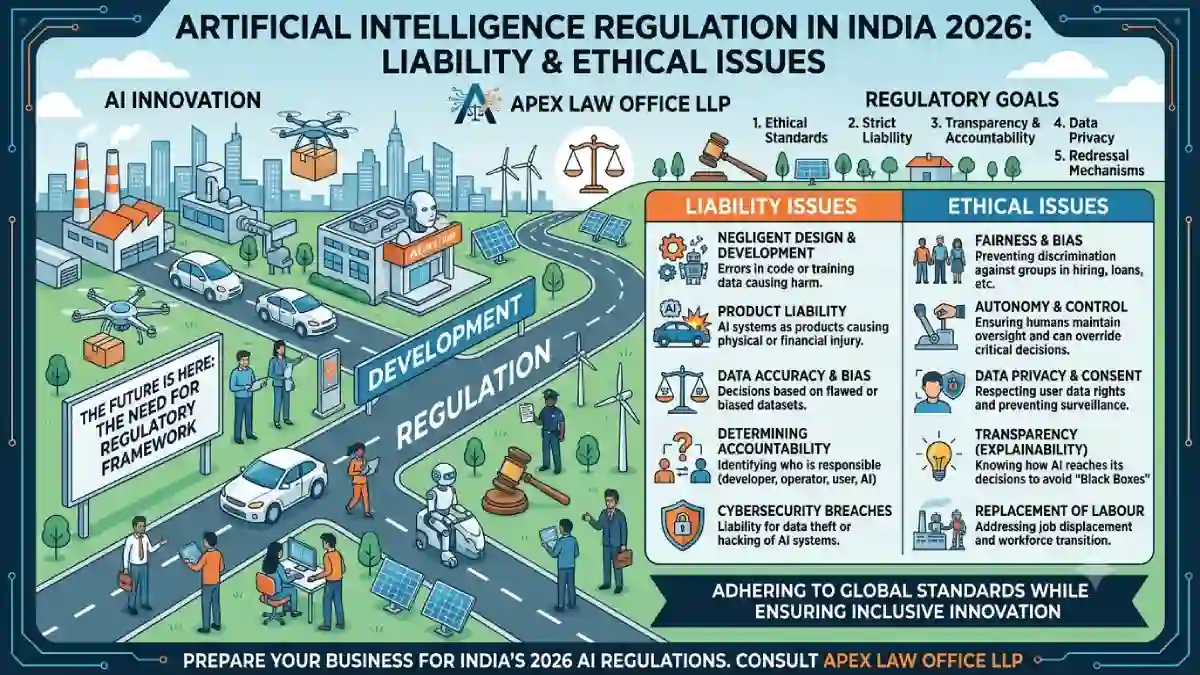

Artificial Intelligence Regulation in India 2026 – Artificial Intelligence regulation in India is becoming essential because AI systems influence businesses, governance, healthcare, finance, education, and public services. Therefore, organizations must understand emerging legal responsibilities before deploying AI technologies. Apex Law Office LLP provides AI legal advisory services, compliance reviews, technology contracts, risk assessments, and dispute resolution support for companies, startups, developers, investors, and government-linked entities. Indian AI regulation combines information technology laws, data protection principles, sectoral guidelines, intellectual property rules, contractual obligations, and constitutional safeguards. Moreover, businesses must evaluate algorithmic accountability, privacy protection, cybersecurity risks, transparency obligations, and ethical deployment standards. Legal challenges may involve data misuse, automated decisions, copyright issues, discrimination, negligence, and consumer harm. Proper legal planning reduces regulatory exposure while promoting responsible innovation. Professional legal support helps organizations develop sustainable AI governance frameworks across India.
Artificial Intelligence Regulation in India 2026: Liability & Ethical Issues – Apex Law Office LLP
Emerging AI Governance Framework and Legal Landscape
India currently follows a developing AI governance model based on existing laws, policy frameworks, regulatory advisories, and sector-specific requirements. Furthermore, government agencies continue examining responsible AI adoption through consultation papers and digital governance initiatives. Important legal areas include the Digital Personal Data Protection Act, 2023, Information Technology Act, 2000, Information Technology Rules, contractual laws, intellectual property regulations, consumer protection principles, and sector-specific compliance requirements. Apex Law Office LLP analyzes AI deployment models before recommending appropriate compliance measures. Businesses using machine learning systems, automated decision tools, generative AI platforms, and predictive analytics require structured legal assessments. Additionally, organizations should maintain documentation regarding data sources, model development, security controls, and accountability mechanisms. Proper compliance reduces future disputes before regulatory authorities, courts, and tribunals. Responsible AI practices strengthen public trust while supporting technological growth.

Liability Issues Arising From Artificial Intelligence Systems
Understanding AI Liability and Accountability
AI liability creates complex legal questions because automated systems involve developers, users, data providers, vendors, and organizations. Consequently, determining responsibility requires detailed examination of contracts, technical processes, and applicable laws. Liability issues may arise from incorrect automated decisions, privacy violations, cybersecurity failures, intellectual property infringement, biased outcomes, financial losses, and consumer injuries. Apex Law Office LLP assists businesses by evaluating AI contracts, risk allocation clauses, indemnity provisions, warranties, and compliance obligations. Moreover, companies should establish internal AI governance policies before implementing advanced technologies. Legal responsibility may depend upon human supervision, system design, data quality, and organizational control. Courts may examine evidence, expert opinions, contractual obligations, and statutory duties during disputes. Effective legal planning reduces uncertainty while protecting innovation-driven businesses from unnecessary litigation risks.
Ethical Challenges in Artificial Intelligence Deployment
Ethical AI deployment requires transparency, fairness, privacy protection, accountability, and human oversight. Therefore, organizations must address ethical concerns before introducing AI systems into commercial operations. Major ethical issues include algorithmic bias, unauthorized data collection, lack of explainability, discriminatory outcomes, excessive surveillance, misinformation generation, and employment disruption. Apex Law Office LLP helps organizations create responsible AI frameworks aligned with legal principles and industry standards. Businesses should consider:
- Data accuracy and lawful collection.
- Human review mechanisms.
- Security safeguards.
- Transparent decision processes.
- Consumer protection measures.
Additionally, ethical compliance improves corporate reputation and stakeholder confidence. AI systems should support human decisions rather than create uncontrolled legal risks. Proper governance frameworks encourage innovation while protecting individual rights. Responsible AI adoption requires continuous monitoring, documentation, and legal review.
Applicable Laws Affecting AI Regulation
Artificial Intelligence systems interact with multiple Indian laws depending upon their application and impact. Moreover, organizations must evaluate applicable legislation before deploying AI solutions. Relevant laws include the Digital Personal Data Protection Act, 2023, Information Technology Act, 2000, Information Technology Rules, 2021, Consumer Protection Act, 2019, Copyright Act, 1957, Contract Act, 1872, Bharatiya Nyaya Sanhita, 2023, Bharatiya Nagarik Suraksha Sanhita, 2023, and Bharatiya Sakshya Adhiniyam, 2023. Data breaches may create regulatory obligations and civil consequences. Intellectual property disputes may involve AI-generated content, software ownership, and licensing issues. Criminal allegations involving fraud or misuse may attract applicable provisions under criminal laws. Procedural matters follow applicable legal procedures, while courts evaluate evidence according to statutory standards. Proper legal analysis helps businesses manage AI-related obligations effectively.
Government Departments and Regulatory Authorities
Several government departments influence AI governance, digital regulation, and technology compliance in India. Furthermore, businesses should monitor official updates from relevant authorities. Important institutions include the Ministry of Electronics and Information Technology, Data Protection Board of India, Department for Promotion of Industry and Internal Trade, sector regulators, consumer authorities, and judicial forums. Regulatory actions may involve investigations, compliance directions, penalties, and dispute proceedings. Nearby police stations may investigate criminal complaints involving cyber fraud, data misuse, identity theft, or technology-related offences under applicable laws. Apex Law Office LLP provides representation and advisory support during regulatory inquiries and legal proceedings. Strong compliance systems reduce enforcement risks while improving organizational accountability. Continuous legal monitoring remains essential because AI regulations continue evolving with technological developments.
AI Compliance, Legal Remedies, and Corporate Protection
Corporate AI Compliance and Risk Management
Businesses adopting Artificial Intelligence require structured compliance systems to manage legal and ethical risks. Therefore, organizations should establish AI governance policies before deploying automated technologies. Apex Law Office LLP assists companies with AI audits, regulatory reviews, technology agreements, privacy assessments, intellectual property analysis, and risk management strategies. Effective AI compliance includes:
- Data protection assessment.
- Vendor contract review.
- Algorithm monitoring.
- Cybersecurity evaluation.
- Employee training.
- Documentation maintenance.
- Ethical impact analysis.
- Incident response planning.
Furthermore, companies should maintain records regarding AI development, testing, deployment, and performance evaluation. Proper governance reduces liability exposure during regulatory investigations and disputes. Legal planning also supports investors, startups, multinational companies, and technology providers. Responsible AI frameworks improve business confidence while ensuring compliance with evolving Indian legal requirements. Professional legal advice helps organizations balance innovation with accountability.
AI Disputes Before Courts and Legal Forums
Artificial Intelligence disputes may involve multiple forums depending upon the nature of legal issues and affected parties. Moreover, appropriate jurisdiction determines effective dispute resolution. Matters may proceed before High Courts, Supreme Court, civil courts, consumer commissions, intellectual property forums, contractual arbitration panels, cybercrime authorities, and regulatory bodies. Disputes may involve data breaches, AI-generated content ownership, unfair automated decisions, software licensing conflicts, cybersecurity failures, and consumer claims. Civil proceedings may involve the Code of Civil Procedure wherever applicable. Criminal investigations may proceed under the Bharatiya Nyaya Sanhita, 2023, while procedural matters follow the Bharatiya Nagarik Suraksha Sanhita, 2023. Courts evaluate technical evidence according to the Bharatiya Sakshya Adhiniyam, 2023. Apex Law Office LLP provides legal representation, documentation support, and strategic advice before appropriate forums.
Legal Remedies Available for AI Related Disputes
AI-related disputes require timely legal intervention because technology issues often involve complex evidence and multiple stakeholders. Therefore, organizations and individuals should understand available remedies. Legal remedies include contractual claims, compensation claims, injunction applications, data protection complaints, regulatory representations, arbitration proceedings, civil suits, intellectual property enforcement, cybersecurity complaints, settlement negotiations, compliance correction measures, and appellate remedies. Apex Law Office LLP evaluates every dispute before recommending suitable strategies. Moreover, legal solutions depend upon contractual terms, technical evidence, statutory obligations, and business objectives. Proper documentation strengthens claims before courts and authorities. Early legal advice prevents unnecessary financial losses. Professional representation also assists clients during negotiations, investigations, and litigation. Effective legal remedies encourage responsible AI adoption while protecting individual and corporate interests.
AI Governance Checklist for Organizations
Organizations should implement comprehensive AI governance measures to reduce legal exposure.
| AI Compliance Area | Legal Importance |
|---|---|
| Data Protection | Protects personal information |
| Contract Review | Allocates responsibilities |
| Algorithm Testing | Reduces errors |
| Cybersecurity Controls | Prevents breaches |
| Human Oversight | Improves accountability |
| Intellectual Property Review | Protects ownership |
| Audit Documentation | Supports compliance |
| Incident Response | Controls legal risks |
Essential compliance actions include:
- Identify AI applications.
- Review applicable laws.
- Document data sources.
- Monitor algorithm performance.
- Establish accountability structures.
- Protect confidential information.
- Train employees.
- Conduct periodic legal audits.
Recommended implementation steps:
- Assess AI risks.
- Create governance policies.
- Review technology contracts.
- Conduct compliance audits.
- Monitor regulatory developments.
- Maintain evidence records.
- Address disputes promptly.
- Seek expert legal advice.
Why Choose Apex Law Office LLP
Apex Law Office LLP provides comprehensive AI regulation legal services for startups, technology companies, enterprises, investors, developers, and organizations using artificial intelligence systems. Furthermore, our lawyers combine technology understanding with corporate legal expertise. We assist clients with AI compliance, privacy advisory, technology contracts, intellectual property protection, cybersecurity disputes, regulatory representation, risk assessment, and litigation support. Every AI project receives detailed legal evaluation based on business objectives and applicable laws. Our team helps organizations create responsible AI strategies while reducing legal uncertainty. Early legal planning improves governance and protects innovation investments. Professional representation supports clients before courts, tribunals, regulators, and dispute resolution forums. Apex Law Office LLP helps businesses adopt AI responsibly while maintaining transparency, accountability, and legal compliance.
Frequently Asked Questions
Q1. Is Artificial Intelligence specifically regulated by a separate Indian AI law?
India follows an evolving AI governance approach using existing technology, privacy, consumer, intellectual property, and sector-specific laws.
Q2. Who is liable for mistakes caused by AI systems?
Liability depends upon system design, contracts, human supervision, data handling, negligence, and applicable statutory obligations.
Q3. Can AI-generated content create copyright disputes?
Yes. AI-generated content may create ownership, licensing, originality, and intellectual property disputes requiring legal evaluation.
Q4. How can companies reduce AI legal risks?
Companies should conduct AI audits, review contracts, protect data, maintain documentation, and establish governance policies.
Q5. Which authorities handle AI-related legal complaints?
Depending on issues, matters may involve cyber authorities, regulators, consumer commissions, courts, tribunals, and government departments.
Q6. Why hire Apex Law Office LLP for AI legal services?
Our lawyers provide AI compliance, technology contracts, regulatory advice, dispute resolution, and corporate legal support for emerging AI challenges.

